If you've been shopping for a midsize electric crossover and noticed shifting headlines around Ford's EV lineup, you're not alone. The question circulating in forums and dealership lots alike: is the Mach-E discontinued? As of early 2026, the answer is no — the Ford Mustang Mach-E remains in production and on sale in the United States. However, Ford has restructured its EV strategy significantly, trimming trims, adjusting pricing, and signaling a pivot toward smaller, more affordable electric vehicles. That context matters if you're evaluating the Mach-E right now.
This review covers the 2026 Ford Mustang Mach-E with exact specs, real-world range expectations, charging performance, pricing after federal incentives, and how it stacks up against the Hyundai Ioniq 5, Tesla Model Y, and Chevrolet Equinox EV. If you're deciding whether to buy, lease, or wait, the numbers below will anchor your decision.
Is the Ford Mustang Mach-E Discontinued? The 2026 Status
The 2026 Mustang Mach-E is not discontinued. Ford continues to sell the model in the U.S. through its dealer network, and it remains available for order in multiple trims. What has changed is Ford's broader EV posture: the company has publicly acknowledged slower-than-expected EV demand growth and has redirected capital toward hybrid and extended-range electric vehicles (EREVs). Ford also discontinued the F-150 Lightning production at its Rouge Electric Vehicle Center to rebalance capacity, which fueled rumors about the Mach-E's future.
For the Mach-E specifically, Ford simplified the lineup for 2026. The base Select trim was dropped in favor of a more streamlined Premium-focused offering, and the high-performance GT variant remains available in limited volume. The California Route 1 trim — once the range champion — has been folded into the Premium Extended Range configuration. If you're looking at 2024 or 2025 model-year inventory on dealer lots, those trims are still valid, but 2026 production reflects a narrower menu.
Range, Battery, and Efficiency: 2026 Mach-E by the Numbers
The 2026 Mustang Mach-E is offered with two battery packs and two drivetrain configurations. The Standard Range pack uses a 72 kWh usable lithium-ion battery (NMC chemistry — nickel manganese cobalt), while the Extended Range pack steps up to 91 kWh usable, also NMC. Ford does not currently offer an LFP (lithium iron phosphate) option in the Mach-E, unlike the base Tesla Model Y or some Chinese-market competitors.
| Attribute | Premium (Std Range RWD) | Premium (Ext Range RWD) | Premium (Ext Range AWD) | GT (Ext Range AWD) |
|---|---|---|---|---|
| Battery (usable) | 72 kWh NMC | 91 kWh NMC | 91 kWh NMC | 91 kWh NMC |
| EPA Range | 250 mi | 320 mi | 290 mi | 280 mi |
| Horsepower | 266 hp | 266 hp | 346 hp | 480 hp |
| 0-60 mph | 6.3 sec | 6.3 sec | 5.1 sec | 3.5 sec |
| Drivetrain | RWD (single motor) | RWD (single motor) | AWD (dual motor) | AWD (dual motor) |
| MPGe (combined) | 105 MPGe | 101 MPGe | 96 MPGe | 84 MPGe |
| Efficiency (kWh/100 mi) | 32 kWh | 33 kWh | 35 kWh | 40 kWh |
| Base MSRP | $43,895 | $48,895 | $51,895 | $62,995 |
Source: EPA / fueleconomy.gov and Ford Motor Company. Prices include destination charge. Tax credit eligibility varies — see pricing section below.
The EPA estimates up to 320 miles for the Extended Range RWD. In practice, expect ~270–290 miles on mixed highway driving at 70–75 mph in moderate temperatures (60–80°F). Sustained highway speeds above 75 mph, aggressive acceleration, and mountain grades will push consumption toward 36–38 kWh/100 mi, dropping effective range to roughly 250 miles on the Extended Range pack.
Cold-weather impact: In sustained sub-freezing conditions (20–32°F), NMC batteries in the Mach-E typically lose 20–30% of range compared to EPA figures. The Extended Range AWD, rated at 290 miles EPA, may deliver 200–230 miles in a January commute without preconditioning. Using the Mach-E's built-in battery preconditioning (activate via the FordPass app or navigation-routed charging) recovers some of that loss by warming the pack before driving.
Charging Speed: DC Fast Charge and Home Level 2
The 2026 Mach-E retains a peak DC fast-charging rate of 150 kW on Extended Range models and approximately 115 kW on Standard Range models. This is a meaningful limitation compared to rivals: the Hyundai Ioniq 5 peaks at 240 kW on its 800V architecture, and the Tesla Model Y (with the NACS connector) can sustain ~250 kW on V3 Superchargers. Ford's 400V electrical architecture caps the Mach-E's charging speed, and the charge curve tapers noticeably above 80% State of Charge (SoC).
| Charging Level | Power / Rate | Time / Miles Added | Notes |
|---|---|---|---|
| Level 1 (120V household) | ~1.4 kW | ~3 miles per hour | Emergency/trickle only |
| Level 2 (240V home, 32A) | 7.7 kW | ~21 mi/hr; full charge in ~12 hr (Ext Range) | Ford Mobile Charger included |
| Level 2 (240V, 48A hardwired) | 10.5 kW (vehicle-limited to ~10.5 kW onboard charger) | ~28 mi/hr; full charge in ~9 hr (Ext Range) | Requires Ford Connected Charge Station or equivalent |
| DC Fast Charge (Extended Range) | Peak 150 kW | 10–80% in ~38 minutes | Tapers to ~50 kW above 80% |
| DC Fast Charge (Standard Range) | Peak 115 kW | 10–80% in ~36 minutes | Smaller pack reaches 80% faster despite lower peak |
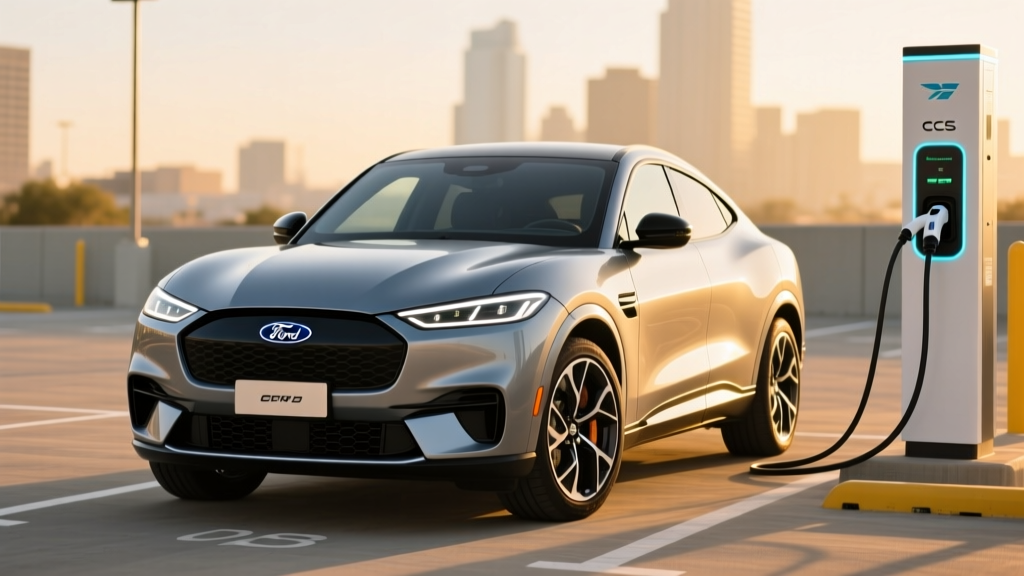
The Mach-E uses the CCS1 connector for DC fast charging and the J1772 connector for Level 2 AC. Ford has not yet transitioned the Mach-E to the NACS (Tesla-style) connector as of the 2026 model year, though Ford has confirmed future models will adopt NACS. Current Mach-E owners can access Tesla Supercharger stations using a Ford-provided CCS-to-NACS adapter, which is included with new 2026 vehicles.
Charging curve reality: The 150 kW peak rate is sustained only between roughly 15–55% SoC on the Extended Range pack. From 55–80%, the rate drops to 80–100 kW, and above 80% it falls to 40–50 kW. If you're road-tripping and charging from 10–80%, budget ~38 minutes at a 150+ kW station. Charging from 80–100% adds another 25–30 minutes — plan your stops accordingly and avoid charging past 80% unless you need the full range for the next leg.
Pricing, Trims, and Federal Tax Credit Eligibility
The 2026 Mustang Mach-E lineup starts at $43,895 for the Premium Standard Range RWD (including $1,895 destination). The volume-selling Extended Range RWD sits at $48,895, while the AWD Extended Range pushes to $51,895. The GT tops the range at $62,995.
| Trim | MSRP (incl. dest.) | Under MSRP Cap? | Est. §30D Credit | Effective Price (best case) |
|---|---|---|---|---|
| Premium Std Range RWD | $43,895 | Yes (cap: $80K SUV) | $3,750–$7,500* | $36,395–$40,145 |
| Premium Ext Range RWD | $48,895 | Yes | $3,750–$7,500* | $41,395–$45,145 |
| Premium Ext Range AWD | $51,895 | Yes | $3,750–$7,500* | $44,395–$48,145 |
| GT Ext Range AWD | $62,995 | Yes | $3,750–$7,500* | $55,495–$59,245 |
*Credit amount depends on battery component and critical mineral sourcing requirements under IRS §30D rules. The Mach-E's battery sourcing has historically qualified for the $3,750 critical-minerals half-credit; full $7,500 eligibility depends on current-year component sourcing compliance. Verify with your tax professional before purchase.
- MSRP cap: SUVs must be ≤ $80,000 — all Mach-E trims qualify.
- Buyer income cap: Modified AGI ≤ $300,000 (joint), $225,000 (head of household), $150,000 (individual). Exceed these and you're ineligible.
- Battery sourcing: The $7,500 credit splits into two $3,750 halves — one for battery components (manufactured/assembled in North America), one for critical minerals (sourced from the U.S. or FTA partners). The Mach-E's eligibility for each half can change quarterly as supply chains shift.
- Point-of-sale transfer: Under current rules, you can transfer the credit to the dealer at purchase, reducing your out-of-pocket cost immediately — even if your tax liability is lower than the credit amount. This is a significant advantage over the old non-refundable structure.
- Final assembly: Must occur in North America. The Mach-E is assembled in Cuautitlán, Mexico — which qualifies under USMCA.
Interior, Cargo, and Technology
The Mach-E's cabin prioritizes a large central touchscreen and minimal physical controls. The 15.5-inch portrait-oriented SYNC 4A display dominates the dashboard, running Ford's latest software with wireless Apple CarPlay and Android Auto, over-the-air updates, and integrated navigation with real-time charger routing.
Passenger space is competitive for the segment:
- Front legroom: 43.3 inches
- Rear legroom: 38.9 inches
- Cargo behind rear seats: 29.7 cubic feet
- Cargo with rear seats folded: 59.7 cubic feet
- Front trunk (frunk): 4.7 cubic feet (drainable — useful for wet gear or tailgating)
The frunk is a genuine advantage over the Tesla Model Y (which eliminated its frunk in recent refreshes) and provides a sealed, drainable compartment that's practical for groceries or gym bags.
Driver assistance: Ford Co-Pilot360 Active 2.0 is standard, including adaptive cruise control with stop-and-go, lane centering, and speed sign recognition. The optional BlueCruise system enables hands-free driving on approximately 130,000 miles of pre-mapped divided highways in the U.S. and Canada. BlueCruise is a SAE Level 2 system — you must remain attentive, and the driver-monitoring camera will issue warnings and eventually slow the vehicle if you look away for too long. This is not autonomous driving; it's an advanced driver-assist feature that reduces fatigue on long highway stretches.
- Does not operate on city streets, residential roads, or unmapped highways.
- Does not handle construction zones, lane merges, or complex interchanges autonomously.
- Requires driver eyes-on monitoring at all times (infrared camera).
- Performance degrades in heavy rain, fog, or when lane markings are obscured by snow.
- Subscription required after the initial trial period (typically 90 days free, then ~$75/month or $800/year).
Notable drawbacks: The Mach-E's one-pedal driving mode is less aggressive than competitors — you'll still need the friction brake pedal for complete stops in most settings. The panoramic glass roof lacks a physical shade, which causes noticeable cabin heat buildup in summer (a tinted film or aftermarket shade is a common owner fix). Rear visibility is compromised by the sloping roofline and thick C-pillars; the 360-degree camera is helpful but not a full substitute.
Mach-E vs. Key Competitors: Which Should You Buy?
| Spec | Ford Mach-E Ext Range AWD | Tesla Model Y Long Range AWD | Hyundai Ioniq 5 Limited AWD | Chevy Equinox EV RS AWD |
|---|---|---|---|---|
| EPA Range | 290 mi | 320 mi | 290 mi | 307 mi |
| Peak DC Charge | 150 kW | 250 kW | 240 kW | 190 kW |
| 10–80% DCFC Time | ~38 min | ~25 min | ~18 min | ~34 min |
| 0-60 mph | 5.1 sec | 4.8 sec | 5.1 sec | 5.9 sec |
| Cargo (rear seats up) | 29.7 cu ft | 30.2 cu ft | 27.2 cu ft | 26.4 cu ft |
| Base MSRP (AWD) | $51,895 | $52,490 | $56,200 | $46,900 |
| Connector | CCS1 (+ NACS adapter) | NACS (native) | CCS1 (+ NACS adapter) | CCS1 (+ NACS adapter) |
- You value a traditional dealer purchase and service experience over Tesla's direct-sales model.
- BlueCruise hands-free highway driving matters to you for long commutes.
- You want a drainable frunk and strong cargo versatility.
- You find a dealer discount that brings the effective price below $45K after incentives.
- Charging speed and Supercharger network access are your top priorities.
- You want the highest real-world range in the segment.
- You're comfortable with Tesla's minimalist interior and direct-service model.
- Fastest DC charging in the segment (18 min 10–80%) is critical for your road-trip habits.
- You prefer the Ioniq 5's retro-futuristic design and more physical HVAC controls.
- Lowest entry price in the segment is your deciding factor.
- You're willing to accept slower acceleration and a less refined ride for the cost savings.
Warranty, Battery Longevity, and Ownership Costs
Ford covers the 2026 Mach-E with a 3-year/36,000-mile bumper-to-bumper warranty and a 5-year/60,000-mile powertrain warranty. The high-voltage battery and electric drivetrain components carry an 8-year/100,000-mile warranty, which is the federal minimum mandated by the EPA for emissions-related components and is standard across the industry for EV battery packs.
The battery warranty guarantees that the pack will retain at least 70% of its original capacity over the 8-year/100,000-mile period. Based on data from 2021–2024 Mach-E owners tracked by communities like MachEForum and analysis from Recurrent Auto, NMC packs in the Mach-E typically show 5–8% degradation at the 3-year/45,000-mile mark — well within the warranty threshold. Long-term projections suggest 85–90% capacity retention at 100,000 miles for drivers who avoid habitual DC fast charging above 90% SoC.
Battery replacement cost: If the battery falls outside warranty coverage, a full pack replacement for the Extended Range model is estimated at $18,000–$24,000 including labor, based on current Ford parts pricing. This is comparable to other NMC packs in the segment but underscores the importance of staying within warranty coverage and following Ford's recommended charging practices (primarily Level 2 home charging, DC fast charging reserved for road trips).
Insurance: Mach-E insurance premiums run 15–25% higher than comparable gas-powered crossovers, consistent with the EV segment. Average annual premiums range from $1,800–$2,400 depending on trim, driving record, and state. Get quotes before purchasing — the GT trim in particular commands a premium.
The Verdict: Is the 2026 Mach-E Worth Buying?
The Mustang Mach-E is not discontinued, but it occupies a complicated position in Ford's lineup. It's a capable, well-rounded electric crossover with competitive range, practical cargo space, and a hands-free driving system that's among the best available from a traditional automaker. Its weaknesses — middling DC fast-charge speed, an aging CCS1 connector, and pricing that undercuts few rivals — are real but not disqualifying.
- 320-mile EPA range (Ext Range RWD) is segment-competitive
- Drainable frunk adds practical versatility
- BlueCruise is a top-tier Level 2 hands-free system
- Comfortable ride quality and quiet cabin at highway speed
- All trims under the $80K federal tax credit MSRP cap
- Ford dealer network provides widespread service access
- 150 kW peak DC charging trails rivals (Ioniq 5: 240 kW)
- CCS1 connector is legacy; NACS adapter required for Superchargers
- No glass roof shade — cabin heat soak in summer
- One-pedal driving mode is weaker than competitors
- Pricing above $43K before incentives; not a budget option
- Ford's EV commitment appears uncertain long-term
If you can negotiate a dealer price in the low-to-mid $40Ks after the federal credit, the Mach-E Extended Range RWD or AWD is a solid daily driver with enough range for most road trips and the comfort for long commutes. If charging speed is your top priority, the Ioniq 5 is the better pick. If network access matters most, the Model Y still wins. But if you want a traditional purchase experience, hands-free highway capability, and a versatile cabin — and the Mach-E isn't going anywhere — it's a rational choice that isn't going out of style anytime soon.
Frequently Asked Questions
Is the Ford Mustang Mach-E being discontinued after 2026?
Ford has not announced any discontinuation of the Mach-E beyond the 2026 model year. The vehicle remains in production at the Cuautitlán plant in Mexico. However, Ford has reduced EV investment and shifted focus toward hybrids and EREVs, so future model-year changes or eventual discontinuation cannot be ruled out. If you're concerned about long-term parts and service support, Ford's dealer network is among the largest in the U.S., and federal mandate requires 15 years of emissions-related parts availability (which includes the battery and powertrain).
What is the real-world range of the 2026 Mach-E?
The Extended Range RWD is EPA-rated at 320 miles. In real-world mixed driving at moderate temperatures, expect 270–290 miles. Highway-only driving at 75+ mph drops that to roughly 250–270 miles. In sustained freezing weather (below 32°F), plan for 200–240 miles depending on cabin heating use and whether you precondition the battery. The AWD Extended Range, rated at 290 EPA, typically delivers 250–270 miles real-world in moderate conditions.
Does the 2026 Mach-E qualify for the $7,500 federal EV tax credit?
All 2026 Mach-E trims fall under the $80,000 MSRP cap for SUVs. Whether you receive the full $7,500, the partial $3,750, or nothing depends on (a) your modified adjusted gross income, (b) the battery's critical mineral and component sourcing compliance at the time of purchase, and (c) final assembly requirements (met — assembled in Mexico under USMCA). The critical minerals and component sourcing rules change periodically; check the latest eligibility list on fueleconomy.gov and consult a tax professional before relying on the credit.
Can I charge the Mach-E at Tesla Superchargers?
Yes. Ford includes a CCS-to-NACS adapter with new 2026 Mach-E vehicles, enabling access to Tesla's Supercharger network (V2 and V3 stations). Charging speeds are limited to the Mach-E's 150 kW peak, so you won't see the full 250 kW that Tesla vehicles can achieve, but the network's reliability and coverage are a significant practical advantage for road trips.
How does the Mach-E's charging speed compare to competitors?
The Mach-E's 150 kW peak is the slowest in its direct competitor set. The Hyundai Ioniq 5 (240 kW, ~18 min 10–80%) and Kia EV6 (240 kW) charge significantly faster thanks to their 800V architecture. The Tesla Model Y peaks at ~250 kW (~25 min 10–80%). The Mach-E's ~38-minute 10–80% time is adequate for road trips with 30–40 minute meal stops, but it's a noticeable disadvantage if you frequently drive routes with limited charging infrastructure.
Is the Mach-E a good EV for a family?
Yes, with caveats. The 38.9 inches of rear legroom accommodates rear-facing child seats, and the 29.7 cu ft cargo area handles strollers and groceries. The frunk adds sealed storage. However, the glass roof without a shade is a complaint from families in hot climates, and the sloping roofline limits vertical cargo space compared to boxier SUVs. For families prioritizing maximum interior volume, the Tesla Model Y or Kia EV9 (three-row) may be better fits.