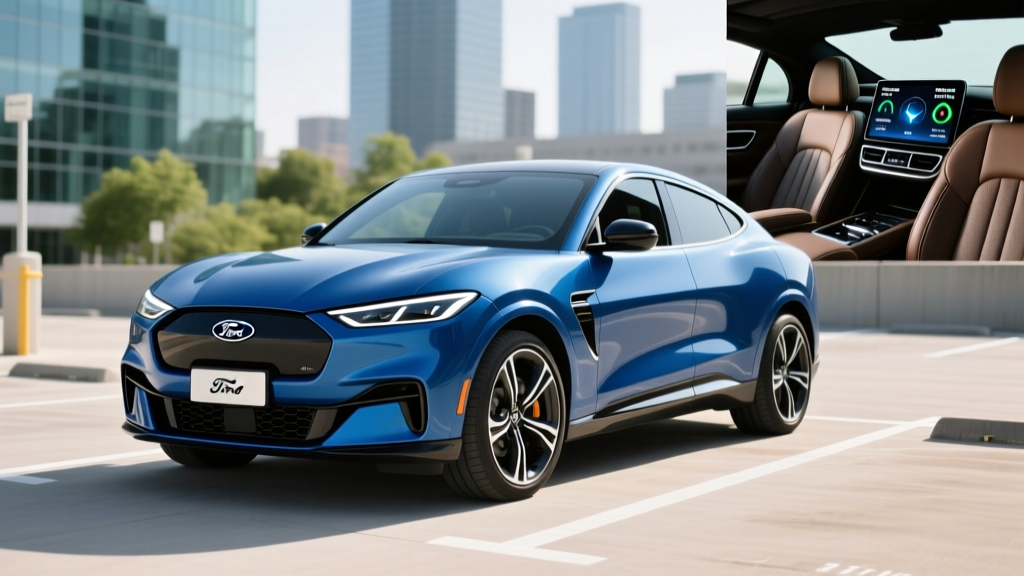
If you've searched for "electric Ford Mustang crash" information, you're likely weighing the safety of the Ford Mustang Mach-E — or concerned about a specific collision involving one. Here's the practical answer: The 2026 Ford Mustang Mach-E holds a 5-Star Overall safety rating from NHTSA and is an IIHS Top Safety Pick, performing comparably to or better than its gas-powered counterparts in crash protection. However, EV crash repair costs tend to run 20-30% higher than equivalent internal-combustion vehicles due to high-voltage system protocols, specialized parts, and battery-pack inspection requirements. Average collision claims on the Mach-E are roughly $4,200–$5,800 depending on severity, and insurance premiums reflect this reality.
Quick Safety Snapshot: 2026 Ford Mustang Mach-E
- NHTSA Overall Rating: 5 Stars
- IIHS Rating: Top Safety Pick (2025–2026 model years)
- Standard ADAS: Ford Co-Pilot360 2.0 (pre-collision assist, evasive steering, BLIS)
- Battery Protection: Reinforced underbody skid plate, high-voltage disconnect on impact
- Avg. Collision Repair Premium Impact: $1,800–$2,400/year (varies by state and driver profile)
Mustang Mach-E Crash Test Ratings: The Full Data
The Ford Mustang Mach-E has been tested extensively by both U.S. safety agencies. The National Highway Traffic Safety Administration (NHTSA) awarded the Mach-E its top 5-Star Overall Vehicle Score, with 5 stars in frontal crash, 5 stars in side crash, and 4 stars in rollover resistance — a typical result for a crossover with its center of gravity.
The Insurance Institute for Highway Safety (IIHS) named the Mach-E a Top Safety Pick when equipped with specific headlights. It earned "Good" ratings — the highest possible — in the moderate overlap front, side, roof strength, and head restraint tests. The updated side crash test (which IIHS made more stringent in 2023–2024) saw the Mach-E maintain its "Good" score, indicating strong B-pillar and door intrusion protection.
| Test | NHTSA Score | IIHS Score |
|---|---|---|
| Frontal Crash (Driver) | 5 Stars | Good (moderate overlap) |
| Frontal Crash (Passenger) | 5 Stars | — |
| Side Crash | 5 Stars | Good (updated test) |
| Rollover | 4 Stars (13.9% risk) | Good (roof strength) |
| Head Restraints/Seats | — | Good |
| Headlights | — | Acceptable (select trims) |
| Front Crash Prevention | — | Superior (vehicle-to-vehicle) |
EV vs. Gas Mustang: How Crash Outcomes Compare
A common misconception is that electric vehicles are inherently more dangerous in crashes due to their lithium-ion battery packs. The data doesn't support this. The Mach-E's battery pack sits low in the chassis within a reinforced steel enclosure, contributing to a lower center of gravity and a stiffer overall structure than the gas Mustang coupe. In NHTSA side-impact testing, the Mach-E's mass (approximately 4,700–4,900 lbs depending on trim and battery) actually provides an advantage in multi-vehicle collisions versus lighter cars.
| Factor | Mustang Mach-E (EV) | Mustang Coupe (Gas, EcoBoost) |
|---|---|---|
| Curb Weight | ~4,700–4,900 lbs | ~3,680–3,850 lbs |
| NHTSA Overall | 5 Stars | Not fully rated (sports coupe segment) |
| Standard AEB | Yes (Co-Pilot360 2.0) | Yes (available package) |
| Front Crash Prevention (IIHS) | Superior | Advanced (when equipped) |
| Post-Crash Fire Risk | Extremely low (NHTSA data) | Low (fuel system shutoff) |
| Avg. Collision Repair Cost | $4,200–$5,800 | $3,100–$4,200 |
| Battery Disconnect on Impact | Automatic (pyro fuse) | Fuel pump shutoff |
The gas Mustang, being a performance coupe, is not directly rated in all the same NHTSA categories (sports cars often have limited federal testing due to lower volume). But in the crash-prevention technology arena, the Mach-E's standard suite is more comprehensive out of the box.
What Happens to the Battery in a Mustang Mach-E Crash?
This is the question most prospective EV buyers actually want answered. The Mach-E uses a liquid-cooled NMC (nickel manganese cobalt) lithium-ion battery pack in capacities of 75.7 kWh (Standard Range) and 98.8 kWh (Extended Range). Ford engineers designed the pack with several crash-specific protections:
- Pyrotechnic disconnect: In a detected collision, a pyro fuse physically severs the high-voltage connection between the battery and the rest of the vehicle within milliseconds, preventing electrical arcing or short circuits.
- Reinforced enclosure: The battery sits in a welded steel cradle with lateral cross-members designed to absorb side-impact energy before it reaches the cells.
- Underbody shielding: A thick skid plate protects against road-debris punctures — the most common source of EV battery damage outside of collisions.
- Coolant isolation: The thermal management system is valved to prevent coolant from flooding damaged cells in a breach scenario.
NHTSA data continues to show that post-crash thermal events (fires) in EVs remain exceedingly rare — estimated at fewer than 25 per 100,000 EV crashes, compared to approximately 1,500 per 100,000 for internal-combustion vehicles based on broader NTSB and BLS data. When Mach-E battery damage does occur, it's most commonly from severe underbody impacts (deep potholes, road debris at speed) rather than collision intrusion.
The Real Cost Picture: Insurance, Repairs, and Ownership
Safety ratings are only part of the crash conversation. If you're in an accident, what does it actually cost? EV insurance premiums and repair bills carry a different profile than gas vehicles, and the Mach-E is no exception.
| Cost Category | Mustang Mach-E (AWD ER) | Gas Crossover (e.g., Mazda CX-5 Turbo) |
|---|---|---|
| Insurance (avg. annual) | $1,900–$2,400 | $1,400–$1,800 |
| Fueling / Charging (12,000 mi/yr) | $480–$720 (home L2 dominant) | $1,600–$2,000 |
| Scheduled Maintenance | $150–$300 | $600–$900 |
| Avg. Collision Repair (at-fault) | $4,200–$5,800 | $3,100–$4,200 |
| Battery Replacement (if needed) | $15,000–$22,000 (covered under warranty if defective) | N/A |
| 5-Year Total Operating Cost (est.) | $12,500–$16,000 | $18,000–$23,000 |
The higher insurance premiums stem from two factors: EV collision repairs require technicians certified in high-voltage system handling, and parts (especially body panels with embedded sensors for ADAS) carry a premium. A fender-bender that might cost $1,200 on a conventional sedan can run $2,000–$2,800 on the Mach-E if the front fascia houses radar and camera modules that need recalibration.
However, the fueling and maintenance savings are substantial. At the U.S. average electricity rate of ~$0.16/kWh and the Mach-E's efficiency of roughly 37 kWh/100 miles (combined, per fueleconomy.gov), home charging costs about $5.92 per 100 miles. A gas crossover averaging 25 MPG at $3.40/gallon costs $13.60 per 100 miles — more than double. Over five years and 60,000 miles, that's roughly $4,600 in fuel savings alone.
Common Misconceptions About EV Crashes
| Myth | Fact |
|---|---|
| "EVs catch fire easily after crashes" | NHTSA and NTSB data show EV post-crash fire rates are far lower than gas vehicles. Thermal events require severe battery cell penetration, which crash structures are designed to prevent. |
| "First responders can't handle EV crashes" | NFPA (National Fire Protection Association) has trained thousands of responders on EV-specific extrication. Every EV has clearly marked high-voltage cables (orange) and emergency disconnect points. |
| "A damaged battery always means total loss" | Minor external damage to the battery enclosure doesn't automatically total the vehicle. Module-level replacement is possible in many cases, though severe cell damage may trigger a total-loss designation due to cost. |
| "EVs are heavier so they're more dangerous to others" | Higher mass provides occupant protection advantages in multi-vehicle crashes. Modern EVs also have sophisticated crumple zones. Compatibility concerns with lighter vehicles are being addressed through updated crash-test protocols. |
| "Water exposure after a crash causes electrocution" | High-voltage systems are sealed to IP67 or higher standards. The pyro disconnect isolates the pack in a crash. Flooding poses risks but not the electrocution hazard often depicted. |
ADAS and Crash Prevention: Ford Co-Pilot360 2.0
The best crash is the one that never happens. Every 2026 Mach-E comes standard with Ford Co-Pilot360 2.0, which includes:
- Pre-Collision Assist with Automatic Emergency Braking (AEB): Detects vehicles, pedestrians, and cyclists. IIHS rated this system "Superior" for vehicle-to-vehicle crash prevention.
- Evasive Steering Assist: Provides steering torque to help the driver maneuver around a detected obstacle when braking alone is insufficient.
- Blind Spot Information System (BLIS) with Cross-Traffic Alert: Monitors adjacent lanes and warns of approaching traffic when reversing.
- Lane-Keeping System: Detects unintentional lane departure and provides steering correction.
- Reverse Brake Assist: Applies brakes when an obstacle is detected behind the vehicle during low-speed reversing.
Important: Co-Pilot360 Is SAE Level 2 — Not Self-Driving
Ford's driver-assistance system, including the available BlueCruise hands-free highway driving feature, is classified as SAE Level 2 automation. This means the system can control steering and acceleration simultaneously under specific conditions, but the driver must remain fully attentive, keep eyes on the road (or be ready to resume control within seconds on BlueCruise), and is legally responsible for the vehicle at all times. BlueCruise operates on pre-mapped divided highways only. It does not handle construction zones, unmapped roads, severe weather, or complex urban intersections. No production vehicle sold to consumers in 2026 is "self-driving" — only geofenced Level 4 robotaxi services (Waymo, Zoox) operate without a human driver.
Buying Decision Framework: Is the Mach-E Right for You?
Should You Buy a Mustang Mach-E? An If/Then Guide
Choose the Mach-E if:
- You want a 5-star NHTSA safety-rated EV with strong crash-prevention tech and have access to home Level 2 charging (a 240V/48A setup adds ~32 miles per hour of charging).
- Your daily commute is under 200 miles and you can charge overnight — the Extended Range AER trim offers an EPA-estimated 312 miles, though expect ~260–280 real-world miles at sustained highway speeds or in cold weather below 30°F.
- You value performance: the GT trim delivers 480 hp and a 0–60 mph time of 3.5 seconds, with the safety infrastructure of a modern crossover.
- You qualify for the federal §30D tax credit (up to $7,500, subject to MSRP caps of $80,000 for SUVs, buyer AGI limits of $150K single/$300K joint, and battery critical-minerals sourcing requirements — verify current eligibility at irs.gov before purchasing, as rules are subject to change).
Look elsewhere if:
- You live in an apartment or lack reliable access to home or workplace charging. Public DC fast charging (the Mach-E peaks at ~150 kW, achieving a 10–80% charge in approximately 38 minutes) is viable for road trips but expensive and inconvenient as a daily strategy.
- You regularly tow more than 3,500 lbs — the Mach-E's maximum towing capacity is 2,700 lbs (Select/Standard Range) to 3,500 lbs (GT/Extended Range with tow package).
- Insurance cost is your primary concern and your state has particularly high EV premiums. Get a quote before committing — some Mach-E owners report premiums 30–50% higher than their previous gas vehicle.
- You need a third row. The Mach-E is strictly a two-row, five-passenger crossover. Consider the Kia EV9 or Rivian R1S if you need seven seats.
Key Specs at a Glance: 2026 Ford Mustang Mach-E
| Specification | Select (SR RWD) | Premium (ER AWD) | GT (ER AWD) |
|---|---|---|---|
| Base MSRP | $42,995 | $52,995 | $62,995 |
| Battery Capacity (usable) | 75.7 kWh (NMC) | 98.8 kWh (NMC) | 98.8 kWh (NMC) |
| EPA Range | 250 mi | 312 mi | 280 mi |
| Real-World Highway Range (est.) | ~210–225 mi | ~260–280 mi | ~235–255 mi |
| Horsepower | 266 hp | 346 hp | 480 hp |
| 0–60 mph | 6.3 sec | 5.2 sec | 3.5 sec |
| Peak DC Fast Charge Rate | 115 kW | 150 kW | 150 kW |
| 10–80% DC Charge Time | ~42 min | ~38 min | ~38 min |
| Level 2 Charge Rate (240V) | 10.5 kW (~32 mi/hr) | 10.5 kW (~32 mi/hr) | 10.5 kW (~32 mi/hr) |
| Efficiency (combined) | 101 MPGe | 98 MPGe | 89 MPGe |
| Battery/Powertrain Warranty | 8 yr / 100,000 mi | 8 yr / 100,000 mi | 8 yr / 100,000 mi |
Frequently Asked Questions
Has the Ford Mustang Mach-E had any safety recalls related to crashes?
As of the 2026 model year, the Mach-E has had recalls related to high-voltage battery contact splitting (2022 model year, software fix) and a half-shaft separation issue on certain GT models (mechanical, not crash-related). No recall has involved structural crashworthiness failures. Always check NHTSA's recall database with a specific VIN before purchasing any used Mach-E.
How much does it cost to repair a Mach-E after a moderate collision?
A moderate front-end collision (bumper, hood, headlight assembly) typically runs $4,200–$5,800 at a Ford-certified body shop. This is 20–30% higher than a comparable gas crossover due to ADAS sensor recalibration ($400–$800 alone), specialized EV training requirements for technicians, and higher parts costs. If the battery pack sustains damage, costs escalate dramatically — but this requires a severe intrusion that most moderate collisions don't produce.
Is the Mach-E safer than a Tesla Model Y in a crash?
Both vehicles earn 5-star NHTSA ratings and strong IIHS scores. The Mach-E and Model Y trade advantages in specific subcategories — the Model Y has slightly higher roof strength numbers, while the Mach-E earned "Superior" in front crash prevention. In real-world terms, both are among the safest vehicles in their class. The choice between them should come down to charging ecosystem preference (Tesla's NACS Supercharger network vs. Ford's growing access to the same network via adapter), interior ergonomics, and software experience rather than a meaningful safety gap.
What should first responders know about a Mach-E crash scene?
Emergency responders are trained to identify EVs and locate the high-voltage disconnect. In the Mach-E, first responders can cut the first-responder loop (marked under the hood) to isolate the high-voltage system. All high-voltage cables are wrapped in orange sheathing. The battery pack itself is sealed and should not be cut into. Ford provides detailed Emergency Response Guides (ERGs) to the NFPA and all major fire/rescue organizations. Water can be used freely for fire suppression — the concern is not electrocution but rather potential thermal runaway if cells are breached, which requires sustained cooling.
Does the federal tax credit still apply to the Mach-E in 2026?
The §30D Clean Vehicle Credit may provide up to $7,500 for eligible buyers of the Mach-E, but eligibility depends on multiple factors: the vehicle must be assembled in North America (the Mach-E is built in Cuautitlán, Mexico, which qualifies under USMCA), must meet critical-minerals and battery-component sourcing thresholds that tighten annually, the buyer's adjusted gross income must not exceed $150,000 (single) or $300,000 (joint), and the vehicle MSRP must be at or below $80,000 for an SUV. The credit can now be transferred to the dealer at point of sale for an immediate price reduction. Always confirm current-year eligibility on IRS.gov or consult a tax professional before finalizing a purchase.