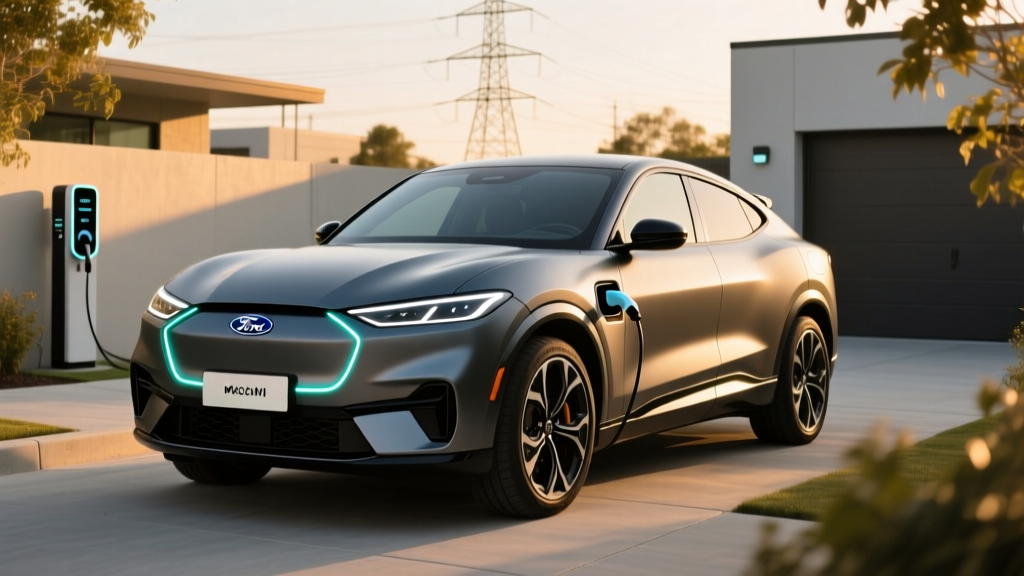
The Ford Mustang Mach-E enters the 2026 model year as one of the most thoroughly crash-tested electric SUVs on the market. With Top Safety Pick awards, strong NHTSA star ratings, and a practical blend of range and charging speed, it remains a serious contender in the midsize electric crossover segment. This review covers everything from its crash-safety credentials to real-world range, charging curves, and whether it still qualifies for the federal tax credit under current IRS rules.
Ford Mach-E Crash Test Ratings & Safety Scores
When buyers search for "Ford Mach-E crash" data, they are typically looking for two things: how the vehicle performs in controlled crash tests, and what active-safety technology it offers to prevent collisions in the first place. The Mach-E performs well on both fronts.
The National Highway Traffic Safety Administration (NHTSA) awarded the Mustang Mach-E an overall 5-Star safety rating, with 5 stars in frontal crash, 5 stars in side crash, and 4 stars in rollover resistance. These are among the highest scores an electric SUV can achieve.
The Insurance Institute for Highway Safety (IIHS) has historically named the Mach-E a Top Safety Pick when equipped with specific headlights. For the current generation, the Mach-E earned "Good" ratings in the moderate overlap front test, side impact test, and roof strength evaluation. Its standard automatic emergency braking system received a "Superior" rating for vehicle-to-vehicle crash prevention.
- NHTSA Overall: 5 Stars
- IIHS Moderate Overlap Front: Good
- Standard AEB: Superior (vehicle-to-vehicle)
- Standard Ford Co-Pilot360 2.0 suite
- Available BlueCruise hands-free highway driving (SAE Level 2)
The Mach-E's battery pack is housed in a reinforced underfloor structure designed to manage crash energy and protect the high-voltage system. Ford has reported no widespread thermal runaway incidents in the Mach-E fleet, a critical distinction from some early-generation EVs.
Range, Battery & Real-World Efficiency
The 2026 Mach-E lineup offers two battery configurations: a Standard Range pack and an Extended Range pack. Both use NMC (nickel manganese cobalt) lithium-ion chemistry, which provides higher energy density than LFP but requires more careful thermal management and benefits from not being routinely charged to 100%.
| Spec | Standard Range | Extended Range |
|---|---|---|
| Battery Capacity (usable) | 72 kWh | 91 kWh |
| Chemistry | NMC | NMC |
| EPA Range (RWD) | 250 mi | 320 mi |
| EPA Range (AWD) | 230 mi | 290 mi |
| Efficiency (combined) | 101 MPGe / 33 kWh/100mi | 103 MPGe / 32 kWh/100mi |
According to fueleconomy.gov, the Extended Range RWD variant achieves 103 MPGe combined, translating to roughly 32 kWh per 100 miles. This is competitive with the Hyundai Ioniq 5 and slightly behind the Tesla Model Y in efficiency per mile.
Charging Speed: DC Fast Charge & Home Level 2
Charging speed is where the Mach-E has historically drawn criticism, and while improvements have been made, it still trails the segment leaders. Understanding the difference between peak charge rate (measured in kW, or power) and battery capacity (measured in kWh, or energy) is essential for evaluating these numbers.
| Charging Level | Standard Range | Extended Range |
|---|---|---|
| DC Fast Charge (peak kW) | 115 kW | 150 kW |
| 10–80% DCFC Time | ~38 min | ~45 min |
| Level 2 Home Charging (kW) | 10.5 kW (48A) | 10.5 kW (48A) |
| Level 2 Miles per Hour | ~30 mi/hr | ~30 mi/hr |
| Connector | CCS1 (NACS adapter available) | CCS1 (NACS adapter available) |
The Extended Range pack peaks at 150 kW on a DC fast charger, but like most EVs, the Mach-E does not sustain peak rate throughout the session. The charge curve tapers significantly above 80% State of Charge (SoC) to protect battery longevity. A 10–80% session takes approximately 45 minutes — adequate for road-trip stops but noticeably slower than the Hyundai Ioniq 5 (18 minutes at up to 350 kW on an 800V architecture) or the Tesla Model Y (roughly 25 minutes at 250 kW).
Ford provides a NACS adapter that allows Mach-E owners to access the Tesla Supercharger network, significantly expanding fast-charging options on road trips. For home charging, the onboard 10.5 kW charger fills the Extended Range battery from empty to full in roughly 9–10 hours on a 48-amp Level 2 circuit — easily manageable overnight.
Performance, Drivetrain & Driving Dynamics
| Trim / Configuration | Horsepower | Torque (lb-ft) | 0–60 mph | Drivetrain |
|---|---|---|---|---|
| Select RWD (Std Range) | 266 hp | 317 | 5.8 sec | RWD |
| Select AWD (Ext Range) | 346 hp | 428 | 4.8 sec | AWD dual-motor |
| GT (Ext Range AWD) | 480 hp | 634 | 3.5 sec | AWD dual-motor |
The base RWD model delivers adequate acceleration for commuting and merging, but the dual-motor AWD configurations are where the Mach-E earns its Mustang badge. The GT variant's 3.5-second 0–60 time puts it in sports-car territory, with immediate torque delivery and a low center of gravity thanks to the underfloor battery.
Ride quality is firm but composed. The Mach-E uses a multi-link rear suspension that handles broken pavement well, though some reviewers note more road noise than the Hyundai Ioniq 5 at highway speeds. One-pedal driving mode provides strong regenerative braking, allowing most city driving without touching the friction brake pedal.
Pricing, Tax Credits & Ownership Cost
| Trim | Base MSRP | Est. After §30D Credit |
|---|---|---|
| Select RWD (Std Range) | $39,995 | ~$32,495* |
| Select AWD (Ext Range) | $46,995 | ~$39,495* |
| Premium (Ext Range AWD) | $51,995 | ~$44,495* |
| GT (Ext Range AWD) | $59,995 | ~$52,495* |
*Estimated pricing assumes full $7,500 federal tax credit eligibility. Actual credit amount depends on individual circumstances.
The federal EV tax credit under IRS §30D can provide up to $7,500 for qualifying new EV purchases, and since 2024, this credit can be transferred to the dealer at the point of sale as an immediate price reduction. However, eligibility is not guaranteed for every buyer or every vehicle configuration:
- MSRP cap: SUVs must have an MSRP at or below $80,000 (all Mach-E trims qualify).
- Income cap: Modified adjusted gross income must not exceed $150,000 (single), $225,000 (head of household), or $300,000 (joint filers).
- Battery sourcing: The credit is split into two halves ($3,750 each) — one for critical minerals sourcing and one for battery component manufacturing. Sourcing requirements tighten annually, and buyers should verify current-year compliance on the IRS website or with their dealer before purchase.
Always confirm eligibility with a tax professional and check the latest IRS clean vehicle credit page before finalizing your purchase.
Interior Space, Cargo & Technology
The Mach-E provides 29.7 cubic feet of cargo space behind the rear seats and 59.7 cubic feet with the rear seats folded — competitive with the Tesla Model Y but slightly less than the Hyundai Ioniq 5's flat-floor versatility. A small front trunk (frunk) adds 4.7 cubic feet of sealed, drainable storage — useful for charging cables or wet gear.
Passenger space is generous in front (43.3 inches of legroom) but rear legroom (38.9 inches) is tighter than some rivals, particularly for tall passengers on long trips.
The centerpiece of the interior is a 15.5-inch portrait-oriented touchscreen running Ford's SYNC 4A system with wireless Apple CarPlay and Android Auto. The interface is responsive and logically laid out, though some climate controls are buried in submenus. A 10.2-inch digital instrument cluster sits behind the steering wheel.
Standout tech features:
- Ford BlueCruise hands-free highway driving (available on Premium/GT)
- Phone-as-a-key via FordPass app
- Over-the-air software updates
- Available panoramic fixed-glass roof
- Ford PowerUp software platform with feature upgrades
Notable drawbacks:
- No physical climate knobs — everything runs through the touchscreen
- Rear visibility is compromised by thick C-pillars (surround-view camera helps)
- Frunk is small compared to some competitors
- DC fast-charge speed lags behind 800V rivals
Warranty Coverage
Ford backs the Mach-E with a competitive warranty package:
- Bumper-to-bumper: 3 years / 36,000 miles
- Powertrain: 5 years / 60,000 miles
- High-voltage battery: 8 years / 100,000 miles (minimum 70% capacity retention)
- Corrosion perforation: 5 years / unlimited miles
The battery warranty's 70% capacity retention threshold is industry standard. Real-world data from early Mach-E owners suggests NMC pack degradation of roughly 5–8% over the first three years of typical use, well within the warranty buffer.
Pros
- Top-tier crash safety ratings (5-star NHTSA)
- Engaging driving dynamics, especially GT trim
- Strong NACS adapter access to Supercharger network
- Comfortable, tech-forward interior
- All trims under $80K MSRP cap for tax credit
Cons
- DC fast charging slower than 800V competitors
- Real-world highway range falls short of EPA sticker
- Rear seat space tighter than some rivals
- No physical climate controls
- NMC battery less ideal for routine 100% charging
Who the Mach-E Suits Best
The Mustang Mach-E is best suited for:
- Daily commuters who can charge at home and want a comfortable, tech-loaded crossover with strong safety credentials.
- Small families who need cargo versatility and appreciate the frunk for gear storage, though larger families may prefer a three-row EV.
- Enthusiast drivers who want EV acceleration with genuine handling engagement, particularly in GT trim.
- Road trippers willing to plan charging stops and take advantage of the Supercharger network via the NACS adapter.
It is less ideal for buyers who frequently tow (maximum towing capacity is only 2,200 lbs on AWD models), those who need maximum rear-seat space, or road warriors who prioritize the fastest possible DC charging times.
Frequently Asked Questions
What is the real-world range of the Ford Mach-E?
The EPA rates the Extended Range RWD at 320 miles and AWD at 290 miles. Real-world highway driving at 70+ mph typically yields 250–265 miles (AWD). In cold weather below 30°F, expect a 20–30% reduction, bringing the AWD down to roughly 200–230 miles.
How fast does the Mach-E charge on DC fast chargers and at home?
The Extended Range model peaks at 150 kW on DC fast chargers, achieving a 10–80% charge in approximately 45 minutes. The Standard Range model peaks at 115 kW with a similar 38-minute session. Home Level 2 charging at 10.5 kW adds roughly 30 miles per hour, fully replenishing the Extended Range battery overnight in about 9–10 hours.
Does the Ford Mach-E qualify for the federal EV tax credit?
All Mach-E trims fall under the $80,000 MSRP cap for SUVs. Buyer eligibility depends on income limits ($150K single / $300K joint) and battery-sourcing compliance, which tightens annually. The credit can be applied at the point of sale as an immediate discount. Verify current-year eligibility at IRS.gov before purchasing.
Is the Mach-E worth buying versus the Tesla Model Y or Hyundai Ioniq 5?
The Mach-E wins on crash-test pedigree, interior material quality, and driving engagement. The Model Y offers superior efficiency, faster charging, and the largest Supercharger network natively. The Ioniq 5 charges significantly faster (18 minutes 10–80% on 350 kW chargers) and has a more spacious rear seat. Choose the Mach-E if safety ratings, Ford dealer service access, and driving dynamics are your top priorities.
What is the Mach-E's biggest weakness?
DC fast-charging speed. At 150 kW peak with a ~45-minute 10–80% session, it trails the Ioniq 5, Kia EV6, and Model Y. For road-trip-heavy buyers, this translates to longer stops and more careful route planning.