Quick Verdict: A Practical EV SUV With Real Cargo Muscle
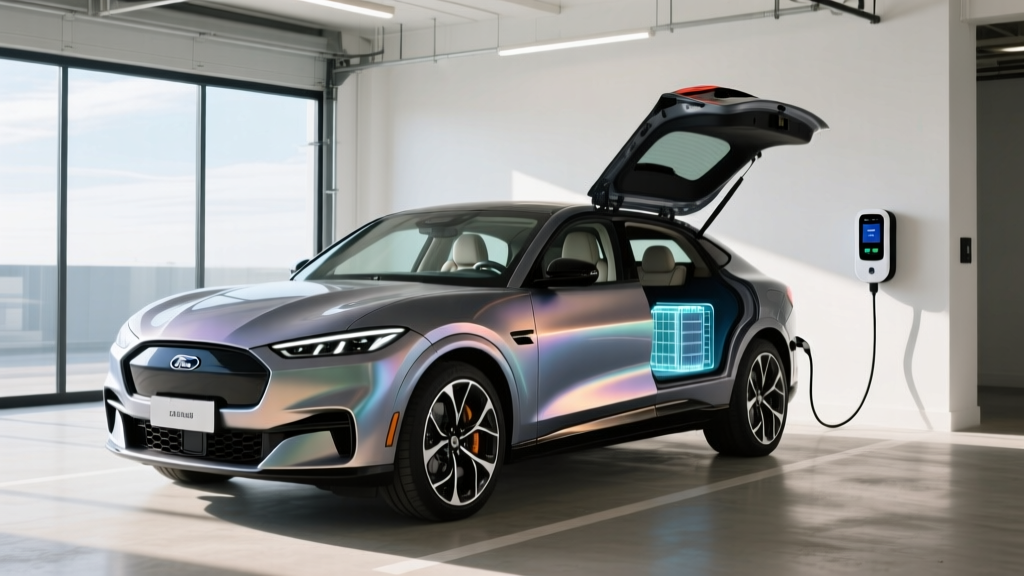
The 2026 Ford Mustang Mach-E remains one of the most well-rounded electric SUVs on the market, and for buyers specifically researching Ford Mach-E cargo space, the numbers deliver. With 29.7 cubic feet behind the rear seats and 59.7 cubic feet with the 60/40 split folded flat — plus an additional 4.7 cubic feet in the front trunk (frunk) — the Mach-E competes directly with the Hyundai Ioniq 5 and Volkswagen ID.4 on utility while offering sharper driving dynamics than either.
But cargo volume is only part of the ownership equation. This review covers the full picture: real-world range across trims, DC fast-charging performance on the road, home Level 2 charging practicality, IRS §30D tax credit eligibility under current rules, and how the Mach-E stacks up against key rivals for families and commuters alike.
| Spec | Select (RWD) | Premium AWD | GT |
|---|---|---|---|
| EPA Range | 250 mi | 290 mi (Extended Range: 320 mi) | 280 mi (Extended Range: 300 mi) |
| Battery (usable) | 70 kWh (LFP) | 70 kWh / 91 kWh (NMC) | 91 kWh (NMC) |
| Horsepower | 266 hp | 300 hp | 480 hp |
| 0–60 mph | 6.3 sec | 5.1 sec | 3.5 sec |
| Drivetrain | RWD (single motor) | AWD (dual motor) | AWD (dual motor) |
| Peak DC Fast Charge | 115 kW | 150 kW | 150 kW |
| 10–80% DC Time | ~38 min | ~33 min (91 kWh: ~41 min) | ~41 min |
| Level 2 Home Rate | 10.5 kW (~30 mi/hr) | 10.5 kW (~30 mi/hr) | 10.5 kW (~30 mi/hr) |
| EPA Efficiency | 105 MPGe (32 kWh/100mi) | 101 MPGe (33 kWh/100mi) | 84 MPGe (40 kWh/100mi) |
| Base MSRP | $39,995 | $45,995 | $55,995 |
Real-World Range: What the EPA Sticker Doesn't Tell You
The EPA numbers above look competitive, but real-world range depends heavily on driving style, ambient temperature, and terrain. Based on owner reports and third-party highway testing, here is what you can actually expect from the most popular configuration — the Premium AWD with the Extended Range 91 kWh NMC battery:
- EPA Sticker: 320 miles
- Mixed city/suburban driving (65°F): 290–310 miles
- Highway cruising at 75 mph (65°F): 250–270 miles
- Highway at 75 mph (30°F, no heat pump): 200–230 miles
- Cold city driving (20°F, cabin heat on): 210–240 miles
Source: Aggregated owner data via fueleconomy.gov and Mach-E owner forums. The Mach-E's optional heat pump (standard on Premium and above for 2026) significantly reduces cold-weather losses compared to resistive heating.
The Standard Range 70 kWh LFP battery in the Select trim trades roughly 50–70 miles of range for a lower purchase price and a chemistry that tolerates frequent 100% charging without degradation concerns. For daily commuters who charge at home nightly, the 250-mile EPA rating is more than sufficient — and LFP owners can set their charge limit to 100% without the battery-health anxiety that NMC owners manage.
Cargo Space Deep Dive: Dimensions, Frunk, and Real-World Usability
This is the section buyers searching for Ford Mach-E cargo space came for, so let's get specific with the measurements and what they mean in practice.
| Measurement | Value |
|---|---|
| Cargo behind rear seats | 29.7 cu ft |
| Cargo with rear seats folded (60/40) | 59.7 cu ft |
| Front trunk (frunk) | 4.7 cu ft (drainable, lockable) |
| Total maximum cargo | 64.4 cu ft |
| Cargo floor length (seats up) | ~37 inches |
| Cargo floor length (seats folded) | ~72 inches |
| Cargo opening width | ~46 inches |
| Rear headroom | 38.2 inches |
| Rear legroom | 38.9 inches |
| Front headroom | 40.4 inches |
| Front legroom | 43.3 inches |
| Max towing capacity | 1,500 lbs (with factory hitch) |
How the Mach-E Cargo Space Compares
Against key competitors in the two-row electric SUV segment:
- Hyundai Ioniq 5: 27.2 cu ft (rear up) / 59.3 cu ft (folded) — the Mach-E wins by 2.5 cu ft with seats up.
- Volkswagen ID.4: 30.3 cu ft / 64.2 cu ft — the ID.4 edges ahead in total volume by ~4.5 cu ft, largely due to its taller, boxier roofline.
- Tesla Model Y: 30.2 cu ft / 76.2 cu ft (including front trunk) — the Model Y's hatch and available third row give it a clear cargo advantage for larger families.
The Mach-E's 4.7-cubic-foot frunk is a standout feature. It's drainable (a plug at the bottom lets you rinse it out), lockable via the FordPass app, and deep enough to hold a charging cable bag, a small cooler, or groceries you want to keep separate from the main cabin. This is genuinely useful — many competitors offer only a shallow frunk or none at all.
With the rear seats folded, the ~72-inch cargo floor length accommodates a full-size bicycle with the front wheel removed, or two large suitcases stacked side by side with room for a stroller frame. The 60/40 split is a practical choice for families who need to carry one child in a car seat while still folding the other side for cargo.
Charging Speed: DC Fast, Home Level 2, and the Charge Curve Reality
Charging speed is consistently a top-3 concern for EV buyers, and the Mach-E's performance here is competent but not class-leading. Here is the full breakdown:
| Charging Level | Power | Speed (Approx.) | Notes |
|---|---|---|---|
| Level 1 (120V outlet) | ~1.4 kW | ~3–4 miles/hour | Emergency/top-up only; a full charge takes 3+ days |
| Level 2 (240V home) | 10.5 kW (48A) | ~30 miles/hour | Full charge overnight (~9–10 hrs for 91 kWh battery) |
| DC Fast Charge (Standard Range) | Peak 115 kW | 10–80% in ~38 min | Sustained rate drops above 60% SoC |
| DC Fast Charge (Extended Range) | Peak 150 kW | 10–80% in ~33–41 min | 150 kW peak lasts to ~40% SoC, then tapers |
The critical nuance that spec sheets gloss over: peak charge rate is not sustained charge rate. The Mach-E Extended Range hits 150 kW only in the early portion of the charge curve (roughly 10–40% State of Charge). From 40–60%, it drops to approximately 100–120 kW, and above 80% it falls below 50 kW as the battery management system protects cell health. This is normal behavior for NMC lithium-ion packs — but it means that a "10–80%" time of 33–41 minutes is realistic only if you precondition the battery (the Mach-E does this automatically when you navigate to a DC fast charger via the onboard navigation).
For home charging, the onboard 10.5 kW charger is solid. Most owners install a 48-amp Level 2 wall connector on a 60-amp dedicated circuit. Expect installation costs of $800–$2,000 depending on panel proximity and local permit requirements — factor in a potential $500–$2,000 panel upgrade if your home still has a 100-amp service. Always get a final spec from a licensed electrician before committing.
The Mach-E uses the CCS1 connector for DC fast charging and J1772 for Level 2. Ford has announced that future model years will transition to NACS (the Tesla connector), and current Mach-E owners can access Tesla Supercharger V3/V4 stations using a Ford-approved NACS adapter. This dramatically expands the available fast-charging network — a significant practical advantage for road-trippers.
Pricing, Trims, and Federal Tax Credit Eligibility
The 2026 Mach-E lineup spans four trims, and pricing has been adjusted to stay competitive within the IRS §30D federal tax credit framework.
| Trim | Drivetrain | Battery | MSRP (incl. destination) |
|---|---|---|---|
| Select | RWD | 70 kWh LFP | $39,995 |
| Premium | RWD or AWD | 70 kWh / 91 kWh NMC | $45,995 – $52,495 |
| GT | AWD | 91 kWh NMC | $55,995 |
| Rally | AWD | 91 kWh NMC | $59,995 |
Federal Tax Credit (§30D) Eligibility Checklist
The IRS §30D Clean Vehicle Credit can provide up to $7,500 — and for 2026, it can be transferred to the dealer at the point of sale as an instant discount. However, eligibility depends on several requirements that change periodically:
- MSRP cap: SUVs must be priced at or below $80,000 — all Mach-E trims qualify.
- Buyer income cap: Modified AGI must not exceed $150,000 (single), $225,000 (head of household), or $300,000 (joint filers).
- Battery component sourcing: A percentage of battery components must be manufactured or assembled in North America (threshold increases annually — check IRS qualifying vehicle list for the current Mach-E status).
- Critical minerals: A percentage of critical minerals must be sourced from the U.S. or a free-trade-agreement partner.
- Assembly: The Mach-E is assembled in Cuautitlán, Mexico — final assembly must be in North America, which qualifies.
Important: Battery sourcing requirements tighten each year. Always verify current eligibility on the IRS website or consult a tax professional before relying on the credit. The credit is non-refundable if claimed on your tax return (though point-of-sale transfer changes this dynamic for 2026). State and local incentives vary — check your state energy office for additional rebates.
Performance, Efficiency, and What It's Like to Drive
The Mach-E's driving character is where Ford's Mustang branding earns its keep — at least in the GT. The Select and Premium trims are tuned more for comfort and efficiency, with well-damped ride quality, responsive steering, and a low center of gravity that makes the SUV feel planted through corners despite its 4,700–4,900 lb curb weight.
The GT's 480 horsepower and 3.5-second 0–60 time put it in sports-sedan territory, and the instant torque delivery means real-world acceleration feels even quicker than the numbers suggest. The GT's MagneRide adaptive dampers (standard on GT for 2026) give it a ride-quality edge over the Tesla Model Y Performance, which tends toward firmness.
Efficiency varies significantly by trim. The RWD Select with the LFP battery achieves an impressive 105 MPGe combined (32 kWh/100 miles), making it one of the most efficient electric SUVs in its class. The GT drops to 84 MPGe (40 kWh/100 miles) — a meaningful difference that translates to roughly 30 fewer miles of range per charge cycle and higher electricity costs over time.
Regenerative braking is adjustable via a steering-wheel paddle (a one-pedal driving mode is available), and the system recovers energy effectively in stop-and-go traffic. The heat pump on Premium and above trims is a critical efficiency feature in cold climates — it uses roughly one-third the energy of resistive cabin heating, preserving range in winter.
Tech, Safety, and Driver-Assist Features
The 2026 Mach-E centers its technology around a 15.5-inch vertical touchscreen running Ford's latest SYNC 4A software. The interface is responsive, supports wireless Apple CarPlay and Android Auto, and features an integrated Google-based navigation system with real-time charger availability and battery preconditioning.
Ford's BlueCruise hands-free driving system is available on Premium and above trims (included for the first year, then a subscription). BlueCruise operates on pre-mapped divided highways and allows hands-off driving while the driver remains attentive — monitored by a driver-facing infrared camera.
BlueCruise is a Level 2 driver-assist system. Despite the "hands-free" label, the driver must remain engaged, monitor the road, and be prepared to take over immediately. This is not autonomous driving (Level 4/5). Ford's system is comparable to GM's Super Cruise and Tesla's Autopilot in capability — useful for reducing fatigue on long highway stretches, but not a substitute for an attentive driver.
Safety ratings are strong: the Mach-E earned a 5-star overall rating from NHTSA and the IIHS Top Safety Pick+ designation. Standard equipment includes automatic emergency braking with pedestrian detection, blind-spot monitoring, rear cross-traffic alert, lane-keeping assist, and evasive steering assist.
Notable Drawbacks
- No third row: Families needing seating for six or seven will need to look at the Kia EV9 or Tesla Model X.
- Charging speed trails rivals: The Hyundai Ioniq 5 and Kia EV6 peak at 240+ kW on 800V architectures, completing 10–80% in ~18 minutes. The Mach-E's 150 kW peak and 33–41 minute time is adequate but not leading-edge.
- Rear visibility: The sloping roofline and thick C-pillars create a notable blind spot — the standard rearview camera helps, but a digital rearview mirror option would be welcome.
- BlueCruise subscription cost: After the initial free period, expect ~$75/year or $20/month to maintain hands-free functionality.
Warranty and Long-Term Ownership
Ford backs the Mach-E with a competitive warranty package:
| Coverage | Term |
|---|---|
| Basic (bumper-to-bumper) | 3 years / 36,000 miles |
| Powertrain | 5 years / 60,000 miles |
| Battery (high-voltage) | 8 years / 100,000 miles (capacity retention ≥70%) |
| Corrosion perforation | 5 years / unlimited miles |
| Roadside assistance | 5 years / 60,000 miles |
The 8-year/100,000-mile battery warranty with a 70% capacity retention threshold is industry-standard and matches most competitors. Real-world degradation data from early 2021–2023 Mach-E owners suggests NMC packs lose approximately 5–8% capacity over the first 60,000 miles, well within the warranty threshold. LFP packs in the Select trim are expected to show even slower degradation, as the chemistry is inherently more cycle-durable — though long-term Mach-E LFP data is still accumulating.
Battery replacement cost (out of warranty) is estimated at $12,000–$18,000 for the Extended Range pack based on current Ford parts pricing — a figure that has been declining as battery cell costs fall, but still a meaningful long-term risk to budget for.
Who Should Buy the 2026 Ford Mustang Mach-E?
Choose the Mach-E if:
- You want a sporty-driving electric SUV with genuine cargo versatility (29.7 + 4.7 cu ft frunk).
- You value a proven dealer network and widespread service availability over startup brands.
- You want BlueCruise hands-free highway driving without a Tesla.
- You commute 30–60 miles daily and can charge at home — the Select LFP trim is ideal for this use case.
Look elsewhere if:
- You need a third row (consider the Kia EV9).
- Fastest possible DC charging is a priority (the Ioniq 5/EV6 at 800V charge significantly faster).
- You need maximum cargo volume (the Tesla Model Y offers 76.2 cu ft total).
- You want the longest possible single-charge range for frequent 300+ mile road trips (the Lucid Gravity or a future 400-mile SUV may serve better).
Pros
- Strong cargo utility with drainable frunk
- Engaging driving dynamics, especially GT
- LFP battery option for worry-free daily charging
- BlueCruise hands-free driving on mapped highways
- Competitive pricing within §30D MSRP caps
- Ford dealer network for service accessibility
Cons
- DC charging slower than 800V rivals (150 kW vs 240+ kW)
- No third-row option
- Rear visibility compromised by styling
- BlueCruise requires ongoing subscription
- Extended Range trims push past $50K before incentives
Frequently Asked Questions
What is the real-world range of the 2026 Ford Mustang Mach-E?
The EPA rates the Extended Range AWD at 320 miles, but expect 250–270 miles at sustained highway speeds in moderate temperatures, and 200–230 miles in cold-weather highway driving (below 35°F). City and suburban driving with regenerative braking recovers more energy, yielding closer to the EPA figure. The Standard Range LFP model delivers approximately 220–240 real-world mixed miles from its 250-mile EPA rating.
How fast does the Mach-E charge at home and on the road?
At home on a 240V Level 2 charger (48 amps), the Mach-E adds roughly 30 miles of range per hour, fully charging the 91 kWh Extended Range battery in about 9–10 hours. On DC fast chargers, the Extended Rate model peaks at 150 kW and charges from 10–80% in approximately 33–41 minutes depending on battery temperature and charger capability. The Standard Range model peaks at 115 kW with a 10–80% time around 38 minutes.
Does the 2026 Mach-E qualify for the $7,500 federal EV tax credit?
It can — but eligibility depends on your income (AGI caps apply), the specific trim's MSRP (all trims are below the $80,000 SUV cap), and current battery-sourcing requirements that tighten annually. The Mach-E is assembled in Mexico (North America), which satisfies final-assembly rules. Check the IRS qualifying vehicles list for the most current status, and consult a tax professional to confirm your personal eligibility. The credit can be transferred to the dealer at point of sale for an instant price reduction in 2026.
How does Mach-E cargo space compare to the Tesla Model Y and Hyundai Ioniq 5?
The Mach-E offers 29.7 cu ft behind the rear seats and 59.7 cu ft with seats folded, plus a 4.7 cu ft frunk for a total of 64.4 cu ft. The Tesla Model Y provides more total space (76.2 cu ft including its larger frunk and available third row), while the Hyundai Ioniq 5 offers slightly less (27.2 / 59.3 cu ft). The Mach-E's drainable frunk is a unique practical advantage for carrying wet or messy items.
Is the Mach-E worth buying over key competitors in 2026?
The Mach-E is a strong choice if you prioritize driving engagement, a practical frunk, BlueCruise, and Ford's dealer-service network. If fastest DC charging is your top priority, the Hyundai Ioniq 5 (800V, 240 kW peak, ~18 min 10–80%) is meaningfully quicker on the road. If maximum cargo and an available third row matter most, the Tesla Model Y or Kia EV9 are better fits. For value-focused buyers, the Select LFP trim at ~$39,995 (potentially ~$32,495 after the full §30D credit) is one of the best-priced electric SUVs with over 250 miles of range.
What is the Mach-E's battery warranty and expected lifespan?
Ford covers the high-voltage battery for 8 years or 100,000 miles against capacity loss below 70%. Real-world data from earlier model years shows NMC packs losing approximately 5–8% over 60,000 miles — well within the warranty. LFP chemistry is expected to degrade more slowly. Out-of-warranty replacement is estimated at $12,000–$18,000, though battery costs continue to decline.