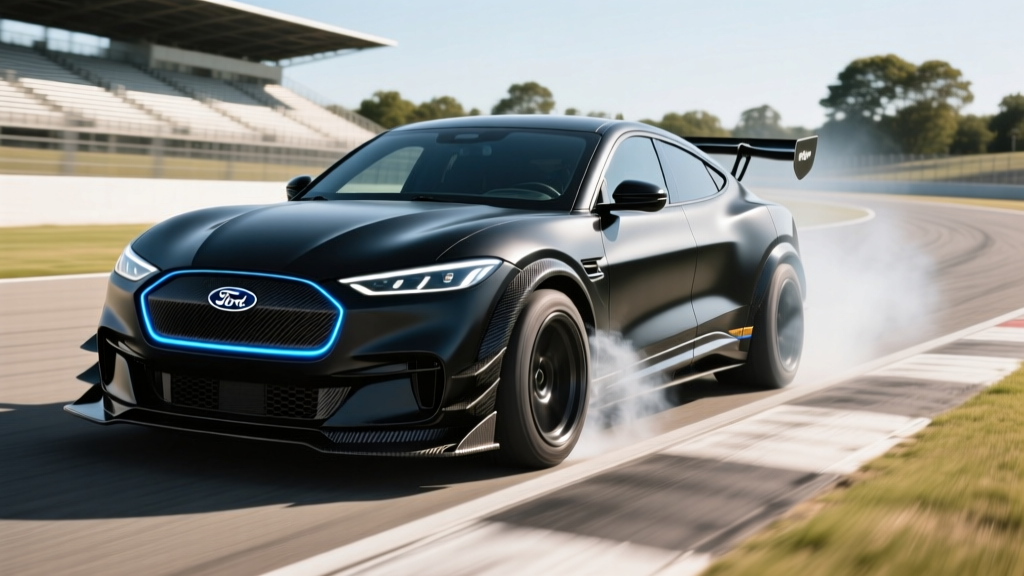
The Ford Mustang Mach-E 1400 is not a car you can walk into a dealership and buy. It is a one-off, seven-motor, 1,400-horseproof electric prototype that Ford Performance and RTR Vehicles built in 2020 to answer a single question: what happens when you take an EV crossover and give it the power output of roughly fourteen Honda Civics? The result was a tire-shredding, drift-capable, drag-strip-dominating technology demonstrator that continues to shape Ford's electric performance strategy heading into 2026.
This article breaks down every available technical detail on the Mach-E 1400 — its motors, battery chemistry, charging architecture, and real-world performance data — while also explaining what this prototype means for buyers shopping production Mach-E models today.
What the Mach-E 1400 Actually Is
The Mustang Mach-E 1400 is a joint project between Ford Performance and RTR Vehicles (the aftermarket company founded by drift champion Vaughn Gittin Jr.). Built on a pre-production Mustang Mach-E body-in-white, the prototype received a ground-up electric drivetrain overhaul:
- Seven electric motors — three on the front axle, four on the rear axle
- 1,400 peak horsepower (combined system output)
- All-wheel drive with independently controllable front and rear power delivery
- 56.8 kWh battery pack using NMC (nickel-manganese-cobalt) pouch cells
- Adjustable drivetrain modes for drift, drag, and track use
Ford's stated purpose was to push EV powertrain boundaries, test thermal management under extreme load, and generate marketing momentum around electric performance. The 1400 served as a rolling laboratory — and the lessons from its development have filtered into production vehicles like the 2024–2026 Mustang Mach-E GT and the F-150 Lightning.
| Specification | Value |
|---|---|
| Total Motors | 7 (3 front, 4 rear) |
| Peak Output | 1,400 HP |
| Drivetrain | AWD (independent front/rear control) |
| Battery Capacity | 56.8 kWh (NMC pouch cells) |
| Battery Cooling | Liquid-cooled with chiller system |
| Body/Chassis | Production Mach-E body-in-white, reinforced |
| Downforce | ~2,300 lbs at 160 mph |
| Production Status | One-off prototype (not for sale) |
Battery and Powertrain: Seven Motors and a Compact NMC Pack
The 56.8 kWh battery pack in the Mach-E 1400 is notably smaller than the Extended Range pack found in production Mach-E models (which uses a 91 kWh usable NMC pack). Ford chose a smaller, lighter pack to prioritize power-to-weight ratio and discharge rate over range. The NMC pouch cells were selected for their high energy density and ability to deliver extreme C-rates — the speed at which a battery can discharge relative to its capacity.
With 1,400 HP (approximately 1,044 kW) drawing from a 56.8 kWh pack, the instantaneous discharge rate under full load exceeds 18C. For context, most production EVs operate at sustained discharge rates between 3C and 5C during hard acceleration. This is why the 1400 required a dedicated liquid-cooling system with a chiller — thermal management was the single biggest engineering challenge.
The seven-motor layout allows torque vectoring at a granularity no production EV currently matches. Ford can independently control power to each axle group and modulate slip for drift mode. In practice, the car can send anywhere from 0% to 100% of available torque to either axle, and the four rear motors can be individually managed to control wheelspin during drifts or drag launches.
Why NMC Over LFP?
For a performance prototype, NMC chemistry was the only viable choice. LFP (lithium iron phosphate) cells offer longer cycle life and lower cost but have significantly lower energy density and lower peak discharge rates. When the goal is extracting 1,044 kW from the lightest possible pack, NMC's advantages in both energy density (Wh/kg) and power density (W/kg) are decisive.
Charging Architecture and Thermal Management
Because the Mach-E 1400 is a one-off prototype, it does not have published DC fast-charging specs comparable to production vehicles. However, the production Mustang Mach-E platform it's based on provides the reference point:
| Charging Method | Production Mach-E GT (2026) | Mach-E 1400 Prototype |
|---|---|---|
| DC Fast Charge (Peak) | 150 kW (CCS/NACS adapter) | Not published (prototype-specific) |
| 10–80% DC Time | ~45 minutes | N/A — track-focused use |
| Level 2 Home Charging | 10.5 kW (~30 mi/hr) | Standard J1772 (estimated) |
| Thermal Preconditioning | Yes (for DC fast charging) | Active liquid chiller (always on) |
The prototype's cooling system is far more aggressive than any production EV's. During testing at Ford's proving grounds and at drift events, the chiller ran continuously to keep cell temperatures within the safe operating window. At 18C+ discharge rates, cell temperatures can spike by 30–40°F in seconds without active cooling — making the thermal system arguably more critical than the motors themselves.
For production Mach-E owners, the takeaway is that Ford's experience managing extreme thermal loads in the 1400 directly informed the battery management system (BMS) calibration in the GT and Rally trims, which now handle repeated hard launches with less power derating than early 2021–2022 models.
Performance: What 1,400 HP Looks Like on a Track
Ford never published an official 0–60 mph time for the Mach-E 1400, but based on its power-to-weight ratio (roughly 1,400 HP moving approximately 4,800 lbs) and all-wheel-drive traction, the prototype is widely estimated to reach 60 mph in the low 3-second range — potentially under 3.0 seconds on a prepped drag surface.
For comparison:
- 2026 Mach-E GT: 0–60 in 3.3 seconds, 480 HP, AWD
- Tesla Model S Plaid: 0–60 in 1.99 seconds, 1,020 HP, tri-motor AWD
- Rivian R1T Quad-Motor: 0–60 in 3.0 seconds, 1,025 HP, quad-motor AWD
The 1400's advantage isn't straight-line speed alone — it's controllability. In drift demonstrations with Vaughn Gittin Jr., the car maintained sustained, controlled slides at speeds above 80 mph, something that requires precise, independent torque management across all four rear wheels. The aerodynamic package (front splitter, rear diffuser, and large rear wing) generates approximately 2,300 lbs of downforce at 160 mph, giving it grip levels that far exceed a stock Mach-E.
What the 1400 Means for Production Mach-E Buyers
If you're shopping for a Mustang Mach-E in 2026, the 1400 prototype is relevant not as a purchase option but as a signal of where Ford's performance engineering is headed. Here's what production buyers should know:
Production Mach-E Range Reality Check
The 2026 Mustang Mach-E lineup (Select, Premium, GT) carries EPA range estimates between 250 and 320 miles depending on battery size and drivetrain. In real-world highway driving at 70+ mph, expect 10–15% less than the EPA sticker. In cold weather (below 32°F), range can drop 20–30% without preconditioning. The 1400's 56.8 kWh pack was never designed for range — its effective range under track use was measured in laps, not miles.
The thermal management lessons from the 1400 program have paid dividends in production models. The 2025–2026 Mach-E GT benefits from improved battery cooling that reduces power derating during repeated acceleration runs — a direct carryover from the extreme thermal demands of the seven-motor prototype.
2026 Production Mach-E Pricing and Tax Credits
For buyers evaluating the production lineup:
| Trim | Base MSRP | Drivetrain | EPA Range | §30D Credit Eligible |
|---|---|---|---|---|
| Select (SR, RWD) | ~$39,995 | RWD, single motor | ~250 mi | Check current IRS rules* |
| Premium (ER, AWD) | ~$48,995 | AWD, dual motor | ~305 mi | Check current IRS rules* |
| GT (ER, AWD) | ~$55,995 | AWD, dual motor | ~280 mi | Check current IRS rules* |
| Rally (ER, AWD) | ~$59,995 | AWD, dual motor | ~265 mi | Check current IRS rules* |
*Federal §30D tax credit eligibility depends on MSRP caps ($55,000 for SUVs), buyer adjusted gross income limits ($150K single / $300K joint), and battery component/critical mineral sourcing requirements that change annually. Consult IRS.gov and a tax professional before purchasing. Point-of-sale transfer is available at participating dealers.
Pros and Cons of the Mach-E Platform (Production Models)
Pros
- Strong performance across trims — GT hits 0–60 in 3.3 sec
- Available NACS port for native Tesla Supercharger access (2025+ models)
- Competitive EPA range (up to ~320 mi on Premium RWD ER)
- Ford BlueCruise hands-free driving on approved highways (SAE Level 2)
- Practical cargo space: 29.7 cu ft rear, 56.9 cu ft with seats folded, plus a 4.7 cu ft frunk
- Over-the-air updates continue to improve vehicle function
Cons
- DC fast charging peaks at 150 kW — slower than Hyundai Ioniq 5 (240 kW) or Tesla Model Y (250 kW)
- 10–80% charge time of ~45 min trails class leaders at ~18–25 min
- GT and Rally trims exceed the $55K SUV MSRP cap for §30D credit
- Rear-seat headroom is tighter than some competitors due to sloping roofline
- No LFP battery option — NMC requires charge-limit discipline for longevity
Warranty Coverage
Ford covers the production Mustang Mach-E with:
- Battery: 8 years / 100,000 miles (whichever comes first), with a capacity retention threshold of 70% of original capacity
- Electric Powertrain Components: 8 years / 100,000 miles
- Bumper-to-Bumper: 3 years / 36,000 miles
- Corrosion Perforation: 5 years / unlimited miles
The 70% capacity retention threshold is industry-standard but worth noting: if your 91 kWh Extended Range pack degrades to below ~63.7 kWh usable capacity within the warranty period, Ford will repair or replace it. Real-world degradation data from fueleconomy.gov and owner surveys suggests most Mach-E packs retain 90%+ capacity after 60,000 miles under normal use.
Who Should Care About the Mach-E 1400?
The Mach-E 1400 speaks to three audiences:
- EV performance enthusiasts who want to see what electric powertrains can do when cost and production constraints are removed. Seven motors, 1,400 HP, and drift capability demonstrate that EVs aren't just efficient — they're dynamically extraordinary.
- Production Mach-E shoppers evaluating Ford's engineering credibility. The 1400 program isn't vaporware — its thermal management and torque-vectoring lessons are in the GT you can buy today.
- Industry watchers tracking how concept vehicles influence production roadmaps. Ford's commitment to multi-motor architectures and aggressive cooling will likely appear in future performance EVs beyond the Mach-E.
If you're a daily commuter prioritizing range and charging speed, the production Mach-E Premium with the Extended Range battery is the sweet spot — roughly $49K before incentives, ~305 miles EPA, and capable Level 2 home charging. If you want maximum performance, the GT delivers 480 HP and 3.3-second sprints, though at a price that likely disqualifies it from the federal credit.
Production Mach-E Decision Framework
Choose the Select RWD if: Budget is the priority, you commute under 60 miles daily, and you want the lowest entry price with §30D credit potential.
Choose the Premium ER AWD if: You need all-weather capability, want 300+ mile range, and value the balance of features and price.
Choose the GT if: Performance matters most — 480 HP, MagneRide suspension, and track-capable cooling justify the higher price and likely credit ineligibility.
Frequently Asked Questions
Can I buy the Ford Mustang Mach-E 1400?
No. The Mach-E 1400 is a one-off prototype built by Ford Performance and RTR Vehicles. It was never intended for production or sale. It serves as a technology demonstrator and marketing vehicle.
What is the real-world range of the production Mach-E?
The 2026 Mach-E Premium with Extended Range RWD carries an EPA estimate of approximately 305–320 miles. Real-world highway driving at 70+ mph typically yields 260–280 miles. In cold weather below freezing, expect 210–250 miles without preconditioning. These figures are based on the production NMC pack, not the 1400's 56.8 kWh track-focused battery.
How fast does the production Mach-E charge?
Production Mach-E models with the Extended Range battery peak at approximately 150 kW on DC fast chargers, achieving a 10–80% charge in roughly 45 minutes. Level 2 home charging at 10.5 kW adds approximately 30 miles of range per hour. The 1400 prototype does not have published consumer charging specs.
Does the production Mach-E qualify for the federal EV tax credit?
Eligibility under IRS §30D depends on the trim's MSRP (capped at $55,000 for SUVs), the buyer's adjusted gross income (capped at $150K single / $225K head of household / $300K joint), and battery component and critical mineral sourcing requirements. Lower trims may qualify; GT and Rally trims likely exceed the MSRP cap. Always verify current rules at IRS.gov before purchasing.
Is the Mach-E GT worth it vs. the Tesla Model Y Performance?
The Mach-E GT offers 480 HP, a 0–60 of 3.3 seconds, and Ford's BlueCruise SAE Level 2 driver assist. The Model Y Performance hits 0–60 in 3.5 seconds with access to the Supercharger network natively. The Mach-E GT provides a more traditional driving feel and stronger build quality impressions; the Model Y wins on charging infrastructure and software. Both are compelling — your preference for ecosystem (Ford dealer network vs. Tesla Superchargers) may be the deciding factor.
How many motors does the Mach-E 1400 have?
Seven total — three on the front axle and four on the rear axle. This is the highest motor count ever installed in a Mustang-branded vehicle and allows independent torque vectoring across both axles for drift, drag, and grip modes.