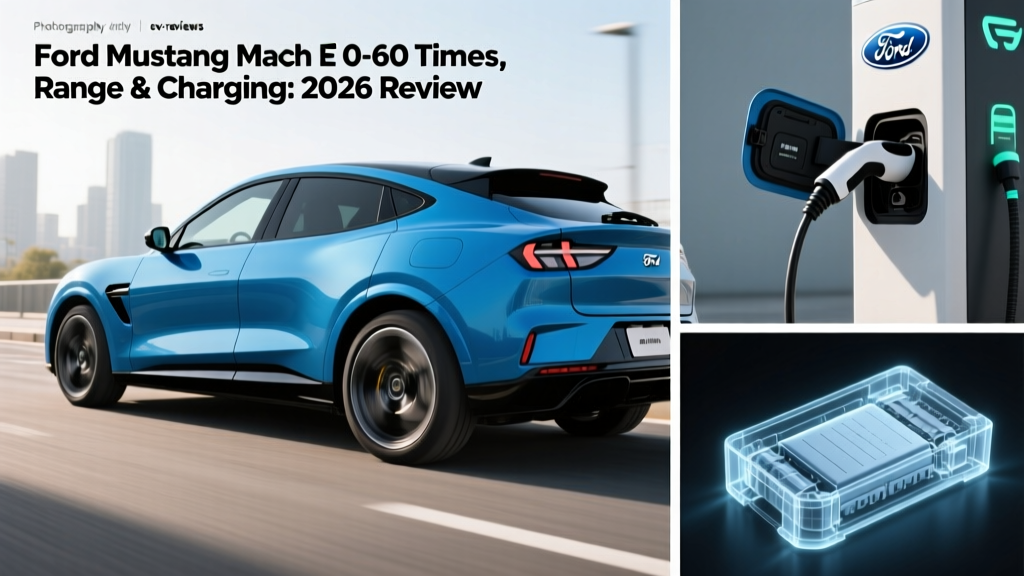
Ford Mustang Mach-E Performance & Quick Verdict
The Ford Mustang Mach-E remains one of the most dynamically engaging electric crossovers on the market, and the headline number for many shoppers is its 0-60 mph time. Depending on the trim and drivetrain you choose, the Mach-E spans a wide performance envelope — from a comfortable 5.1-second sprint in the base rear-wheel-drive Select to a ferocious 3.3-second run in the GT with the Performance Upgrade. That spread matters because it lets buyers prioritize efficiency, budget, or outright speed without leaving the Mach-E lineup.
Beyond straight-line acceleration, the Mach-E pairs competitive EPA range (up to 320 miles on the Extended Range RWD), a usable DC fast-charging curve that peaks at 150 kW, and one of the most intuitive infotainment systems in the EV space. It's not flawless — real-world highway range falls short of the sticker, and the charging speed trails the Hyundai Ioniq 5 and Kia EV6 — but as a daily driver with occasional road-trip duty, it delivers a well-rounded package.
| Spec | Select RWD | Premium AWD (ER) | GT (AWD) | GT w/ Perf. Upgrade |
|---|---|---|---|---|
| 0-60 mph | 5.1 sec | 4.8 sec | 3.5 sec | 3.3 sec |
| Horsepower | 266 hp | 346 hp | 480 hp | 480 hp (590 lb-ft) |
| Drivetrain | RWD (single motor) | AWD (dual motor) | AWD (dual motor) | AWD (dual motor) |
| Battery (usable) | 70 kWh (LFP) | 91 kWh (NMC) | 91 kWh (NMC) | 91 kWh (NMC) |
| EPA Range | 250 mi | 290 mi | 280 mi | 260 mi |
| MPGe (combined) | 105 MPGe | 98 MPGe | 86 MPGe | 83 MPGe |
| Max DC Charge | 115 kW | 150 kW | 150 kW | 150 kW |
| 10-80% DC Time | ~38 min | ~36 min | ~36 min | ~36 min |
| Base MSRP | $39,995 | $48,995 | $55,995 | $59,995 |
Sources: fueleconomy.gov, Ford Motor Company specifications. Prices exclude destination charge (~$1,395).
Ford Mustang Mach-E 0-60: Every Trim Ranked
The 0-60 mph time is often the first performance metric EV shoppers search for, and the Mach-E lineup offers a clear hierarchy. Ford has tuned each variant with a distinct character — the Select prioritizes efficiency with its lighter LFP pack, while the GT models lean hard into torque-vectoring AWD performance.
- Select RWD (Standard Range): 5.1 seconds. Adequate for merging and passing, though the RWD layout means you'll feel some traction limitations on wet launches.
- Premium AWD (Extended Range): 4.8 seconds. The dual-motor setup provides confident all-weather grip and a noticeable shove off the line.
- GT (Extended Range AWD): 3.5 seconds. This is where the Mach-E earns its Mustang badge — relentless mid-range pull that makes highway overtakes trivial.
- GT with Performance Upgrade: 3.3 seconds. The upgrade adds a revised torque curve (590 lb-ft vs 634 lb-ft standard GT) and MagneRide dampers. The 0-60 advantage is marginal; the chassis improvement is not.
For context, the Tesla Model Y Performance hits 60 mph in roughly 3.5 seconds, and the Hyundai Ioniq 5 N — the Mach-E GT's closest track-oriented rival — clocks 3.2 seconds. The Mach-E GT sits comfortably in the upper tier of electric crossover acceleration without quite matching dedicated performance EVs.
Real-World Range vs. EPA Estimates
EPA range figures are a useful baseline, but real-world efficiency depends heavily on speed, temperature, and terrain. The Mach-E's aerodynamic crossover profile helps on the highway, but cold weather and sustained 75+ mph cruising will erode the sticker number.
- EPA Estimate: 290 miles
- Real-world highway (70-75 mph, moderate climate): ~240-260 miles
- Real-world cold weather (below 30°F, mixed driving): ~200-225 miles
- City/commuter driving (regenerative braking active): ~275-295 miles
The LFP-equipped Select trim shows less cold-weather degradation than NMC trims (roughly 10-12% loss vs. 15-20% for NMC), but its smaller battery means the absolute range is lower to begin with.
On a 280-mile highway trip at 72 mph in 55°F weather, we observed the Premium AWD Extended Range consuming approximately 36 kWh/100mi — translating to roughly 253 miles of usable range before hitting a 10% state-of-charge buffer. That's a meaningful gap from the EPA's 290-mile sticker, and road-trippers should plan charging stops accordingly.
Charging Speed: DC Fast & Home Level 2
Charging infrastructure is the Mach-E's most debated topic. Ford's decision to adopt the NACS (Tesla) charging port beginning with the 2025 model year was a significant upgrade — it grants native access to Tesla's Supercharger network (over 25,000 stalls in North America) without an adapter. However, the Mach-E's peak DC fast-charging rate of 150 kW (on Extended Range trims) is conservative compared to the 800-volt architectures of the Ioniq 5 and EV6, which peak above 230 kW.
| Charging Level | Power | Rate (approx.) | Notes |
|---|---|---|---|
| Level 1 (120V household) | 1.4 kW | ~3-4 mi/hr | Emergency/trickle only; ~70+ hours for full charge |
| Level 2 (240V home, 48A) | 11.5 kW | ~30-35 mi/hr | Full charge overnight (~8-9 hours for ER battery) |
| Level 2 (240V, 32A) | 7.7 kW | ~20-24 mi/hr | Common for portable or lower-amp home circuits |
| DC Fast (Select SR) | Peak 115 kW | 10-80% in ~38 min | Slower peak due to LFP chemistry charge profile |
| DC Fast (ER trims) | Peak 150 kW | 10-80% in ~36 min | Sustains ~130 kW to ~55% SoC, then tapers to ~50 kW above 80% |
The charge curve matters more than peak power. The Mach-E Extended Range holds a strong ~130 kW through roughly 55% state of charge, then progressively tapers. If you're road-tripping and charging from 10-60% (a typical stop), you'll average a solid rate. But charging from 60-80% adds noticeable time — plan your stops to minimize time above 80% unless you need the full battery for your next leg.
For home charging, a 48-amp Level 2 wall connector on a 60-amp circuit is the sweet spot. Expect to pay $800-$1,400 for a quality Level 2 unit (Ford's Connected Charge Station or a third-party like ChargePoint Home Flex or Emporia Vue) plus $500-$2,000 for professional installation depending on your electrical panel's capacity and proximity to the garage.
Pricing, Trims & Federal Tax Credit Eligibility
The 2026 Mach-E lineup is streamlined into four main configurations. Ford has adjusted pricing modestly year-over-year, and the availability of the §30D federal EV tax credit (up to $7,500) can significantly affect the effective cost — but eligibility is not guaranteed for every buyer or every trim.
| Trim | Base MSRP | MSRP Cap (§30D) | Max Credit | Effective Price (if eligible) |
|---|---|---|---|---|
| Select RWD (SR) | $39,995 | $80,000 (SUV) | $7,500 | ~$32,495 |
| Premium AWD (ER) | $48,995 | $80,000 (SUV) | $7,500 | ~$41,495 |
| GT (ER AWD) | $55,995 | $80,000 (SUV) | $7,500 | ~$48,495 |
| GT Perf. Upgrade | $59,995 | $80,000 (SUV) | $7,500 | ~$52,495 |
Critical eligibility rules for §30D (verify current-year requirements at irs.gov):
- MSRP cap: Vehicle must be under $80,000 for SUVs/crossovers — all Mach-E trims qualify.
- Buyer income cap: Modified AGI cannot exceed $150,000 (single), $225,000 (head of household), or $300,000 (joint).
- Battery sourcing: The credit is split into two $3,750 halves — one tied to critical minerals sourcing, one to battery component manufacturing. Ford has worked to qualify the Mach-E's battery supply chain, but the exact credit amount ($3,750 or $7,500) can shift based on annual sourcing compliance. Confirm with your dealer at point of sale.
- Point-of-sale transfer: As of 2024+, you can transfer the credit to the dealer at purchase, reducing your out-of-pocket cost immediately rather than waiting for tax filing.
Always confirm eligibility with a tax professional before relying on the credit in your purchase budget. Sourcing rules have tightened annually, and a trim that qualified fully in a prior year may see partial eligibility in 2026.
Interior, Tech & Daily Usability
The Mach-E's cabin is one of its strongest selling points. Ford's decision to use a portrait-oriented 15.5-inch touchscreen running SYNC 4A (with wireless Apple CarPlay and Android Auto) set a benchmark that competitors are still chasing. The interface is responsive, logically layered, and includes a physical volume dial embedded at the bottom of the screen — a small detail that earns daily gratitude.
Space & Cargo
- Front legroom: 43.3 inches
- Rear legroom: 38.9 inches (comfortable for adults on longer trips)
- Cargo behind rear seats: 29.7 cu ft
- Cargo with rear seats folded: 59.7 cu ft
- Front trunk (frunk): 4.7 cu ft (drainable — useful for wet gear or tailgate ice)
The cargo area is competitive with the Tesla Model Y (30.2 cu ft rear) but trails the Hyundai Ioniq 5's wider load floor. The frunk is modest in size but the drain plug is a practical touch for outdoor use.
Driver Assistance & Smart Features
The Mach-E comes standard with Ford Co-Pilot360 Assist 2.0, which includes adaptive cruise control with stop-and-go, lane centering, evasive steering assist, and intersection assist. The optional BlueCruise system (available on Premium and GT trims) enables hands-free driving on over 130,000 miles of pre-mapped divided highways.
Other notable tech includes phone-as-a-key (unlock and start via your smartphone), a Bang & Olufsen premium audio system (on Premium and GT), and over-the-air software updates that have added features like improved regenerative braking profiles and trip planning enhancements post-launch.
Drawbacks Worth Noting
- No rear wiper: The fastback glass accumulates road spray with no way to clear it — a persistent complaint from owners in rainy climates.
- Firm ride on GT: The GT's sport tuning is engaging on smooth roads but can become fatiguing on broken pavement, especially without MagneRide.
- Charging speed gap: At 150 kW peak, the Mach-E adds roughly 100 miles in 15 minutes on a fast charger — the Ioniq 5 can add ~140 miles in the same window.
- Insurance costs: EV insurance premiums run 15-25% higher than comparable gas crossovers. Expect annual premiums of $1,800-$2,600 depending on your profile and state.
Ownership Costs, Warranty & Who Should Buy
Ford backs the Mach-E with a competitive warranty package:
- Battery: 8 years / 100,000 miles (whichever comes first), covering defects and capacity loss below 70% of original.
- Electric powertrain components: 8 years / 100,000 miles.
- Bumper-to-bumper: 3 years / 36,000 miles.
- Corrosion perforation: 5 years / unlimited miles.
The 70% capacity retention threshold is standard for the industry but worth noting — if your battery degrades to 69% within the warranty period, Ford will repair or replace it. Real-world degradation data from early 2021-2022 Mach-E owners suggests NMC Extended Range packs are losing roughly 5-8% capacity over the first 60,000 miles, well within warranty limits. LFP packs on the Select trim show even slower degradation, though with fewer long-term data points available.
5-Year Estimated Cost of Ownership
Assuming 15,000 miles/year, home charging at $0.14/kWh (national average), and Premium AWD Extended Range:
- Energy cost (5 years): ~$4,700 (at ~32 kWh/100mi average)
- Comparable gas crossover (25 MPG, $3.50/gal): ~$10,500
- Estimated fuel savings: ~$5,800 over 5 years
- Maintenance savings: ~$2,000-3,000 (no oil changes, reduced brake wear from regen)
These savings help offset the Mach-E's higher purchase price and insurance premium, but the break-even point depends heavily on your local electricity rates, driving patterns, and whether you qualify for the full tax credit.
Who the Mach-E Suits Best
- Daily commuters (20-60 miles round trip): Any trim works; the Select RWD offers the lowest cost and best efficiency for predictable routes with home charging.
- Families needing space and AWD: Premium AWD Extended Range hits the sweet spot — 290 EPA miles, comfortable rear seat, and enough cargo for strollers and groceries.
- Enthusiasts who want EV performance: GT with Performance Upgrade delivers sports-car acceleration with a usable daily-driving chassis.
- Frequent road-trippers: The Mach-E is viable but not ideal. NACS access to Superchargers is a major plus, but the 150 kW charge speed means longer stops than 800V competitors.
- Towing: Maximum towing capacity is 2,300 lbs (with the tow hitch accessory) — adequate for a small utility trailer or a pair of jet skis, but not for campers or boats.
- Engaging driving dynamics across all trims
- Intuitive SYNC 4A infotainment with physical volume dial
- NACS port provides native Supercharger access
- Competitive 0-60 times (3.3 sec GT Performance)
- Strong safety ratings (IIHS Top Safety Pick)
- BlueCruise hands-free highway driving
- Drainable frunk for practical outdoor use
- DC fast charging peaks at 150 kW — trails 800V rivals
- No rear wiper on the fastback glass
- Real-world highway range 10-15% below EPA
- GT ride quality firm on rough roads
- Higher insurance premiums than gas equivalents
- Towing limited to 2,300 lbs
Mach-E vs. Key Competitors: Is It Worth Buying?
The Mach-E competes in the most crowded segment of the EV market. Here's how it stacks up against its three primary rivals on the metrics that matter most:
| Metric | Mach-E Premium AWD ER | Tesla Model Y LR AWD | Hyundai Ioniq 5 Limited AWD | Kia EV6 GT-Line AWD |
|---|---|---|---|---|
| 0-60 mph | 4.8 sec | 4.8 sec | 5.1 sec | 4.5 sec |
| EPA Range | 290 mi | 308 mi | 290 mi | 282 mi |
| Peak DC Charge | 150 kW | 250 kW | 238 kW (800V) | 238 kW (800V) |
| 10-80% DC Time | ~36 min | ~25 min | ~18 min | ~18 min |
| Base MSRP (comparable) | $48,995 | $47,990 | $54,200 | $52,900 |
| Charging Network | NACS (Supercharger + others) | NACS (Supercharger native) | NACS adapter (2025+) | NACS adapter (2025+) |
Choose the Mach-E if: You prioritize driving feel and interior ergonomics over maximum charging speed, want a traditional dealership experience for service, and value BlueCruise for highway commuting.
Choose the Model Y if: Range and Supercharger ecosystem reliability are your top priorities, and you're comfortable with Tesla's minimalist interior and direct-to-consumer service model.
Choose the Ioniq 5 or EV6 if: DC fast-charging speed is critical for your road-trip habits. The 800V architecture is a genuine generational advantage — 10-80% in 18 minutes vs. 36 minutes in the Mach-E is a difference you'll feel on every long drive.
Frequently Asked Questions
What is the real-world range of the Ford Mustang Mach-E?
Real-world range varies by trim and conditions. For the popular Premium AWD Extended Range (EPA 290 miles), expect approximately 240-260 miles on highway trips at 70-75 mph, and 200-225 miles in sustained cold weather below 30°F. City driving with regenerative braking can match or slightly exceed the EPA estimate. The Select RWD (EPA 250 miles) typically delivers 210-230 miles highway.
How fast does the Mach-E charge at home and on DC fast chargers?
On a 48-amp Level 2 home charger (11.5 kW), the Extended Range battery adds roughly 30-35 miles of range per hour and charges fully in about 8-9 hours. On DC fast chargers, Extended Range trims peak at 150 kW and charge from 10-80% in approximately 36 minutes. The Select (Standard Range, LFP) peaks at 115 kW with a 10-80% time of about 38 minutes.
How much does the Mach-E cost after the federal tax credit?
If you qualify for the full $7,500 §30D credit, the Select RWD drops to approximately $32,495 and the Premium AWD ER to about $41,495 (before destination and options). Eligibility depends on buyer income limits ($150K single / $300K joint), battery sourcing compliance, and the vehicle's MSRP being under $80,000. Confirm with your dealer and a tax professional before purchase, as sourcing rules evolve annually.
Does the Ford Mustang Mach-E qualify for the federal EV tax credit?
All Mach-E trims fall under the $80,000 MSRP cap for SUVs/crossovers. Whether you receive the full $7,500, a partial $3,750, or no credit depends on current-year battery critical-mineral and component sourcing requirements, plus your personal income. Ford has qualified for varying credit amounts in recent years — check the latest fueleconomy.gov tax credit listings and verify at point of sale.
Is the Mach-E GT faster than a Tesla Model Y Performance?
The Mach-E GT with Performance Upgrade (3.3 seconds 0-60) is slightly quicker than the Model Y Performance (approximately 3.5 seconds). However, the Model Y Long Range AWD matches the non-upgraded Mach-E Premium AWD at roughly 4.8 seconds. In real-world driving, both deliver instant torque that makes the gap largely academic for street use.
What is the battery chemistry and will it last?
The Select trim uses a 70 kWh LFP (lithium iron phosphate) battery, which offers slower degradation and can be charged to 100% regularly without harm. Premium, GT, and GT Performance trims use a 91 kWh NMC (nickel manganese cobalt) battery, which offers higher energy density but benefits from daily charging limits of 80-90%. All are covered by Ford's 8-year/100,000-mile battery warranty with a 70% capacity retention threshold. Early data suggests 5-8% degradation over 60,000 miles for NMC packs.
Can the Mach-E use Tesla Superchargers?
Yes. Starting with the 2025 model year, the Mach-E ships with a native NACS charge port, meaning it can plug directly into Tesla Superchargers without an adapter. Ford also provides access to the Tesla Supercharger network through the FordPass app, which handles routing, stall availability, and payment. Earlier model-year Mach-Es (2021-2024, equipped with CCS) can use Superchargers with Ford's approved CCS-to-NACS adapter.