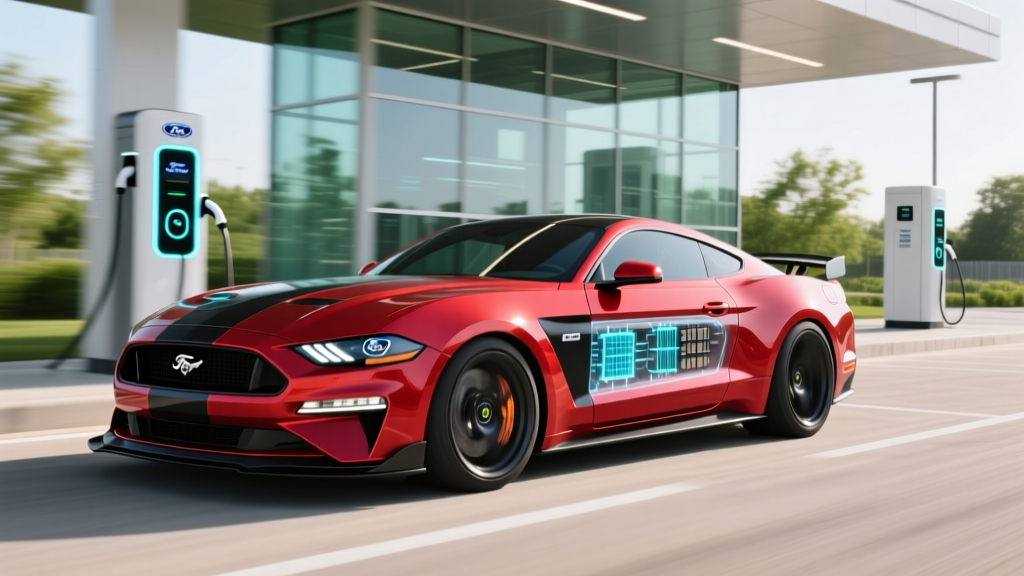
When the Ford Mustang Cobra Jet sets new electric car speed record headlines, it's easy to assume Ford is on the verge of selling a 10-second quarter-mile EV to the public. The reality is more nuanced — and more useful for actual car buyers. The Cobra Jet 1400 and its successors are purpose-built drag racing prototypes, not street-legal production models. They demonstrate what electric powertrains can do at the extreme edge of performance, but the technology trickling down to consumer EVs like the Mustang Mach-E GT is what matters for your garage and your wallet.
The Quick Answer
The Ford Mustang Cobra Jet electric drag car prototype (Cobra Jet 1400) ran a quarter-mile in the low 8-second range at over 170 mph, making it one of the fastest factory-backed electric drag cars ever built. It is not a production vehicle and cannot be purchased. However, its dual-motor, high-discharge battery architecture validates the performance potential now available in consumer EVs like the 2026 Mustang Mach-E GT (0-60 in ~3.5 seconds, 480 hp, EPA 290 miles, starting at ~$59,995).
What the Cobra Jet Electric Record Actually Is
Ford Performance developed the Cobra Jet 1400 as a one-off electric drag racing prototype, first unveiled in 2020 and refined in subsequent runs. The name references Ford's legendary Cobra Jet drag package from the muscle-car era, but the electric version replaces the V8 with a high-voltage battery pack and electric motors producing a claimed 1,400 horsepower at the wheels.
Key prototype specifications from Ford Performance disclosures:
- Powertrain: Dual electric motors with custom inverter and high-discharge battery pack
- Claimed output: ~1,400 hp (prototype, not SAE-certified for production)
- Quarter-mile: Low 8-second range at 170+ mph
- Drivetrain: Rear-wheel drive with solid rear axle (drag-optimized)
- Street-legal: No — tube-chassis race car, no production planned
This is fundamentally a technology demonstrator. Ford uses the Cobra Jet platform to stress-test electric motor thermal management, high-C-rate battery discharge, and power electronics cooling — all of which inform production vehicles like the Mustang Mach-E and the F-150 Lightning.
How the Cobra Jet's Tech Reaches Consumer EVs
The real story isn't the record itself — it's the engineering that transfers from the drag strip to the showroom. Here's what trickles down:
Thermal Management Under Extreme Load
Running an 8-second quarter-mile requires dumping an entire battery's energy in roughly 8 seconds. That demands liquid-cooled battery packs, motor stators, and inverters that can handle extreme thermal loads without derating. The same thermal architecture, scaled for sustained highway driving, is what allows the 2026 Mach-E GT to maintain performance across repeated hard accelerations without the power fade that plagued early EVs.
High-C-Rate Battery Discharge
The Cobra Jet's battery must discharge at rates exceeding 20C (twenty times its capacity per second). Consumer EVs don't need that, but the cell chemistry and pack engineering developed for those extremes improve the charge acceptance rates in production packs — meaning faster DC fast charging. The Mach-E GT's extended-range battery (91 kWh usable, NMC chemistry) can accept a peak 150 kW on a DC fast charger, reaching 10-80% in approximately 36 minutes when preconditioned.
Motor and Inverter Efficiency
Ford's permanent-magnet synchronous motors, refined through motorsport use, now deliver higher power density in smaller, lighter packages. The Mach-E GT's dual-motor setup (480 hp, 600 lb-ft torque) fits in a footprint comparable to a compact crossover's engine bay.
The Consumer EV You Can Actually Buy: 2026 Mustang Mach-E GT
If the Cobra Jet sparked your interest in Ford electric performance, the 2026 Mustang Mach-E GT is the street-legal beneficiary of that R&D. Here's the full spec breakdown:
| Specification | 2026 Mustang Mach-E GT |
|---|---|
| EPA Range | 290 miles (real-world highway: ~245-260 mi; cold weather: ~200-220 mi) |
| Battery | 91 kWh usable, NMC (nickel-manganese-cobalt) |
| Power | 480 hp / 600 lb-ft torque |
| 0-60 mph | ~3.5 seconds |
| DC Fast Charge (peak) | 150 kW (10-80% in ~36 min, preconditioned) |
| Level 2 Charge Rate | 10.5 kW (~30 mi/hr added) |
| Drivetrain | Dual-motor AWD |
| Efficiency | 84 MPGe combined (per fueleconomy.gov) |
| Base MSRP | ~$59,995 (GT trim, before incentives) |
| Battery Warranty | 8 years / 100,000 miles (capacity retention ≥70%) |
Real-World Range Reality Check
The EPA rates the Mach-E GT at 290 miles. In real-world highway driving at 70-75 mph, expect 245-260 miles. In sub-freezing temperatures (below 32°F), that drops to roughly 200-220 miles due to battery chemistry limitations and cabin heating draw. If your daily commute exceeds 80 miles round-trip or you regularly drive in cold climates, plan charging accordingly.
Cost Breakdown: Mach-E GT vs. Gas Mustang GT vs. Hybrid Alternatives
Performance comparisons to the Cobra Jet are aspirational. The practical comparison is the Mach-E GT against its gas and hybrid alternatives. Here's a 5-year total cost of ownership estimate based on 15,000 miles/year, national average electricity ($0.16/kWh), and regular unleaded ($3.40/gallon):
| Cost Factor (5 years / 75,000 mi) | Mach-E GT (EV) | Mustang GT (Gas V8) | Toyota GR Supra (Gas) |
|---|---|---|---|
| Purchase Price (MSRP) | $59,995 | $44,090 | $56,250 |
| Federal Tax Credit (§30D) | Up to $7,500 (see eligibility below) | $0 | $0 |
| Effective Purchase | ~$52,495 | $44,090 | $56,250 |
| Fuel / Charging Cost | ~$3,900 | ~$11,475 | ~$10,200 |
| Maintenance (5 yr) | ~$1,800 | ~$4,500 | ~$4,200 |
| Insurance (avg) | ~$12,500 | ~$10,800 | ~$11,000 |
| Est. 5-Year Total | ~$70,695 | ~$70,865 | ~$81,650 |
Key takeaways: The Mach-E GT's higher sticker price is largely offset by the §30D tax credit (if eligible) and dramatically lower fueling and maintenance costs over five years. EV insurance premiums remain higher than gas equivalents — typically 15-25% more — due to repair cost structures and battery replacement exposure. The Mach-E GT breaks roughly even with a gas Mustang GT over five years, while delivering 0-60 performance that rivals cars costing twice as much.
§30D Federal Tax Credit Eligibility (2026 Rules)
The Mach-E GT may qualify for up to $7,500 under IRS §30D, but eligibility is not automatic. Requirements include:
- MSRP cap: SUVs/vans/pickups ≤$80,000; sedans ≤$55,000 (Mach-E qualifies as SUV)
- Buyer income cap: AGI ≤$300,000 (joint), $225,000 (head of household), $150,000 (single)
- Battery sourcing: Critical minerals and battery components must meet escalating domestic/free-trade-agreement thresholds (increasing annually through 2030)
- Point-of-sale transfer: You can apply the credit at purchase to reduce the transaction price, rather than waiting for tax filing
Always verify current-year eligibility on the IRS website or with a tax professional before committing to a purchase.
Common Misconceptions About EV Performance Records
| Myth | Fact |
|---|---|
| "The Cobra Jet is a production car I can buy" | It's a one-off tube-chassis drag prototype. Ford has no plans to sell it. |
| "EVs can't sustain high speeds" | Production EVs like the Mach-E GT hold 100+ mph effortlessly. The limitation is range consumption — at 100 mph, efficiency drops ~30-40% vs. 65 mph. |
| "Electric motors overheat on repeated hard pulls" | Modern liquid-cooled motors and inverters manage thermal loads well. The Mach-E GT can do multiple 0-60 runs before derating, unlike early EVs. |
| "Performance EVs have terrible range" | The Mach-E GT delivers 290 EPA miles — comparable to many non-performance EVs from just a few years ago. Performance and range are no longer mutually exclusive. |
| "EVs are slower than gas cars at high speed" | EVs dominate 0-60 due to instant torque. Gas cars may have higher top-end speed due to gearing, but few public roads reward that advantage. |
What First-Time EV Buyers Should Know Before Chasing Performance
Records and prototypes are exciting, but daily ownership depends on practical factors. Before buying any performance EV, evaluate these:
Home Charging Access Is Non-Negotiable for Most Owners
Over 80% of EV charging happens at home. If you can install a Level 2 charger (240V, ~$500-$2,500 including electrician and panel work), the Mach-E GT adds roughly 30 miles of range per hour of charging — a full overnight replenishment. Without home charging, you'll rely on public DC fast charging, which costs $0.30-$0.50/kWh (roughly double home rates) and requires 30-40 minute stops.
Cold Weather Cuts Range 20-30%
NMC batteries (like the Mach-E GT's) lose efficiency below freezing. If you live in the upper Midwest or Northeast, plan for 200-220 real-world miles in winter rather than the 290 EPA sticker. The Mach-E includes a heat pump and battery preconditioning to mitigate this, but physics sets a floor.
Insurance Costs More — Budget for It
EV insurance averages 15-25% higher than equivalent gas vehicles. The Mach-E GT's $59,995 MSRP and performance classification push premiums higher. Get quotes before purchasing.
DC Fast Charging Isn't as Fast as the Peak Number Suggests
The Mach-E GT's "150 kW peak" only applies between roughly 10-40% state of charge. Above 60%, the charge curve tapers significantly — from 150 kW down to 50 kW or less by 80%. That's why the 10-80% time is ~36 minutes, not the ~15 minutes a sustained 150 kW would suggest. This is true for all EVs and is a function of battery chemistry protection.
Should You Buy a Performance EV Like the Mach-E GT?
Buy the Mach-E GT if:
- You have home Level 2 charging access (or can install it)
- Your daily driving is under 150 miles round-trip
- You want sports-car acceleration (3.5-sec 0-60) with crossover practicality
- You qualify for the §30D tax credit (check income and sourcing rules)
- You accept higher insurance premiums as a trade-off for performance
Consider a gas or hybrid alternative if:
- You lack reliable home charging and your area has sparse public DC infrastructure
- You regularly tow heavy loads or drive 300+ miles in single trips
- You live in extreme cold climates and can't accommodate 25-30% range loss
- Your budget is under $45,000 and you can't absorb the Mach-E GT's premium
Frequently Asked Questions
Can I buy the Ford Mustang Cobra Jet electric drag car?
No. The Cobra Jet 1400 electric is a one-off prototype built by Ford Performance for drag racing demonstrations. It is not street-legal and not available for purchase. The closest consumer equivalent is the 2026 Mustang Mach-E GT.
How fast is the Mach-E GT compared to a gas Mustang GT?
The Mach-E GT hits 0-60 in ~3.5 seconds, which is faster than the 2026 gas Mustang GT (~4.2 seconds with the 5.0L V8). However, the gas Mustang GT has a higher top speed and is lighter, making it more agile on a track. For street driving and daily use, the Mach-E GT's instant torque advantage is more noticeable.
Does the Mach-E GT qualify for the $7,500 federal tax credit?
It may, depending on your income (AGI caps apply), the vehicle's MSRP (under the $80,000 SUV cap), and current battery-sourcing compliance. Check the IRS §30D page and confirm with your dealer and tax professional before purchase. Rules tighten annually.
What does it cost to charge the Mach-E GT at home vs. gas?
At the national average of $0.16/kWh, fully charging the 91 kWh battery costs roughly $14.56 and delivers ~250-270 real-world miles — about $0.05-$0.06 per mile. A gas Mustang GT getting 19 MPG combined at $3.40/gallon costs ~$0.18 per mile. Over 15,000 miles/year, that's roughly $750 in electricity vs. $2,685 in gasoline — a ~$1,935 annual savings.
Will the Mach-E GT's battery degrade quickly with performance driving?
Occasional hard acceleration has minimal impact on long-term battery health. Sustained high-speed driving and frequent DC fast charging have a larger (but still manageable) effect. Ford warranties the battery for 8 years/100,000 miles with at least 70% capacity retention. Most NMC packs retain 85-90% capacity after 100,000 miles under normal use.