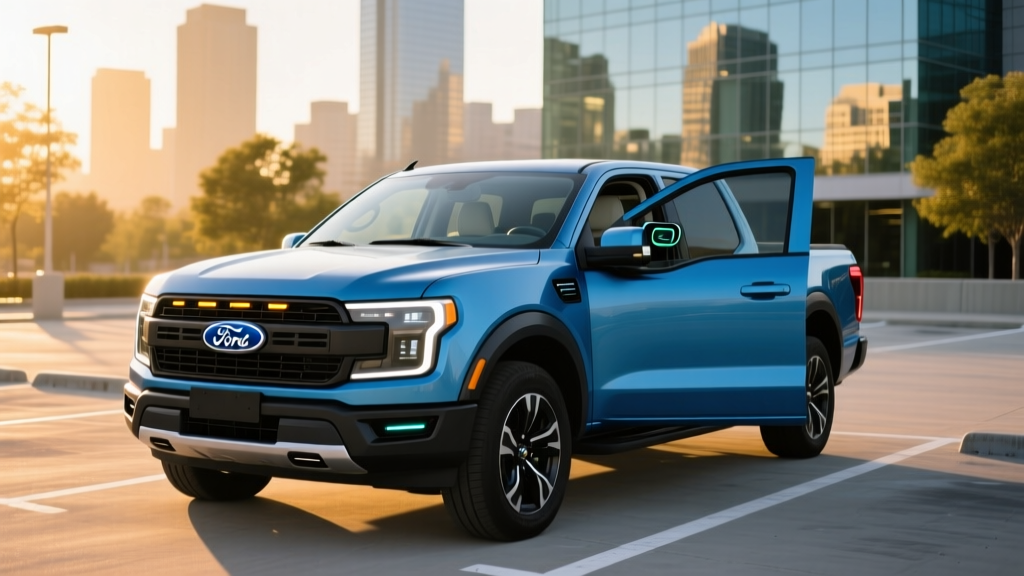
If you're researching a Ford midsize EV truck, you're likely weighing whether an electric pickup can replace your gas-powered Ranger or compete with midsize rivals like the Toyota Tacoma or Chevy Colorado. Here's the direct answer: Ford's midsize electric truck, the next-generation Ranger EV (expected late 2026 as a 2027 model year), is projected to offer approximately 250-300 miles of EPA range, 150+ kW DC fast charging, and a starting MSRP near $40,000-$45,000. However, as of early 2026, Ford has not officially released final specifications, pricing, or an on-sale date. What is available now is the full-size F-150 Lightning, which starts around $55,000 and offers up to 320 miles of EPA range. This guide breaks down what we know about Ford's upcoming midsize electric truck, compares EV truck ownership costs to gas alternatives, and provides a framework to decide if you should wait or buy now.
What Is Ford's Midsize EV Truck Strategy?
Ford has confirmed it is developing a next-generation, body-on-frame midsize pickup truck built on a new flexible architecture that will support both internal combustion and electrified powertrains. While Ford has not officially branded this as the "Ranger EV," industry analysts and supply chain reports indicate the next-generation Ranger platform will accommodate a battery-electric variant alongside hybrid and conventional gas options.
The current Ford Ranger (redesigned for 2024) remains gas-only with a 2.3L EcoBoost or 2.7L EcoBoost V6. Ford's electric truck lineup currently consists solely of the full-size F-150 Lightning. The midsize EV truck would slot below the Lightning in both size and price, targeting buyers who want electric pickup capability without the Lightning's $55,000+ starting price or full-size footprint.
Projected Specs: What We Expect from a Ford Midsize EV Truck
While final specifications remain unconfirmed, we can project likely figures based on Ford's existing EV architecture, competitor benchmarks (Rivian R1T, upcoming Chevy Silverado EV midsize variants), and the physical constraints of a midsize truck platform.
| Spec | Projected Figure | Context |
|---|---|---|
| EPA Range | 250-300 miles | Real-world highway: ~210-260 mi |
| Battery Capacity | 85-100 kWh (usable) | Likely NMC chemistry |
| DC Fast Charge (Peak) | 150-180 kW | 10-80% in ~25-30 min |
| Level 2 Charge Rate | 11.5 kW (48A) | ~25 mi/hr added |
| Horsepower | 350-450 HP | Dual-motor AWD likely |
| 0-60 mph | 5.0-6.0 seconds | Faster than gas Ranger |
| Towing Capacity | 5,000-7,500 lbs | Towing cuts range 30-50% |
| Payload | 1,400-1,800 lbs | Battery weight reduces payload |
| Starting MSRP | $40,000-$45,000 | Before incentives |
Real-world range reality check: EPA range estimates assume ideal conditions. In real-world highway driving at 70-75 mph, expect to achieve 80-85% of the EPA sticker. In cold weather (below 32°F), lithium-ion batteries lose 20-30% of usable capacity due to increased internal resistance and cabin heating demands. A midsize EV truck rated at 280 miles EPA might deliver 220-240 miles on a warm highway day and 180-210 miles in freezing conditions.
EV Truck vs Gas Truck: Cost Comparison
The decision between a Ford midsize EV truck and a gas-powered Ranger (or competitor like the Toyota Tacoma) hinges on total cost of ownership, not just sticker price. Let's compare a projected midsize EV truck against the current 2026 Ford Ranger XLT 4x4 (2.3L EcoBoost, EPA 21 city / 26 hwy / 23 combined MPG) over 5 years and 75,000 miles.
| Category | Ford Midsize EV (Projected) | 2026 Ranger XLT 4x4 Gas |
|---|---|---|
| Base MSRP | $42,500 | $38,500 |
| Federal Tax Credit (§30D) | Up to $7,500* | $0 |
| Effective Purchase Price | $35,000 | $38,500 |
| Fuel/Energy (75k mi) | $3,750 (home charging)** | $9,375 ($3.50/gal, 23 MPG) |
| Maintenance (5 yr) | $1,200 | $3,500 |
| Insurance (5 yr avg) | $9,500 | $7,500 |
| Total 5-Year Cost | $49,450 | $58,875 |
*Federal §30D tax credit eligibility depends on MSRP caps ($80,000 for trucks), buyer income limits ($150k single / $300k joint), and battery component/critical mineral sourcing requirements. Verify current-year rules at IRS.gov. Credit can be transferred to dealer at point of sale as of 2024+.
**Assumes 80% home Level 2 charging at $0.15/kWh, 20% public DC fast charging at $0.40/kWh, and 3.0 kWh/mile efficiency. Public-only charging raises EV energy cost to ~$6,000-$7,500 over 75k miles.
The Home Charging Advantage (and Limitation)
The cost savings above assume reliable home charging access. If you can install a Level 2 (240V) home charger, you'll pay $0.10-$0.20 per kWh depending on your utility, translating to $0.04-$0.07 per mile driven. Gas at $3.50/gallon and 23 MPG costs $0.15 per mile. That's a 55-70% per-mile energy savings.
However, if you lack home charging (apartment living, street parking, no garage access), you'll rely on public DC fast charging at $0.35-$0.50 per kWh. At 3.0 kWh/mile, that's $0.11-$0.15 per mile—narrowing or eliminating the fuel cost advantage. Home charging access is the single biggest determinant of EV truck economics.
Level 2 home charger installation costs $800-$2,500 total (charger unit $400-$700, electrician labor $400-$1,500, potential panel upgrade $1,000-$2,500 if your home has a 100A service that needs upgrading to 200A).
Federal Tax Credit Eligibility: What You Need to Know
The federal §30D Clean Vehicle Credit offers up to $7,500 for qualifying new EVs, but eligibility is complex and changes based on battery sourcing rules that tighten annually. For a Ford midsize EV truck to qualify:
- MSRP Cap: Truck must have MSRP ≤$80,000 (likely met by midsize truck)
- Buyer Income Cap: Adjusted gross income ≤$150,000 (single) or ≤$300,000 (married filing jointly)
- Battery Components: Increasing percentages of battery components must be manufactured/assembled in North America (requirements escalate yearly through 2029)
- Critical Minerals: Increasing percentages of critical minerals must be sourced from the US or FTA partners
- Final Assembly: Vehicle must undergo final assembly in North America (Ford's US plants likely qualify)
As of 2026, the battery sourcing requirements are stringent enough that some EVs that previously qualified have lost partial or full credit eligibility. Ford's F-150 Lightning currently qualifies for the full $7,500 credit, but a midsize truck's eligibility will depend on its specific battery supply chain. Always verify current eligibility at fueleconomy.gov before purchasing.
Real-World Ownership Considerations
Charging Time and Daily Use
For most truck owners, daily driving is 30-50 miles round-trip. A midsize EV truck with 250+ mile range covers a week of commuting before needing a charge. Overnight Level 2 charging (11.5 kW) adds roughly 25 miles of range per hour, so a depleted 280-mile battery fully recharges in 10-12 hours—perfect for overnight replenishment.
For road trips, DC fast charging at 150-180 kW (peak) delivers a 10-80% charge in 25-30 minutes. However, charging speed tapers significantly above 80% state of charge to protect battery health. A 10-100% charge might take 45-50 minutes total. Plan road trip stops around 20-30 minute charging breaks every 180-220 miles (accounting for highway efficiency loss).
Towing and Payload Reality
Electric trucks can tow, but towing dramatically reduces range. Expect a 30-50% range reduction when towing near maximum capacity. A midsize EV truck rated for 280 miles might deliver only 140-190 miles when towing a 5,000-pound trailer. This makes EV trucks challenging for frequent long-distance towing unless your route has reliable DC fast charging infrastructure.
Payload is also impacted by battery weight. A midsize EV truck's battery pack (85-100 kWh) weighs 1,000-1,300 pounds, reducing available payload capacity compared to a gas equivalent. If you regularly haul 1,500+ pounds in the bed, verify the specific payload rating.
Cold Weather Performance
Lithium-ion batteries lose efficiency in cold temperatures. Below 32°F, expect 20-30% range reduction due to increased battery internal resistance and energy consumed by cabin/battery heating. In extreme cold (below 0°F), range loss can reach 40%. Ford's EVs use liquid thermal management systems to mitigate this, but physics cannot be fully overcome. If you live in northern climates with harsh winters, budget for reduced winter range or consider a larger battery option if available.
Should You Wait for the Midsize EV or Buy Now?
The decision framework below helps you determine whether to wait for Ford's midsize EV truck or purchase an available alternative now.
Decision Framework: Wait or Buy Now?
Wait for the Ford Midsize EV Truck (2027 model) if:
- You want a midsize electric truck specifically (not full-size F-150 Lightning)
- Your budget is $40,000-$50,000 and you need the lower price point vs Lightning
- You have reliable home charging access
- Your daily driving is under 100 miles and you rarely tow long distances
- You can wait 12-18 months for availability
Buy the F-150 Lightning now if:
- You need an electric truck immediately
- You need full-size truck capability (towing 8,000+ lbs, larger bed)
- Your budget allows $55,000+ starting price
- You want proven, available technology with established charging network compatibility
Buy a gas Ranger or Tacoma now if:
- You lack home charging access and rely on street parking
- You frequently tow heavy loads long distances (400+ miles)
- You live in an area with limited DC fast charging infrastructure
- You need maximum range certainty in extreme cold climates
- Your budget is under $35,000
Consider a hybrid truck (Ford Maverick Hybrid, Tacoma Hybrid) if:
- You want fuel efficiency (35-40 MPG) without range anxiety
- You lack home charging but want lower fuel costs
- You want a lower purchase price ($25,000-$35,000)
- You're not ready for full EV ownership but want to reduce emissions
Common Misconceptions About EV Trucks
| Myth | Fact |
|---|---|
| "EV trucks can't tow" | EV trucks can tow (F-150 Lightning tows 10,000 lbs), but towing reduces range 30-50%. Suitable for short-distance towing, challenging for long hauls. |
| "Batteries need replacement every 5 years" | Modern EV batteries are warrantied for 8 years/100,000 miles with 70%+ capacity retention. Most last 150,000-200,000+ miles before significant degradation. |
| "Charging takes too long" | Home Level 2 charging is overnight (inconsequential time). DC fast charging adds 150-200 miles in 20-30 minutes. Longer than gas fill-ups, but compatible with rest stops. |
| "EVs don't work in cold weather" | EVs work in cold but lose 20-30% range. With 250+ mile range, you still have 175-200 usable miles. Preconditioning while plugged in mitigates loss. |
| "Everyone gets the $7,500 tax credit" | Credit has income caps, MSRP caps, and battery sourcing requirements. Many buyers qualify, but not all. Verify at IRS.gov before purchasing. |
Frequently Asked Questions
When will Ford's midsize EV truck be available?
Ford has not announced an official release date. Based on industry reports and Ford's product cadence, expect a 2027 model year vehicle arriving in late 2026 or early 2027. Ford typically announces new models 6-12 months before production begins.
Will the midsize EV truck use NACS or CCS charging?
Ford has committed to adopting the North American Charging Standard (NACS, Tesla's connector) for future EVs starting in 2025. The midsize EV truck will almost certainly use NACS, providing native access to Tesla Superchargers (15,000+ locations) without adapters.
How much will home charging installation cost?
Level 2 (240V, 48A) home charger installation costs $800-$2,500 total. This includes the charger unit ($400-$700), electrician labor ($400-$1,500), and potentially an electrical panel upgrade ($1,000-$2,500) if your home has older 100A service. Most modern homes with 200A service don't need panel upgrades.
Can I use an EV truck for worksite power (V2L)?
Vehicle-to-Load (V2L) capability allows an EV to power tools and equipment via standard 120V/240V outlets. The F-150 Lightning offers Pro Power Onboard with up to 9.6 kW output. Ford will likely include V2L in the midsize EV truck, but output capacity (3-7 kW projected) remains unconfirmed.
What's the battery warranty?
Federal regulations require EV battery warranties of at least 8 years/100,000 miles. Ford's current EV battery warranty covers 8 years/100,000 miles with a 70% capacity retention threshold. If the battery degrades below 70% of original capacity within the warranty period, Ford will repair or replace it.
Is an EV truck practical without home charging?
It's possible but significantly more expensive and less convenient. Public DC fast charging costs $0.35-$0.50/kWh (vs $0.10-$0.20/kWh at home), eliminating most fuel cost savings. You'll also spend 1-2 hours per week at charging stations. Home charging access is strongly recommended for EV truck ownership.