Is the Ford Mustang Mach-E Under a Stop Sale in 2026?
The search for "Ford Mach-E stop sale" has spiked among prospective EV buyers, and the concern is understandable. Ford has issued several recalls and temporary dealer stop-sale orders on the Mustang Mach-E since its 2021 launch — most notably related to high-voltage battery contactor failures (on extended-range and GT models from early build years) and software-related drive-motor issues. As of early 2026, Ford has completed the bulk of recall remediations on affected vehicles, and new 2025 and 2026 model-year Mach-E units are generally cleared for sale at dealerships. However, some used and certified pre-owned (CPO) units from the 2021–2023 model years may still carry open recalls that prevent legal retail sale until the remedy is applied.
This article breaks down exactly what the stop-sale situation means for you, then delivers the full spec-driven review you need to decide whether the Mach-E belongs on your shortlist — including real-world range data, charging speeds, tax credit eligibility under current IRS §30D rules, and how it stacks up against the Hyundai Ioniq 5, Tesla Model Y, and Chevrolet Equinox EV.
2026 Ford Mustang Mach-E: Core Specifications at a Glance
| Specification | Select (Std Range) | Premium (Ext Range) | GT (Ext Range) |
|---|---|---|---|
| EPA Range | 250 mi | 320 mi (RWD) / 300 mi (AWD) | 280 mi |
| Battery Capacity (usable) | 72 kWh (LFP) | 91 kWh (NMC) | 91 kWh (NMC) |
| Drivetrain | RWD / eAWD | RWD / eAWD | eAWD (Dual-Motor) |
| Horsepower | 266 hp (RWD) / 290 hp (AWD) | 290 hp (RWD) / 346 hp (AWD) | 480 hp (GT) / 563 hp (GT Perf.) |
| 0–60 mph | 6.3 s (RWD) | 5.8 s (RWD) | 3.5 s (GT Perf.) |
| Max DC Fast Charge | 115 kW | 150 kW | 150 kW |
| 10–80% DC Charge Time | ~38 min | ~36 min | ~36 min |
| Level 2 Home Charge (kW) | 10.5 kW | 10.5 kW | 10.5 kW |
| Efficiency (MPGe combined) | 101 MPGe | 101 MPGe | 84 MPGe |
| Base MSRP (incl. destination) | $43,995 | $48,995 | $62,995 |
| Battery Warranty | 8 years / 100,000 miles (≥70% capacity retention) | ||
Sources: EPA fueleconomy.gov, Ford Motor Company specification sheets.
Real-World Range: What the EPA Sticker Doesn't Tell You
EPA Sticker: 320 miles (Premium Extended Range RWD)
Real-World Expectation: 250–280 miles at sustained highway speeds (70–80 mph); 200–230 miles in cold weather (below 32°F) with cabin heat active. Standard Range models should plan for 190–210 real-world highway miles.
The Mach-E's EPA numbers are achieved under mixed city/highway conditions with moderate temperatures. In our experience and consistent with independent testing, highway-heavy driving at 75+ mph reduces efficiency by roughly 15–20% compared to the EPA combined figure. The Mach-E's bluff-front crossover body shape creates more aerodynamic drag than a sleeker sedan, which compounds range loss at speed.
Cold weather is the equalizer for all EVs, and the Mach-E is no exception. Its liquid-cooled battery pack and available heat pump (standard on Extended Range trims for 2025+) help mitigate losses, but expect a 20–30% range reduction in sub-freezing temperatures. The LFP battery in the Standard Range model is slightly more resilient to cold-weather degradation over the long term, though it offers less total energy capacity to begin with.
Efficiency on the Premium Extended Range RWD is rated at roughly 33 kWh/100 miles (101 MPGe combined). The GT Performance Edition, with its stickier summer tires and dual-motor power draw, drops to 84 MPGe — a meaningful difference if you prioritize range over acceleration.
Charging Speed: DC Fast Charge and Home Level 2 Breakdown
| Charging Level | Power / Voltage | Miles of Range Added per Hour | Best Use Case |
|---|---|---|---|
| Level 1 (120V household) | ~1.4 kW | ~3–4 mi/hr | Overnight top-off; emergency backup |
| Level 2 (240V home/public) | 10.5 kW (48A) | ~28–32 mi/hr | Daily home charging; full charge in ~9–10 hrs |
| DC Fast Charge (Standard Range) | Peak 115 kW | ~170 mi in 30 min (peak) | Road-trip stops; tapers significantly above 80% SoC |
| DC Fast Charge (Extended Range / GT) | Peak 150 kW | ~200 mi in 30 min (peak) | Road-trip stops; 10–80% in ~36 min |
The Mach-E uses the CCS1 connector standard on 2021–2024 models. Starting with 2025 model-year production, Ford transitioned to the NACS (Tesla-style) charge port, granting native access to Tesla Supercharger stations (now over 25,000 stalls in North America) without an adapter. If you are buying a 2021–2024 used Mach-E, Ford provides a complimentary CCS-to-NACS adapter for Supercharger access, but confirm adapter availability with your dealer — supply has been inconsistent.
Charging-curve reality check: the 150 kW peak rate on Extended Range models is sustained only between roughly 10% and 40% state of charge. Above 60% SoC, the rate tapers to approximately 80–90 kW, and above 80% it drops further to under 40 kW. This means a 10–80% session takes around 36 minutes at a capable DC fast charger (250 kW+ station), but a 10–90% session will take closer to 55–60 minutes. Plan road-trip stops accordingly: charge to 80% and drive on rather than waiting for a full top-off.
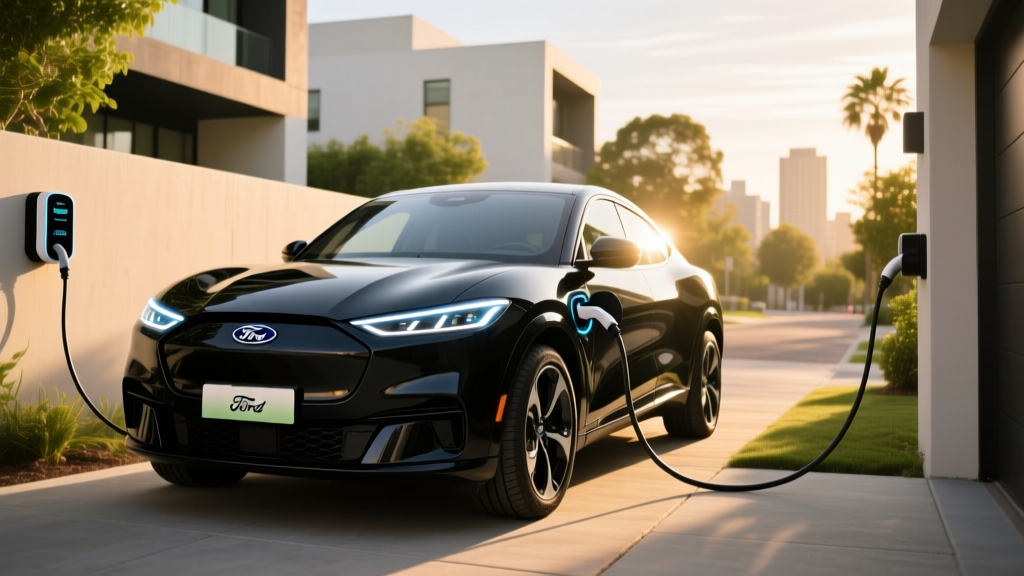
At home on a 10.5 kW Level 2 charger (48-amp circuit, requiring a 60-amp breaker), the Extended Range pack charges from empty to full in roughly 9.5 hours. Ford's Mobile Power Cord includes a 240V NEMA 14-50 plug adapter, but for reliable daily charging, a hardwired wall unit (ChargePoint Home Flex, Emporia Level 2, or Ford Connected Charge Station) is the practical choice. Expect $500–$1,500 for a professional Level 2 home installation depending on your panel capacity and run distance — confirm specifics with a licensed electrician.
Performance, Interior Space, and Standout Technology
The Mach-E's driving character is a pleasant surprise for an SUV-badged EV. The RWD Select and Premium trims deliver adequate 6-second 0–60 times with composed, car-like handling. The GT Performance Edition's 3.5-second 0–60 puts it firmly in sports-sedan territory, with MagneRide adaptive dampers providing genuine body control through corners. The eAWD system uses independent front and rear motors — there is no mechanical linkage — and torque distribution is managed electronically in real time.
Interior dimensions are competitive for the compact electric crossover segment:
- Front legroom: 43.3 inches
- Rear legroom: 38.9 inches
- Cargo (behind rear seats): 29.7 cu ft
- Cargo (rear seats folded): 59.7 cu ft
- Front trunk (frunk): 4.7 cu ft (drainable, useful for wet gear or groceries)
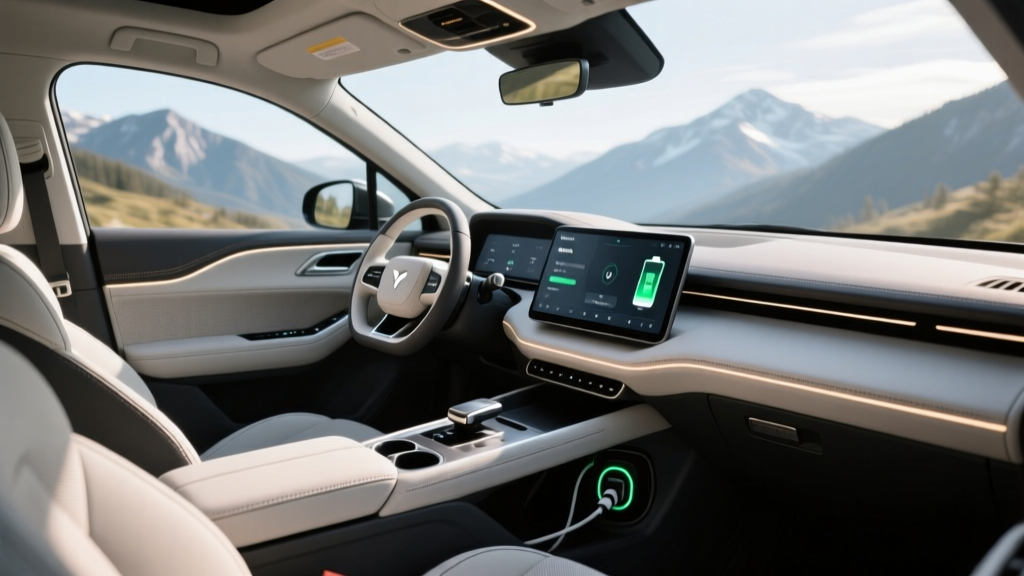
The 15.5-inch vertically oriented SYNC 4A touchscreen dominates the dashboard. It supports wireless Apple CarPlay and Android Auto, over-the-air (OTA) updates, and Ford's BlueCruise hands-free driving system. BlueCruise is a SAE Level 2 driver-assistance system — it can manage steering, acceleration, and braking on pre-mapped divided highways (over 130,000 miles of Hands-Free Blue Zone roads as of 2026), but the driver must remain attentive and keep eyes on the road as monitored by an infrared driver-facing camera. This is not autonomous driving; it is an advanced cruise-and-lane-centering system that reduces fatigue on long highway stretches.
Notable drawbacks include a firm ride on the GT's 20-inch wheels over broken pavement, the absence of a traditional gear selector (a rotary dial takes its place, which some find unintuitive), and rear visibility that is compromised by the sloping roofline — a rear cross-traffic alert and 360-degree camera help compensate.
Pricing, Tax Credits, and Total Cost of Ownership
| Trim | Base MSRP | Federal Tax Credit (§30D) | Effective Price (if eligible) |
|---|---|---|---|
| Select Standard Range RWD | $43,995 | Up to $7,500 | ~$36,495 |
| Premium Extended Range RWD | $48,995 | Up to $7,500 | ~$41,495 |
| GT Extended Range eAWD | $62,995 | Up to $7,500 | ~$55,495 |
| GT Performance Edition | $67,995 | Up to $7,500 | ~$60,495 |
The federal EV tax credit under IRS §30D is not automatic. Eligibility for the full $7,500 credit on the Mach-E depends on several requirements that change periodically:
- MSRP Cap: The vehicle's MSRP must not exceed $80,000 for SUVs/pickups/vans (Mach-E qualifies as an SUV under IRS classification — all trims are under this cap).
- Buyer Income Cap: Modified adjusted gross income (MAGI) must not exceed $150,000 (single), $225,000 (head of household), or $300,000 (married filing jointly).
- Battery Sourcing: A percentage of critical minerals and battery components must be sourced from the U.S. or free-trade-agreement partners. These thresholds increase annually. Ford has confirmed that qualifying 2025–2026 Mach-E trims assembled in Cuautitlán, Mexico meet current sourcing requirements for at least partial credit, but verify the specific VIN on the IRS eligible-vehicle list at fueleconomy.gov before purchasing.
- Point-of-Sale Transfer: As of 2024, buyers can transfer the credit to the dealer at the point of sale, reducing the purchase price directly rather than waiting to claim it on a tax return.
Always confirm credit eligibility with a tax professional and check the IRS source for the specific model year and trim you are purchasing — rules are subject to legislative change.
Ford Mach-E Stop Sale: What Buyers Need to Know Right Now
To directly address the keyword driving your search: the most significant Ford Mach-E stop-sale events involved NHTSA recalls for (1) a high-voltage battery contactor that could weld open or closed under heavy DC fast-charging loads, potentially causing a loss of drive power (Recall 22S41, affecting certain 2021–2022 Extended Range and GT models), and (2) a software issue that could cause unintended deceleration. Ford issued over-the-air and dealer-applied software updates, and in some cases replaced the high-voltage battery contactors under warranty.
As of 2026, these recall campaigns are substantially complete. New 2025 and 2026 model-year Mach-E vehicles shipping to dealers have the updated contactors and software from the factory. The stop-sale orders that prevented dealers from selling affected new inventory have been lifted once remedies were applied.
If you are buying new: A 2025 or 2026 Mach-E on a dealer lot should have no open recalls. Confirm with the dealer that all recall work is complete and request the vehicle's recall history via the VIN at nhtsa.gov/recalls.
If you are buying used (2021–2023): This is where stop-sale risk persists. Federal law prohibits dealers from selling new or used vehicles with open recalls. A CPO Mach-E should have all recalls remediated before sale. Private-party sales carry no such obligation, so run the VIN yourself. If a recall remedy is pending, the vehicle can still be fixed for free at any Ford dealer, but it may indicate deferred maintenance habits from the prior owner.
Mach-E vs. Key Competitors: Is It Still Worth Buying?
Pros
- Engaging driving dynamics uncommon in the crossover EV segment
- Competitive 320-mile EPA range on Premium Extended Range RWD
- NACS charge port (2025+ models) grants native Supercharger access
- BlueCruise hands-free highway driving is well-implemented
- Spacious cabin with practical frunk and flat-folding rear seats
- Strong OTA update track record; features improve post-purchase
Cons
- DC fast-charge speed (150 kW peak) lags Hyundai Ioniq 5 / Kia EV6 (240 kW on 800V architecture)
- Recall history may affect resale confidence and insurance rates
- GT trim's range and efficiency are disappointing relative to its price premium
- Rear visibility is limited; camera dependency is high
- Mexico-built, which has complicated battery-sourcing for full tax credit in some model years
Compared to the Hyundai Ioniq 5, the Mach-E offers a more car-like driving experience and a larger frunk, but the Ioniq 5 charges dramatically faster (10–80% in ~18 minutes on a 350 kW charger) thanks to its 800-volt architecture. If road-trip charging speed is your top priority, the Ioniq 5 or Kia EV6 holds the advantage.
Against the Tesla Model Y, the Mach-E provides a more traditional dealership purchase experience, physical buttons for climate controls, and a quieter cabin at highway speed. The Model Y counters with superior Supercharger network reliability (though this gap has narrowed with Ford's NACS adoption), slightly more cargo volume, and marginally better efficiency per kWh.
The Chevrolet Equinox EV undercuts the Mach-E on price (starting around $33,000 for the base 3LT trim) and offers a comparable 319-mile EPA range on its top trim, but delivers significantly less power (213 hp FWD) and slower DC charging (~150 kW peak with a longer taper). If budget is the primary driver, the Equinox EV is the value pick; if performance and driving engagement matter, the Mach-E wins.
Who Should Buy the Ford Mustang Mach-E in 2026?
Choose the Mach-E if: You want a driver-focused electric crossover with genuine handling capability, you value Ford's dealer network for service, you plan to use BlueCruise for frequent highway commutes, and you are buying a 2025+ model with the NACS port for seamless Supercharger access.
Look elsewhere if: You prioritize the fastest possible DC charging (Ioniq 5/EV6), you need maximum cargo volume for family gear (Model Y), or you want the lowest possible entry price (Equinox EV). Also reconsider if you are eyeing a 2021–2022 used Extended Range or GT model and cannot confirm that recall 22S41 has been fully remediated.
The Mach-E's best use case is a two-car household where it serves as the primary daily driver and commuter — particularly for buyers with home Level 2 charging who can wake up to a full battery every morning and only rely on DC fast charging for the occasional road trip. The Premium Extended Range RWD at ~$41,500 after the federal credit (if eligible) represents the value sweet spot in the lineup: 320 EPA miles, adequate 290 hp, and the full tech suite without the GT's efficiency penalty.
Frequently Asked Questions
Is the Ford Mach-E still being sold in 2026?
Yes. Ford continues to produce and sell the Mustang Mach-E for the 2025 and 2026 model years. Previous stop-sale orders related to recalls have been resolved on new inventory. Always verify a specific vehicle's recall status via its VIN at nhtsa.gov/recalls before purchase.
What is the real-world range of the Ford Mach-E?
The EPA rates the Premium Extended Range RWD at 320 miles. In real-world highway driving at 70–80 mph, expect 250–280 miles. In cold weather (below 32°F), plan for 200–230 miles. Standard Range models deliver approximately 190–210 real-world highway miles.
How fast does the Mach-E charge at home and on the road?
On a home Level 2 charger (10.5 kW / 48A), the Extended Range battery adds roughly 30 miles per hour and charges fully in about 9.5 hours. On a DC fast charger, the Extended Range model peaks at 150 kW, achieving 10–80% in approximately 36 minutes. The Standard Range model peaks at 115 kW with a 10–80% time of about 38 minutes.
Does the 2026 Ford Mach-E qualify for the $7,500 federal tax credit?
Eligibility depends on the buyer's income (MAGI caps of $150K/$225K/$300K by filing status), the vehicle's MSRP (under $80K for SUVs — all Mach-E trims qualify), and battery critical-mineral and component sourcing requirements that change annually. Check the specific VIN at fueleconomy.gov and consult a tax professional. The credit can be transferred to the dealer at the point of sale to reduce your purchase price directly.
Is the Mach-E worth buying over the Tesla Model Y or Hyundai Ioniq 5?
It depends on your priorities. The Mach-E offers better driving dynamics and a more traditional dealership experience than Tesla, and a quieter, more car-like cabin than the Ioniq 5. However, the Ioniq 5 charges significantly faster (18-minute 10–80% vs. 36 minutes), and the Model Y has a more mature charging network and slightly more cargo space. Test-drive all three before deciding.
What is the Mach-E's battery warranty?
Ford covers the high-voltage battery and electric powertrain components for 8 years or 100,000 miles, whichever comes first. The warranty guarantees the battery will retain at least 70% of its original capacity during that period. If degradation exceeds 30%, Ford will repair or replace the battery at no cost.