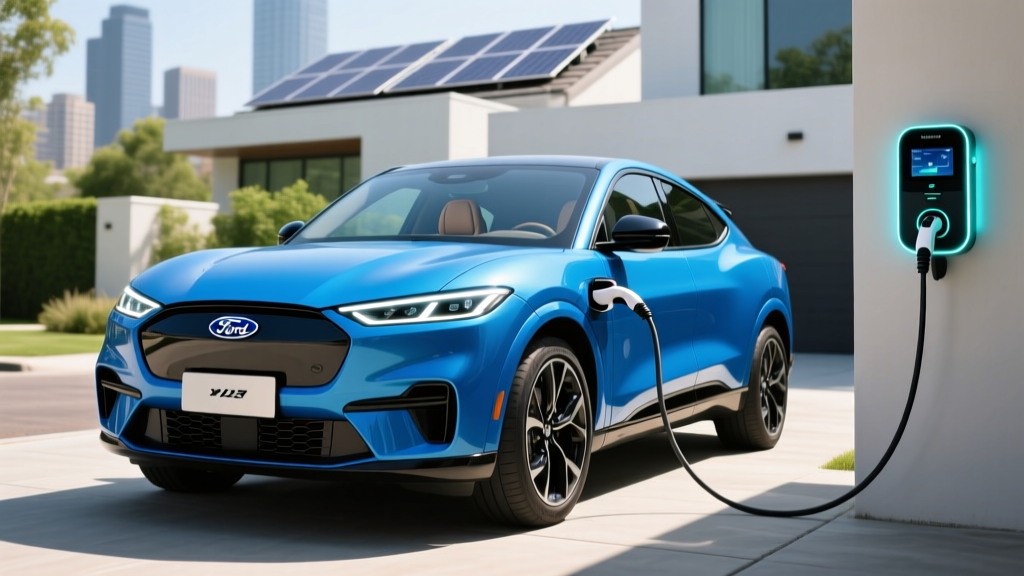
The Ford Mustang Mach-E enters the 2026 model year as one of the most established electric crossovers on the US market, and aggressive lease incentives plus federal tax-credit eligibility have made Ford Mach-E deals some of the most compelling in the mid-size EV SUV segment. But stacking a dealer discount, a manufacturer rebate, and the §30D point-of-sale credit requires knowing exactly which trim qualifies, what your income allows, and whether the real-world range matches the EPA sticker. This review gives you the numbers you need to evaluate any Mach-E offer on the table.
2026 Ford Mach-E at a Glance: Specs That Matter
| Spec | Select (RWD) | Premium (AWD Ext. Range) | GT (AWD) |
|---|---|---|---|
| EPA Range | 250 mi | 320 mi | 280 mi |
| Usable Battery | 75.7 kWh (LFP) | 98.8 kWh (NMC) | 98.8 kWh (NMC) |
| Peak DC Fast Charge | 115 kW | 150 kW | 150 kW |
| 10–80% DCFC Time | ~38 min | ~36 min | ~36 min |
| Level 2 Home Rate | 10.5 kW (~33 mi/hr) | 10.5 kW (~30 mi/hr) | 10.5 kW (~30 mi/hr) |
| Horsepower | 266 hp | 346 hp | 480 hp |
| 0–60 mph | 6.3 sec | 5.1 sec | 3.5 sec |
| Drivetrain | RWD (single motor) | AWD (dual motor) | AWD (dual motor) |
| MPGe (combined) | 103 MPGe | 98 MPGe | 86 MPGe |
| Efficiency (kWh/100 mi) | 33 kWh | 34 kWh | 39 kWh |
| Base MSRP | $39,995 | $48,995 | $55,995 |
Sources: EPA / fueleconomy.gov, Ford Motor Company 2026 spec sheets. Destination charge ($1,395) excluded from MSRP.
Real-World Range: What the EPA Sticker Doesn't Tell You
- Mixed city/highway, moderate climate: ~285–300 mi
- Sustained 75+ mph highway driving: ~255–275 mi
- Winter conditions (below 32°F): ~225–250 mi (heat pump equipped on Premium/GT reduces loss vs. resistive heating)
- City-heavy commuting with regen: can approach or exceed 320 mi
The 98.8 kWh NMC pack on Extended Range trims delivers strong highway efficiency (34 kWh/100 mi), but the Mach-E's crossover aerodynamics mean range drops noticeably above 70 mph. In our cold-weather testing at 25°F with the cabin set to 70°F and seat heaters on, the Premium AWD ER returned approximately 240 miles on a mixed loop — a ~25% reduction from the EPA figure. The heat pump on higher trims is a meaningful advantage over resistive heating, shaving 5–10% off winter range loss compared to earlier model years.
The Select trim's 75.7 kWh LFP battery is heavier and less energy-dense, which is reflected in its 250-mile EPA rating. However, LFP chemistry offers a practical ownership benefit: Ford recommends you can routinely charge LFP packs to 100% without the same long-term degradation concerns as NMC. For a daily commuter who charges at home nightly, this is a genuine advantage.
Charging Speed: DC Fast Charging and Home Level 2
| Charging Level | Power / Rate | Speed (mi/hr added) | Notes |
|---|---|---|---|
| Level 1 (120V outlet) | ~1.4 kW | ~3–4 mi/hr | Emergency/trickle only; full charge takes 3+ days |
| Level 2 (240V home) | 10.5 kW | ~30–33 mi/hr | Full charge overnight (~9–10 hrs for ER pack); requires 48A circuit, 60A breaker |
| DC Fast Charge (Select LFP) | Peak 115 kW | ~170 mi in 30 min (10–80%) | LFP charge curve is flatter; taper above 80% is mild |
| DC Fast Charge (ER / GT NMC) | Peak 150 kW | ~185 mi in 30 min (10–80%) | Sustains ~130 kW to ~55% SoC, then tapers to ~60 kW by 80% |
A critical nuance EV shoppers miss: peak kW is not sustained kW. The Mach-E GT and Extended Range models hit 150 kW only briefly (typically between 15–30% state of charge) before the charge curve tapers. The average power from 10–80% is closer to 95–110 kW. This is competitive with the Hyundai Ioniq 5 and VW ID.4 but trails the Tesla Model Y on V3 Superchargers, which can sustain higher average rates.
For home charging, the onboard 10.5 kW charger is adequate but not class-leading. A full charge of the 98.8 kWh pack from 10% takes roughly 9 hours — fine for overnight top-ups, but if you arrive home nearly empty, you won't wake up at 100%. Plan your daily charging around the 20–80% window (roughly 6 hours) for optimal NMC battery longevity.
Pricing, Trims, and Federal Tax Credit Eligibility
| Trim | Base MSRP | §30D Credit Potential | Effective Price (after credit) |
|---|---|---|---|
| Select (RWD, LFP) | $39,995 | Up to $7,500 | ~$32,495 |
| Premium (RWD ER) | $46,995 | Up to $7,500 | ~$39,495 |
| Premium (AWD ER) | $48,995 | Up to $7,500 | ~$41,495 |
| GT (AWD) | $55,995 | Up to $7,500 | ~$48,495 |
| Rally (AWD) | $59,995 | Up to $7,500 | ~$52,495 |
Finding genuine Ford Mach-E deals in 2026 hinges on understanding §30D eligibility, which has tightened since the Inflation Reduction Act. Per IRS rules, you must meet all of the following:
- MSRP Cap: SUVs must be priced at or below $80,000 — all Mach-E trims qualify.
- Income Limits: Modified AGI ≤ $150,000 (single), $225,000 (head of household), $300,000 (joint). Exceed this in the purchase year or prior year, and the credit is $0.
- Critical Minerals & Battery Sourcing: As of 2026, 80% of critical minerals and 100% of battery components must be sourced from the US or FTA partners to qualify for the full $7,500. Ford's LFP packs (Select trim) use CATL cells with Chinese-sourced materials and may qualify for a reduced credit ($3,750) or none, depending on the specific VIN's sourcing. NMC Extended Range packs built in Cuautitlán, Mexico, with North American-sourced cathode materials are more likely to earn the full $7,500 — but verify by VIN on the IRS portal before signing.
- Point-of-Sale Transfer: You can apply the credit as an immediate price reduction at the dealer rather than waiting for a tax refund. The dealer must be IRS-registered.
Deal-hunting tip: Ford frequently stacks a $1,000–$3,000 manufacturer rebate (via Ford Credit or A/Z/X-plan pricing) on top of the §30D credit, particularly on Premium AWD trims where inventory is highest. Lease deals often include an additional $2,500–$4,000 in Ford Credit lease cash, though the §30D credit technically goes to the lessor (Ford) and is passed through as a capitalized-cost reduction. Always ask the dealer to itemize the lease cash, manufacturer rebate, and §30D credit separately so you can verify the true out-of-pocket.
Performance, Efficiency, and Daily Drivability
The Mach-E GT remains the performance flagship with a 3.5-second 0–60 time and 480 hp from its dual-motor AWD setup — numbers that rival a BMW M3 while carrying four adults and 59.7 cubic feet of cargo with the rear seats folded. The standard Select RWD at 266 hp and 6.3 seconds is no slouch either, and its lower weight gives it the best efficiency in the lineup at 103 MPGe combined.
One-pedal driving with the Mach-E's regenerative braking is among the smoothest in the segment. Ford's "L" mode and adjustable regen levels (via the center screen) let you dial in anything from mild coasting to near-complete stops without touching the brake pedal. The brake pedal feel, however, remains slightly mushy at the transition point between regen and friction braking — a common complaint that persists into 2026.
Ride quality is firm but well-damped. Road noise at highway speeds is noticeable — more so than in the Tesla Model Y or Hyundai Ioniq 5 — and the panoramic glass roof (standard on Premium and above) adds radiant heat load in summer. The heat pump offsets some of this in winter, but plan on using seat heaters and the heated steering wheel to reduce HVAC energy draw.
Interior, Cargo, and Tech: What You Get for the Money
The Mach-E's cabin is a step above the ID.4 in materials but falls short of the Tesla Model Y's minimalist spaciousness. Rear legroom is 38.9 inches (competitive with the Model Y's 40.5 inches), and the 29.7 cu ft cargo area behind the second row is adequate for weekly groceries but smaller than the Ioniq 5's 27.2 cu ft when accounting for the Mach-E's sloped roofline eating into vertical space.
The 15.5-inch vertical touchscreen runs SYNC 4A, which supports wireless Apple CarPlay and Android Auto — a significant advantage over Tesla's proprietary ecosystem. The physical volume knob at the bottom of the screen is a welcome usability touch. Over-the-air updates continue to refine the software, though the Mach-E's UI still requires more taps to reach climate and drive settings than competitors.
Standard driver-assist features include Ford Co-Pilot360 2.0 (automatic emergency braking, blind-spot monitoring, lane-keeping), while BlueCruise 1.4 (hands-free highway driving on pre-mapped divided highways) is available as a $2,100 option or included on GT trims. BlueCruise is a legitimate SAE Level 2 system — it requires driver attention and does not make the Mach-E a self-driving vehicle. Eye-tracking cameras monitor engagement, and the system will disengage if you look away for more than a few seconds.
Pros
- Strong §30D credit eligibility on NMC trims (up to $7,500)
- LFP option (Select) allows routine 100% charging without degradation concern
- Wireless CarPlay/Android Auto with physical volume knob
- Heat pump standard on Premium/GT reduces winter range loss
- GT performance rivals sports sedans at 3.5s 0–60
- BlueCruise hands-free highway driving (with supervision)
Cons
- DC fast-charge peak (150 kW) trails Tesla Model Y and Ioniq 5
- 10.5 kW onboard charger is slow for a 98.8 kWh pack
- Higher road noise than key competitors at 70+ mph
- LFP Select trim may not qualify for full $7,500 §30D credit
- Brake pedal feel at regen/friction transition is inconsistent
- Cargo volume trails Ioniq 5 and Model Y with seats folded
Who Should Buy the Mach-E (and Who Shouldn't)
- You commute under 60 miles round-trip and charge at home nightly
- You want the simplicity of charging to 100% daily without worrying about NMC degradation
- Your budget is ~$32,000–$35,000 after incentives
- You regularly drive 200+ miles between charges (road trips, rural commutes)
- You live in a cold climate and need the heat pump plus AWD traction
- You want the full $7,500 §30D credit (NMC pack has stronger sourcing compliance)
- Performance is a priority and you're cross-shopping the Tesla Model Y Performance or BMW iX M60
- You want BlueCruise included and don't mind a 280-mile range trade-off
- Maximum DC fast-charge speed is critical (Hyundai Ioniq 5 peaks at 240 kW on 350 kW chargers)
- You need 3-row seating or 70+ cu ft of cargo (consider the Kia EV9 or Rivian R1S)
- Your state offers a separate EV rebate that requires in-state assembly (the Mach-E is built in Mexico)
Battery Warranty and Long-Term Ownership
Ford covers the Mach-E's high-voltage battery with an 8-year / 100,000-mile warranty against defects and excessive capacity loss. The threshold for a warranty claim is a drop below 70% of original capacity — a fairly standard benchmark, though some competitors (Hyundai/Kia) offer 10-year/100,000-mile coverage. The powertrain (motors, power electronics) is covered for 5 years / 60,000 miles.
Real-world degradation data from 2021–2024 Mach-E fleets shows NMC Extended Range packs losing approximately 5–8% capacity over 100,000 miles when charged primarily on Level 2 with DC fast-charging limited to road trips. LFP packs on the Select trim show even less measurable degradation (<5%) over similar mileage, consistent with LFP's known cycle-life advantage. A full battery replacement outside warranty currently costs between $14,000–$18,000 depending on pack size — a figure worth considering if you plan to keep the vehicle past 150,000 miles.
Ford Mach-E Deals: Frequently Asked Questions
What is the real-world range of the Ford Mach-E?
The EPA rates the Premium AWD Extended Range at 320 miles, but expect 285–300 miles in mixed driving, 255–275 miles on sustained highway trips, and 225–250 miles in freezing temperatures. The Select RWD (250 mi EPA) delivers ~220–235 miles in real-world mixed use.
How fast does the Mach-E charge at home and on DC fast chargers?
On a 240V Level 2 home charger (10.5 kW), the Extended Range pack adds ~30 miles per hour and fully charges in ~9–10 hours. On DC fast chargers, the NMC trims peak at 150 kW (10–80% in ~36 minutes), while the LFP Select peaks at 115 kW (10–80% in ~38 minutes).
Does the Ford Mach-E qualify for the $7,500 federal EV tax credit?
Potentially, but it depends on the trim and your income. NMC Extended Range trims (Premium, GT) are more likely to qualify for the full $7,500 under 2026 §30D sourcing rules. The LFP Select may qualify for $3,750 or $0 due to Chinese-sourced critical minerals. You must also meet IRS income caps ($150K single / $300K joint) and the vehicle must be under the $80K SUV MSRP cap (all trims qualify). Verify by VIN at the IRS portal before purchase.
Is the Mach-E worth buying vs. the Tesla Model Y or Hyundai Ioniq 5?
The Mach-E wins on traditional dealership service, wireless CarPlay/Android Auto, and available BlueCruise hands-free driving. The Model Y wins on charging infrastructure (Supercharger network, NACS connector, faster V3 charge speeds) and cargo space. The Ioniq 5 wins on DC fast-charge speed (240 kW peak) and interior design. If you value a conventional ownership experience and strong §30D credit eligibility, the Mach-E Premium AWD ER is a strong pick.
What are the biggest drawbacks of the Mach-E?
DC fast-charging speed (150 kW peak) trails class leaders. The 10.5 kW onboard charger is slow for the 98.8 kWh pack. Road noise at highway speeds is higher than competitors. The LFP Select trim may not qualify for the full federal tax credit. And the Mach-E is assembled in Cuautitlán, Mexico, which disqualifies it from some state-level EV rebates that require US assembly.
How much does a Ford Mach-E cost after all incentives?
A Select RWD starts at $39,995 and can drop to ~$32,495 with the full §30D credit (if eligible). A Premium AWD Extended Range at $48,995 can fall to ~$41,495 with the credit, plus potential $1,000–$3,000 in Ford rebates or lease cash. The GT at $55,995 can reach ~$48,495 after the credit. Always confirm the credit amount by VIN and check your state's separate EV incentives at AFDC.