The Electric Truck Promise vs. The Towing Reality
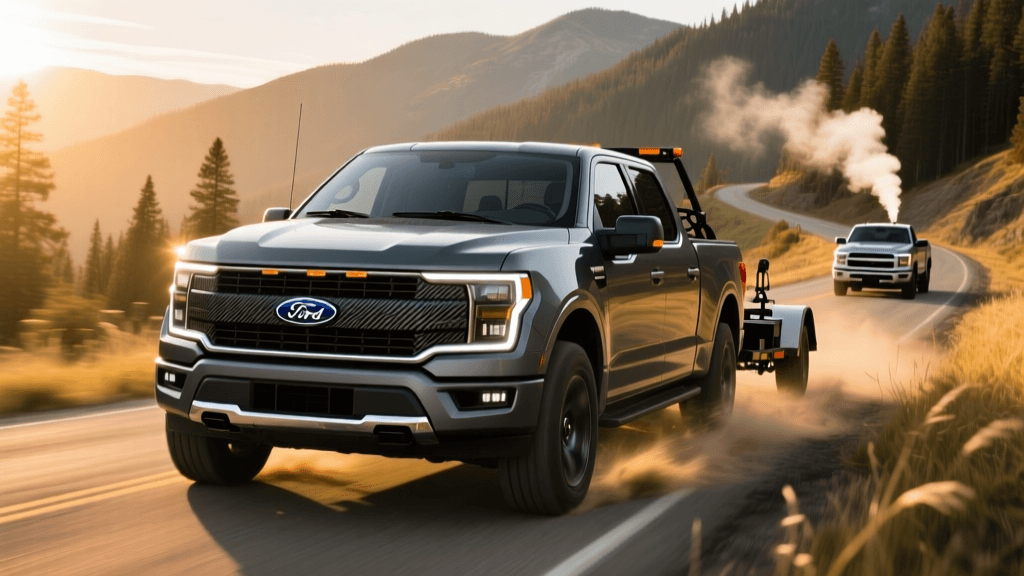
When Ford introduced the F-150 Lightning, it promised to revolutionize the worksite and the campsite alike. With instant torque, massive frunk storage, and the ability to power a home during an outage, the value proposition was undeniable. However, for truck buyers, the ultimate test of any half-ton pickup is its ability to tow. As an electric vehicle (EV), the Lightning faces the immutable laws of physics: moving heavy, un-aerodynamic loads requires immense energy. For buyers weighing the upfront premium of an EV against long-term operational savings, understanding the Ford F-150 Lightning's towing capacity, its severe range impact, and the true cost-per-mile is essential. In this cost and value breakdown, we dissect whether the Lightning makes financial and practical sense for those who tow.
Official Towing Capacities and Configurations
The F-150 Lightning is not a one-size-fits-all vehicle. Its towing capacity is heavily dependent on the battery pack size, the trim level, and whether the truck is equipped with the Max Trailer Tow Package. According to Ford's official F-150 Lightning specifications, the truck maxes out at an impressive 10,000 pounds, but achieving that number requires specific configurations.
To reach the 10,000-pound threshold, buyers must opt for the Extended Range battery (131 kWh usable) and the Max Trailer Tow Package. The Standard Range battery (98 kWh usable), which is available on the Pro and XLT trims, caps out at 7,700 pounds. While 7,700 pounds is sufficient for a small boat, a pair of dirt bikes, or a light teardrop camper, it falls short of the 13,000-pound limits found in heavy-duty gas counterparts or even some V6 gas F-150s.
| Configuration | Battery Pack | Max Towing Capacity | Est. Range (Empty) | Est. Range (Towing Max) |
|---|---|---|---|---|
| Pro / XLT (Standard) | 98 kWh (Std Range) | 7,700 lbs | 240 miles | ~100 - 120 miles |
| XLT / Lariat (Extended) | 131 kWh (Ext Range) | 10,000 lbs* | 320 miles | ~140 - 160 miles |
| Platinum (Extended) | 131 kWh (Ext Range) | 8,600 lbs | 300 miles | ~130 - 150 miles |
*Requires Max Trailer Tow Package. Platinum trim is heavier, reducing max towing capacity despite having the larger battery.
The Physics of Towing: Real-World Range Impact
The most critical factor in the Lightning's value equation for towers is range degradation. Internal combustion engine (ICE) trucks lose fuel efficiency when towing, but they can quickly refuel at any gas station. EVs lose range exponentially due to aerodynamic drag and the sheer mass of the trailer, and DC fast charging on the highway is significantly slower and more expensive than pumping gas.
Independent testing by Car and Driver's comprehensive F-150 Lightning review hub and other automotive journalists has consistently shown that towing a heavy, boxy trailer at highway speeds (65-70 mph) cuts the Lightning's range by roughly 45% to 55%. If you are towing a 7,000-pound travel trailer with the Extended Range battery, your 320-mile EPA estimate drops to a realistic 140 to 160 miles. In cold weather or mountainous terrain, that number can dip below 120 miles.
This severe range impact forces a change in towing behavior. Instead of driving 300 miles and stopping for a 10-minute gas refill, Lightning owners must plan routes around 150 kW+ DC fast chargers and accept 45-to-60-minute charging stops to go from 15% to 80% state of charge. For commercial fleets or frequent long-distance towers, this time cost translates directly to lost productivity or extended travel days.
Cost Breakdown: Towing with Electrons vs. Gasoline
Does the Lightning save you money while towing? The answer depends entirely on where you get your electrons. Let us break down the cost per mile (CPM) when towing a 6,000-pound load.
Scenario A: Home Charging (The Value Sweet Spot)
When towing locally—such as hauling landscaping equipment to a job site 40 miles away and returning home to charge on a Level 2 setup—the Lightning shines. Towing efficiency drops to roughly 1.8 to 2.0 miles per kWh. At the national average residential electricity rate of $0.16 per kWh, the energy cost is about $0.08 to $0.09 per mile. A comparable gas F-150 towing the same load might achieve 9 MPG. At $3.50 per gallon, the gas truck costs $0.38 per mile. Value Winner: Lightning. Over 10,000 miles of local towing, the EV saves roughly $2,900 in fuel.
Scenario B: Highway DC Fast Charging (The Cost Trap)
If you are towing cross-country and relying on public DC fast chargers (like Electrify America or Tesla Superchargers), the math flips. Public fast charging rates average $0.45 to $0.60 per kWh, and can peak higher in certain states. At 2.0 mi/kWh and $0.50 per kWh, your towing cost jumps to $0.25 per mile. While still technically cheaper than the gas truck's $0.38 per mile, the savings are drastically narrowed, and you are paying a massive premium in time. Furthermore, frequent DC fast charging while towing heavy loads generates immense battery heat, which over years of use could accelerate battery degradation—a hidden long-term cost.
Hidden Value: Pro Power Onboard ROI
To accurately assess the Lightning's value, we must look beyond the drivetrain and evaluate its utility as a mobile power station. The available Pro Power Onboard system transforms the truck's massive battery into a generator, offering up to 9.6 kW of exportable power through bed and cabin outlets.
For contractors, this feature alone can justify the truck's premium. A high-quality, quiet 7,000-watt gas generator costs between $1,500 and $2,500, requires fuel, needs oil changes, and is incredibly loud on a job site. The Lightning allows you to run chop saws, air compressors, and floodlights simultaneously without the noise or emissions. If a contractor uses the truck to power tools for 4 hours a day, the fuel savings from not running a gas generator can exceed $1,500 annually. According to the U.S. Department of Energy's guide on electric vehicle technology and efficiency, EVs offer unique secondary utility benefits that ICE vehicles simply cannot match, and the Lightning's onboard power is the pinnacle of this advantage.
Actionable Advice for Lightning Towers
If you decide the F-150 Lightning fits your towing profile, follow these actionable steps to maximize your investment and mitigate range anxiety:
- Install a High-Amperage Level 2 Charger: Do not rely on a standard 120V wall outlet. Invest in a hardwired Level 2 charger like the ChargePoint Home Flex or Ford Charge Station Pro, wired to a 60-amp or 80-amp circuit. This ensures your truck is at 100% every morning before a tow day.
- Pre-Condition While Plugged In: Use the FordPass app to pre-condition the cabin and battery while the truck is still connected to your home charger. This uses grid power instead of battery power to reach optimal operating temperatures, preserving your range for the road.
- Upgrade Your Trailer Tires and Bearings: Because EVs are heavier and deliver instant torque, trailer tires and bearings wear out faster. Invest in high-load-range (LR E or G) tires and perform bearing maintenance more frequently than you would with a gas truck.
- Master the FordPass Route Planner: Always input your destination into the truck's native navigation or the FordPass app before leaving. The system will pre-condition the battery for upcoming fast-charging stops, significantly reducing your time spent plugged in on the highway.
Final Verdict: Is the Lightning Worth It for Towers?
The Ford F-150 Lightning is a masterclass in daily drivability, job-site utility, and local towing efficiency. If your towing needs consist of daily commutes to a job site with equipment, weekend trips to a nearby lake with a small boat, or powering tools on-site, the Lightning offers unparalleled cost savings and convenience. The Pro Power Onboard feature alone provides a return on investment that gas trucks cannot touch.
However, if your primary use case involves towing a large, heavy travel trailer across multiple state lines at 75 mph, the Lightning's value proposition crumbles. The 50% range penalty, combined with the time and expense of public DC fast charging, makes the cross-country towing experience frustrating and economically questionable. For long-haul towers, a traditional gas or diesel F-150, or perhaps a plug-in hybrid alternative, remains the more practical and cost-effective choice. Ultimately, the Lightning's value is entirely dictated by the geography of your tow routes and your access to cheap, home-based electrons.