Why the Ford F-150 Lightning Weight Matters for Buyers
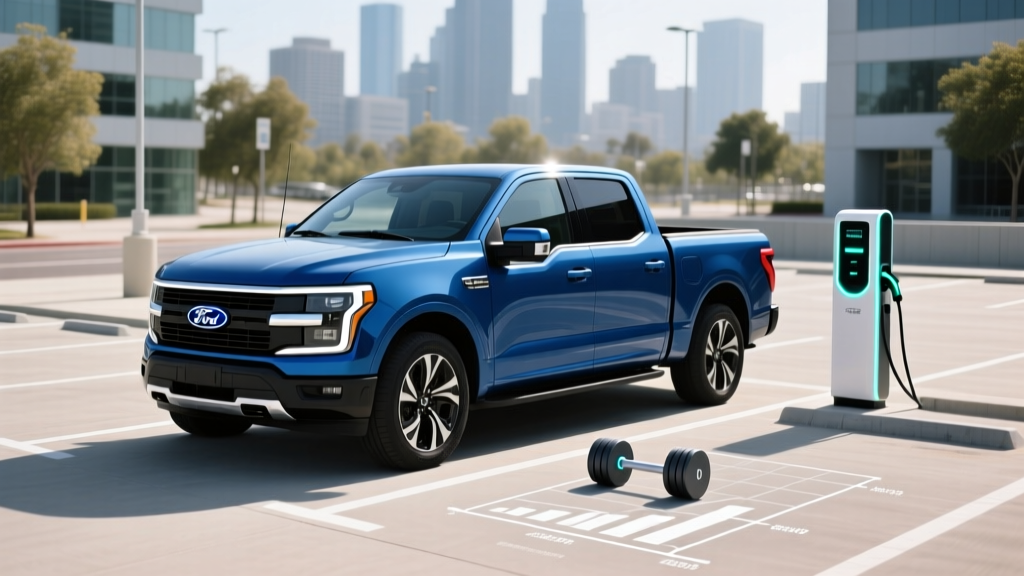
The Ford F-150 Lightning redefined what an electric pickup could be when it launched, but one question continues to dominate buyer research: how does the Ford F-150 Lightning weight affect its capability, range, and daily usability? At between 6,015 and 6,893 pounds curb weight depending on battery pack and trim, the Lightning is substantially heavier than its gas-powered F-150 siblings — and that mass has real consequences for payload capacity, efficiency, and real-world range.
This review breaks down every spec that matters, from the dual-motor powertrain and NMC battery chemistry to DC fast-charging curves and §30D federal tax credit eligibility for the 2025 model year. If you're cross-shopping the Lightning against the Rivian R1T, Chevrolet Silverado EV, or Tesla Cybertruck, the numbers below will clarify which truck actually fits your work and life.
Ford F-150 Lightning Spec Sheet at a Glance
| Spec | Standard-Range (Pro/XLT) | Extended-Range (Lariat/Platinum) |
|---|---|---|
| EPA Range | 240 miles | 320 miles |
| Battery Capacity (usable) | 98 kWh (NMC) | 131 kWh (NMC) |
| Curb Weight | 6,015 lbs | 6,893 lbs |
| Drivetrain | Dual-motor AWD | Dual-motor AWD |
| Horsepower | 452 hp | 580 hp |
| Torque | 775 lb-ft | 775 lb-ft |
| 0-60 mph | ~4.5 seconds | ~3.8 seconds |
| Max Payload | 2,235 lbs | 1,800 lbs |
| Max Towing | 7,700 lbs (up to 10,000 w/ Max Trailer Tow) | 8,500 lbs (up to 10,000 w/ Max Trailer Tow) |
| Max DC Fast Charge | 120 kW | 150 kW |
| 10-80% DC Fast Charge | ~44 min | ~41 min |
| Level 2 Home Charge Rate | 11.3 kW (~23 mi/hr) | 19.2 kW (~39 mi/hr) with 80A charger |
| EPA Efficiency | 76 MPGe (2.4 kWh/mi) | 70 MPGe (2.6 kWh/mi) |
| Base MSRP (2025) | $54,995 (Pro) | $69,995 (Lariat) |
| Battery Warranty | 8 years / 100,000 miles (70% capacity retention) | |
Breaking Down the Curb Weight and Payload Trade-Offs
The Ford F-150 Lightning weight ranges from roughly 6,015 pounds (Standard-Range Pro) to 6,893 pounds (Extended-Range Platinum). For context, a comparably equipped gas F-150 XLT 4x4 SuperCrew weighs around 4,700–5,100 pounds. That 1,000–1,800 pound delta comes almost entirely from the lithium-ion battery pack sitting in the truck's structural floor.
Here's what that mass means in practice:
- Payload compression: The Extended-Range models carry a larger, heavier battery, which paradoxically reduces max payload from 2,235 lbs down to 1,800 lbs. If your work depends on hauling heavy bed loads daily, the Standard-Range truck is the more capable workhorse.
- GVWR ceiling: The Lightning's Gross Vehicle Weight Rating tops out around 8,550–8,650 lbs depending on trim. Subtract curb weight, and you're left with a relatively narrow payload window on Extended-Range trims.
- Towing range loss: The Lightning can tow up to 10,000 lbs when properly equipped, but expect range to drop by 40–55% under max trailer load. That 320-mile Extended-Range EPA sticker can shrink to 140–180 miles on the highway pulling a 7,000-lb camper.
The weight also affects tire wear, braking distances, and suspension component longevity — factors fleet buyers should model into their total cost of ownership calculations.
The Extended-Range Lightning carries a 320-mile EPA estimate (240 miles for Standard-Range). In real-world driving, expect:
- City/suburban mixed driving: 290–310 miles (regenerative braking recovers energy)
- Sustained 70+ mph highway: 240–270 miles (aerodynamic drag dominates at speed)
- Cold weather (below 32°F): 200–240 miles (battery chemistry loses efficiency; cabin heating draws significant power)
- Towing 5,000+ lb trailer: 140–190 miles depending on speed and terrain
Preconditioning the battery while plugged in mitigates some cold-weather loss. The Lightning's liquid thermal management system helps, but physics is physics — a 6,900-lb truck pushing through freezing air will consume more energy.
Charging Speed: DC Fast and Home Level 2
The Lightning's charging performance is one area where its weight and large battery create a notable bottleneck. Neither pack supports the 250–350 kW peak rates you'll find on vehicles like the Hyundai Ioniq 5 or the newer 800V architectures.
| Charging Method | Standard-Range (98 kWh) | Extended-Range (131 kWh) |
|---|---|---|
| DC Fast Charge (peak) | 120 kW | 150 kW |
| 10-80% DC Time | ~44 minutes | ~41 minutes |
| Level 2 (240V, 48A) | 11.3 kW (~23 mi/hr) | 11.3 kW (~23 mi/hr) |
| Level 2 (240V, 80A w/ Ford Charge Station Pro) | N/A (single onboard charger) | 19.2 kW (~39 mi/hr) |
| Level 1 (120V, 12A) | ~1.4 kW (~3 mi/hr) | ~1.4 kW (~3 mi/hr) |
Charging curve reality: The Extended-Range Lightning peaks at 150 kW only briefly between roughly 15–30% State of Charge, then tapers progressively. From 60–80%, expect sustained rates closer to 50–70 kW. This is why the 10-80% time is 41 minutes rather than the ~25 minutes a sustained 150 kW rate would suggest. Plan road-trip charging stops accordingly — a 30-minute stop won't get you from 20% to 90%.
For home charging, the Extended-Range models benefit enormously from the optional Ford Charge Station Pro (80A hardwired unit). At 19.2 kW, you'll add roughly 39 miles of range per hour, fully replenishing the 131 kWh pack in about 8 hours overnight. This requires a 100-amp dedicated circuit — budget $1,500–$3,500 for professional installation depending on your electrical panel capacity, per Ford's home charging guidelines.
Performance, Drivetrain, and Efficiency
Every F-150 Lightning comes with a dual-motor all-wheel-drive powertrain. There is no rear-wheel-drive option, which simplifies the lineup but eliminates a lower-price entry point some fleet buyers want.
The Standard-Range truck produces 452 hp and 775 lb-ft of torque, hitting 0-60 mph in approximately 4.5 seconds. The Extended-Range models bump output to 580 hp (torque stays at 775 lb-ft) and drop the 0-60 time to roughly 3.8 seconds — sports-sedan acceleration in a truck that weighs nearly 7,000 pounds.
Efficiency, measured by the EPA, comes in at 76 MPGe for the Standard-Range and 70 MPGe for the Extended-Range. Translated to consumption, that's roughly 42–48 kWh per 100 miles depending on driving conditions. The heavier Extended-Range truck is less efficient per mile, which is the direct trade-off for its additional 80 miles of range.
The Lightning's regenerative braking offers two modes: standard (coasts when you lift off the accelerator) and one-pedal driving (aggressive regen that can bring the truck to a full stop without touching the brake pedal). In stop-and-go traffic, one-pedal mode recovers meaningful energy and reduces brake pad wear.
Interior, Cargo, and Technology
The Lightning uses the SuperCrew cab configuration exclusively, offering seating for five with 43.6 inches of front legroom and 40.4 inches of rear legroom. The rear seats fold flat for cargo flexibility.
Cargo dimensions:
- Bed length: 67.1 inches (5.5-foot Styleside box)
- Mega Power Frunk: 14.1 cubic feet of lockable front-trunk storage with 400 lbs payload capacity — large enough for tools, groceries, or a full set of golf clubs
- Bed payload volume: 52.8 cubic feet
- Pro Power Onboard: Available 2.4 kW or 9.6 kW onboard generator system with 120V and 240V outlets in the bed and cabin (9.6 kW can power job-site tools or serve as home backup during outages)
Infotainment and driver assists:
- SYNC 4 with a 12-inch touchscreen standard; 15.5-inch portrait screen on Lariat and above
- Wireless Apple CarPlay and Android Auto
- Ford BlueCruise: SAE Level 2 hands-free driving on pre-mapped divided highways (requires active driver monitoring; this is not autonomous driving)
- Ford Co-Pilot360 2.0 suite: automatic emergency braking, blind-spot monitoring, lane-keeping, rear cross-traffic alert, and available Pro Trailer Backup Assist
- Over-the-air updates via Ford Power-Up platform
BlueCruise enables hands-free driving on over 130,000 miles of qualified highways, but the driver must remain attentive. A driver-facing camera monitors eye gaze and will issue escalating warnings if you look away. You are legally responsible for the vehicle at all times. This is fundamentally different from Level 4 robotaxi services like Waymo, which operate without any human driver.
Pricing, Trims, and Federal Tax Credit Eligibility
The 2025 Ford F-150 Lightning lineup spans four trims, with MSRP climbing sharply as you move up the range:
| Trim | Battery | MSRP | Est. Price After §30D Credit |
|---|---|---|---|
| Pro | Standard-Range (98 kWh) | $54,995 | $47,495* |
| XLT | Standard-Range (98 kWh) | $59,995 | $52,495* |
| Lariat | Extended-Range (131 kWh) | $69,995 | $62,495* |
| Platinum | Extended-Range (131 kWh) | $84,995 | $77,495* |
*Prices assume full $7,500 §30D credit eligibility. Destination charges (~$2,095) not included.
The F-150 Lightning may qualify for up to $7,500, but eligibility depends on multiple factors. Per IRS guidelines:
- MSRP cap: Trucks/vans/SUVs must be priced at or below $80,000. The Platinum trim at $84,995 MSRP exceeds this cap and does not qualify.
- Buyer income limits: Modified AGI must not exceed $300,000 (joint), $225,000 (head of household), or $150,000 (single).
- Battery sourcing: Critical minerals and battery components must meet escalating domestic-content and free-trade-agreement thresholds. Ford has worked to qualify the Lightning, but sourcing rules tighten annually — verify current eligibility at fueleconomy.gov before purchasing.
- Point-of-sale transfer: As of 2024, eligible buyers can transfer the credit to the dealer at purchase, reducing the out-of-pocket price immediately rather than waiting for a tax refund.
Consult a tax professional to confirm your personal eligibility. Rules are subject to legislative change.
Pros, Cons, and Who Should Buy the Lightning
Pros
- Pro Power Onboard (9.6 kW) turns the truck into a mobile generator — genuine job-site and emergency-home-power utility
- Mega Power Frunk provides 14.1 cu ft of secure, weatherproof front storage unmatched by competitors
- 320-mile Extended-Range EPA rating is competitive for the full-size electric truck segment
- BlueCruise hands-free highway driving is well-calibrated and confidence-inspiring on long hauls
- 775 lb-ft of instant torque makes merging and passing effortless, even loaded
- Qualifies for §30D credit on most trims (not Platinum)
Cons
- Heavy curb weight (up to 6,893 lbs) cuts into payload capacity, especially on Extended-Range trims
- DC fast charging peaks at only 150 kW — slower than most 2025 competitors with 800V architectures
- Towing range drops dramatically (40–55% loss) under heavy trailer loads
- No rear-wheel-drive option means no lower-priced work-truck entry point
- Extended-Range models require expensive 80A home charger upgrade for optimal overnight replenishment
- Platinum trim exceeds $80K MSRP cap, disqualifying it from the federal tax credit
Who the Lightning suits best:
- Homeowners with solar or cheap electricity who can charge overnight and use Pro Power Onboard as backup power during outages
- Commuters and families who want a full-size truck for weekend projects but spend most weekdays driving unloaded — the ride quality and quietness beat any gas F-150
- Fleet operators with depot charging who run predictable sub-200-mile daily routes and value the lower per-mile energy cost vs. gasoline
Who should look elsewhere:
- Frequent heavy towers who regularly pull 7,000+ lbs over long distances — the range penalty is severe, and charging infrastructure for trailers remains sparse
- Buyers prioritizing payload over everything — a gas or hybrid F-150 offers more usable payload headroom
- Road-trippers without patience for 40+ minute charging stops — the 150 kW peak charge rate means longer breaks than vehicles with 250+ kW capability
Frequently Asked Questions
What is the real-world range of the Ford F-150 Lightning?
The Extended-Range Lightning is EPA-rated at 320 miles, but expect 240–270 miles in real-world highway driving, and as little as 200–240 miles in freezing temperatures. The Standard-Range model's 240-mile EPA rating translates to roughly 190–220 miles on the highway. Towing cuts range nearly in half.
How fast does the F-150 Lightning charge?
On a DC fast charger, the Extended-Range model peaks at 150 kW and charges from 10-80% in about 41 minutes. The Standard-Range peaks at 120 kW in roughly 44 minutes. At home on a Level 2 charger, expect 23 miles of range per hour (48A) or up to 39 mi/hr with the 80A Ford Charge Station Pro on Extended-Range models.
Does the Ford F-150 Lightning qualify for the $7,500 federal tax credit?
The Pro, XLT, and Lariat trims can qualify for the full $7,500 §30D credit if the buyer meets income limits ($150K single / $300K joint) and the vehicle's battery components and critical minerals meet current-year sourcing requirements. The Platinum trim's $84,995 MSRP exceeds the $80,000 truck cap and does not qualify. Always verify at fueleconomy.gov and with a tax professional.
Is the F-150 Lightning worth buying vs. the Rivian R1T or Silverado EV?
The Lightning wins on value (starting ~$55K vs. the R1T's ~$70K+), frunk utility, and Pro Power Onboard. The Rivian R1T offers superior off-road capability, faster charging, and a more premium interior but at a significantly higher price. The Chevrolet Silverado EV (4WT trim) targets commercial fleets with up to 440 miles of range and higher payload but has limited retail availability. For most retail truck buyers, the Lightning remains the most practical and affordable full-size electric pickup in 2025.
How much does the F-150 Lightning's weight affect tire wear and maintenance?
The 6,000–6,900 lb curb weight accelerates tire wear compared to lighter vehicles. Expect to replace tires every 25,000–35,000 miles depending on driving style and load. Ford specifies high-load-rated tires for the Lightning — budget $1,200–$1,800 for a set of four. Beyond tires, EV maintenance remains minimal: no oil changes, no transmission fluid, and regenerative braking extends brake pad life significantly.
What is the battery warranty on the F-150 Lightning?
Ford covers the Lightning's high-voltage battery for 8 years or 100,000 miles, whichever comes first, against defects and capacity loss below 70% of original capacity. The electric powertrain components carry the same 8-year/100,000-mile warranty. If the battery drops below 70% State of Health within that window, Ford will repair or replace it at no cost.