Ford F-150 Lightning Towing & Range Review: What You Need to Know Before You Buy
The Ford F-150 Lightning represents one of the most ambitious electric vehicle launches in automotive history. Taking America's best-selling pickup truck and reimagining it with a fully electric powertrain was never going to be a simple exercise, and the result is a vehicle that excels in many areas while raising important questions about real-world range — especially when towing. In this comprehensive review, we dig into the numbers, the technology, and the ownership experience to help you decide whether the F-150 Lightning is the right electric truck for your needs.
Whether you are a contractor hauling equipment to job sites, an outdoor enthusiast towing a camper on weekends, or simply curious about what electric truck ownership looks like, this review covers every angle. For more electric truck comparisons, check out our best electric trucks roundup and our complete EV towing guide.
Vehicle Overview: The F-150 Lightning at a Glance
The Ford F-150 Lightning is built on a modified version of the same platform that underpins the internal-combustion F-150, which means it retains the familiar proportions, cab configurations, and bed dimensions that truck buyers expect. Available in Pro, XLT, Lariat, and Platinum trims, the Lightning offers two battery options: the Standard Range battery (approximately 98 kWh usable) and the Extended Range battery (approximately 131 kWh usable).
Every Lightning comes with dual motors and all-wheel drive as standard, producing either 452 horsepower with the Standard Range pack or a robust 580 horsepower and 775 lb-ft of torque with the Extended Range battery. Ford quotes a 0–60 mph time in the low four-second range for the Extended Range variant — genuinely quick for a full-size pickup.
The maximum towing capacity is rated at 10,000 pounds when equipped with the Max Trailer Tow Package and the Extended Range battery. Payload capacity reaches up to 2,235 pounds depending on configuration. These are impressive figures that place the Lightning squarely in the conversation with its gasoline and diesel counterparts.
| Specification | Standard Range | Extended Range |
|---|---|---|
| Usable Battery Capacity | ~98 kWh | ~131 kWh |
| Horsepower | 452 hp | 580 hp |
| Torque | 775 lb-ft | 775 lb-ft |
| EPA-Estimated Range | ~230 miles | ~300–320 miles |
| Max Towing Capacity | 7,700 lbs | 10,000 lbs |
| Max Payload | 2,235 lbs | 1,952 lbs |
| DC Fast Charge Rate (Peak) | ~150 kW | ~150 kW |
| Drivetrain | Dual Motor AWD | Dual Motor AWD |
| Frunk Capacity | 14.1 cu ft | 14.1 cu ft |
Real-World Range: Highway Driving & Towing Efficiency
The EPA-estimated range for the F-150 Lightning Extended Range is approximately 300 to 320 miles depending on trim level and wheel size. The Standard Range model is rated at roughly 230 miles. These figures are competitive within the electric truck segment, but as any seasoned EV owner will tell you, the EPA number is only part of the story.
Unloaded Highway Range
In real-world highway testing at sustained speeds of 70–75 mph, independent reviewers have recorded actual range figures between 250 and 280 miles for the Extended Range model. Factors such as ambient temperature, wind conditions, tire pressure, and elevation changes all play a role. In cold weather (below freezing), expect a reduction of roughly 15–25 percent due to battery chemistry limitations and increased cabin heating demands.
The Lightning's regenerative braking system recovers energy during deceleration and downhill stretches, and the one-pedal driving mode can extend range modestly in stop-and-go traffic. On rolling terrain, the truck's ability to regenerate on descents partially offsets the energy consumed climbing hills.
Towing Range: The Critical Question
This is where the F-150 Lightning — and indeed every electric truck currently on the market — faces its greatest challenge. When towing a trailer, aerodynamic drag increases dramatically, and the vehicle's energy consumption rises proportionally.
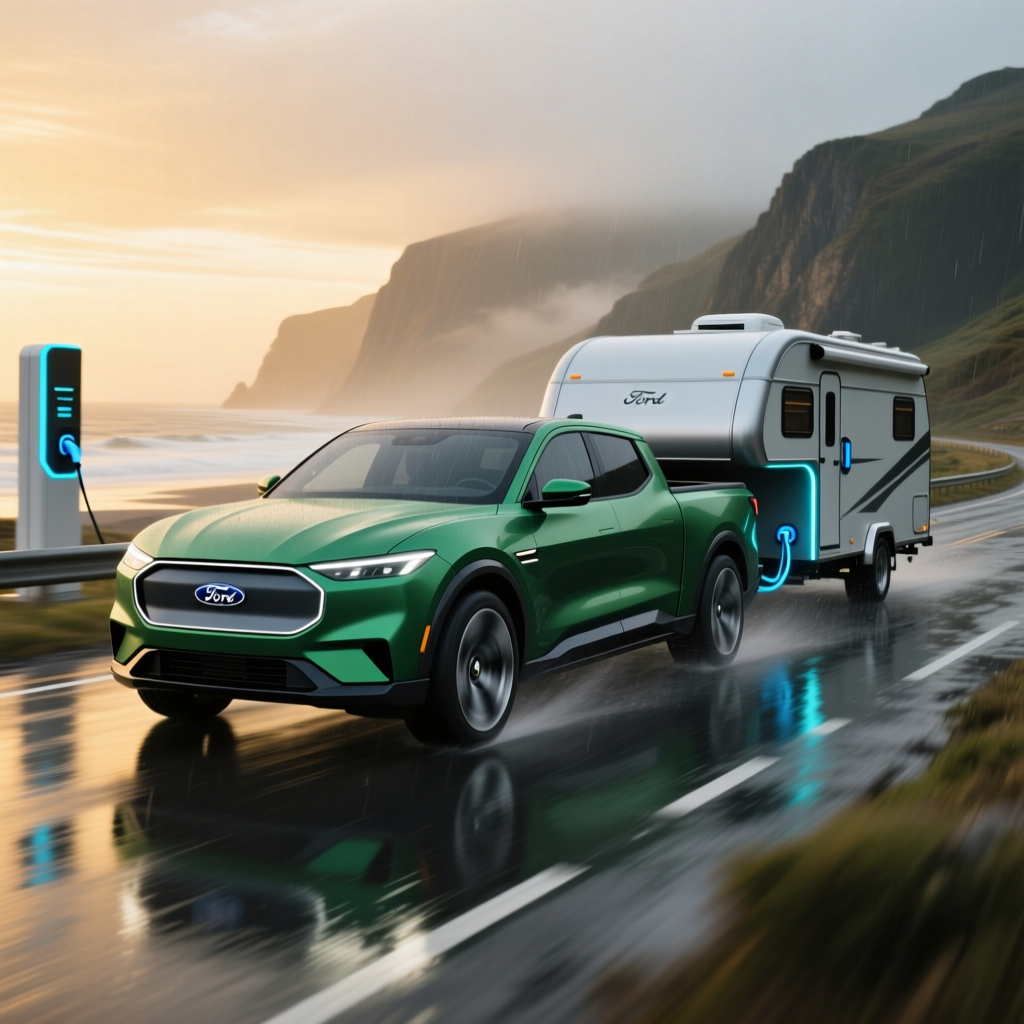
Independent tests conducted by outlets such as Motor Trend, Car and Driver, and various YouTube-based EV reviewers have consistently shown that towing a mid-size travel trailer (approximately 5,000–6,000 pounds) reduces the Lightning's range by roughly 45–55 percent. That means an Extended Range model rated at 300 miles may deliver only 130 to 165 miles of real-world towing range under typical highway conditions.
When towing near the maximum 10,000-pound rating, range can drop even further, potentially to under 100 miles in worst-case scenarios involving high speeds, headwinds, or mountainous terrain. This is not a flaw unique to the Lightning — it is a fundamental reality of physics that applies to every electric vehicle — but it is something buyers must plan around.
Ford has addressed this with the onboard Intelligent Range system, which calculates remaining range based on real-time factors including trailer weight, weather, and terrain. When paired with the FordPass app and the built-in navigation, the truck can suggest charging stops along your route and pre-condition the battery for optimal charging speed upon arrival. For a deeper look at how different EVs handle towing, see our EV towing comparison guide.
Charging Speed: Home & DC Fast Charging
Charging infrastructure and speed are critical considerations for any EV owner, and they become even more important when towing is part of your routine.
Level 2 Home Charging
The F-150 Lightning supports Level 2 AC charging at up to 19.2 kW with the available Ford Charge Station Pro (80-amp hardwired unit). At this rate, a fully depleted Extended Range battery can be replenished in roughly eight hours — ideal for overnight charging. With a more common 48-amp Level 2 charger (11.5 kW), a full charge takes approximately 13 hours for the Extended Range pack.
Ford also offers a mobile charger that works with both 120-volt and 240-volt outlets, though 120-volt trickle charging adds only about two to three miles of range per hour and is best reserved for emergencies or occasional top-ups.
DC Fast Charging
On the road, the Lightning supports DC fast charging at peak rates of approximately 150 kW. Under ideal conditions at a compatible station, the Extended Range battery can charge from 15 to 80 percent in roughly 41 minutes, according to Ford. In practice, charging speed tapers significantly above 80 percent to protect battery health, so the final 20 percent can take nearly as long as the first 65 percent.
The Lightning uses the CCS (Combined Charging System) connector. With the expanding BlueOval Charge Network, owners gain access to tens of thousands of charging points across North America, including Tesla Superchargers via an adapter. This network access is a significant advantage for long-distance travel and especially for towing routes that require mid-trip charging.
However, it is worth noting that charging while towing presents logistical challenges at many public stations. Most charging stalls are not designed to accommodate a truck with an attached trailer, meaning you may need to unhitch or find pull-through stations specifically designed for larger vehicles. The EV charging industry is gradually addressing this gap, but it remains a pain point for frequent towers.
Interior, Technology & the Mega Power Frunk
Step inside the F-150 Lightning and you will find a cabin that balances familiar truck utility with modern electric-vehicle technology. The centerpiece of higher trims is a massive 15.5-inch vertical touchscreen running Ford's SYNC 4A system, which includes wireless Apple CarPlay, wireless Android Auto, and over-the-air software updates.
The digital instrument cluster is configurable and displays EV-specific information such as real-time energy consumption, regenerative braking levels, and battery temperature. The available head-up display projects key driving data onto the windshield, helping you keep your eyes on the road.
The Mega Power Frunk
One of the Lightning's most celebrated features is the Mega Power Frunk — a front trunk that replaces the engine bay with 14.1 cubic feet of lockable, weather-sealed storage. It includes four 120-volt outlets, two USB charge ports, and a drain plug for easy cleaning. With the available Pro Power Onboard system, the frunk becomes a mobile power source capable of running tools, appliances, and even powering essential circuits in your home during an outage (up to 9.6 kW with the Extended Range battery).
Pro Power Onboard
The Pro Power Onboard system transforms the Lightning into a rolling generator. Available in 2.4 kW and 9.6 kW configurations, it provides 120-volt and 240-volt outlets in the bed, the frunk, and the cabin. Job-site workers can run power tools, welders, and compressors directly from the truck. Campers can power electric grills, lights, and entertainment systems without a separate generator. The 9.6 kW version can even power a home during an emergency when paired with the Ford Intelligent Backup Power system and a compatible home transfer switch.
Towing Technology
Ford equips the Lightning with a suite of towing aids that reduce stress and improve safety. The available Pro Trailer Hitch Assist automates the process of aligning the truck with a trailer hitch, while the Trailer Reverse Guidance system uses multiple camera views to help you back into tight spots. The onboard scale feature estimates payload and displays it on the touchscreen and through the taillights, giving you a quick visual check before hitting the road. For more on the best tech-equipped trucks, browse our best electric trucks list.
Driving Dynamics & Performance
Driving the F-150 Lightning is a revelation if your frame of reference is a traditional pickup. The instant torque delivery from the dual electric motors provides seamless, surge-free acceleration that makes merging onto highways and overtaking slower traffic effortless. The low center of gravity — thanks to the battery pack mounted beneath the floor — reduces body roll compared to a gas-powered F-150, and the independent rear suspension (a first for the F-150 lineup) delivers noticeably improved ride quality, particularly when the bed is empty.
Steering is well-weighted and responsive, and the truck feels remarkably planted in corners for something that weighs over 6,000 pounds. The available BlueCruise hands-free driving system works on pre-mapped divided highways and reduces fatigue on long trips, though it still requires driver attention and periodic steering wheel contact.
Off-road capability is adequate for light trails and unpaved roads, with decent ground clearance and the instant torque control that electric motors provide. However, the Lightning's weight and the absence of traditional low-range gearing mean it is not designed for serious rock crawling. For dedicated off-road electric SUVs, check out our best electric SUVs comparison.
Braking is handled by a combination of regenerative braking and traditional friction brakes. The transition between the two is generally smooth, though some drivers report a slightly mushy pedal feel during the initial bite. The one-pedal driving mode provides strong regeneration that can bring the truck to a complete stop in most urban driving scenarios without touching the brake pedal.
Ownership Costs & Value
The financial case for the F-150 Lightning depends heavily on your use case, local electricity rates, and available incentives.
Purchase Price & Incentives
Pricing spans a wide range, from the work-oriented Pro trim to the luxury-focused Platinum. Federal tax incentives, state rebates, and utility company programs can significantly reduce the effective purchase price. The federal EV tax credit eligibility varies by trim and battery configuration, so buyers should verify current qualification status before purchasing.
Fuel & Maintenance Savings
Electricity costs per mile are typically a fraction of gasoline or diesel costs, especially when charging at home on off-peak rates. Maintenance expenses are also substantially lower — there are no oil changes, spark plugs, transmission fluid services, or exhaust system repairs. Brake pad life is extended thanks to regenerative braking, and the electric drivetrain has far fewer moving parts than an internal combustion engine.
Over a typical ownership period, these savings can offset a meaningful portion of the Lightning's premium over a comparably equipped gas F-150. However, the exact break-even point varies widely based on annual mileage, towing frequency, local fuel and electricity prices, and how long you keep the vehicle.
Depreciation & Resale
EV depreciation has historically been steeper than that of gasoline vehicles, driven by rapid technological advancement and fluctuating consumer demand. The F-150 Lightning, as a high-profile model from a legacy automaker with a massive dealer network, may hold value better than some competitors, but buyers should factor in the possibility of accelerated depreciation compared to a traditional truck.
Insurance Costs
Insurance premiums for the Lightning tend to be higher than for equivalent gas-powered F-150s, reflecting the vehicle's higher purchase price and the specialized repair requirements of electric powertrains. Shopping around and comparing quotes from multiple insurers is strongly recommended.
Pros & Cons
Pros
- Instant torque and impressive acceleration — the Lightning feels quicker than its specs suggest
- Mega Power Frunk — 14.1 cubic feet of secure, weather-sealed front storage with power outlets
- Pro Power Onboard — transforms the truck into a mobile power station for job sites, camping, or home backup
- Refined ride quality — independent rear suspension and low center of gravity improve comfort and handling
- Advanced towing technology — Pro Trailer Hitch Assist, onboard scales, and intelligent range estimation
- Low running costs — reduced fuel and maintenance expenses compared to gas and diesel trucks
- Quiet cabin — near-silent operation at all speeds enhances comfort on long drives
Cons
- Significant range loss when towing — expect a 45–55 percent reduction, limiting long-distance towing feasibility
- Charging logistics with a trailer — most public charging stations cannot accommodate a truck with an attached trailer
- Heavy curb weight — over 6,000 pounds impacts tire wear and braking distances
- Cold weather range reduction — 15–25 percent loss in freezing temperatures compounds the towing range issue
- Higher insurance costs — premiums exceed those of comparable gas-powered F-150 models
- DC fast charging speed — peak rate of ~150 kW trails some newer competitors in the EV market
Frequently Asked Questions
How far can the Ford F-150 Lightning really tow?
In real-world testing, the F-150 Lightning Extended Range typically achieves between 130 and 165 miles of range when towing a 5,000–6,000 pound trailer at highway speeds. When towing closer to the 10,000-pound maximum, range may drop below 100 miles depending on conditions. Terrain, speed, wind, and temperature all significantly affect these numbers. Ford's Intelligent Range system helps by providing real-time range estimates that factor in trailer weight and route conditions.
Is the F-150 Lightning good for daily driving without towing?
Absolutely. When used as a daily driver without a trailer, the Lightning is one of the most refined and enjoyable full-size pickups available. The quiet cabin, smooth acceleration, comfortable ride, and generous technology suite make it an excellent commuter vehicle. The Extended Range model comfortably covers most daily driving needs with range to spare, and overnight home charging means you start every day with a full battery.
How long does it take to charge the F-150 Lightning at home?
With the available 80-amp Ford Charge Station Pro (19.2 kW), the Extended Range battery charges from empty to full in approximately eight hours. With a standard 48-amp Level 2 charger (11.5 kW), expect roughly 13 hours for a full charge. For most owners who plug in overnight and do not fully deplete the battery daily, home charging is more than sufficient to maintain a full charge every morning.
Can the F-150 Lightning power my home during an outage?
Yes. When equipped with the 9.6 kW Pro Power Onboard system and the Ford Intelligent Backup Power home integration kit (which includes a transfer switch installed by a licensed electrician), the Lightning can power essential home circuits for up to three days during an outage, or up to 10 days with rationed use. This feature has proven invaluable for owners in areas prone to storms, wildfires, and grid instability.
How does the F-150 Lightning compare to the Rivian R1T and Chevrolet Silverado EV for towing?
Each electric truck has distinct strengths. The Rivian R1T offers a more adventure-oriented design with a shorter bed and a quad-motor option for extreme performance, though its towing capacity is lower. The Chevrolet Silverado EV targets a similar audience to the Lightning with competitive range and towing specs. The Lightning stands out for its familiar F-150 packaging, extensive dealer network, Pro Power Onboard system, and the Mega Power Frunk. For a detailed side-by-side breakdown, see our best electric trucks comparison.
Final Verdict
The Ford F-150 Lightning is a remarkably capable electric truck that succeeds in making electrification feel practical, familiar, and even exciting for mainstream truck buyers. As a daily driver, a job-site tool, and a mobile power station, it is difficult to fault. The instant torque, quiet operation, and Pro Power Onboard system deliver tangible benefits that gasoline trucks simply cannot match.
However, if frequent long-distance towing is a core part of your truck usage, the Lightning's range limitations are a genuine constraint that requires careful trip planning and acceptance of more frequent charging stops. The EV charging infrastructure is improving rapidly, but the reality of charging with a trailer attached remains a friction point.
For the majority of truck owners who tow occasionally or over short distances, the F-150 Lightning is an outstanding choice that delivers lower operating costs, impressive performance, and technology that genuinely enhances your life on and off the job site. If you are ready to explore more options, browse our best electric trucks guide and our complete EV buying guide for expert recommendations tailored to your needs.