Ford F-150 Lightning at a Glance: 2026 Pricing and Incentives
For truck buyers hunting Ford F-150 Lightning specials, timing and trim selection matter more than ever in 2026. Ford has streamlined the Lightning lineup this year, and aggressive dealer incentives — layered on top of the federal §30D tax credit — have pushed effective pricing well below MSRP for qualified buyers. Below is the current trim breakdown before any dealer discounts or incentives are applied.
| Trim | Base MSRP | Battery Pack | EPA Range | §30D Credit Eligible |
|---|---|---|---|---|
| Pro (Standard Range) | $52,990 | 98 kWh (usable) | 240 mi | Yes — up to $7,500 |
| XLT (Standard Range) | $57,990 | 98 kWh (usable) | 240 mi | Yes — up to $7,500 |
| Lariat (Extended Range) | $69,990 | 131 kWh (usable) | 320 mi | Yes — up to $7,500 |
| Platinum (Extended Range) | $91,990 | 131 kWh (usable) | 300 mi | Yes — up to $7,500 |
| Flash (Standard Range) | $59,990 | 98 kWh (usable) | 240 mi | Yes — up to $7,500 |
The F-150 Lightning qualifies as a light-duty truck under IRS §30D rules, meaning the MSRP cap is $80,000 — not the $55,000 cap that applies to sedans and crossovers. That keeps every trim except a fully loaded Platinum within credit range. Buyer income caps still apply: $150,000 single / $225,000 head of household / $300,000 joint filers (modified AGI). Battery critical-mineral and component sourcing requirements must also be met for the full $7,500; partial credits of $3,750 apply if only one threshold is satisfied. Confirm eligibility with your tax professional and check the latest guidance at IRS.gov.
Dealer Specials Tip: Many Ford dealers in 2026 are stacking manufacturer incentives ($2,000–$5,000 depending on region and inventory) with the point-of-sale §30D credit transfer. A Pro Standard Range with the full $7,500 credit and a $3,000 dealer discount can land under $42,500 — undercutting many gas-powered F-150 XLT configurations.
Real-World Range: What the EPA Number Doesn't Tell You
EPA Estimated Range: 240 mi (Standard Range) / 320 mi (Extended Range)
Real-World Expectation: 200–220 mi highway (Standard); 260–290 mi highway (Extended). In freezing temperatures, subtract 20–30% from either figure.
The F-150 Lightning is a heavy vehicle — curb weight exceeds 6,000 lbs on Extended Range trims — and that mass is the enemy of highway efficiency. Around town, regenerative braking recovers energy and range tracks close to EPA. But sustained 70+ mph Interstate driving pushes consumption to 48–54 kWh/100 mi depending on conditions, which is the root of the highway shortfall.
Cold weather compounds the problem. Lithium-ion batteries lose capacity and accept charge more slowly below freezing, and cabin heating in a truck-sized interior is energy-intensive. The Lightning's standard heat pump (on Extended Range trims) helps, but owners in northern climates should budget for 25–30% range loss in sub-30°F conditions. Preconditioning the battery and cabin while still plugged in at home is the single most effective countermeasure.
For context, fueleconomy.gov rates the Extended Range Lightning at 2.0 kWh/mile combined (50 MPGe), which is reasonable for a full-size truck but means long highway stretches will demand careful charge planning.
Charging Speed: DC Fast and Home Level 2 Breakdown
| Charging Level | Max Power | Speed / Time | Connector |
|---|---|---|---|
| Level 1 (120V household) | ~1.4 kW | ~3 mi/hr added | NACS (native) |
| Level 2 (240V home/public) | 19.2 kW (80A) | ~30 mi/hr added; full charge ~10 hr (Std) / ~13 hr (Ext) | NACS (native) |
| DC Fast Charge | 150 kW peak (Std) / 150 kW peak (Ext) | 10–80% in ~41 min (Std) / ~45 min (Ext) | NACS (native); CCS adapter available |
Ford adopted the NACS (North American Charging Standard) port as native equipment on the Lightning, giving direct access to Tesla Supercharger V3/V4 stations — currently the most reliable and widespread DC fast-charging network in the US. This is a significant practical advantage over CCS-equipped competitors that still rely on Electrify America or regional networks with more variable uptime.
The 150 kW peak DC charge rate is the Lightning's most common criticism. Competitors like the Rivian R1T and the Chevrolet Silverado EV can accept 200+ kW, shaving 10–15 minutes off a highway charge stop. The Lightning's charge curve is relatively flat — it holds near peak rate through ~60% SoC before tapering — but the ceiling is lower. On a 300-mile road trip, plan for one 40–45 minute stop at a 150 kW+ charger.
At home, the 80A / 19.2 kW onboard charger is class-leading. Most home Level 2 installations use a 60A circuit delivering 48A / 11.5 kW, which adds roughly 18 miles per hour — enough to fully replenish overnight. If your electrical panel supports a 100A circuit, the full 19.2 kW capability cuts a Standard Range charge to about 5.5 hours. Budget $1,200–$3,000 for a professional Level 2 installation depending on panel capacity and run length; a panel upgrade can add $2,000–$4,000.
Performance, Towing, and Drivetrain
| Specification | Standard Range | Extended Range |
|---|---|---|
| Drivetrain | Dual-motor AWD | Dual-motor AWD |
| Horsepower | 452 hp | 580 hp |
| Torque | 775 lb-ft | 775 lb-ft |
| 0–60 mph | ~4.5 sec | ~3.8 sec |
| Max Towing (with Max Trailer Tow Pkg) | 7,700 lbs | 10,000 lbs |
| Max Payload | 2,235 lbs | 1,800 lbs |
| Battery Chemistry | NMC (nickel manganese cobalt) | NMC (nickel manganese cobalt) |
Every F-150 Lightning is dual-motor all-wheel drive. The instant torque delivery makes it genuinely quick — the Extended Range model's 3.8-second 0–60 time outpaces most gas-powered F-150s and lands in sports-sedan territory. But the real utility story is towing.
Be honest with yourself about towing and range: pulling a 7,000-lb trailer at highway speed will cut range by 40–50%. The Extended Range model rated at 320 miles EPA may deliver 160–180 miles with a heavy trailer in tow. Ford's onboard scales and Intelligent Range estimation are genuinely useful here, factoring trailer weight, grade, and weather into remaining-range predictions. For frequent heavy towing, the Lightning works — but plan routes around charging infrastructure carefully.
Cargo, Interior Space, and the Mega Power Frunk
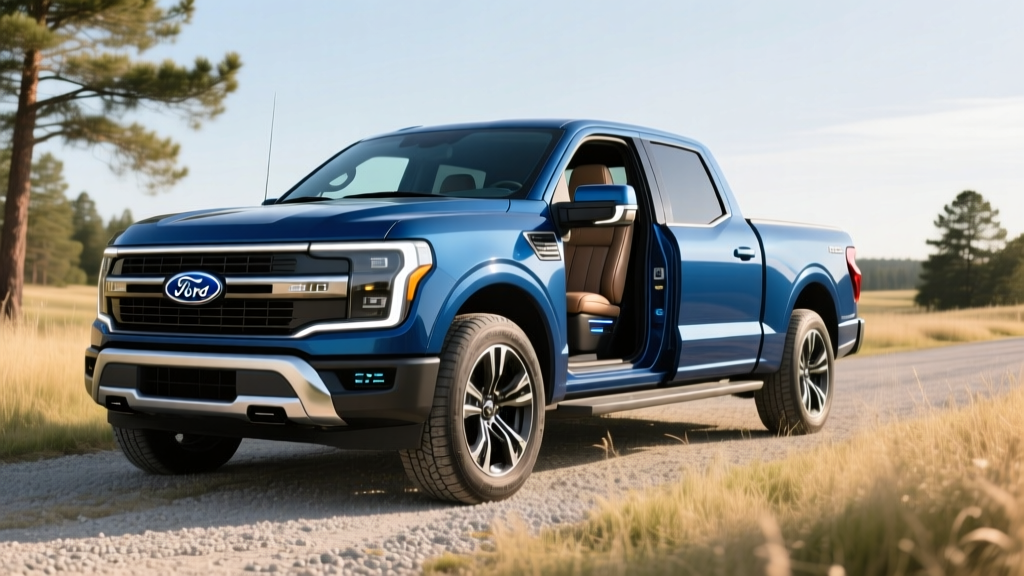
The Lightning retains the F-150 SuperCrew cab configuration, meaning full four-door access and generous rear-seat room:
- Rear legroom: 43.6 inches
- Rear headroom: 40.4 inches
- Bed length: 5.5 ft (standard box)
- Bed volume: 52.8 cu ft
- Front trunk (frunk): 14.1 cu ft — lockable, drainable, with 400 lbs max payload
The Mega Power Frunk remains the Lightning's signature differentiator. It replaces the engine bay with a weather-sealed, power-operated compartment large enough for two carry-on bags or a full set of power tools. The 2.4 kW (standard) or 9.6 kW (available) Pro Power Onboard system turns the truck into a mobile generator — running job-site tools, tailgate appliances, or home backup power during outages via a transfer switch.
Technology, Driver Assists, and Drawbacks
The 2026 Lightning runs Ford's SYNC 4A infotainment on a 12-inch touchscreen (15.5-inch portrait screen on Lariat and Platinum). Wireless Apple CarPlay and Android Auto are standard. The available BlueCruise hands-free driving system operates on over 130,000 miles of pre-mapped divided highways.
SAE Automation Level: BlueCruise is a Level 2 driver-assistance system. The driver must remain attentive, and the cabin camera monitors eye gaze. This is not self-driving — you are legally responsible for the vehicle at all times.
Standard driver-assist features include automatic emergency braking with pedestrian detection, blind-spot monitoring with trailer coverage, lane-keeping assist, and rear cross-traffic alert. The Lightning earned a Top Safety Pick designation from IIHS in prior model years, with good ratings across crash-test categories.
Notable Drawbacks:
- DC fast charging capped at 150 kW — slower than Rivian R1T and Silverado EV on long road trips
- Towing drastically reduces range; a 50% range penalty under heavy load is realistic
- Curb weight (6,000–6,500 lbs) increases tire wear and reduces payload on Extended Range trims
- Platinum trim pushes past the $80,000 MSRP cap for §30D tax credit eligibility
Warranty and Long-Term Ownership
| Battery & Electric Components | 8 years / 100,000 miles |
| Basic Bumper-to-Bumper | 3 years / 36,000 miles |
| Powertrain (non-electric) | 5 years / 60,000 miles |
| Corrosion Perforation | 5 years / unlimited miles |
Ford warrants the Lightning's high-voltage battery against capacity loss below 70% of original capacity for 8 years or 100,000 miles, whichever comes first. NMC chemistry has proven durable in Ford's real-world fleet data, with most owners reporting less than 5% degradation in the first 50,000 miles. Routine maintenance costs are minimal — no oil changes, no transmission fluid, and regenerative braking significantly extends brake pad life.
F-150 Lightning vs. Key Competitors: Is It the Right Electric Truck?
| Spec | Ford F-150 Lightning Ext. | Rivian R1T Dual-Motor | Chevy Silverado EV 4WT |
|---|---|---|---|
| Starting MSRP | $69,990 | $75,900 | $74,800 |
| EPA Range | 320 mi | 352 mi | 380 mi |
| DC Fast Charge Peak | 150 kW | 200+ kW | 200+ kW |
| 0–60 mph | 3.8 sec | 4.5 sec | ~4.5 sec |
| Max Towing | 10,000 lbs | 11,000 lbs | 10,000 lbs |
| Native Connector | NACS | NACS | NACS |
Pros
- Lowest entry price among full-size electric trucks (Pro at ~$45k after credits)
- Native NACS — Supercharger access without adapters
- Pro Power Onboard: 9.6 kW vehicle-to-home capability
- Class-leading frunk (14.1 cu ft)
- Familiar F-150 driving dynamics and dealer network
Cons
- 150 kW DC fast charge cap is below rivals
- Heavy towing cuts range by ~50%
- Platinum trim exceeds §30D MSRP cap
- No Standard Range option on Lariat and above
Choose the F-150 Lightning if: You want the most affordable full-size electric truck, value home-backup power capability, and your typical drives stay within 200 miles or include reliable Supercharger stops.
Consider the Rivian R1T or Silverado EV if: You need maximum DC fast-charging speed for frequent long road trips, require more than 320 miles of EPA range, or regularly tow heavy loads over long distances.
Frequently Asked Questions
What is the real-world range of the Ford F-150 Lightning?
The Standard Range model delivers about 200–220 miles on the highway and close to its 240-mile EPA rating in city driving. The Extended Range model achieves 260–290 highway miles and approaches its 320-mile EPA rating in mixed suburban use. Cold weather (below freezing) can reduce either figure by 20–30%.
How fast does the F-150 Lightning charge?
On a DC fast charger, it peaks at 150 kW and charges from 10–80% in roughly 41–45 minutes depending on battery pack size. At home on a 240V Level 2 connection, the 19.2 kW onboard charger adds about 30 miles of range per hour — among the fastest AC charging rates available in any EV.
How much does the Lightning cost after federal tax credits?
A Pro Standard Range at $52,990 MSRP minus a $7,500 point-of-sale §30D credit comes to roughly $45,490 before dealer discounts. Many dealers offer additional incentives of $2,000–$5,000, potentially bringing the net price into the low $40,000s. Income, sourcing, and MSRP caps apply — verify with your tax advisor.
Does the F-150 Lightning qualify for the federal EV tax credit?
Yes, all trims under $80,000 MSRP qualify as light-duty trucks under §30D rules. Buyer income must fall below $150K (single) / $300K (joint). The vehicle must also meet battery critical-mineral and component sourcing requirements for the full $7,500; check the fueleconomy.gov credit tracker for current eligibility status.
Is the Lightning worth buying over a gas F-150?
If you have home charging and drive under 250 miles daily, the Lightning's lower fuel and maintenance costs, instant torque, Pro Power Onboard, and available tax credits make it a compelling alternative. For frequent long-distance towing or remote-area driving without reliable charging, a gas or hybrid F-150 still has practical advantages.
Can the F-150 Lightning power my home?
Yes. With the available 9.6 kW Pro Power Onboard system and a professionally installed home transfer switch (Ford's Intelligent Backup Power system), the Lightning can supply up to 9.6 kW to essential home circuits for up to three days during an outage, depending on usage.