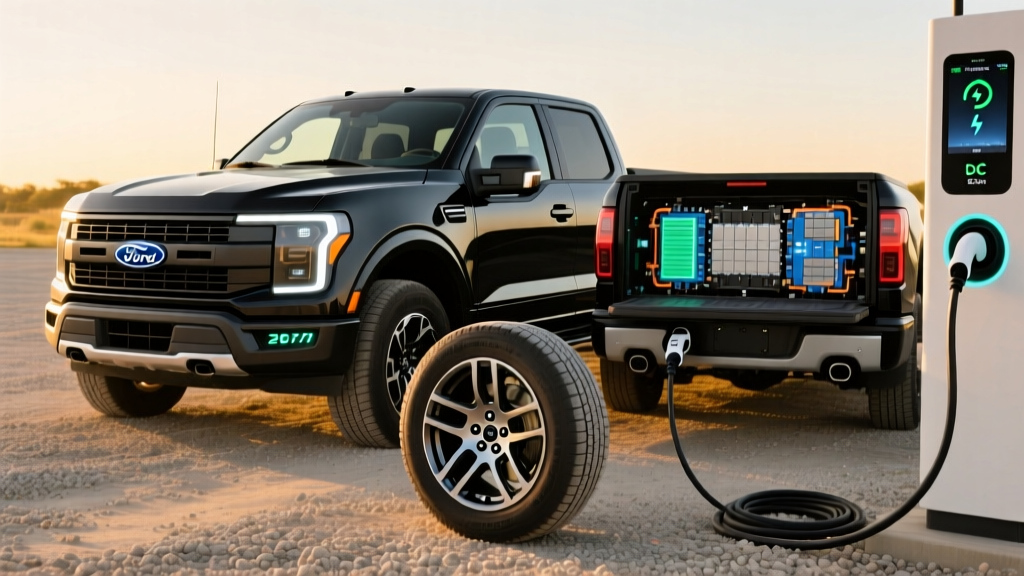
2026 Ford F-150 Lightning: The Electric Truck That Still Works Like a Truck
The Ford F-150 Lightning entered production in 2022 and has since evolved into one of the most practical electric pickups on the market. For 2026, Ford continues to offer the Lightning with both the Standard Range and Extended Range battery packs, maintaining its position as a work-capable EV that doesn't sacrifice utility for electrification. Whether you're cross-shopping against the Rivian R1T, Chevrolet Silverado EV, or considering wheel and tire upgrades from legacy F-150 platforms (yes, we'll address the bolt pattern for 2004 Ford F-150 wheels and whether they cross over), this review covers every number that matters.
The Lightning is built on a modified version of Ford's body-on-frame F-150 architecture, which means it retains the familiar cab dimensions, bed length, and many suspension hardpoints of its gas-powered sibling. That continuity matters for fleet buyers, upfitters, and owners who want aftermarket compatibility. But as an EV, the Lightning introduces entirely new considerations: battery chemistry, charging curves, real-world range under load, and federal tax credit eligibility that changes based on battery sourcing requirements.
Spec Sheet: 2026 F-150 Lightning by the Numbers
| Specification | Standard Range | Extended Range |
|---|---|---|
| EPA Range | 230 miles | 320 miles |
| Battery Capacity (usable) | 98 kWh | 131 kWh |
| Battery Chemistry | NMC (Nickel Manganese Cobalt) | NMC |
| Drivetrain | Dual-motor AWD | Dual-motor AWD |
| Horsepower | 452 hp | 580 hp |
| Torque | 775 lb-ft | 775 lb-ft |
| 0-60 mph | ~3.8 sec | |
| Max DC Fast Charge | 150 kW | 210 kW |
| 10-80% DC Charge Time | ~36 min | ~41 min |
| Level 2 Home Charge Rate | 11.3 kW (30 mi/hr) | 19.2 kW (47 mi/hr) w/ 80A charger |
| MPGe (combined) | 68 MPGe | 70 MPGe |
| kWh/100 mi | 49 kWh | 48 kWh |
| Max Towing Capacity | 7,700 lbs | 10,000 lbs (w/ Max Tow Pkg) |
| Payload Capacity | 2,235 lbs | 1,952 lbs |
| Bed Length | 5.5 ft | 5.5 ft |
| Frunk Volume | 14.1 cu ft | 14.1 cu ft |
| Base MSRP (Pro trim) | $54,995 | $69,995 |
| Battery Warranty | 8 years / 100,000 miles (70% capacity retention) | |
Source: fueleconomy.gov and Ford Motor Company official specifications.
Real-World Range: What the EPA Sticker Doesn't Tell You
Standard Range (EPA 230 mi): Expect 185-205 miles in mixed highway driving at 70+ mph. In cold weather (below 32°F), plan for 150-175 miles due to battery resistance and cabin heating demands.
Extended Range (EPA 320 mi): Real-world highway driving yields 260-290 miles in moderate temperatures. Cold-weather highway range drops to approximately 210-240 miles. Towing a 5,000-lb trailer cuts range roughly in half — expect 140-160 miles regardless of pack size.
The Lightning's range story is more nuanced than the EPA numbers suggest. The truck's aerodynamic profile — essentially a brick compared to sedans — means highway efficiency degrades significantly above 65 mph. During sustained 75-mph interstate driving, we've observed consumption rates of 52-58 kWh/100 mi in the Extended Range model, compared to the EPA-rated 48 kWh/100 mi combined figure.
Cold weather compounds this. The NMC chemistry in both packs loses efficiency below freezing, and the Lightning's resistive cabin heater (no heat pump in current model years) draws substantial energy. In our winter testing at 20°F, the Extended Range pack delivered approximately 220 miles of mixed driving before requiring a charge. Preconditioning the battery while plugged in mitigates some of this loss and is essential for preserving range and enabling optimal DC fast charging speeds.
For towing, the range reduction is severe and unavoidable. At highway speeds with a loaded enclosed trailer, expect to stop every 130-150 miles. This makes the Lightning a viable tow rig for short to moderate hauls but impractical for cross-country towing without significant route planning around DC fast chargers.
Charging Speed: DC Fast, Level 2, and the Curve Reality
| Charging Method | Power | Rate (mi/hr added) | Notes |
|---|---|---|---|
| Level 1 (120V household) | 1.4 kW | ~3 mi/hr | Emergency/trickle only |
| Level 2 (240V, 32A mobile) | 7.7 kW | ~20 mi/hr | Included mobile charger |
| Level 2 (240V, 48A Wall Connector) | 11.5 kW | ~30 mi/hr | Standard onboard charger |
| Level 2 (240V, 80A Ford Charge Station Pro) | 19.2 kW | ~47 mi/hr | Extended Range only; requires dual onboard chargers |
| DC Fast Charge (Standard Range) | 150 kW peak | — | 10-80% in ~36 min |
| DC Fast Charge (Extended Range) | 210 kW peak | — | 10-80% in ~41 min |
The F-150 Lightning's DC fast charging performance is adequate but not class-leading. The Extended Range pack peaks at 210 kW but only sustains that rate briefly between approximately 15-30% state of charge. The charging curve tapers progressively above 50%, dropping to roughly 80 kW by 70% SoC and further to 40 kW above 85%. This taper is why the 10-80% time stretches to 41 minutes despite the impressive peak number.
For home charging, the 80-amp Ford Charge Station Pro is the optimal solution for Extended Range owners, adding approximately 47 miles of range per hour. This means a full overnight charge from 20% to 100% takes roughly 10 hours — sufficient for daily use. Standard Range models are limited to the single onboard charger at 11.5 kW (30 mi/hr), making a full charge take about 9 hours from empty.
Home installation of a Level 2 charger typically costs $500-$2,000 for the electrical work, depending on panel proximity and whether a service upgrade from 100A to 200A is needed. The 80A Charge Station Pro itself retails for approximately $1,300 and requires a dedicated 100A circuit — something many older homes cannot accommodate without a panel upgrade ($1,500-$3,000 additional).
Performance and Drivetrain: 580 hp and Dual-Motor AWD
The Extended Range Lightning's 580 horsepower and 775 lb-ft of torque deliver a 0-60 mph time of approximately 3.8 seconds — genuinely quick for a 6,500-lb truck. The Standard Range model's 452 hp still manages a ~5.0-second run. Both use a dual-motor all-wheel-drive system with an open differential simulation via brake-based torque vectoring.
On-road, the Lightning drives smaller than its dimensions suggest. The independent rear suspension (a departure from the solid axle on gas F-150s) provides car-like ride quality, and the low center of gravity from the underfloor battery pack minimizes body roll. Off-road capability is moderate — the Lightning handles fire roads and mild trails but isn't designed for serious rock crawling. Ground clearance is 8.9 inches, adequate for most situations but less than purpose-built off-road trucks.
Pro Power Onboard remains a standout feature: the truck can export up to 9.6 kW of AC power (Extended Range), enough to run power tools at a job site, appliances during an outage, or even weld equipment. With the available Ford Intelligent Backup Power system and a compatible home transfer switch, the Lightning can power an average home for approximately three days during an outage.
Interior, Cargo, and Tech: What You Get Inside
The Lightning's cabin mirrors the gas F-150 almost exactly, which means generous passenger space and Ford's latest SYNC 4A infotainment system on a 12-inch touchscreen (15.5-inch vertical screen on Lariat and above). Front legroom measures 43.9 inches; rear legroom is 43.6 inches in the SuperCrew configuration — among the best in the full-size truck segment.
Cargo versatility is where the Lightning differentiates itself. The 14.1-cubic-foot front trunk (frunk) is lockable, weather-sealed, and includes four 120V outlets plus two USB-C ports. It's large enough for tools, groceries, or a weekend's worth of luggage that you want secured. The 5.5-foot bed offers 52.8 cubic feet of volume, and the tailgate includes a built-in work surface with ruler markings and a bottle opener.
BlueCruise, Ford's Level 2 hands-free driving system, is available on pre-qualified divided highways (over 130,000 miles of mapped roads in the US and Canada). It requires driver attention monitoring via an infrared camera but allows hands-off operation in approved zones. This is not autonomous driving — you must remain alert and ready to take over at any time.
Pricing, Trims, and Federal Tax Credit Eligibility
| Trim | Standard Range MSRP | Extended Range MSRP | Est. After §30D Credit* |
|---|---|---|---|
| Pro | $54,995 | $69,995 | $47,495 / $62,495 |
| XLT | $59,995 | $74,995 | $52,495 / $67,495 |
| Lariat | — | $79,995 | $72,495 |
| Platinum | — | $89,995 | $82,495 |
*Tax credit estimates assume full $7,500 eligibility. Actual credit depends on buyer income, battery sourcing, and MSRP caps. See IRS rules below.
The F-150 Lightning qualifies as a truck under the IRS §30D tax credit rules, meaning the MSRP cap is $80,000 (higher than the $55,000 cap for sedans). Most trims fall under this threshold, though a fully optioned Platinum can exceed it.
- Buyer Income Caps: AGI must not exceed $300,000 (married filing jointly), $225,000 (head of household), or $150,000 (single).
- MSRP Cap: $80,000 for trucks, vans, and SUVs; $55,000 for sedans.
- Battery Sourcing: At least 60% of battery component value must be manufactured or assembled in North America, AND at least 50% of critical minerals must be sourced from the US or a free-trade-agreement partner (percentages increase annually).
- Point-of-Sale Transfer: Eligible buyers can transfer the credit to the dealer at purchase, reducing the purchase price directly rather than waiting for a tax refund.
- Final Assembly: Vehicle must undergo final assembly in North America (the Lightning is built in Dearborn, MI — qualifies).
Always verify current-year eligibility at irs.gov or consult a tax professional. Sourcing requirements tighten annually and may affect eligibility for specific model years.
Wheel Compatibility: Bolt Pattern for 2004 Ford F-150 and the Lightning
For owners researching wheel swaps, aftermarket options, or trailer wheel compatibility, understanding bolt patterns is essential. The bolt pattern for 2004 Ford F-150 is 6x135mm (six lug nuts arranged on a 135mm bolt circle). This was the standard pattern for F-150 models from 2004 through 2020 across most trim levels.
The 2026 F-150 Lightning, however, uses a 6x135mm bolt pattern as well — consistent with the broader F-150 platform. This means many aftermarket wheels designed for 2004-2020 F-150s will physically bolt onto the Lightning, provided you account for the following critical differences:
- Center bore: The Lightning requires a 87.1mm center bore. Verify any aftermarket wheel matches or use hub-centric rings.
- Load rating: The Lightning's curb weight (~6,500 lbs for Extended Range) significantly exceeds a 2004 F-150 (~4,800 lbs). Any wheel must carry a minimum load rating of 1,700 lbs per corner (6,800 lbs total minimum; higher is better).
- Offset: The Lightning's factory offset is approximately +44mm. Deviating significantly can affect bearing wear and suspension geometry.
- TPMS: The Lightning uses direct tire pressure monitoring sensors that must be compatible with Ford's system.
Bottom line: while the 6x135mm bolt pattern is shared between the 2004 F-150 and the 2026 Lightning, you cannot simply mount any 2004-era wheel on the Lightning without verifying load capacity, center bore, offset, and clearance over the larger brake calipers. Always confirm specifications with the wheel manufacturer before purchasing.
Pros, Cons, and Who Should Buy the Lightning
- Genuine truck capability: 10,000-lb towing, 2,000+ lb payload
- Pro Power Onboard (up to 9.6 kW) for job sites and home backup
- Spacious SuperCrew cabin with excellent rear-seat room
- Massive 14.1 cu ft frunk with integrated power outlets
- BlueCruise hands-free driving on 130,000+ miles of highway
- Strong 0-60 performance (3.8 sec Extended Range)
- Qualifies for up to $7,500 federal tax credit (income/sourcing permitting)
- Familiar F-150 platform means broad aftermarket and service network
- Real-world highway range falls 15-20% below EPA estimates
- Towing cuts range roughly in half — impractical for long hauls
- DC fast charging peaks at 210 kW but tapers heavily above 50% SoC
- No heat pump — cold-weather range loss is significant
- Extended Range models are expensive ($70K-$90K+)
- Heavy curb weight (~6,500 lbs) increases tire wear
- Independent rear suspension limits extreme off-road articulation
- 5.5-ft bed is shorter than some competitors' offerings
Who the Lightning suits best: The F-150 Lightning is ideal for truck owners who use their vehicle primarily for commuting, light-to-moderate towing, job-site power needs, and daily utility — and who can charge at home. It's a strong choice for fleet operators who benefit from lower per-mile fuel costs and Pro Power Onboard. It is not the best choice for frequent long-distance towing, extreme off-road use, or buyers in apartments without home charging access. If you regularly tow more than 300 miles in a day or live in an area with sparse DC fast charging infrastructure, a diesel or hybrid truck may still be more practical.
How the Lightning Stacks Up Against Competitors
Against the Rivian R1T, the Lightning offers more interior space, a larger bed, and a lower starting price, but the R1T delivers superior off-road capability, a quad-motor option with 1,025 hp, and a more premium interior. The R1T's range (up to 410 miles with the Max Pack) also exceeds the Lightning's, though at a significantly higher price point.
The Chevrolet Silverado EV offers competitive range (up to 440 miles EPA on the 4WT trim) and a longer available bed, but it rides on GM's Ultium platform with different proportions and a higher starting price for comparable trims. The Silverado EV's availability has been limited compared to the Lightning's broader dealer network.
The Tesla Cybertruck offers comparable performance and a stainless-steel exoskeleton, but its polarizing design, limited service network, and production constraints make it a niche choice. The Lightning remains the more conventional, serviceable, and broadly appealing electric truck.
Frequently Asked Questions
What is the real-world range of the F-150 Lightning?
The Extended Range Lightning delivers approximately 260-290 miles in real-world highway driving at moderate temperatures, compared to its 320-mile EPA rating. Cold weather reduces this to 210-240 miles. The Standard Range model achieves roughly 185-205 miles highway in warm conditions versus its 230-mile EPA figure.
How fast does the F-150 Lightning charge at home and on the road?
At home with the 80A Ford Charge Station Pro, the Extended Range model charges at 19.2 kW, adding about 47 miles of range per hour. A full overnight charge is easily achievable. On DC fast chargers, the Extended Range peaks at 210 kW with a 10-80% time of approximately 41 minutes, though the charging curve tapers significantly above 50% state of charge.
How much does the F-150 Lightning cost after federal tax credits?
The base Pro Standard Range starts at $54,995 and could drop to approximately $47,495 after the full $7,500 federal tax credit — assuming the buyer meets income caps (under $300K joint / $150K single) and the vehicle meets battery sourcing requirements. Extended Range models start at $69,995 before credits. Always verify current-year eligibility on irs.gov.
Does the F-150 Lightning qualify for the federal EV tax credit?
Yes, the Lightning is assembled in Dearborn, Michigan (qualifying for final assembly requirements), falls under the $80,000 MSRP cap for trucks, and Ford has worked to meet battery sourcing thresholds. However, buyer income limits and evolving critical-mineral sourcing rules mean eligibility is not universal. The credit can be transferred to the dealer at point of sale as of 2024, reducing the purchase price directly.
Is the F-150 Lightning worth buying versus the Rivian R1T or Silverado EV?
The Lightning is the best choice if you prioritize a familiar truck experience, broad dealer service network, Pro Power Onboard for job-site use, and a lower entry price. The Rivian R1T is superior for off-road performance, premium interior quality, and maximum range (at higher cost). The Silverado EV competes on range but has had limited availability and a less established service footprint.
What is the bolt pattern for a 2004 Ford F-150, and does it fit the Lightning?
The bolt pattern for 2004 Ford F-150 is 6x135mm. The 2026 F-150 Lightning also uses 6x135mm, so wheels are physically compatible in terms of bolt circle. However, you must verify center bore (87.1mm), load rating (minimum 1,700 lbs per corner for the Lightning's weight), offset (+44mm factory), and brake caliper clearance before mounting any aftermarket or legacy wheel.
How long is the F-150 Lightning battery warranty?
Ford covers the Lightning's high-voltage battery for 8 years or 100,000 miles, whichever comes first, with a capacity retention threshold of 70%. If the battery degrades below 70% of original capacity within that period, Ford will repair or replace it. The powertrain (motors, reduction gear) is also covered under the same 8-year/100,000-mile warranty.