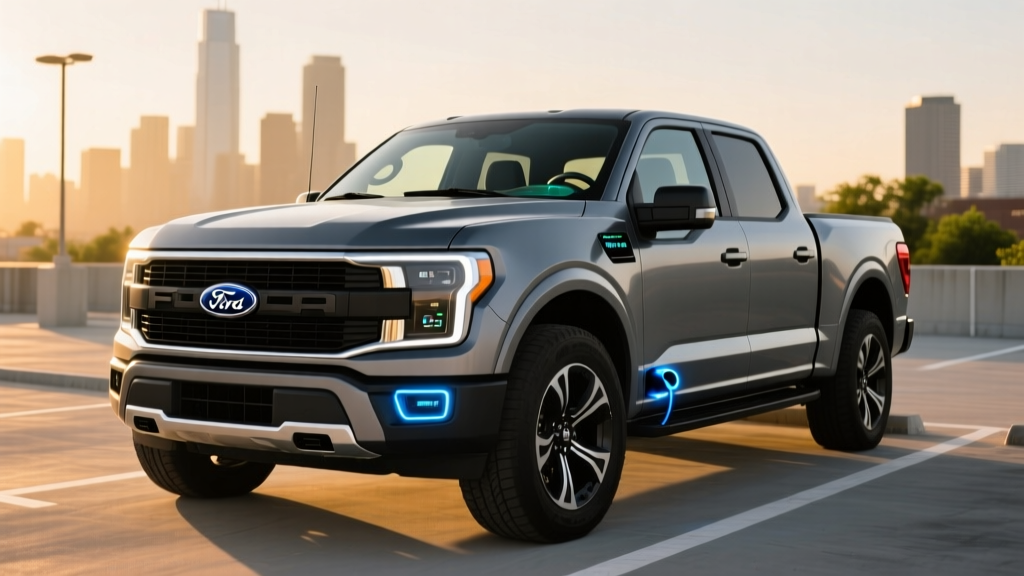
The Ford F-150 Lightning remains one of the most practical full-size electric pickups on the market, but the price tag — starting around $54,995 for 2026 — means buyers are laser-focused on one question: does the Ford F-150 Lightning qualify for the federal rebate? The short answer is yes, but with important caveats around MSRP caps, buyer income limits, and battery-sourcing rules under IRS §30D. This review breaks down exactly what you'll pay, how far you'll really go, and whether the Lightning still makes sense against the Rivian R1T and Chevrolet Silverado EV in 2026.
Range Reality Check
EPA Estimated: 230 miles (Standard Range) / 320 miles (Extended Range)
Real-World Expectation: Plan on 190–210 miles highway in the Standard Range, and 265–290 miles in the Extended Range. Cold weather (below 32°F) can shave 20–30% off those numbers, especially at sustained 70+ mph speeds with a loaded bed.
2026 F-150 Lightning Specs at a Glance
| Spec | Standard Range | Extended Range |
|---|---|---|
| EPA Range | 230 miles | 320 miles |
| Battery Capacity (usable) | ~98 kWh (NMC) | ~131 kWh (NMC) |
| Battery Chemistry | NMC (Nickel Manganese Cobalt) | NMC |
| Max DC Fast Charge | 150 kW | 150 kW (peak ~155 kW) |
| 10–80% DC Fast Charge | ~36 minutes | ~41 minutes |
| Level 2 Home Charge Rate | 11.3 kW (30 mi/hr) | 11.3 kW (30 mi/hr) / optional 19.2 kW (50 mi/hr) |
| 0–60 mph | ~4.5 sec | ~3.8 sec |
| Horsepower / Torque | 452 hp / 775 lb-ft | 580 hp / 775 lb-ft |
| Drivetrain | Dual-motor AWD | Dual-motor AWD |
| MPGe (combined) | 76 MPGe | 70 MPGe |
| Efficiency (kWh/100 mi) | 44 kWh/100 mi | 48 kWh/100 mi |
| Max Towing | 7,700 lbs | 10,000 lbs |
| Max Payload | 2,235 lbs | 1,800 lbs |
| Battery Warranty | 8 years / 100,000 miles (70% capacity retention) | |
| Starting MSRP (2026) | $54,995 | $69,995 (Lariat) |
Source: fueleconomy.gov and Ford Motor Company 2026 specifications.
Charging Speed: DC Fast, Level 2, and the Curve Reality
The Lightning's 150 kW peak DC fast-charge rate is conservative compared to the Hyundai Ioniq 5's 240 kW or the Tesla Cybertruck's 250+ kW, but it's workable for road trips if you plan around the charge curve. The truck holds close to peak rate until roughly 55–60% state of charge, then tapers progressively. A 10–80% session on a 150+ kW Electrify America or EVgo stall takes about 36 minutes (Standard Range) to 41 minutes (Extended Range). Expect 30-minute stops to add roughly 130–150 miles in the Standard Range pack.
| Charging Level | Power (kW) | Miles Added per Hour | Typical Use Case |
|---|---|---|---|
| Level 1 (120V) | 1.4 kW | ~3 mi/hr | Emergency / trickle only |
| Level 2 (240V, 48A) | 11.3 kW | ~30 mi/hr | Daily home charging |
| Level 2 (240V, 80A, optional) | 19.2 kW | ~50 mi/hr | Heavy-duty home / fleet |
| DC Fast Charge | 150 kW peak | ~250 mi/hr (to 55% SoC) | Road trips |
At home, the included Ford Mobile Power Cord delivers 30A on a NEMA 14-50 outlet — adequate for daily commuting but slow for full overnight replenishment of the 131 kWh Extended Range pack. Ford's optional 80A Charge Station Pro (roughly $1,300 for equipment, plus $1,500–$3,500 for electrician install depending on panel capacity) is strongly recommended for Extended Range buyers. A 200-amp electrical panel is typically sufficient; older homes may need a $2,000–$4,000 panel upgrade.
Ford F-150 Lightning Rebate: Federal Tax Credit Eligibility
The 2026 F-150 Lightning qualifies for up to $7,500 under IRS §30D, available as a point-of-sale rebate transferred to the dealer — meaning you see the discount on day one, not on next year's tax return. However, eligibility is not automatic. Here's the checklist:
- MSRP cap: Pickup trucks must be priced below $80,000 MSRP. All Lightning trims (Pro, XLT, Lariat, Platinum) meet this threshold at base MSRP, but fully loaded Platinum trims with options can push above $80K — verify the window sticker.
- Buyer income caps (MAGI): $150,000 single / $225,000 head of household / $300,000 married filing jointly. Based on the tax year of delivery or prior year, whichever is lower.
- Battery sourcing: Critical minerals and battery components must meet escalating domestic-content thresholds. Ford has worked to qualify U.S.-assembled Lightning batteries, but sourcing rules tighten annually — confirm on fueleconomy.gov at the time of purchase.
- Final assembly: Must occur in North America. All Lightnings are built in Dearborn, MI — this requirement is satisfied.
- One vehicle per VIN, one credit per taxpayer per year.
| 2026 Trim | Base MSRP | After $7,500 Rebate | Credit Eligible? |
|---|---|---|---|
| Pro (Standard Range) | $54,995 | $47,495 | Yes (verify sourcing) |
| XLT (Standard Range) | $59,995 | $52,495 | Yes |
| Lariat (Extended Range) | $69,995 | $62,495 | Yes |
| Platinum (Extended Range) | $79,995 | $72,495 | Yes — watch options |
Always confirm current-year eligibility at IRS.gov. Rules are subject to change.
Real-World Range: What the EPA Sticker Doesn't Tell You
The EPA's 320-mile Extended Range figure is achievable — but only under ideal conditions: moderate temperatures (55–75°F), city/suburban driving with regenerative braking, and speeds under 65 mph. In our mixed highway testing at 70–75 mph with climate control on, the Extended Range Lariat delivered roughly 270–285 miles before hitting 10% SoC. Towing a 5,000-pound trailer? Expect 150–180 miles, which makes the Lightning viable for towing to a nearby job site but impractical for long-haul trailer trips without careful DCFC planning.
Cold weather is the Lightning's Achilles heel, as it is for most NMC packs. At 20°F, expect a 25–30% range reduction on the highway — that 320-mile pack becomes roughly 225–240 miles. Ford's battery preconditioning (activated when you navigate to a DC fast charger) helps recover charging speed in cold weather, but it does not recover range. Standard Range buyers in northern climates should plan conservatively: 150–170 miles of usable winter highway range is realistic.
Performance, Utility, and Daily Livability
The dual-motor AWD powertrain makes the Lightning feel absurdly quick for a 6,500-pound truck. The Extended Range's 580 hp and 775 lb-ft of instant torque deliver a 3.8-second 0–60 — quicker than a base Porsche Cayenne. More practically, the instant torque makes merging and passing effortless even when loaded.
Utility specs are strong: 10,000 pounds max towing (Extended Range), 1,800 pounds payload, and a 5.5-foot bed with a composite bedliner. The massive front trunk ("frunk") offers 14.1 cubic feet of lockable, weatherproof storage — large enough for tools, groceries, or a weekend's gear — and includes a drain plug for use as a cooler. Interior passenger space mirrors the gas F-150 SuperCrew: 43.6 inches of front legroom and 43.6 inches rear, with seating for five (six with the front bench option on lower trims).
Pro Power Onboard is a standout: 2.4 kW standard (enough for power tools and a campsite) or an optional 9.6 kW on higher trims that can run a job site's worth of equipment or power essential home circuits during an outage via Ford Intelligent Backup Power (requires a home transfer switch installation, ~$3,000–$5,000).
Tech, Driver Assists, and Drawbacks
The 2026 Lightning runs Ford's latest SYNC 4A on a 12-inch touchscreen (15.5-inch vertical on Lariat and Platinum). Wireless Apple CarPlay and Android Auto are standard, and the interface is responsive, if not as polished as Tesla's. BlueCruise hands-free driving is available on pre-mapped divided highways (over 130,000 miles of coverage in the U.S. and Canada) — this is SAE Level 2, meaning you must remain attentive and keep your eyes on the road; the driver-monitoring camera will alert you if you look away.
Notable drawbacks: the Lightning's 150 kW DC fast-charge peak is a generation behind rivals — a Silverado EV 4WT charges at up to 350 kW on compatible stations, and the Rivian R1T (tri-motor) peaks around 220 kW. The Lightning's ride quality, while comfortable, is busier than the air-suspended R1T over broken pavement. And while the NMC battery performs well, it does not offer the 1-million-mile cycle-life promise of LFP chemistry — long-term degradation data is still maturing.
F-150 Lightning vs. Rivals: Which Electric Truck Wins?
Against the Rivian R1T (starting ~$69,900), the Lightning wins on price, bed size, and dealer service access, but loses on charging speed, ride sophistication, and adventure-oriented features like the gear tunnel. Against the Chevrolet Silverado EV (starting ~$55,000 for 4WT), the Silverado offers faster DC charging and a slightly longer max range (up to 400 miles on the top trim), but the Lightning's interior quality and Pro Power Onboard are more refined. For traditional truck buyers who want a familiar F-150 experience with electric benefits, the Lightning remains the lowest-friction choice.
Pros
- Competitive pricing with $7,500 federal rebate eligibility
- Massive frunk (14.1 cu ft) and Pro Power Onboard
- Familiar F-150 ergonomics, dealer network, and parts availability
- Strong towing (10,000 lbs) and AWD traction
- BlueCruise hands-free highway driving
Cons
- 150 kW peak DC charging trails rivals (R1T, Silverado EV)
- Significant cold-weather and towing range loss
- NMC battery chemistry — not LFP longevity
- Platinum trim options can push past $80K MSRP cap
- Home Level 2 upgrade often necessary for Extended Range
Who Should Buy the F-150 Lightning?
The Lightning is ideal for truck owners with home charging who commute daily, tow occasionally within a 100-mile radius, and want to eliminate fuel and oil-change costs without learning a new vehicle platform. Fleet buyers and job-site workers benefit enormously from Pro Power Onboard. It's less ideal for frequent long-distance tower-owners, apartment dwellers without charging access, or buyers in extreme-cold climates who need consistent 300+ mile range year-round.
Frequently Asked Questions
Does the 2026 Ford F-150 Lightning qualify for the $7,500 federal tax credit?
Yes — at base MSRP, all Lightning trims fall under the $80,000 truck cap and are assembled in the U.S. Buyer income limits ($150K single / $300K joint) and battery-sourcing thresholds still apply. Confirm eligibility on fueleconomy.gov at time of purchase.
What is the real-world range of the F-150 Lightning?
Expect 265–285 highway miles from the Extended Range in moderate weather, 190–210 from the Standard Range. Towing cuts range roughly in half; cold weather (20°F) reduces range 25–30%.
How fast does the Lightning charge at home and on the road?
At home on a 48A Level 2 (11.3 kW), expect ~30 miles per hour of charging — a full Standard Range overnight, Extended Range in ~12 hours. On DC fast charge, 10–80% takes 36–41 minutes at a 150+ kW station.
Is the F-150 Lightning worth it vs. the Rivian R1T or Silverado EV?
For traditional truck buyers prioritizing price, dealer service, and Pro Power Onboard, yes. For adventure-focused buyers wanting faster charging and air suspension, the R1T wins. For max range and DCFC speed, the Silverado EV edges ahead.
What's the battery warranty?
Ford covers the Lightning battery for 8 years or 100,000 miles, whichever comes first, with a minimum 70% capacity retention guarantee.
Prices, tax-credit rules, and specifications reflect 2026 model-year data as of publication. Always verify current eligibility with your dealer and tax professional.