Quick Verdict: The Working-Class Electric Truck
The Ford F-150 Lightning Pro is the entry point into Ford's electric full-size pickup lineup, and it doesn't feel like a compromise. With 563 horsepower, standard all-wheel drive, and a starting MSRP that undercuts most competitors, the Pro trim targets fleet operators, tradespeople, and budget-conscious buyers who need a truck first and an EV second. For 2026, Ford continues to offer the Pro with the Standard Range battery (EPA-estimated 240 miles) while reserving the Extended Range pack (320 miles) for higher trims or as a standalone option.
The Lightning Pro isn't trying to be a luxury cruiser. It's a tool — one that happens to accelerate like a sports car, costs roughly $0.04–$0.06 per mile to fuel at home, and qualifies for the full federal tax credit under current IRS rules. But with real-world highway range dropping below 200 miles and DC fast-charging speeds that lag behind newer platforms, buyers need to know exactly what they're signing up for.
Range, Battery & Real-World Efficiency
Real-World Expectation: 190–215 miles highway; 220–240 miles mixed city; 160–185 miles in cold weather (below 32°F) or while towing.
The Standard Range Lightning Pro uses a 98 kWh usable lithium-ion NMC (nickel manganese cobalt) battery pack. Ford does not offer LFP chemistry on the Lightning lineup — all trims use NMC for its higher energy density, which matters in a truck this size. The pack sits low in the chassis between the frame rails, contributing to a low center of gravity that makes the Lightning feel more planted than its gas counterpart.
On the EPA's fueleconomy.gov listing, the F-150 Lightning Standard Range AWD achieves 76 MPGe combined (78 city / 74 highway), translating to roughly 49 kWh per 100 miles. That's thirsty by EV standards — for comparison, a Tesla Model Y uses about 28 kWh/100mi — but expected for a 6,500-pound truck pushing a brick-wall frontal area.
In real-world testing, highway cruising at 70–75 mph consistently yields 2.0–2.3 miles per kWh, putting actual highway range between 196 and 225 miles. Cold weather compounds this: lithium-ion batteries lose efficiency below freezing, and cabin heating in a truck-sized cabin draws significant power. Expect a 20–30% range reduction in sustained sub-32°F conditions unless you precondition the battery and cabin while plugged in.
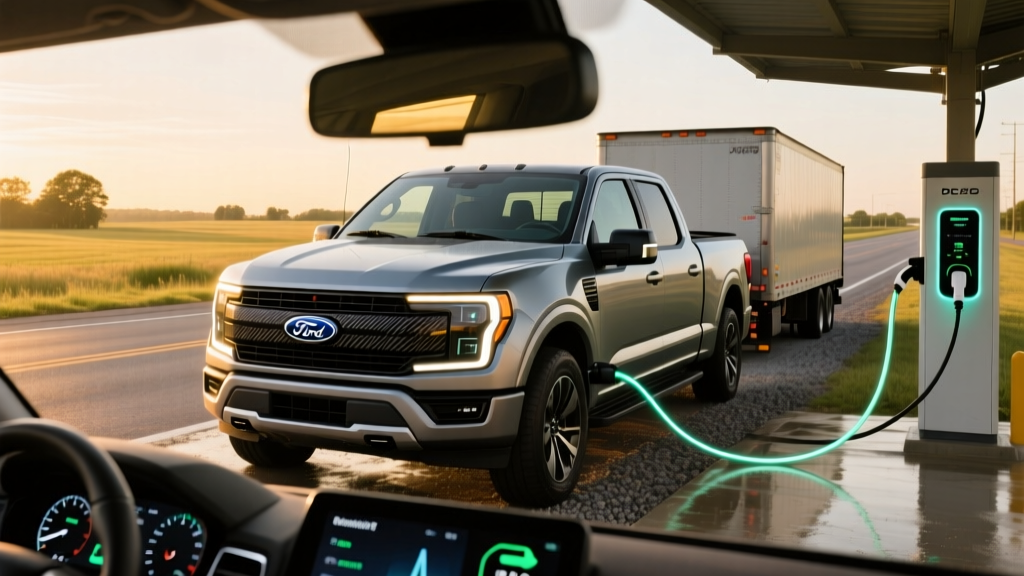
Towing is where range anxiety becomes range reality. Pulling a 5,000-pound trailer at highway speeds can cut range nearly in half, yielding 120–150 miles before you need a charger. Ford's onboard range calculator accounts for trailer load and terrain, and it's remarkably accurate — trust it over the dashboard guess-o-meter.
Charging Speed: DC Fast, Level 2 & Home Setup
| Charging Level | Power / Rate | Time / Speed | Notes |
|---|---|---|---|
| DC Fast Charge (Peak) | 150 kW max | 15%–80% in ~44 minutes | Peak rate not sustained; tapers sharply above 80% |
| DC Fast Charge (Sustained Avg) | ~90–110 kW avg | 10%–80% in ~48–52 minutes | Real-world average on 150+ kW stations |
| Level 2 (Home, 48A) | 11.5 kW | ~30 miles of range per hour | Full charge in ~8.5 hours (0–100%) |
| Level 2 (Home, 32A) | 7.7 kW | ~20 miles of range per hour | Adequate for overnight top-ups |
| Level 1 (120V outlet) | 1.4 kW | ~3–4 miles per hour | Emergency only; ~60+ hours for full charge |
The Lightning Pro's DC fast-charging capability is its most debated spec. At a peak of 150 kW, it's slower than the Rivian R1T (220 kW) and the Chevrolet Silverado EV (350 kW on capable trims). On a Electrify America or Tesla Supercharger (via Ford's NACS adapter, now standard for 2026 models), you'll see 150 kW briefly around 20–30% state of charge, then a steady taper. The charge curve drops to roughly 80 kW by 60% SoC and falls further to 40 kW past 80%.
For home charging, the Lightning Pro comes with a Ford Mobile Power Cord that handles Level 1 (120V) and, with a 240V NEMA 14-50 outlet, Level 2 at up to 30 amps (7.2 kW). For the full 11.5 kW Level 2 experience (48 amps), you'll need a hardwired Ford Charge Station Pro or a third-party unit like the ChargePoint Home Flex, installed by a licensed electrician on a 60-amp circuit. Budget $800–$1,500 for the unit plus $500–$2,000 for professional installation depending on your panel capacity and run length.
One critical advantage: the Lightning Pro supports Pro Power Onboard with 2.4 kW of built-in power export (upgradeable to 9.6 kW on higher trims). The Pro's 2.4 kW system includes two 120V bed outlets and two 120V cabin outlets — enough to run job-site tools, a refrigerator during an outage, or tailgate essentials.
Performance, Drivetrain & Towing
| Specification | F-150 Lightning Pro (Standard Range) |
|---|---|
| Drivetrain | Dual-motor AWD (standard) |
| Horsepower | 563 HP |
| Torque | 775 lb-ft |
| 0–60 mph | ~4.0 seconds |
| Top Speed | ~110 mph (electronically limited) |
| Max Payload | 2,235 lbs |
| Max Towing (with Max Tow Pkg) | 7,700 lbs |
| Curb Weight | ~6,171 lbs |
Every F-150 Lightning Pro comes with dual motors and all-wheel drive — there's no rear-wheel-drive option. The 563 HP and 775 lb-ft of torque make it the quickest F-150 Ford has ever sold, hitting 60 mph in roughly 4.0 seconds. That's not just quick for a truck; it's quick by any standard, and the instant electric torque makes merging and passing effortless even when loaded.
Towing capacity on the Pro trim is 7,700 pounds when equipped with the optional Max Trailer Tow Package. Without it, the standard rating drops to 5,000 pounds. Payload capacity of 2,235 pounds is competitive with gas F-150s, and the independent rear suspension (a Lightning exclusive vs. the gas truck's solid axle) gives the Lightning a noticeably smoother ride when the bed is empty.
The regenerative braking system offers two modes: a mild setting that mimics a gas truck's coasting feel, and a one-pedal mode that provides aggressive deceleration. Most owners settle into one-pedal driving within a week and rarely touch the brake pedal in city traffic, which also reduces brake pad wear significantly.
Interior, Cargo & Technology
The Lightning Pro's interior is purposeful rather than premium. You get cloth seats, a 12-inch touchscreen running SYNC 4, wireless Apple CarPlay and Android Auto, and a 12-inch digital instrument cluster. The center stack is dominated by physical knobs for climate control — a refreshing choice for work-truck buyers who wear gloves. The shifter folds flat into the center console, creating a makeshift work surface Ford calls the "Interior Work Surface" (standard on Pro).
Cargo and passenger dimensions:
- Front legroom: 43.9 inches
- Rear legroom: 43.6 inches (SuperCrew cab)
- Bed length: 5.5 feet (standard on all Lightning trims)
- Bed volume: 52.8 cubic feet
- Front trunk (frunk): 14.1 cubic feet — lockable, weatherproof, with a drain plug and 400 lbs of payload capacity
- Rear seat cargo (behind second row): Limited to under-seat storage; seats fold flat for longer items
The frunk is the Lightning's party trick. At 14.1 cubic feet, it swallows two carry-on bags and a backpack easily, or serves as secure, lockable storage for tools and gear. The power-open hood is activated by a button on the key fob or grille.
On the driver-assistance front, the Pro includes Ford Co-Pilot360 2.0 as standard: automatic emergency braking with pedestrian detection, blind-spot monitoring with trailer coverage, lane-keeping assist, rear parking sensors, and a rearview camera. BlueCruise (Ford's hands-on-highway Level 2 system) is not standard on the Pro trim — it requires the Co-Pilot360 Assist 2.0 package or stepping up to XLT/Lariat trims. Remember: BlueCruise is SAE Level 2, meaning the driver must remain attentive at all times. It is not self-driving.
Pricing, Tax Credit & Total Cost
| Item | Amount |
|---|---|
| Base MSRP (Pro, Standard Range) | $54,995 (incl. $2,095 destination) |
| As-Tested (Pro + Max Tow Pkg + Mobile Power Cord upgrade) | ~$58,500 |
| Federal §30D Tax Credit (if eligible) | Up to $7,500 |
| Effective Price After Full Credit | ~$47,495 |
| Estimated State Incentives | Varies ($0–$5,000+; check your state) |
The 2026 F-150 Lightning Pro starts at $54,995 including destination charges. That positions it as one of the most affordable electric full-size pickups on the market, undercutting the Rivian R1T (starting ~$70,000+) and landing close to the Chevrolet Silverado EV Work Truck.
Federal tax credit eligibility (§30D): The F-150 Lightning Pro is a pickup truck, so it falls under the $80,000 MSRP cap for trucks, vans, and SUVs. However, qualifying for the full $7,500 credit depends on several IRS rules that change periodically. Per the IRS clean vehicle credit page, key requirements include:
- Buyer income caps: Modified AGI must not exceed $300,000 (joint), $225,000 (head of household), or $150,000 (single)
- MSRP cap: Vehicle MSRP must be under $80,000 (trucks/SUVs) — the Lightning Pro clears this easily
- Battery sourcing: Critical minerals and battery components must meet phased-in domestic/content requirements that tighten annually through 2032
- Point-of-sale transfer: As of 2024+, you can transfer the credit to the dealer at purchase, reducing your out-of-pocket cost immediately rather than waiting for tax filing
- Assembly: Vehicle must undergo final assembly in North America (the Lightning is built in Dearborn, MI ✓)
Battery-sourcing rules are the wildcard. Ford has worked to shift its supply chain toward compliant sources, and as of early 2026, the Lightning Standard Range qualifies for at least $3,750 of the credit; the full $7,500 depends on the latest critical-mineral sourcing thresholds. Always verify current eligibility on fueleconomy.gov's tax credit tool before purchasing, and consult a tax professional for your specific situation.
Warranty, Ownership Costs & Reliability
Ford backs the F-150 Lightning with a solid warranty package:
- Battery & electric components: 8 years / 100,000 miles (whichever comes first), covering defects and capacity loss below 70% of original capacity
- Bumper-to-bumper: 3 years / 36,000 miles
- Powertrain (non-electric): 5 years / 60,000 miles
- Corrosation perforation: 5 years / unlimited miles
The 70% capacity retention threshold is industry-standard and aligns with competitors like Rivian and GM. In practice, NMC packs in liquid-cooled systems like the Lightning's have shown degradation curves of roughly 5–8% over the first 100,000 miles based on early fleet data — well within the warranty buffer.
On the cost side, electricity for home charging averages $0.13–$0.18 per kWh nationally. At 49 kWh/100mi, that's roughly $6.37–$8.82 per 100 miles, compared to $14–$18 per 100 miles for a gas F-150 getting 18 MPG at $3.50/gallon. Over 15,000 miles annually, the Lightning Pro can save $1,200–$1,800 per year in fuel costs alone when charging primarily at home.
Insurance premiums for the Lightning tend to run 15–25% higher than a comparable gas F-150, according to industry averages — factor in roughly $1,800–$2,600 annually depending on your state and driving record. Maintenance costs are dramatically lower: no oil changes, no transmission fluid, and regenerative braking extends pad life to 100,000+ miles in typical driving.
Pros, Cons & Who Should Buy
Pros
- 563 HP / 775 lb-ft standard — quickest F-150 ever sold
- Standard AWD dual-motor on every Pro trim
- 14.1 cu-ft frunk with power open and 400-lb payload
- Pro Power Onboard (2.4 kW standard) for job-site and backup use
- Competitive base price under $55K before incentives
- Qualifies for federal §30D credit (verify sourcing rules)
- Smooth independent rear suspension; excellent ride quality
- Ford BlueCruise available as an option
Cons
- 240-mile EPA range (Standard Range) limits road-trip flexibility
- 150 kW peak DC charging is slower than Rivian R1T and Silverado EV
- Real-world highway range drops to ~190–215 miles; towing cuts it further
- 5.5-foot bed is shorter than many gas F-150 configurations
- BlueCruise not standard on Pro trim
- Heavy curb weight (6,171 lbs) impacts tire wear and efficiency
- No LFP battery option for buyers prioritizing cycle life over energy density
Who the F-150 Lightning Pro Is For
Choose the Lightning Pro if: You need a work truck with daily commute duties, you can charge at home (Level 2 overnight), your typical daily driving is under 150 miles, you value instant torque and Pro Power Onboard for tools, and you want the lowest entry price into a full-size electric pickup.
Look elsewhere if: You regularly tow heavy trailers over 200 miles, you need a 6.5-foot bed, you want 300+ miles of range without upgrading trims, or you need the fastest DC charging for frequent road trips. Consider the Lightning Extended Range (320 mi, available on XLT and above), the Rivian R1T, or the Chevrolet Silverado EV depending on your priorities.
Frequently Asked Questions
What is the real-world range of the Ford F-150 Lightning Pro?
The EPA rates the Standard Range Lightning Pro at 240 miles. In real-world driving, expect 190–215 miles on the highway at 70+ mph, 220–240 miles in mixed city driving, and as low as 160–185 miles in sustained cold weather (below freezing). Towing a trailer can reduce range to 120–150 miles depending on weight and speed.
How fast does the F-150 Lightning Pro charge?
On a DC fast charger, the Lightning Pro peaks at 150 kW and charges from 15% to 80% in approximately 44 minutes, though the average sustained rate is closer to 90–110 kW. At home on a Level 2 charger (48 amps / 11.5 kW), you'll add about 30 miles of range per hour, reaching a full charge overnight in roughly 8.5 hours.
Does the F-150 Lightning Pro qualify for the $7,500 federal tax credit?
The Lightning Pro qualifies for the federal §30D clean vehicle credit, but the exact amount ($3,750 or $7,500) depends on current battery-sourcing and critical-mineral requirements set by the IRS. Buyer income must be under $300K (joint) / $150K (single), and the vehicle's MSRP must be below the $80,000 truck cap — the Pro clears both easily. Verify current eligibility at fueleconomy.gov and consult a tax professional before purchasing. The credit can be transferred to the dealer at point of sale as of 2024.
How much does the F-150 Lightning Pro cost after incentives?
The base MSRP is $54,995 including destination. With the full $7,500 federal credit, the effective price drops to approximately $47,495. Additional state incentives (where available) can reduce this further. A realistically equipped Pro with the Max Tow Package runs about $58,500 before credits.
Is the F-150 Lightning Pro worth buying vs. the Rivian R1T or Silverado EV?
The Lightning Pro wins on value — it's significantly cheaper than the Rivian R1T and offers a more traditional truck experience with Ford's dealer network for service. The R1T offers longer range, faster charging (220 kW), and a more innovative quad-motor option, but starts above $70,000. The Chevrolet Silverado EV Work Truck is a closer competitor in price but uses a different platform with a longer bed option and 350 kW charging on higher trims. For fleet buyers and budget-conscious owners, the Lightning Pro remains the most accessible electric full-size pickup.
What is the battery warranty on the F-150 Lightning Pro?
Ford covers the battery and electric drivetrain components for 8 years or 100,000 miles, whichever comes first. The warranty includes coverage for capacity degradation below 70% of the original usable capacity. The bumper-to-bumper warranty is 3 years / 36,000 miles.
Can I use the F-150 Lightning Pro to power my home or job site?
Yes. The Pro trim includes Pro Power Onboard with 2.4 kW of output through 120V outlets in the bed and cabin. This is sufficient for power tools, lighting, small appliances, and emergency backup. For whole-home backup (up to 9.6 kW with available equipment), you'll need to step up to the XLT or Lariat trim or add the upgraded onboard generator option.
Sources: EPA fueleconomy.gov, Ford F-150 Lightning official page, IRS §30D Clean Vehicle Credits.