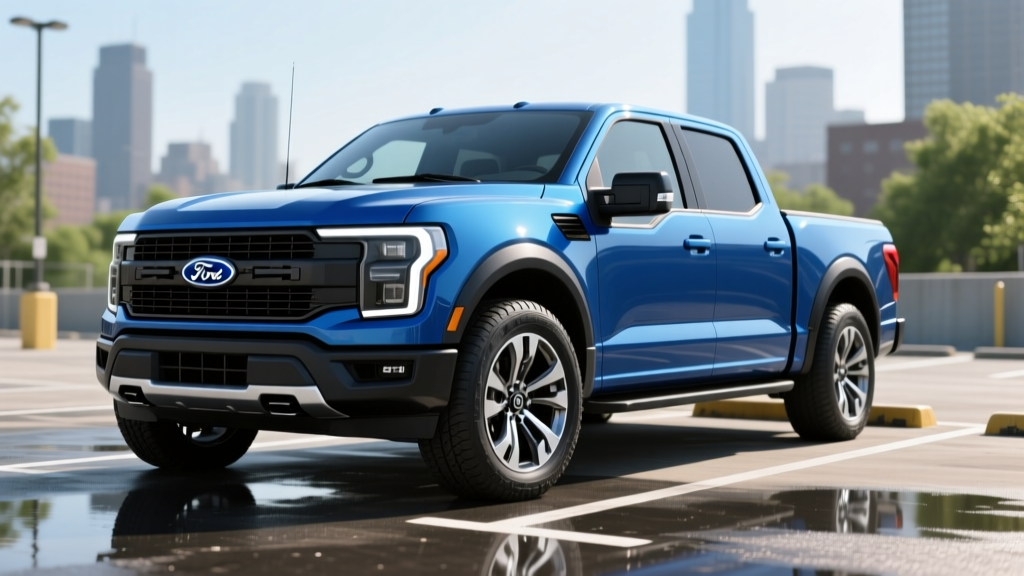
The Ford F-150 Lightning remains the most accessible full-size electric pickup on the market, but the sticker price only tells part of the story. Buyers searching for a low cost Ford electric pickup need to look beyond MSRP and evaluate the total cost of ownership (TCO) — factoring in federal tax credits, charging expenses, maintenance savings, insurance premiums, and depreciation trends. This guide breaks down every dollar you'll spend (and save) over five years of owning the 2026 F-150 Lightning.
2026 F-150 Lightning: Starting Price and Key Specs
Before calculating ownership costs, let's establish what you're buying. The 2026 F-150 Lightning starts at approximately $54,995 for the Pro trim with the Standard Range battery, climbing to over $95,000 for the Platinum with the Extended Range pack. Here are the critical numbers:
| Spec | Standard Range | Extended Range |
|---|---|---|
| Base MSRP (Pro) | $54,995 | $69,995 |
| Battery Capacity (usable) | 98 kWh (LFP) | 131 kWh (NMC) |
| EPA Range | 240 miles | 320 miles |
| Real-World Highway Range | ~195–215 miles | ~260–285 miles |
| Peak DC Fast Charge | 150 kW | 200 kW |
| 10–80% DC Charge Time | ~38 min | ~41 min |
| Level 2 Charge Rate | 11.5 kW (32 mi/hr) | 19.2 kW (52 mi/hr) w/80A |
| Horsepower | 452 hp | 580 hp |
| 0–60 mph | ~5.0 sec | ~3.8 sec |
| Max Towing | 7,700 lbs | 10,000 lbs |
| EPA Efficiency | 68 MPGe | 70 MPGe |
| Battery/Powertrain Warranty | 8 years / 100,000 miles | |
Federal Tax Credit: Can You Claim Up to $7,500?
The IRS §30D Clean Vehicle Credit can reduce your effective purchase price by up to $7,500, but eligibility depends on several moving targets. As of 2026, the F-150 Lightning's credit amount varies by trim and battery sourcing compliance. Here's what you must satisfy:
- MSRP Cap: Trucks and vans must be under $80,000 MSRP (base price + factory options, before destination). This eliminates the Platinum Extended Range from eligibility.
- Buyer Income Limits: Modified AGI must not exceed $150,000 (single), $225,000 (head of household), or $300,000 (joint filers).
- Battery Component Sourcing: A percentage of battery components must be manufactured or assembled in North America — this threshold increases annually. Ford has generally met this requirement for U.S.-built Lightning models.
- Critical Minerals: A percentage of critical minerals must be sourced from the U.S. or free-trade-agreement countries. The required percentage rises each year, and partial compliance may yield a $3,750 half-credit.
- Point-of-Sale Transfer: You can now transfer the credit to the dealer at purchase, reducing your out-of-pocket cost immediately rather than waiting for tax filing. (Source: IRS)
- Vehicle Assembly: Final assembly must occur in North America. All F-150 Lightnings are assembled in Dearborn, Michigan — this box is checked.
What this means in practice: A Pro Standard Range buyer earning under the income caps, purchasing at $54,995, can potentially apply the full $7,500 at the dealership — bringing the effective price to roughly $47,495 before state incentives. However, battery-sourcing rules tighten yearly, so confirm current eligibility on fueleconomy.gov before signing.
5-Year Total Cost of Ownership Breakdown
Here's where the "low cost" question gets answered. We modeled five years / 75,000 miles of ownership for the F-150 Lightning Pro Standard Range, compared against a similarly equipped 2026 F-150 XLT 4WD with the 2.7L EcoBoost V6 (MSRP ~$48,000).
| Cost Category | F-150 Lightning Pro | Gas F-150 XLT 4WD |
|---|---|---|
| Purchase Price (after credit) | $47,495 | $48,000 |
| Fuel / Charging (75k mi) | $4,500 | $10,875 |
| Maintenance | $1,800 | $4,200 |
| Insurance (5-year total) | $12,500 | $9,750 |
| Depreciation (est. 5-yr) | $22,000 | $19,500 |
| Total 5-Year Cost | $88,295 | $92,325 |
| Cost Per Mile | $1.18 | $1.23 |
The verdict: Over five years, the Lightning Pro saves roughly $4,000 compared to the gas equivalent — but only when the federal tax credit applies in full. Without the credit, the Lightning costs about $3,500 more over the same period. The savings widen if gas prices rise or if you secure state and utility incentives.
Charging vs. Gas: The Per-Mile Math
The Lightning's efficiency advantage depends entirely on how and where you charge. Here's the concrete math:
| Scenario | Cost/Mile | Annual Cost (15k mi) |
|---|---|---|
| Lightning — Home Level 2 ($0.14/kWh avg) | $0.043 | $645 |
| Lightning — Home Level 2 ($0.22/kWh high-cost state) | $0.067 | $1,005 |
| Lightning — Public DC Fast ($0.48/kWh avg) | $0.146 | $2,190 |
| Gas F-150 (19 MPG combined, $3.50/gal) | $0.184 | $2,760 |
| Gas F-150 (19 MPG combined, $4.50/gal) | $0.237 | $3,555 |
Key takeaway: Home charging is where the Lightning shines — at $0.14/kWh, you spend roughly $645/year on electricity versus $2,760 on gas. But if you rely exclusively on public DC fast chargers at $0.48/kWh, your "fuel" savings nearly disappear. The Lightning consumes approximately 3.0 kWh per mile (combined), which is typical for a full-size electric truck.
To maximize savings, install a Level 2 home charger (budget $800–$2,000 for equipment and electrician work) and take advantage of utility off-peak rates, which can drop below $0.08/kWh in some regions.
Maintenance Savings: What You Won't Pay For
Electric drivetrains eliminate dozens of service items that gas trucks require. Here's a side-by-side look at five-year maintenance expectations:
| Service Item | F-150 Lightning | Gas F-150 |
|---|---|---|
| Oil Changes (synthetic, ~$75 each) | $0 | $750 (10 changes) |
| Transmission Fluid | $0 (single-speed) | $250 |
| Brake Pads/Rotors | $200 (regen extends life) | $800 |
| Coolant Flush | $150 | $200 |
| Air Filters (engine) | $0 | $150 |
| Cabin Air Filter | $150 | $150 |
| Tire Rotation/Replacement | $1,100 (heavier = faster wear) | $900 |
| Misc. (wipers, bulbs, belts) | $200 | $500 |
| Total Estimated | $1,800 | $4,200 |
Net savings: ~$2,400 over five years. Regenerative braking dramatically extends brake pad life — many Lightning owners report original pads at 60,000+ miles. However, the Lightning's heavier curb weight (~6,500 lbs) accelerates tire wear. Budget for a set of replacement tires around year four; expect to pay $1,000–$1,400 for a quality all-terrain set.
Insurance: The Cost EV Owners Often Overlook
EVs are more expensive to insure than their gas counterparts, and the F-150 Lightning is no exception. Based on national average quotes for a 40-year-old driver with clean record:
- F-150 Lightning Pro: ~$2,500/year ($208/month)
- Gas F-150 XLT 4WD: ~$1,950/year ($163/month)
- Annual premium gap: ~$550
Why the premium? Insurers factor in higher repair costs (specialized EV body shops, battery replacement risk), greater vehicle weight (more damage in collisions), and elevated parts pricing. The Lightning's battery pack alone can cost $20,000+ to replace if damaged — a scenario insurers price into every policy.
How to reduce it: Shop at least three insurers — some (like State Farm and USAA) offer EV-specific discounts. Bundling home and auto, maintaining a clean record, and opting for a higher deductible ($1,000 vs. $500) can each shave 10–15% off your premium. Also check whether your insurer offers a telematics discount for safe driving habits.
Depreciation and Resale Value: What to Expect
EV depreciation has been steeper than gas-vehicle depreciation in recent years, driven by rapid technology advancement, battery-health uncertainty among used buyers, and aggressive price cuts from Tesla that ripple across the market.
For the F-150 Lightning, current projections suggest:
- 5-year depreciation: ~40–45% of purchase price (after tax credit)
- Estimated resale value at 75,000 miles: $25,000–$28,000 (Pro Standard Range, purchased at $47,495 after credit)
- Gas F-150 XLT 5-year depreciation: ~38–42%
The gap has narrowed since 2023–2024, when EV resale values plummeted. The Lightning benefits from strong brand loyalty, proven capability as a work truck, and Ford's commitment to the platform. However, buyers should expect slightly faster depreciation than a gas F-150, primarily because used-EV buyers remain cautious about battery longevity and future technology obsolescence.
Mitigation strategy: If depreciation concerns you, consider leasing. Ford Credit frequently offers competitive lease deals on the Lightning, and the lessor absorbs the resale risk. A 36-month lease also aligns well with the period of fastest technology improvement.
State, Local, and Utility Incentives
Federal incentives are only the starting point. Depending on your state and utility, additional savings may include:
- State purchase rebates: Colorado offers up to $5,000; California's CVRP provides up to $7,000 for income-qualified buyers; New York offers up to $2,000.
- Utility charger rebates: Many utilities rebate $300–$1,000 for home Level 2 charger purchase and installation.
- Time-of-use (TOU) rates: Off-peak electricity rates can cut your per-mile charging cost by 40–60%.
- HOV lane access: States like California, Colorado, and Virginia grant single-occupant HOV access to qualifying EVs — a non-monetary but high-value perk.
- Property/sales tax exemptions: Some states exempt EVs from sales tax or reduced registration fees.
Incentive amounts vary by jurisdiction and change frequently. Always verify current programs with your state energy office, local utility, and AFDC before purchasing.
For a Colorado buyer stacking the $7,500 federal credit with a $5,000 state rebate and a $500 utility charger rebate, the effective Lightning Pro price drops to roughly $41,995 — making it genuinely cheaper than the gas F-150 XLT from day one.
Frequently Asked Questions
How much does it really cost to own an F-150 Lightning over 5 years?
Our modeling shows approximately $88,300 over five years and 75,000 miles for the Pro Standard Range, including purchase (after the $7,500 federal credit), home charging, maintenance, insurance, and depreciation. That works out to about $1.18 per mile — roughly $4,000 less than a comparably priced gas F-150 over the same period. Without the federal credit, the Lightning costs about $3,500 more.
Do I qualify for the $7,500 federal EV tax credit?
It depends on three factors: your income (must be under $150K single / $300K joint), the truck's MSRP (must be under $80,000), and battery-sourcing compliance (which varies by model year and trim). Check the official IRS Clean Vehicle Credit page and the DOE eligibility list for the specific trim you're considering. You can transfer the credit to the dealer at point of sale for an immediate price reduction.
How much do I save on fuel and maintenance?
Charging at home at $0.14/kWh saves roughly $2,100/year versus gas at $3.50/gallon. Maintenance savings add another $480/year (no oil changes, fewer brake replacements). Combined, expect to save about $2,580 annually — or roughly $12,900 over five years — compared to a gas F-150. These savings shrink if you rely on expensive public DC fast chargers.
Are EVs more expensive to insure?
Yes. The F-150 Lightning typically costs $500–$600 more per year to insure than a gas F-150, due to higher repair costs, specialized parts, and the vehicle's weight. Over five years, that's an additional $2,500–$3,000 in insurance expense. Shop multiple insurers and ask about EV-specific discounts to narrow the gap.
How well does the F-150 Lightning hold its value?
Current projections estimate 40–45% depreciation over five years, slightly worse than the gas F-150's 38–42%. The gap has narrowed as the Lightning proves itself in the used market, but EV depreciation remains higher due to rapid tech advancement and buyer caution about used batteries. Leasing can transfer this risk to the lessor.
Is the F-150 Lightning actually a low-cost electric pickup?
Compared to the Rivian R1T (starting ~$75,000) and the Tesla Cybertruck (starting ~$62,000+), the Lightning Pro at $54,995 — potentially $47,495 after the federal credit — is the most affordable full-size electric pickup available. When stacked with state and utility incentives, it can undercut the gas F-150 on effective purchase price and total ownership cost. It's not cheap in absolute terms, but it's the lowest-cost entry point into a full-size electric truck in 2026.