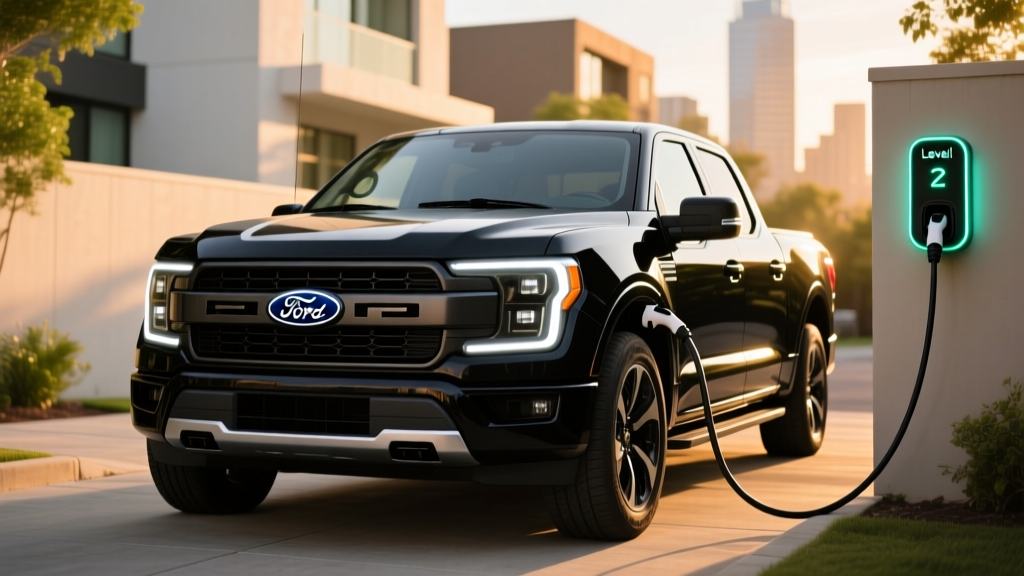
The Ford F-150 Lightning remains one of the most capable electric trucks on the market in 2026, but its sticker price can sting before you factor in available incentives. This review breaks down exactly what the Lightning delivers in range, charging, and utility — and more importantly, how federal §30D tax credits and point-of-sale transfers can shave thousands off the final price. Whether you're cross-shopping the Rivian R1T, Chevrolet Silverado EV, or Tesla Cybertruck, here's the data you need to decide.
Ford F-150 Lightning at a Glance: Key Specs
| Specification | Standard Range | Extended Range |
|---|---|---|
| EPA Range | 240 miles | 320 miles |
| Battery Capacity (usable) | 98 kWh (LFP) | 131 kWh (NMC) |
| Drivetrain | Dual-motor AWD | Dual-motor AWD |
| Horsepower | 452 hp | 580 hp |
| Torque | 775 lb-ft | 775 lb-ft |
| 0-60 mph | ~4.0 sec | |
| Max DC Fast Charge | 150 kW | 150 kW |
| 10-80% DC Charge Time | ~44 min | ~49 min |
| Level 2 Home Charge Rate | 11.3 kW (~22 mi/hr) | 19.2 kW (~30 mi/hr) |
| MPGe (combined) | 78 MPGe | 70 MPGe |
| Max Towing Capacity | 7,700 lbs | 10,000 lbs |
| Payload Capacity | 2,235 lbs | 1,800 lbs |
| Base MSRP (Pro trim) | $54,995 | $69,995 (Lariat) |
| Battery/Powertrain Warranty | 8 years / 100,000 miles (≥70% capacity) | |
Real-World Range: What the EPA Number Doesn't Tell You
Ford equips the Extended Range with an NMC (nickel manganese cobalt) pack for maximum energy density, while the Standard Range uses LFP (lithium iron phosphate) chemistry. LFP sacrifices some range but offers superior cycle life and can be charged to 100% daily without degradation concerns — a practical advantage for fleet and daily-driver use. The NMC pack is better suited to buyers who need every mile of range for road trips or long rural commutes. Both packs feature liquid thermal management with a heat pump for improved cold-weather efficiency.
For context on how the Lightning compares to EPA figures across the EV truck segment, fueleconomy.gov maintains the official efficiency database. The Lightning's combined MPGe of 70–78 places it behind the Rivian R1T (roughly 73–86 MPGe depending on configuration) but ahead of the GMC Hummer EV, which sacrifices efficiency for mass and power.
Charging Speed and Infrastructure: Home and DC Fast Charging
Charging speed remains one of the Lightning's most debated specifications. The truck peaks at 150 kW on DC fast chargers — adequate but not class-leading. The Chevrolet Silverado EV and Rivian R1T both accept higher peak rates, which matters on long road trips where every 10-minute difference adds up.
| Charging Level | Power / Voltage | Miles Added per Hour | Notes |
|---|---|---|---|
| Level 1 (120V) | ~1.4 kW | ~2–3 mi/hr | Emergency/trickle only |
| Level 2 (240V, 48A) | 11.3 kW | ~22 mi/hr | Standard onboard charger |
| Level 2 (240V, 80A) | 19.2 kW | ~30 mi/hr | Extended Range with optional charger |
| DC Fast Charge | 150 kW peak | ~140 mi in 25 min (10-60%) | Tapers significantly above 80% SoC |
The charge curve is the critical detail most spec sheets bury. The Lightning hits 150 kW only in a narrow state-of-charge window (roughly 15–40% SoC on the Extended Range pack). By 60% SoC, power drops to approximately 100 kW, and above 80%, it falls below 50 kW. This taper is typical for large NMC packs but means a 10–80% session takes roughly 49 minutes for the Extended Range. Plan road-trip stops accordingly.
At home, the optional 80-amp Charge Station Pro (paired with the Extended Range's dual onboard chargers) delivers a full overnight recovery in about 7–8 hours. The 80-amp circuit requires a 100-amp breaker and likely a panel upgrade if your home has a standard 100-amp service — budget $500–$2,000 for electrical upgrades beyond the charger itself. The Standard Range model's single 11.3 kW onboard charger works fine on a 48-amp circuit and a standard NEMA 14-50 outlet or hardwired Level 2 unit.
The Lightning uses the CCS1 connector for DC fast charging and J1772 for Level 2. Ford has confirmed NACS adapter compatibility for Tesla Supercharger network access, expanding the Lightning's public charging footprint significantly. For current Supercharger access details, check Ford's official charging page.
Ford F-150 Lightning Incentives: Federal Tax Credits and What You'll Actually Pay
The federal EV tax credit under IRS §30D remains the single biggest incentive for Lightning buyers, but eligibility depends on a matrix of rules that change periodically. Here's what applies to the 2026 model year based on current IRS guidance.
- MSRP Cap: Trucks/vans/SUVs must have an MSRP at or below $80,000. Most Lightning trims qualify; the Platinum Extended Range ($96,874) does NOT.
- Buyer Income Cap: Modified adjusted gross income must not exceed $150,000 (single), $225,000 (head of household), or $300,000 (joint filing).
- Battery Sourcing: The credit is split into two halves ($3,750 + $3,750) based on critical-mineral and battery-component sourcing requirements. Vehicles meeting both thresholds receive the full $7,500.
- Point-of-Sale Transfer: Buyers can transfer the credit to the dealer at purchase, reducing the purchase price immediately rather than waiting for a tax refund.
- Assembly: Vehicle must undergo final assembly in North America (the Lightning is built in Dearborn, Michigan — confirmed eligible).
Rules are subject to change. Always verify current eligibility at irs.gov and consult a tax professional before relying on credit amounts for purchase decisions.
| Trim | Battery | MSRP | Est. Credit | Effective Price |
|---|---|---|---|---|
| Pro | Standard Range | $54,995 | $7,500* | $47,495 |
| XLT | Standard Range | $59,995 | $7,500* | $52,495 |
| Lariat | Extended Range | $69,995 | $7,500* | $62,495 |
| Platinum | Extended Range | $96,874 | $0 (over MSRP cap) | $96,874 |
*Full $7,500 credit assumes buyer meets all income, sourcing, and MSRP requirements. Some configurations may qualify for only $3,750 depending on battery-component sourcing. State and utility incentives may stack on top — check your local jurisdiction.
The Pro trim at an effective $47,495 after the federal credit represents the strongest value proposition in the Lightning lineup. It includes the dual-motor AWD powertrain, 98 kWh LFP battery, Ford Co-Pilot360 driver assists, and the 12-inch touchscreen. The XLT adds comfort features most buyers want (heated seats, power tailgate, upgraded audio) and still clears the $80,000 MSRP cap comfortably.
The Platinum trim's six-figure pricing removes it from federal credit eligibility entirely. Buyers at this price point are paying for luxury features — massaging seats, BlueCruise hands-free driving, and premium materials — rather than optimizing for incentives.
Performance, Towing, and Daily Driving
The Lightning's dual-motor AWD powertrain delivers truck capability with sports-car acceleration in the Extended Range variant. The 580 hp, 775 lb-ft setup hits 60 mph in approximately 4.0 seconds — quicker than a base Porsche Cayenne. The Standard Range model's 452 hp is hardly slow at 5.0 seconds to 60, and the instant torque delivery makes it feel even quicker in stoplight-to-stoplight driving.
Towing is where physics reasserts itself. The Extended Range's 10,000-lb max tow rating (with the Max Trailer Tow package) is legitimate, but expect range to plummet to 130–160 miles when pulling a 7,000-lb trailer at highway speeds. Ford's onboard scales and intelligent range calculator do a good job of predicting remaining range with a trailer, which reduces anxiety. The Standard Range model is limited to 7,700 lbs and is better suited to light boat or utility trailers.
The Lightning's independent rear suspension delivers a noticeably better unloaded ride quality than the live-axle gas F-150. Potholes and expansion joints are absorbed cleanly, and the low center of gravity (batteries mounted under the floor) keeps body roll well-controlled for a full-size truck.
Cargo, Interior Space, and the Mega Power Frunk
The Lightning's 5.5-foot bed offers 52.8 cu ft of cargo volume — identical to the gas F-150 SuperCrew short-bed configuration. The 60.1 inches of maximum bed width between the wheel wells accommodates standard 4x8 plywood sheets flat on the floor.
The headline feature is the Mega Power Frunk: 14.1 cu ft of front trunk space with 400 lbs of payload capacity. It's weather-sealed, lockable, and features a drain plug for use as a cooler. Four 120V outlets and two USB ports inside make it a practical mobile workstation.
Interior dimensions mirror the gas F-150 SuperCrew:
- Front legroom: 43.9 inches
- Rear legroom: 43.6 inches
- Front headroom: 40.8 inches
- Rear headroom: 40.4 inches
The available Pro Power Onboard system turns the Lightning into a mobile generator. The 9.6 kW option provides up to seven days of backup power for an average home during an outage when paired with the Ford Intelligent Backup Power system and a home transfer switch. This V2H (vehicle-to-home) capability is a genuine differentiator for buyers in areas with unreliable grid power.
Technology, Driver Assists, and the SYNC Experience
The Lightning's tech stack centers on a 12-inch touchscreen (15.5-inch portrait screen on Lariat and Platinum) running SYNC 4A. Wireless Apple CarPlay and Android Auto are standard. The interface is responsive, and over-the-air updates (Ford Power-Up) continue to add features post-purchase.
Ford Co-Pilot360 2.0 is standard across all trims and includes:
- Pre-Collision Assist with Automatic Emergency Braking
- Blind Spot Information System (BLIS) with trailer coverage
- Lane-Keeping System
- Rear View Camera with dynamic hitch assist
BlueCruise works well in practice on long interstate stretches, reducing fatigue significantly. However, it disengages at construction zones, unmapped interchanges, and in heavy rain or snow. It's a genuine convenience feature, not a replacement for an engaged driver.
Who Should Buy the F-150 Lightning — And Who Shouldn't
Buy the Lightning If:
- You need a full-size truck bed and 10,000-lb towing but want to eliminate fuel costs for daily driving
- You have reliable Level 2 home charging and your daily commute is under 150 miles round-trip
- You value the Pro Power Onboard / V2H backup power capability
- You want a comfortable daily-driver truck with sports-car acceleration
- You qualify for the full $7,500 federal credit and can apply it at point of sale
Look Elsewhere If:
- You regularly tow heavy trailers over long distances (range collapse is severe)
- You lack access to home or workplace Level 2 charging
- You need DC fast-charging speeds over 200 kW for frequent road trips
- You want a compact truck footprint for urban parking (consider the Rivian R1T or Ford Maverick hybrid)
- Your income exceeds the §30D caps and your state offers no additional incentives
How the Lightning Stacks Up Against Key Competitors
The electric truck segment has matured considerably. Here's how the Lightning compares on the metrics that matter most:
| Metric | F-150 Lightning Ext. Range | Rivian R1T (Dual Max) | Chevy Silverado EV 4WT | Tesla Cybertruck AWD |
|---|---|---|---|---|
| EPA Range | 320 mi | 410 mi | 440 mi | 340 mi |
| Max DC Charge | 150 kW | 220 kW | 350 kW | 250 kW |
| 10-80% Time | ~49 min | ~30 min | ~20 min | ~28 min |
| Max Tow Rating | 10,000 lbs | 11,000 lbs | 10,000 lbs | 11,000 lbs |
| Starting MSRP | $54,995 | $69,900 | $54,995 | $79,990 |
| Federal Credit | Up to $7,500 | Up to $7,500 | Up to $7,500 | Up to $7,500 |
The Silverado EV's 350 kW DC charging and 440-mile range make it the road-trip king, but its availability and real-world delivery have been inconsistent. The Rivian R1T is more compact and more adventurous off-road but starts at a higher price. The Cybertruck's polarizing design and build-quality questions remain concerns despite strong specs. The Lightning's advantage is its familiar F-150 form factor, proven dealer network, and the lowest entry price in the segment when incentives are applied.
Pros, Cons, and the Bottom Line
Pros
- Lowest effective price in the segment after $7,500 federal credit
- Pro Power Onboard / V2H backup power is genuinely useful
- Mega Power Frunk adds 14.1 cu ft of secure storage
- Comfortable independent rear suspension ride quality
- Strong dealer network and parts availability
- LFP Standard Range battery supports daily 100% charging
Cons
- 150 kW DC fast-charging peak lags behind competitors
- Extended Range 10-80% charge takes nearly 50 minutes
- Towing cuts range by 40-50% (130-160 mi with heavy trailer)
- Platinum trim exceeds $80K MSRP cap — no federal credit
- 5.5-foot bed is the only option (no long-bed configuration)
- Heavy: curb weight over 6,200 lbs impacts tire wear
The F-150 Lightning's incentives story in 2026 is straightforward: the Pro and XLT Standard Range trims, plus the Lariat Extended Range, all clear the $80,000 MSRP cap and can deliver the full $7,500 federal credit at point of sale if you meet income and sourcing requirements. That makes the Pro trim an effective $47,495 — a remarkable entry point for a 452-hp dual-motor AWD truck with home backup power capability.
The Lightning won't win any charging-speed contests, and its highway range with a trailer demands careful trip planning. But for buyers who need truck capability 10% of the time and a comfortable, quick, zero-tailpipe-emissions daily driver the other 90%, it remains the most pragmatic electric truck on the market. Just make sure your home electrical panel can support a Level 2 charger before signing the paperwork.
Frequently Asked Questions
What is the real-world range of the Ford F-150 Lightning?
The Extended Range model's 320-mile EPA estimate translates to roughly 260–280 miles in real-world highway driving and 210–240 miles in cold weather (below 30°F). The Standard Range model's 240-mile EPA figure delivers approximately 190–210 miles on the highway. Towing reduces range by 40–50%.
How fast does the F-150 Lightning charge at home and on DC fast chargers?
On DC fast chargers, the Lightning peaks at 150 kW and charges from 10–80% in approximately 44 minutes (Standard Range) or 49 minutes (Extended Range). At home on a Level 2 charger, the Extended Range with the optional 80-amp Charge Station Pro adds about 30 miles of range per hour; the Standard Range adds about 22 miles per hour on a 48-amp circuit.
Does the Ford F-150 Lightning qualify for the federal EV tax credit?
Yes — the Pro ($54,995), XLT ($59,995), and Lariat Extended Range ($69,995) trims all fall under the $80,000 MSRP cap for trucks. The Platinum trim ($96,874) exceeds the cap and does not qualify. Buyer income must not exceed $150K single / $300K joint, and the vehicle must meet battery-sourcing requirements. Always verify current rules at irs.gov.
Is the F-150 Lightning worth buying over the Rivian R1T or Chevy Silverado EV?
The Lightning wins on value (lowest effective price after incentives), dealer network, and the Pro Power Onboard / V2H feature. The Silverado EV charges significantly faster (350 kW vs 150 kW) and offers more range. The Rivian R1T is more capable off-road and more compact. If fast DC charging and road-trip range are your top priorities, the Silverado EV is the stronger pick. If you want the best deal and home backup power, choose the Lightning.
What is the battery warranty on the F-150 Lightning?
Ford covers the Lightning's high-voltage battery and electric powertrain for 8 years or 100,000 miles, whichever comes first. The warranty guarantees the battery will retain at least 70% of its original capacity during that period. If degradation exceeds 30%, Ford will repair or replace the battery at no cost.
Can I use the F-150 Lightning to power my home during an outage?
Yes, with the available Ford Intelligent Backup Power system (which requires the 9.6 kW Pro Power Onboard option and a professionally installed home transfer switch). The Extended Range battery can power an average home for up to 7 days. The Standard Range battery provides approximately 3–4 days of backup power depending on household consumption.