The Ford F-150 Lightning has carved out a unique position in the electric truck market not just as a workhorse, but as a rolling power station. For buyers researching Ford F-150 Lightning home backup power, the appeal is clear: a massive battery pack sitting in your driveway that can keep your house running for days during an outage — while also serving as a daily-driver pickup. This review covers the 2026 model year's specs, the Intelligent Backup Power (IBP) system, real-world range expectations, charging performance, pricing, and whether the Lightning still holds up against a growing field of electric truck competitors.
Ford F-150 Lightning at a Glance: 2026 Specs
| Attribute | Standard Range | Extended Range |
|---|---|---|
| EPA Range | ~240 miles | ~320 miles |
| Battery Capacity (usable) | ~98 kWh (LFP) | ~131 kWh (NMC) |
| Drivetrain | Dual-motor AWD | Dual-motor AWD |
| Horsepower | 452 hp | 580 hp |
| Torque | 775 lb-ft | 775 lb-ft |
| 0–60 mph | ~4.5 seconds | ~3.8 seconds |
| Max DC Fast Charge | ~150 kW | ~150 kW |
| 10–80% DC Time | ~44 minutes | ~49 minutes |
| Level 2 Home Charge Rate | ~11.3 kW (~20 mi/hr) | ~11.3 kW (~25 mi/hr) |
| MPGe (combined) | ~68 MPGe | ~66 MPGe |
| Max Towing | ~7,700 lbs | ~10,000 lbs |
| Max Payload | ~2,235 lbs | ~1,800 lbs |
| Battery/Powertrain Warranty | 8 years / 100,000 miles | |
Real-World Range: What the EPA Number Doesn't Tell You
Real-World Expectation: Highway driving at 70+ mph typically yields 200–220 miles (Standard) or 260–290 miles (Extended). In cold weather (below 32°F), expect a 20–30% reduction — bringing the Extended Range down to roughly 200–240 miles in winter conditions. Towing a 5,000-lb trailer can cut range nearly in half.
The F-150 Lightning's boxy aerodynamics and substantial curb weight (over 6,000 lbs for Extended Range trims) work against efficiency at highway speeds. According to fueleconomy.gov, the Extended Range model achieves roughly 66 MPGe combined, which translates to about 51 kWh per 100 miles. That's thirstier than a Rivian R1T or a Tesla Cybertruck, both of which benefit from more aerodynamic profiles.
City driving with frequent regenerative braking opportunities is where the Lightning performs closest to its EPA estimate. If your daily routine involves stop-and-go commuting under 50 mph, you'll see numbers near the sticker. But plan road trips around the lower real-world figures — and always factor in a buffer for terrain, temperature, and payload.
Intelligent Backup Power: How the Lightning Powers Your Home
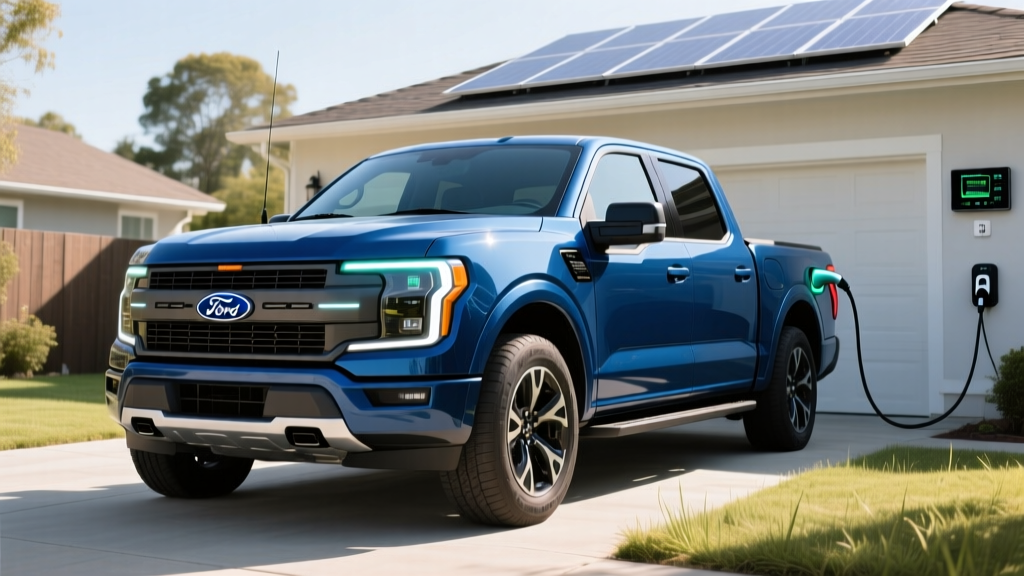
The headline feature for many Lightning buyers is Ford's Intelligent Backup Power (IBP) system. Here's how it works in practice:
The Lightning can export up to 9.6 kW of continuous AC power through its Pro Power Onboard system. When paired with the Ford Charge Station Pro (an 80-amp bidirectional Level 2 wall unit) and a compatible home transfer switch or a full home energy management system, the truck can automatically detect a grid outage and begin supplying power to your home's circuits.
With the Extended Range battery's ~131 kWh of usable energy, Ford estimates the Lightning can power an average home for up to three days at typical consumption levels. If you're running only essential circuits — refrigerator, furnace blower, lights, a few outlets — that stretches considerably longer. At a sustained 9.6 kW draw, the Extended Range pack provides roughly 13.5 hours of full-load runtime.
The Standard Range pack (~98 kWh usable) offers proportionally less — roughly two days of average home power, or about 10 hours at maximum draw.
What you need for IBP:
- Ford Charge Station Pro (~$1,300–$1,500 for the unit)
- A licensed electrician to install a home transfer switch or energy management system (~$1,500–$3,500 depending on panel complexity)
- A 200-amp electrical panel is recommended; some homes may need a panel upgrade ($1,500–$3,000)
- Total installed system cost: approximately $4,500–$8,000 on top of the truck's price
The Pro Power Onboard system also provides standard 120V and 240V outlets in the bed and cab — useful for job-site tools, tailgating, or camping — without needing the full home integration. The base Pro Power Onboard delivers 2.4 kW; the upgraded version (standard on Lariat and above, optional on XLT) provides the full 9.6 kW.
Charging Performance: DC Fast Charging and Home Setup
| Charging Level | Power / Rate | Miles Added per Hour | Notes |
|---|---|---|---|
| Level 1 (120V) | ~1.4 kW | ~2–3 mi/hr | Emergency/trickle only; full charge takes days |
| Level 2 (240V, 32A) | ~7.7 kW | ~13–16 mi/hr | Standard mobile charger; overnight for most daily needs |
| Level 2 (240V, 48A) | ~11.3 kW | ~20–25 mi/hr | Ford Charge Station Pro; full overnight charge |
| DC Fast Charge | Peak ~150 kW | N/A | 10–80% in ~44–49 min; tapers significantly above 80% |
The Lightning's peak DC fast-charge rate of approximately 150 kW is competitive for its class but trails the Rivian R1T's available charging speeds and the Cybertruck's 250+ kW architecture. In real-world DC charging, you'll see the Lightning sustain close to 150 kW from roughly 10% to 50% state of charge, after which the charge curve tapers. The 10–80% time of 44–49 minutes is respectable for road trips, but plan your stops accordingly — this isn't a 20-minute pit stop.
One important note on charging chemistry: the Standard Range Lightning uses LFP (lithium iron phosphate) cells, while the Extended Range uses NMC (nickel manganese cobalt). LFP batteries tolerate frequent 100% charging better than NMC, making the Standard Range model more forgiving for daily top-offs. NMC packs benefit from daily charging limits around 80–90% to maximize longevity, with 100% reserved for road trips. Both chemistries carry Ford's 8-year/100,000-mile battery warranty with a capacity retention threshold of 70%.
Pricing, Trims, and Federal Tax Credit Eligibility
| Trim | Battery | Base MSRP (2026) | Est. After §30D Credit |
|---|---|---|---|
| Pro (Standard Range) | ~98 kWh LFP | ~$52,000 | ~$44,500* |
| XLT (Standard Range) | ~98 kWh LFP | ~$58,000 | ~$50,500* |
| XLT (Extended Range) | ~131 kWh NMC | ~$68,000 | ~$60,500* |
| Lariat (Extended Range) | ~131 kWh NMC | ~$76,000 | ~$68,500* |
| Platinum (Extended Range) | ~131 kWh NMC | ~$90,000 | ~$82,500* |
*Tax credit estimates assume full $7,500 eligibility. Actual credit depends on individual circumstances.
The Ford F-150 Lightning qualifies for the IRS §30D federal clean vehicle credit, but eligibility is not automatic. Key rules for 2026 include:
- MSRP cap: The vehicle must have an MSRP at or below $80,000 for pickups — this eliminates the Platinum trim from credit eligibility in most configurations.
- Buyer income limits: Modified adjusted gross income must not exceed $150,000 (single), $225,000 (head of household), or $300,000 (joint filers).
- Battery sourcing requirements: The credit splits into two halves ($3,750 each) based on critical mineral sourcing and battery component manufacturing. Ford has worked to North American-ize its supply chain, but exact credit amounts can vary by model year and production batch. Always verify current eligibility with your tax professional before purchase.
- Point-of-sale transfer: As of 2024, buyers can transfer the credit to the dealer at purchase, reducing the out-of-pocket price immediately rather than waiting for a tax refund.
Interior, Cargo, and Technology
The Lightning retains the F-150's SuperCrew cab configuration, offering seating for five with approximately 43.6 inches of rear legroom — genuinely comfortable for adults on long drives. The front trunk (frunk) is a standout: 14.1 cubic feet of lockable, drainable storage with a 400-lb payload capacity. It's one of the largest frunks in any production vehicle and doubles as a cooler for tailgating.
The bed measures 5.5 feet (67.1 inches) on all trims, with a maximum payload of approximately 2,235 lbs (Standard Range) or 1,800 lbs (Extended Range). The heavier battery in the Extended Range model eats into payload capacity — a real consideration for work-truck buyers who regularly haul heavy loads.
Infotainment centers around a 12-inch touchscreen (15.5-inch portrait screen on Lariat and Platinum trims) running Ford's SYNC 4A system with wireless Apple CarPlay and Android Auto. The available BlueCruise hands-free driving system is an SAE Level 2 driver-assist feature — it handles steering, acceleration, and braking on pre-qualified divided highways, but the driver must remain attentive and ready to take over at all times. It is not autonomous driving.
Other notable tech includes over-the-air updates, Ford Power-Up software improvements, a 360-degree camera system with trailer hitch assist, and Pro Trailer Backup Assist. The Lightning also supports vehicle-to-load (V2L) power delivery through its bed outlets and, with the proper setup, vehicle-to-home (V2H) through the Intelligent Backup Power system.
How It Compares: Lightning vs. Rivian R1T vs. Tesla Cybertruck
The Lightning's closest competitors are the Rivian R1T and Tesla Cybertruck. Each takes a different approach:
Rivian R1T: More expensive (starting around $70,000), but offers faster DC charging (peak ~220 kW on the latest pack), a more car-like quad-motor option, and a gear tunnel for extra storage. Range tops out around 410 miles with the Max Pack. However, the R1T does not offer a home backup power system comparable to Ford's IBP.
Tesla Cybertruck: Starts around $60,000 for the dual-motor AWD variant, offers up to ~340 miles of range, and supports 250+ kW DC fast charging. The Cybertruck's Powershare feature provides up to 11.5 kW of bidirectional power, making it a legitimate backup power competitor. However, its polarizing design, limited service center network, and build-quality inconsistencies remain concerns for some buyers.
The Lightning's edge is familiarity. It looks, feels, and drives like an F-150. Dealership service networks are nationwide, parts availability is strong, and the IBP system is the most mature home-backup integration from a legacy automaker. For buyers who want a truck first and a backup generator second — without venturing into startup territory — the Lightning remains the default choice.
Pros, Cons, and Who Should Buy
Pros
- Best-in-class home backup power system (9.6 kW, up to 3 days)
- Familiar F-150 ergonomics with a massive 14.1 cu ft frunk
- Strong nationwide Ford dealer service network
- LFP chemistry on Standard Range allows daily 100% charging
- Qualifies for up to $7,500 federal tax credit (with caveats)
- Pro Trailer Backup Assist and BlueCruise reduce driving fatigue
Cons
- DC fast charging peaks at ~150 kW — slower than Cybertruck and latest R1T
- Real-world highway range falls 10–15% below EPA estimates
- Heavy curb weight reduces payload (especially Extended Range)
- IBP system requires $4,500–$8,000 in home electrical upgrades
- Efficiency lags behind more aerodynamic EV trucks (~51 kWh/100 mi)
- Platinum trim exceeds $80K MSRP cap, disqualifying it from §30D credit
Who this EV suits best: Homeowners in areas with frequent power outages who also need a full-size pickup for daily use. The Lightning excels as a dual-purpose vehicle — commuter truck by day, home battery by night. It's ideal for suburban and rural owners with Level 2 home charging access and a garage or driveway where the truck stays plugged in. Work-truck buyers who tow heavy loads regularly should note the range penalty of towing and consider whether the Extended Range's reduced payload is a dealbreaker. Road-trippers who prioritize fast charging above all else may find the Cybertruck or R1T more suitable.
Frequently Asked Questions
What is the real-world range of the Ford F-150 Lightning?
The EPA rates the Extended Range at approximately 320 miles and the Standard Range at 240 miles. In real-world highway driving at 70 mph, expect roughly 260–290 miles (Extended) or 200–220 miles (Standard). Cold weather can reduce these figures by 20–30%, and towing cuts range dramatically — often by 40–50%.
How fast does the F-150 Lightning charge at home and on the road?
On a Level 2 Ford Charge Station Pro (48A/11.3 kW), the Lightning adds roughly 20–25 miles of range per hour, fully charging overnight in 8–12 hours depending on pack size. On DC fast chargers, it peaks at approximately 150 kW, reaching 10–80% in about 44–49 minutes. The charge rate tapers significantly above 80% state of charge.
Does the F-150 Lightning qualify for the $7,500 federal EV tax credit?
Most Lightning trims qualify, but eligibility depends on the buyer's income (capped at $300,000 for joint filers), the vehicle's MSRP (must be at or below $80,000 for pickups), and battery component/critical mineral sourcing requirements. The Platinum trim often exceeds the MSRP cap. Always verify current rules on irs.gov and consult a tax professional.
How long can the Lightning power my home during an outage?
With the Extended Range pack (~131 kWh usable) and Ford's Intelligent Backup Power system, Ford estimates up to three days of average home power. At the maximum 9.6 kW continuous draw, expect roughly 13.5 hours of runtime. Actual duration depends on your home's consumption — running only essential circuits extends this significantly.
Is the F-150 Lightning worth buying over the Rivian R1T or Cybertruck?
If home backup power, familiar truck ergonomics, and a nationwide dealer network are priorities, the Lightning is the strongest choice. The Rivian R1T offers faster charging and longer available range but costs more and lacks a comparable home power system. The Cybertruck offers competitive range and charging speed with its own Powershare feature, but its service network is limited and build quality remains inconsistent. Test-drive all three if possible.
What is the battery warranty on the F-150 Lightning?
Ford covers the Lightning's battery and electric powertrain for 8 years or 100,000 miles, whichever comes first. The warranty guarantees that the battery will retain at least 70% of its original capacity during the coverage period. This is in line with industry standards for EV battery warranties.