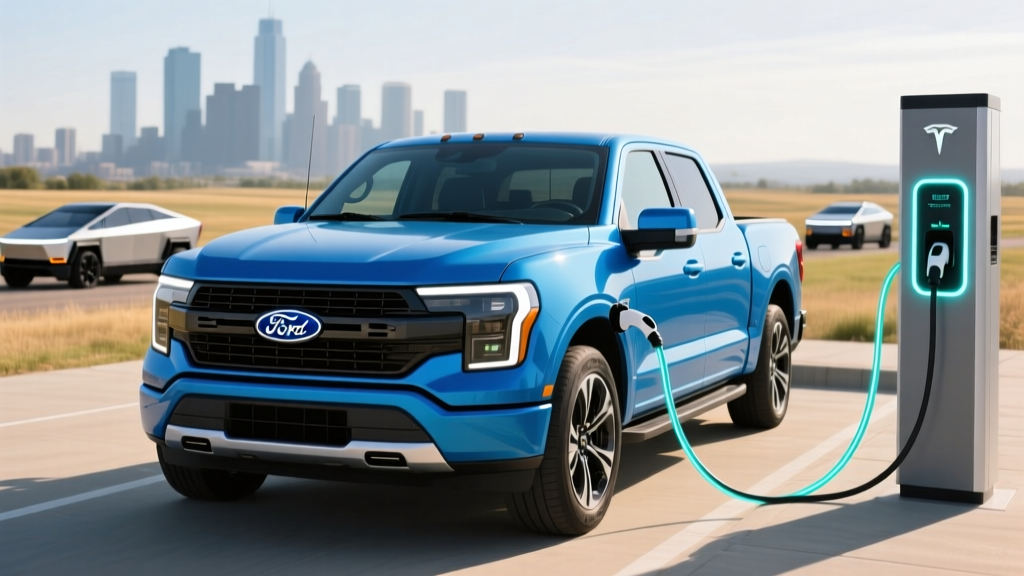
If you've been searching for Ford's new EV truck, you're likely looking at the 2026 F-150 Lightning, Ford's flagship full-size electric pickup now in its fourth model year. The short answer: it remains one of the most practical electric trucks on the market for buyers who need real towing, bed utility, and daily drivability — but whether it saves you money over a gas F-150 depends heavily on your driving patterns, electricity rates, and whether you can charge at home.
Quick Verdict: Ford's New EV Truck at a Glance
- EPA Range: 240 mi (Standard Range, 98 kWh) / 320 mi (Extended Range, 131 kWh)
- Real-World Highway: Expect ~200–215 mi (Std) / ~270–290 mi (Ext) at 70 mph
- Max DC Fast Charge: 150 kW (Std) / 155 kW (Ext), 10–80% in ~36–41 min
- Starting MSRP: ~$54,995 (Pro Standard Range) before incentives
- Federal Tax Credit: Up to $7,500 via §30D, subject to income, MSRP, and battery-sourcing rules — verify at IRS.gov
- Best For: Homeowners with Level 2 access, moderate towing needs, and daily commutes under 150 mi round-trip
Range, Efficiency, and the Real-World Gap
The 2026 F-150 Lightning offers two battery packs. The Standard Range model uses a 98 kWh usable lithium-ion NMC pack delivering an EPA-estimated 240 miles. The Extended Range variant bumps capacity to 131 kWh usable, earning an EPA 320 miles — a meaningful jump for highway-heavy drivers or those in colder climates.
EPA vs. Real-World Range
The EPA cycle mixes city and highway driving at moderate speeds. In real-world 70 mph highway testing, expect the Standard Range model to deliver roughly 200–215 miles and the Extended Range around 270–290 miles. Cold-weather driving (below 32°F) can reduce range by 20–30% due to cabin heating and battery chemistry limitations — plan for 165–185 mi (Std) or 225–250 mi (Ext) in winter conditions. The Lightning's standard heat pump helps mitigate this loss compared to resistive heating systems, but physics still applies.
Efficiency lands around 78 MPGe combined for the Extended Range model per fueleconomy.gov, translating to roughly 43–47 kWh/100mi depending on trim and wheel size. That's typical for a 6,000+ lb electric truck — heavier vehicles with larger frontal areas consume more energy regardless of powertrain.
| Spec | Standard Range | Extended Range |
|---|---|---|
| Battery (usable) | 98 kWh NMC | 131 kWh NMC |
| EPA Range | 240 mi | 320 mi |
| Real-World Highway (~70 mph) | ~200–215 mi | ~270–290 mi |
| Horsepower | 452 hp | 580 hp |
| Torque | 775 lb-ft | 775 lb-ft |
| 0–60 mph | ~5.0 sec | ~3.8 sec |
| Max DC Fast Charge | 150 kW | 155 kW |
| 10–80% DC Charge Time | ~36 min | ~41 min |
| Level 2 Charge Rate | 19.2 kW (80A) | 19.2 kW (80A) |
| Max Towing | 7,700 lb | 10,000 lb |
| Starting MSRP (Pro trim) | ~$54,995 | ~$69,995 |
| Battery Warranty | 8 years / 100,000 miles (≥70% capacity retention) | |
Charging: Home Setup and Public Network Reality
The Lightning uses the NACS (North American Charging Standard) connector natively on 2026 models, granting access to Tesla Supercharger stations via Ford's integrated navigation — no adapter required. This is a significant advantage over CCS-equipped trucks still waiting for reliable adapter availability.
| Level | Power | Miles Added per Hour | Typical Use Case |
|---|---|---|---|
| Level 1 (120V) | ~1.4 kW | ~3 mi/hr | Emergency/trickle only |
| Level 2 (240V, 32A) | 7.7 kW | ~17 mi/hr | Basic home charging |
| Level 2 (240V, 48A) | 11.5 kW | ~25 mi/hr | Recommended home setup |
| Level 2 (240V, 80A) | 19.2 kW | ~42 mi/hr | Ford Charge Station Pro (full speed) |
| DC Fast Charge | 150–155 kW peak | ~180–250 mi/hr (peak) | Road trips, 10–80% in ~36–41 min |
Home charging reality: To unlock the Lightning's 19.2 kW Level 2 capability, you need Ford's Charge Station Pro and a dedicated 100-amp circuit. Most homes require a panel upgrade (200A service minimum) and professional installation. Budget $1,200–$2,500 total for equipment plus electrician labor, or $3,500–$6,000+ if a panel upgrade is needed. A more modest 48A Level 2 setup (like a ChargePoint Home Flex on a 60A circuit) costs $800–$1,800 installed and adds ~25 mi/hr — sufficient for most daily driving.
On DC fast charging, note that the Lightning's 150–155 kW peak rate is modest by 2026 standards. Competitors like the Rivian R1T and Chevrolet Silverado EV achieve 200+ kW peaks. Ford's charge curve holds reasonably well from 10–60% SoC but tapers significantly above 80%, meaning those last 20% can add 15–20 minutes. For road-trip planning, plan stops around 20–80% to stay in the fastest charging window.
EV vs. Gas F-150: Cost and Capability Comparison
The most common question from truck buyers: does the Lightning actually save money compared to a gas F-150? The answer depends on your mileage, electricity cost, and how long you keep the truck.
| Category | F-150 Lightning Ext Range | F-150 Gas (3.5L V6 EcoBoost) |
|---|---|---|
| Base MSRP | ~$69,995 | ~$52,000 |
| Federal Tax Credit (§30D) | Up to –$7,500 (if eligible) | $0 |
| Effective Purchase Price | ~$62,495 | ~$52,000 |
| Fuel/Energy (75,000 mi, $0.14/kWh, $3.50/gal) | ~$4,725 | ~$13,125 |
| Maintenance (5 yr) | ~$1,500 | ~$4,000 |
| Insurance (est. avg) | ~$11,500 | ~$9,000 |
| Estimated Depreciation | ~$28,000 | ~$22,000 |
| 5-Year Total (est.) | ~$108,220 | ~$100,125 |
The Lightning's energy savings are real — roughly $8,400 less in fuel over 75,000 miles at national-average electricity rates. Maintenance savings add another ~$2,500 (no oil changes, fewer brake replacements thanks to regenerative braking). But the higher purchase price, steeper depreciation, and typically higher EV insurance premiums eat into those gains. The breakeven point typically arrives around year 6–7 for drivers covering 12,000–15,000 miles annually with affordable home charging.
If you pay above-average electricity rates ($0.25+/kWh in states like California or Massachusetts) or rely primarily on DC fast charging ($0.35–$0.55/kWh at public stations), the fuel savings shrink considerably. Conversely, if you have solar panels or access to time-of-use rates below $0.10/kWh, the Lightning's economics improve dramatically.
Towing, Payload, and Work-Truck Practicality
The Extended Range Lightning tows up to 10,000 lb (with the Max Trailer Tow Package) and offers a max payload of around 1,800 lb. That's competitive with mid-tier gas F-150 configurations, though heavy-duty gas and diesel trucks still dominate for maximum towing.
The critical caveat: towing cuts EV range roughly in half. A 7,500 lb trailer at highway speeds will reduce the Extended Range model from 320 EPA miles to approximately 150–170 miles of real-world range. This makes the Lightning viable for towing to a job site within 70–80 miles of home, but impractical for long-distance trailer hauling without frequent 30–40 minute charging stops.
The Lightning's front trunk (frunk) adds 14.1 cu ft of lockable, weatherproof storage — a genuine advantage over gas trucks for securing tools or gear. The Pro Power Onboard system (up to 9.6 kW exportable power) turns the truck into a mobile generator, capable of running power tools, lighting, or even backing up essential home circuits during an outage.
Federal Tax Credit and Incentive Eligibility
The F-150 Lightning may qualify for the §30D federal tax credit of up to $7,500, but eligibility is not guaranteed and depends on several factors that change periodically:
- MSRP Cap: Trucks/vans/SUVs must have an MSRP ≤ $80,000 — Lightning Pro, XLT, and most Lariat trims qualify; high-end Platinum trims may exceed the cap
- Buyer Income Limits: AGI ≤ $300,000 (joint), $225,000 (head of household), $150,000 (single)
- Battery Sourcing: Critical minerals and battery components must meet escalating domestic/free-trade-partner sourcing thresholds — verify current-year compliance at IRS.gov
- Point-of-Sale Transfer: As of 2024+, you can transfer the credit to the dealer for an immediate price reduction rather than waiting for tax filing
- Tax Liability: The credit is non-refundable — you must owe at least $7,500 in federal tax to claim the full amount (unless transferred at point of sale)
State and local incentives can stack on top: Colorado offers up to $5,000, California's CVRP provides up to $7,000 for income-qualified buyers, and various utility companies offer $500–$1,500 rebates for home charger installation. Check your specific state and utility for current programs.
Common Misconceptions About the Lightning
| Myth | Fact |
|---|---|
| "EV trucks can't tow anything useful." | The Lightning tows up to 10,000 lb — comparable to many gas F-150 configs. Range drops significantly while towing, but capability is real. |
| "The battery will need replacing in 5 years." | Ford warranties the battery for 8 years/100,000 miles at ≥70% capacity. Real-world data from 2022–2024 Lightnings shows ~5–8% degradation at 60,000 miles — well within warranty. |
| "You'll be stranded without a charger." | The NACS connector opens 15,000+ Tesla Superchargers. Ford's onboard navigation routes through chargers and preconditions the battery for optimal charging speed. |
| "It's slower than a gas truck." | The Extended Range model hits 0–60 in ~3.8 seconds with 775 lb-ft of instant torque — faster than most V8 gas trucks off the line. |
| "Home charging is too expensive to install." | A basic 48A Level 2 setup costs $800–$1,800 installed in most homes. Some utilities offer rebates covering 50%+ of installation. |
Decision Framework: Is the Lightning the Right Truck for You?
Choose the F-150 Lightning If:
- You have home charging access (garage or driveway with 240V circuit capability)
- Your daily driving is under 150 miles round-trip, with occasional longer road trips
- You value instant torque, quiet operation, and the frunk for daily utility
- You want backup power capability (Pro Power Onboard for home or job site)
- You qualify for the §30D tax credit and/or state incentives that narrow the price gap
Stick with a Gas or Hybrid F-150 If:
- You regularly tow heavy trailers over 200+ miles (range loss makes EV impractical)
- You live in an apartment or lack reliable home charging access
- Your area has sparse public DC fast-charging infrastructure
- You need maximum payload (above 2,200 lb) or heavy-duty towing (above 10,000 lb)
- You plan to keep the truck under 4 years (the EV's fuel savings won't offset the price premium)
Consider the F-150 PowerBoost Hybrid Instead If:
- You want some electric efficiency (25 MPG combined vs. 19–22 gas-only) without range compromise
- You tow long distances frequently but still want fuel savings around town
- Home charging installation isn't feasible for your situation
Frequently Asked Questions
How long does the F-150 Lightning battery last?
Ford warranties the battery for 8 years or 100,000 miles, guaranteeing at least 70% capacity retention. Based on real-world data from early 2022 models, most Lightning batteries show 5–8% degradation after 60,000 miles. With proper care (avoiding frequent 100% charges and extreme heat exposure), the battery should outlast 150,000–200,000 miles before approaching the warranty threshold.
Can I charge the Lightning at a Tesla Supercharger?
Yes. Starting with the 2025 model year, the F-150 Lightning ships with a native NACS charge port, meaning it plugs directly into Tesla Superchargers without an adapter. Ford's navigation system integrates Supercharger locations and handles battery preconditioning automatically.
What happens if I need to tow a long distance?
Towing cuts range roughly in half. Plan for 150–170 real-world miles (Extended Range) before needing a 30–40 minute DC fast-charge stop. For a 400-mile towing trip, expect 2–3 charging stops. This is viable but adds significant travel time compared to a gas truck. If you tow long distances weekly, a gas or diesel truck remains more practical.
Does the Lightning qualify for the $7,500 tax credit in 2026?
It may, but eligibility depends on your income, the specific trim's MSRP (must be ≤$80,000 for trucks), and current battery-sourcing requirements. Check the latest eligibility list at fueleconomy.gov and verify your personal situation with a tax professional. The credit can now be transferred at point of sale for an immediate price reduction.
How much does it cost to charge at home vs. gas?
At the US average electricity rate of ~$0.16/kWh, fully charging the Extended Range 131 kWh battery costs roughly $21 for 320 miles of range — about $0.066 per mile. A gas F-150 averaging 19 MPG at $3.50/gallon costs about $0.184 per mile. That's a per-mile energy savings of nearly 64% with home charging. Public DC fast charging at $0.40/kWh narrows the gap to roughly break-even with gas.
Is the Lightning good in cold weather?
It's capable but range suffers. Expect 20–30% range loss below freezing due to battery chemistry and cabin heating demands. The standard heat pump helps, but preconditioning the battery while plugged in (using grid power instead of battery) is essential for preserving range. If you live in northern climates and can't charge at home in a garage, the real-world range reduction may be frustrating.
Always verify current pricing, tax-credit eligibility, and specifications on Ford's official site and fueleconomy.gov before purchasing. Rules and specs change, and this guide reflects data available at time of publication.