Quick Verdict: Can the Lightning Power Your Workday?
The 2026 Ford F-150 Lightning remains the most practical full-size electric pickup for fleet managers and independent contractors exploring construction vehicle electrification. With up to 320 miles of EPA-estimated range (Extended Range), a 131 kWh usable battery, and Pro Power Onboard turning the bed into a mobile generator, it bridges the gap between daily drivability and jobsite utility. But cold-weather range loss, DC charging taper, and a starting price near $55,000 mean it isn't a universal fit for every crew.
Range Reality Check
EPA Estimated: 240 mi (Standard Range) / 320 mi (Extended Range)
Real-World Expectation: Plan for 190–210 mi highway at 70 mph (Standard), or 260–280 mi (Extended). In sub-30°F winter conditions with a bed load, expect a further 15–25% reduction. Contractors doing 150+ mi round trips daily with heavy payloads should spec the Extended Range pack and budget for midday top-ups.
Full Spec Sheet: 2026 F-150 Lightning
| Specification | Standard Range | Extended Range |
|---|---|---|
| Base MSRP (Pro trim) | $54,995 | $69,995 |
| As-Tested (Lariat Extended) | $81,450 | |
| Battery Capacity (usable) | 98 kWh (NMC) | 131 kWh (NMC) |
| EPA Range | 240 mi | 320 mi |
| EPA Efficiency | 68 MPGe (2.0 kWh/mi) | 70 MPGe (1.9 kWh/mi) |
| Drivetrain | Dual-motor AWD | |
| Horsepower | 452 hp | 580 hp |
| Torque | 775 lb-ft | 775 lb-ft |
| 0–60 mph | ~5.0 sec | ~3.8 sec |
| Max DC Fast Charge | 120 kW | 150 kW |
| 10–80% DC Charge | ~44 min | ~41 min |
| Level 2 Home Charge (80A) | ~13 mi/hr (19.2 kW) | |
| Max Towing | 7,700 lb | 10,000 lb |
| Max Payload | 2,235 lb | 1,800 lb |
| Bed Volume | 52.8 cu ft (5.5-ft bed) | |
| Frunk (Mega Power Frunk) | 14.1 cu ft / 400 lb payload | |
| Battery Warranty | 8 yr / 100,000 mi (≥70% capacity retention) | |
| Powertrain Warranty | 5 yr / 60,000 mi | |
Charging on the Job and at Home
For construction fleets, charging logistics determine whether electrification works. The Lightning's charge curve is conservative — peak rate of 150 kW on Extended Range is sustained only between roughly 15–45% state of charge, then tapers sharply. At an Electrify America or Tesla Supercharger (via the NACS adapter Ford now includes standard), expect 10–80% in approximately 41 minutes. That's slower than the Hyundai Ioniq 5's 18-minute 10–80% sprint, but acceptable if you're charging during a lunch break or while a crew is on-site.
| Charging Level | Power / Voltage | Rate | Best Use Case |
|---|---|---|---|
| Level 1 (120V) | 1.4 kW | ~2 mi/hr | Emergency / overnight trickle |
| Level 2 (240V, 48A) | 11.5 kW | ~9 mi/hr | Standard home / depot |
| Level 2 (240V, 80A) | 19.2 kW | ~13 mi/hr | Ford Mobile Power Cord w/ 80A wall connector |
| DC Fast (Standard) | 120 kW peak | ~44 min 10–80% | Public fast-charger |
| DC Fast (Extended) | 150 kW peak | ~41 min 10–80% | Public fast-charger |
Depot charging for fleets: If your crew returns to a yard nightly, Level 2 at 80A adds roughly 100 miles in an 8-hour shift — enough for most urban/suburban construction routes under 80 miles round-trip. Panel upgrades to 200A or 400A service are often required for multi-truck depots; budget $2,500–$7,000 per charger installed, plus potential utility demand charges.
Pro Power Onboard: The Jobsite Differentiator
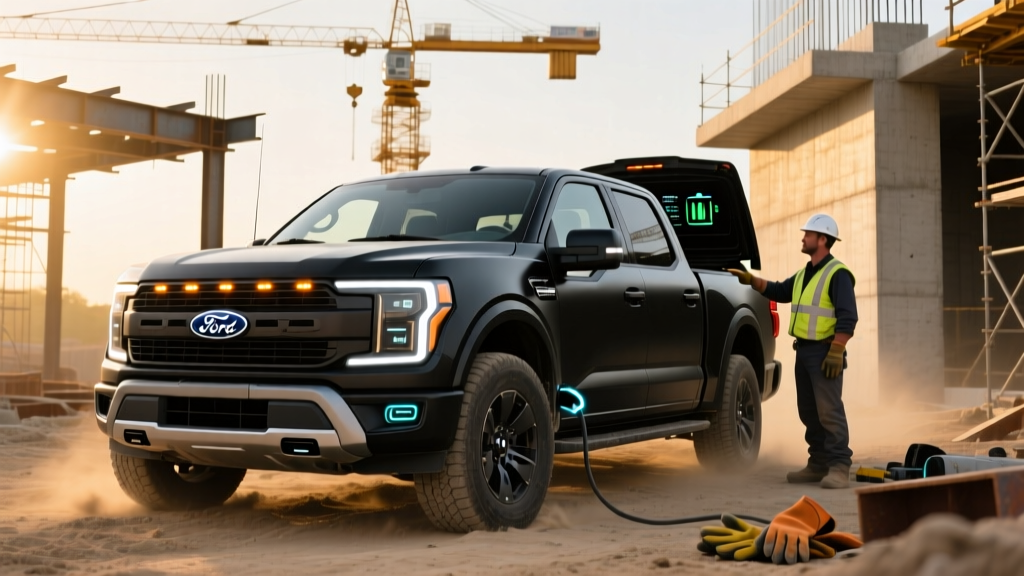
This is where the Lightning earns its place in construction vehicle electrification discussions. The available Pro Power Onboard system exports up to 9.6 kW of continuous 240V/120V AC power through outlets in the bed and frunk. That's enough to run:
- A full-size chop saw and circular saw simultaneously (~3,600W combined)
- A portable air compressor (1,500W) plus job-site lighting (500W)
- A 240V welder at partial duty cycle for light fab work
- Overnight power for a job trailer without a diesel generator
Contractors who currently idle a diesel truck to power tools or tow a generator can eliminate that fuel burn entirely. Ford estimates up to 30 hours of continuous 9.6 kW export on the Extended Range pack before hitting reserve — a full workday and then some.
Interior, Tech, and Driver Assistance
The 2026 Lightning carries forward the 15.5-inch vertical touchscreen (Lariat and above) running SYNC 4A, with wireless Apple CarPlay/Android Auto and over-the-air updates. The 12-inch digital cluster is standard across all trims. BlueCruise 1.5 (Ford's hands-free highway driver assist) is available on Lariat and above for $2,100 — it's an SAE Level 2 system requiring eyes-on supervision, not autonomous driving, but it reduces fatigue on long hauls to remote jobsites.
Notable interior drawback: rear legroom is 43.6 inches (competitive with the SuperCrew gas F-150), but the flat floor — a benefit of the skateboard platform — makes the middle seat genuinely usable for a third crew member.
Pricing, Trims, and Federal Tax Credit
| Trim | Battery | MSRP | Est. After §30D Credit* |
|---|---|---|---|
| Pro | Standard (98 kWh) | $54,995 | $47,495 |
| XLT | Standard | $62,995 | $55,495 |
| Lariat | Extended (131 kWh) | $76,995 | $69,495 |
| Platinum | Extended | $96,874 | $89,374 |
*Federal tax credit caveats (IRS §30D, 2026 rules): The up-to-$7,500 credit requires the buyer to meet income caps ($300K joint / $225K head-of-household / $150K single modified AGI), the vehicle to be under the $80,000 MSRP cap for trucks (Platinum exceeds this), and battery components plus critical minerals to satisfy phased-in domestic-sourcing thresholds. The credit can now be transferred to the dealer at point of sale as an instant discount. Always verify current-year eligibility on irs.gov and confirm with a tax professional before purchase.
Ownership Costs: Lightning vs Diesel F-150
Construction buyers think in total cost of ownership, not sticker price. Over 5 years / 75,000 miles, a Lightning Extended Range charged primarily at a depot ($0.14/kWh national commercial average) costs roughly $2,800 in electricity. A comparable 3.5L Power Stroke diesel F-150 at $4.10/gal and 22 mpg combined burns about $13,950 in fuel. That's an ~$11,000 energy savings before factoring eliminated oil changes, no DEF fluid, and reduced brake wear from regenerative braking.
Offset this against typically higher commercial EV insurance premiums (10–20% above ICE equivalents per industry data) and faster tire wear from the Lightning's 6,500+ lb curb weight. For high-mileage crews, the math favors electric. For low-mileage or extreme-towing applications (consistently over 8,000 lb), diesel still wins on range predictability.
Who Should Buy the Lightning — and Who Shouldn't
Pros
- 9.6 kW Pro Power Onboard eliminates the jobsite generator
- 14.1 cu ft frunk with 400 lb payload is lockable secure storage
- AWD dual-motor traction with instant torque on muddy/graded sites
- Low operating cost vs diesel for sub-150 mi daily routes
- Quiet operation ideal for residential/noise-restricted zones
Cons
- Real-world range drops significantly towing or in cold weather
- DC fast charge curve is conservative (41 min 10–80%)
- Payload reduced to 1,800 lb on Extended Range
- High entry price; Platinum trim exceeds §30D MSRP cap
- Depot charging requires electrical infrastructure investment
Best for: Electrical, HVAC, plumbing, and general contractors with predictable daily routes under 150 miles, depot or home charging access, and a need for onboard AC power. Also ideal for municipalities and utilities with yard-charging infrastructure.
Look elsewhere if: You tow heavy (8,000+ lb) daily over long distances, operate in extreme cold climates without garage parking, or lack reliable overnight charging. In those cases, the F-150 PowerBoost hybrid or a diesel variant remains the pragmatic choice.
FAQ: Lightning for Construction Use
What is the real-world range with a bed load?
With 500–800 lb of tools and materials, expect a 5–8% range reduction from EPA. A fully loaded Extended Range Lightning realistically delivers 245–265 miles in mild weather, dropping to 190–220 miles in sustained sub-freezing temperatures.
Can the Lightning tow a skid steer or mini excavator?
Yes, within limits. The Extended Range max-tow package handles 10,000 lb — enough for a mini excavator on a trailer. However, towing at max capacity can cut range by 40–50%, so plan routes under 120 miles one-way with a charge stop.
Does it qualify for the federal EV tax credit in 2026?
The Pro, XLT, and Lariat trims (all under the $80,000 truck MSRP cap) can qualify for up to $7,500, provided the buyer meets IRS income limits and the vehicle's battery sourcing satisfies current-year critical-mineral and component thresholds. The Platinum trim's MSRP exceeds the cap and does not qualify. Verify on fueleconomy.gov before purchasing.
How does it compare to the Chevy Silverado EV or Rivian R1T?
The Silverado EV 4WT (work truck) offers longer range (up to 400 mi EPA on higher trims) but starts higher and has less established dealer service infrastructure. The Rivian R1T is more refined off-road but costs significantly more and lacks Pro Power Onboard's 9.6 kW export. For pure jobsite utility per dollar, the Lightning Pro or XLT still leads.
What's the battery replacement cost out of warranty?
Current dealer estimates for a full 131 kWh Extended Range pack replacement run $18,000–$25,000 including labor, though module-level repair is often possible for less. Ford's 8-year/100,000-mile battery warranty covers capacity loss below 70%, which is the industry-standard threshold per NHTSA-tracked norms.