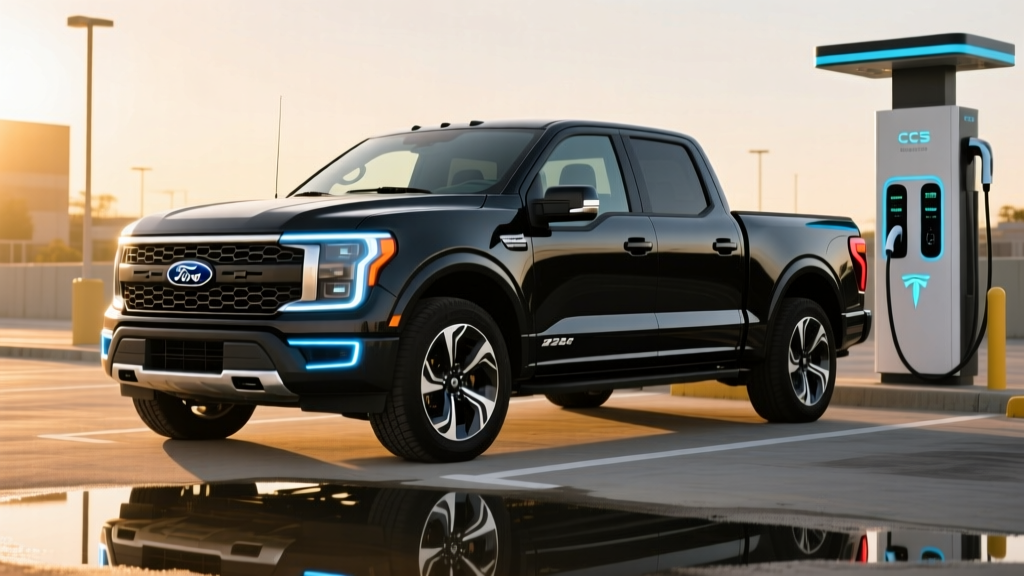
If you've ever searched for a 2002 Ford F-150 bolt pattern while swapping wheels on a classic truck, you already know Ford's full-size pickups have long used the 6×135 mm (6×5.31-inch) lug configuration. That same bolt pattern carries forward into the electric era on the 2026 Ford F-150 Lightning — meaning aftermarket wheel options that fit a 2004 F-150 will often cross-reference directly to the Lightning platform. But wheels are just the starting point. This review covers the full picture: EPA range, charging speed, battery chemistry, towing capability, pricing, and whether the Lightning still holds up against the growing field of electric trucks in 2026.
Bolt Pattern, Wheel Specs, and Platform Continuity
The 2026 Ford F-150 Lightning retains the 6×135 mm bolt pattern (6-lug, 135 mm bolt circle diameter) that Ford has used on the F-150 since the 2004 model year. Whether you're referencing a 2002 Ford F-150 bolt pattern for a restoration project or shopping for aftermarket wheels for your Lightning, the lug count and circle diameter are the same — though you must verify center bore (87.1 mm on the Lightning), offset, and load rating independently.
| Bolt Pattern | 6×135 mm (6×5.31") |
| Center Bore | 87.1 mm |
| Thread Size | M14 × 1.5 |
| OEM Wheel Sizes | 18", 20", 22" depending on trim |
| Historical Note | Same 6×135 pattern used since 2004 F-150; 2002 and earlier used 5×139.7 mm (5-lug) |
Important distinction for 2002 owners: The 1997–2003 Ford F-150 used a 5×139.7 mm (5×5.5-inch) bolt pattern with 5 lugs. If you're cross-shopping wheels between a 2002 F-150 and a 2026 Lightning, they are not interchangeable — the lug count differs. The 6×135 mm pattern began with the 2004 redesign and persists today.
2026 F-150 Lightning Powertrain, Battery, and Range
The 2026 Lightning is offered with two battery packs across multiple trims. The Standard Range pack uses a 98 kWh usable lithium-ion NMC (nickel manganese cobalt) battery, while the Extended Range pack steps up to a 131 kWh usable NMC pack. Both powertrains use a dual-motor all-wheel-drive layout.
| Spec | Standard Range | Extended Range |
|---|---|---|
| EPA Range | 240 miles | 320 miles |
| Usable Battery | 98 kWh (NMC) | 131 kWh (NMC) |
| Horsepower | 452 hp | 580 hp |
| Torque | 775 lb-ft | 775 lb-ft |
| 0–60 mph | ~4.5 sec | ~3.8 sec |
| Max Towing | 7,700 lbs | 10,000 lbs |
| MPGe (Combined) | 68 MPGe | 70 MPGe |
| Efficiency | 49 kWh/100 mi | 48 kWh/100 mi |
| Drivetrain | Dual-motor AWD | Dual-motor AWD |
Source: EPA Fuel Economy
The Extended Range Lightning's EPA estimate of 320 miles is achievable in mixed city/suburban driving at moderate temperatures. In real-world highway testing at 70–75 mph, expect 250–275 miles due to the aerodynamic penalty of a full-size pickup. In cold weather (below 32°F), range can drop to 200–230 miles on the highway without preconditioning. The Standard Range pack delivers roughly 190–210 miles highway in temperate conditions. If you tow, plan for a 40–55% range reduction depending on trailer weight and profile.
Charging Speed: DC Fast Charge and Home Level 2
Charging remains one of the Lightning's stronger attributes among electric trucks, though the large battery pack means fill times are substantial from low states of charge.
| Charge Level | Standard Range (98 kWh) | Extended Range (131 kWh) |
|---|---|---|
| DC Fast Charge (Peak) | 150 kW | 190 kW |
| DC 10–80% Time | ~41 minutes | ~41 minutes |
| Level 2 (Home, 240V) | 11.3 kW (~22 mi/hr) | 19.2 kW (~30 mi/hr) with Ford Charge Station Pro |
| Level 1 (120V) | ~2 mi/hr | ~2 mi/hr |
| Connector | CCS1 (NACS adapter available) | CCS1 (NACS adapter available) |
Charging curve reality check: The Lightning's 190 kW peak on the Extended Range pack is only sustained from roughly 10–35% state of charge. From 35–60%, the rate tapers to 120–140 kW, and above 80% it drops sharply below 40 kW. This means a 10–80% session takes roughly 41 minutes at a capable 350 kW station, but a 20–90% session can stretch past 55 minutes. Always precondition the battery via the FordPass app before arriving at a DC fast charger — skipping this step in cold weather can add 15–20 minutes to your session.
Ford's inclusion of a NACS adapter (for Tesla Supercharger network access) significantly expands the Lightning's road-trip charging map. As of 2026, the Supercharger network remains the most reliable DC fast-charging infrastructure in the U.S., and the adapter enables 150+ kW charging at V3 and V4 stalls.
Pricing, Trims, and Federal Tax Credit Eligibility
The 2026 F-150 Lightning lineup spans from work-truck fleet pricing to near-luxury territory at the Platinum trim.
| Trim | Battery | MSRP | Est. After §30D Credit |
|---|---|---|---|
| Pro (SR) | 98 kWh | $54,995 | $47,495* |
| XLT (SR) | 98 kWh | $59,995 | $52,495* |
| Lariat (ER) | 131 kWh | $72,995 | $65,495* |
| Platinum (ER) | 131 kWh | $86,995 | $79,495* |
*Tax credit amount assumes full $7,500 eligibility. See rules below.
- IRS §30D Federal Tax Credit — up to $7,500, available as a point-of-sale rebate at participating dealers. Eligibility depends on:
- Buyer AGI: ≤$150,000 single / ≤$300,000 joint
- MSRP cap for trucks/SUVs: ≤$80,000 (Pro, XLT, Lariat qualify; Platinum exceeds cap)
- Battery component and critical mineral sourcing requirements (per IRS guidelines)
- Vehicle must be assembled in North America (Lightning is built in Dearborn, MI — qualifies)
Key point: The Platinum trim at $86,995 exceeds the $80,000 MSRP cap for trucks and does not qualify for the federal credit. The Lariat Extended Range at $72,995 is the highest trim that remains eligible. Verify current battery-sourcing compliance on the fueleconomy.gov tax credit lookup before purchasing, as critical-mineral requirements tighten annually.
Cargo, Interior Space, and the Mega Power Frunk
The Lightning's dual-motor layout eliminates the engine bay, freeing up the 14.1 cu-ft Mega Power Frunk — the largest front trunk on any production EV. It features a drain plug, four 120V outlets, two USB-C ports, and a powered tailgate that doubles as a workbench. This is genuinely useful for job sites and tailgating.
| Dimension | Measurement |
|---|---|
| Frunk Volume | 14.1 cu ft |
| Bed Length (5.5' box) | 67.1 inches |
| Bed Volume | 52.8 cu ft |
| Front Legroom | 43.9 inches |
| Rear Legroom | 41.6 inches |
| Max Payload | 2,235 lbs (SR) / 1,800 lbs (ER) |
Rear-seat space is generous — identical to the gas F-150 SuperCrew — and the flat floor (no transmission tunnel) makes the middle seat usable for adults on shorter trips.
Tech, Driver Assistance, and Pro Power Onboard
The 2026 Lightning comes equipped with Ford's SYNC 4A infotainment system on a 12-inch touchscreen (15.5-inch vertical screen on Lariat and Platinum). Wireless Apple CarPlay and Android Auto are standard, and Ford's BlueCruise hands-free driving system is available on highway-mapped routes.
Ford BlueCruise is a Level 2 driver-assistance system per SAE classification. It provides hands-free steering, acceleration, and braking on pre-mapped divided highways — but the driver must remain attentive and ready to take over at all times. It is not self-driving. A driver-monitoring camera enforces attention. BlueCruise is useful for reducing fatigue on long highway stretches, but it does not handle construction zones, unmapped roads, or complex urban intersections.
Pro Power Onboard remains the Lightning's killer feature for tradespeople and off-grid use. The available 9.6 kW system turns the truck's battery into a mobile generator — enough to simultaneously run a welder, circular saw, and job-site lights. This is a genuine differentiator that no competitor matches in output.
Pros, Cons, and Competitor Comparison
Pros
- 320-mile EPA range (ER) is class-leading for electric trucks
- Pro Power Onboard 9.6 kW — unmatched mobile power
- 14.1 cu-ft frunk is genuinely useful for work and gear
- NACS adapter opens Tesla Supercharger network
- Smooth, quiet ride with strong acceleration (3.8s 0–60)
- F-150 parts, service, and familiarity everywhere
Cons
- Highway range drops significantly (~250 mi ER) at speed
- Cold-weather towing range can fall below 150 miles
- 190 kW peak DC charge rate trails Hyundai/Kia 800V rivals
- Platinum trim exceeds $80K MSRP tax-credit cap
- Only 5.5-foot bed — no 6.5 or 8-foot option
- Heavy curb weight (6,500+ lbs) accelerates tire wear
Vs. Rivian R1T: The R1T offers more adventurous off-road capability and a quad-motor option with 1,025 hp, but its maximum range (352 mi with Max Pack) comes at a significantly higher price ($89,000+). The Lightning wins on value, frunk utility, and dealer service access.
Vs. Chevrolet Silverado EV: The Silverado EV 4WT targets fleet buyers with 450 miles of range on the massive 200+ kWh pack, but it starts at $74,800 and is physically larger, making it harder to park. The Lightning remains more livable as a daily driver.
Who Should Buy the F-150 Lightning?
Choose the Lightning if:
- You need a full-size truck for work (payload, towing, Pro Power) and want to eliminate fuel costs on job-site commutes
- You have home Level 2 charging and your daily driving is under 200 miles
- You value frunk storage and onboard power for tailgating, camping, or trades
- You want an EV truck serviced at any Ford dealer nationwide
Look elsewhere if:
- You regularly tow heavy trailers over 200+ miles — the range penalty is severe
- You live in an apartment without charging access and rely solely on public infrastructure
- You need a long bed (6.5' or 8') for commercial use
- You prioritize fastest-possible DC charging — 800V rivals charge 10–80% in under 20 minutes
Battery Warranty and Long-Term Ownership
Ford covers the Lightning's battery pack with an 8-year / 100,000-mile warranty (whichever comes first), guaranteeing the pack will retain at least 70% of its original capacity during that period. The powertrain (motors, power electronics) carries the same 8-year/100,000-mile coverage. For reference, the Ford EV warranty is competitive with the industry standard, though some competitors offer 10-year battery coverage.
Real-world degradation data from early 2022–2023 Lightning owners shows approximately 3–5% capacity loss over the first 40,000 miles, which is within normal NMC behavior. Minimizing sustained 100% charges, using Level 2 for daily charging, and preconditioning before DC fast charging will help preserve long-term battery health.
Frequently Asked Questions
What is the bolt pattern on a 2026 Ford F-150 Lightning?
The 2026 F-150 Lightning uses a 6×135 mm (6×5.31-inch) bolt pattern with a center bore of 87.1 mm and M14×1.5 lug nuts. This is the same pattern Ford has used on the F-150 since the 2004 model year.
Will wheels from a 2002 Ford F-150 fit a 2026 Lightning?
No. The 1997–2003 F-150 used a 5×139.7 mm (5-lug) bolt pattern. The Lightning uses 6×135 mm (6-lug). The lug count and bolt circle are different. However, wheels from a 2004–2025 gas F-150 with 6×135 may physically bolt on — always verify center bore, offset, and load rating for the Lightning's heavier curb weight.
What is the real-world highway range of the Extended Range Lightning?
Expect 250–275 miles at 70–75 mph in moderate temperatures. In sub-freezing weather, highway range drops to approximately 200–230 miles. Towing a 5,000+ lb trailer can reduce range to 150–180 miles.
Does the 2026 F-150 Lightning qualify for the $7,500 federal tax credit?
Most trims qualify, but it depends on your income, the trim's MSRP, and current battery-sourcing rules. The Pro, XLT, and Lariat trims are under the $80,000 MSRP cap for trucks. The Platinum ($86,995) does not qualify. Buyer AGI must be ≤$150K single / ≤$300K joint. Check the fueleconomy.gov database for the latest sourcing compliance status.
How long does it take to charge the Lightning at home?
With the Ford Charge Station Pro (80A, 19.2 kW), the Extended Range pack charges from 15–100% in roughly 8 hours — ideal for overnight charging. On a standard 48A Level 2 (11.3 kW), the same session takes about 13 hours. A 120V Level 1 outlet adds only ~2 miles per hour and is best used as a trickle top-off.
Is the Lightning worth buying over the Rivian R1T or Silverado EV?
The Lightning is the best value proposition in the electric truck segment — it's the most affordable, has the most dealer support, and offers the unique Pro Power Onboard feature. The Rivian R1T is more capable off-road and more premium but costs significantly more. The Silverado EV offers more range and a longer bed option but is larger and pricier. For most truck buyers transitioning to electric, the Lightning Lariat Extended Range at ~$65,495 after the tax credit is the sweet spot.