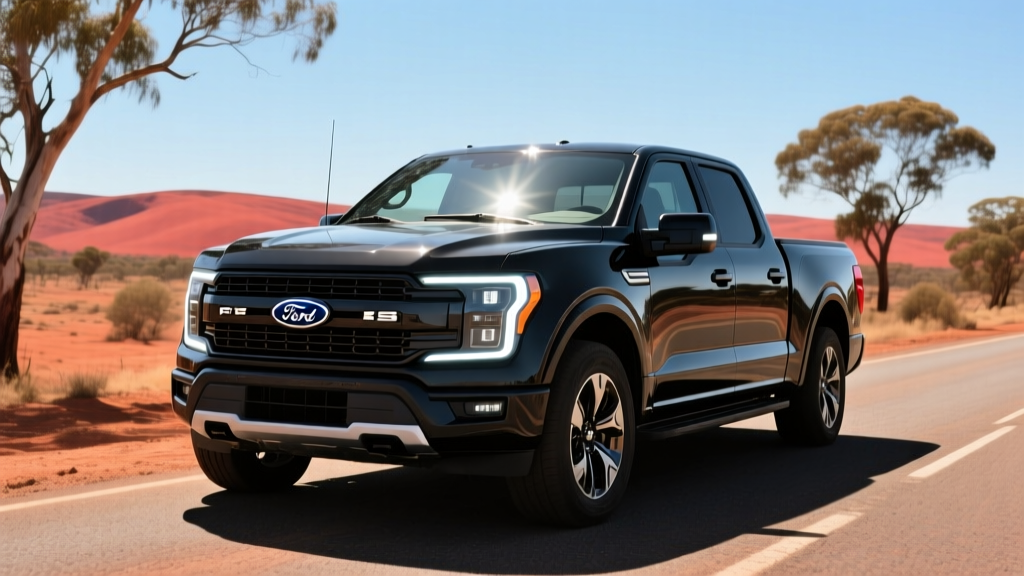
The Ford F-150 Lightning has become one of the most talked-about electric trucks in North America, but for buyers outside the U.S., acquiring one involves a complex web of import logistics, right-hand-drive (RHD) conversions, and local compliance. The Ford F-150 Lightning Australia deal landscape in 2026 is shaped by a handful of specialist importers offering turnkey RHD conversions alongside private grey-market imports. This profile breaks down exactly what Australian buyers need to know — from real-world range on the Extended Range battery to the true landed cost after shipping, conversion, and Australian luxury car tax (LCT).
F-150 Lightning at a Glance: 2026 U.S. Specs
Before dissecting the Australian import pathway, here are the baseline U.S.-market specifications for the current-generation F-150 Lightning. These numbers form the foundation for what arrives on Australian soil after conversion.
| Specification | Standard Range (Pro/XLT) | Extended Range (Lariat/Platinum) |
|---|---|---|
| EPA Range | 240 miles (386 km) | 320 miles (515 km) |
| Battery Usable Capacity | 98 kWh (NMC) | 131 kWh (NMC) |
| Drivetrain | Dual-motor AWD | Dual-motor AWD |
| Horsepower | 452 hp / 775 lb-ft | 580 hp / 775 lb-ft |
| 0-60 mph | ~4.0 sec | |
| Max DC Fast Charge | 150 kW | 150 kW (peak, tapering) |
| 10-80% DC Time | ~36 min | ~41 min |
| Level 2 Home Charge Rate | 11.3 kW (~20 mi/hr) | 19.2 kW (~30 mi/hr) w/ 80A charger |
| MPGe (Combined) | 68 MPGe | 66 MPGe |
| kWh/100 mi | 49 kWh | 51 kWh |
| Max Towing | 7,700 lbs (3,493 kg) | 10,000 lbs (4,536 kg) |
| Max Payload | 2,235 lbs (1,014 kg) | 1,952 lbs (885 kg) |
| Base U.S. MSRP | ~$55,000 | ~$78,000 (Platinum) |
The Australian Import Pathway: How the Deal Works
Ford does not officially sell the F-150 Lightning in Australia. Unlike the RAM 1500 — which Stellantis converts to RHD through a partnership with Walkinshaw Automotive in Melbourne — the Lightning arrives through independent specialist converters and grey-market importers. As of 2026, the most established pathway involves:
- U.S. Vehicle Purchase: Buyer sources a new or low-kilometre used F-150 Lightning from a U.S. dealer, typically in the $55,000-$85,000 USD range depending on trim.
- Shipping: Roll-on/roll-off (RoRo) or container shipping from a U.S. West Coast port to Melbourne or Sydney, costing approximately $4,000-$7,000 AUD.
- RHD Conversion: Specialist firms (such as Autogroup Conversions or Performax International) perform a full steering-column, dashboard, pedal, and wiring-loom conversion. This process typically runs $45,000-$65,000 AUD and takes 3-6 months.
- ADR Compliance: The converted vehicle must meet Australian Design Rules, including lighting modifications, child-seat anchorage compliance, and ADR-approved glass. This adds $5,000-$10,000 AUD.
- Registration & Taxes: State registration, stamp duty, and the federal Luxury Car Tax (LCT) — currently 33% on the amount exceeding the $80,545 AUD threshold for fuel-efficient vehicles (2025-26 financial year, adjusted annually) — apply on the total landed value.
Total Landed Cost: What Australian Buyers Actually Pay
Let's model a realistic 2026 import scenario for the F-150 Lightning XLT Extended Range — the trim most commonly sought by Australian buyers for its balance of range and features.
| Cost Component | Estimated Cost (AUD) |
|---|---|
| U.S. Purchase (XLT Extended Range, ~$72,000 USD) | ~$112,000 |
| Shipping & Insurance | $5,500 |
| Import Duty (5%, if applicable) | $5,600 |
| GST (10% on CIF + duty) | $12,300 |
| RHD Conversion | $55,000 |
| ADR Compliance & Modifications | $7,500 |
| Luxury Car Tax (if threshold exceeded) | $15,000-$25,000 |
| State Registration & Stamp Duty | $4,000-$8,000 |
| Total Estimated Landed Cost | $217,000-$231,000 AUD |
This places the converted Lightning firmly in premium territory — competing against the RAM 1500 REV (when available), the Chevrolet Silverado EV (also import-only), and conventional diesel utes like the Ford Ranger Raptor or Toyota LandCruiser 79 Series at far lower price points. The value proposition hinges on wanting a full-size electric pickup with 500+ km theoretical range and Pro Power Onboard capability in a market with no local factory alternative.
Charging in Australia: Connector Compatibility & Infrastructure
A critical consideration for any U.S.-import EV landing in Australia is the charging connector mismatch. The F-150 Lightning uses the CCS1 (Combo 1) connector standard in North America, while Australia has adopted CCS2 (Combo 2) as its DC fast-charging standard.
| Charging Level | U.S. Spec (Lightning) | Australian Reality |
|---|---|---|
| Level 1 (120V / 240V) | J1772 (1.4 kW) | Needs adapter; AU uses 240V standard — faster than U.S. Level 1 |
| Level 2 (AC Home) | J1772 (11.3-19.2 kW) | Type 2 adapter required; most AU home chargers are Type 2 — adapters cost $150-$300 AUD |
| DC Fast Charging | CCS1 (up to 150 kW) | CCS1-to-CCS2 adapter mandatory (~$400-$600 AUD); limits public network access to adapter-compatible sessions |
The CCS1-to-CCS2 adapter situation has improved since 2024, with several Australian EV accessory companies offering certified adapters rated for up to 200 kW DC. However, not all public chargers (Chargefox, Evie Networks, Ampol AmpCharge) handle adapter-mediated sessions flawlessly — handshake failures occur more frequently than with native CCS2 vehicles. Plan for a 10-15% public charging inconvenience factor on road trips.
At home, the Lightning's onboard charger accepts up to 19.2 kW on the Extended Range model when paired with Ford's 80-amp Charge Station Pro. In Australia, most residential installations max out at 7.4 kW (single-phase, 32A) or 11-22 kW (three-phase). A full three-phase home install (requiring a 63A circuit) runs $3,500-$6,000 AUD including electrician, cabling, and switchboard upgrade — essential to check with a licensed electrician before committing.
Performance, Towing & Practical Capability
The dual-motor AWD powertrain delivers genuinely impressive performance. The Extended Range model's 580 hp and 775 lb-ft of torque propel the Lightning to 100 km/h in approximately 4.5 seconds — remarkable for a 2,900 kg vehicle. The instant torque delivery makes highway overtaking effortless, and the low centre of gravity (battery pack under the floor) reduces body roll compared to any diesel ute on the market.
Towing is where the Lightning excels and simultaneously exposes its Achilles heel. The 4,536 kg (10,000 lb) max tow rating exceeds most Australian dual-cab utes, and the integrated trailer brake controller, Pro Trailer Backup Assist, and onboard scales work well. However, towing a 3,000 kg caravan at highway speeds will consume roughly 80-100 kWh/100 km — effectively halving the Extended Range battery's usable distance to around 220-260 km between charges. For Australian outback touring where DC chargers are sparse beyond coastal corridors, this is a serious limitation.
The Mega Power Frunk (front trunk) offers 400 litres of lockable storage with 400 lbs of payload capacity — a genuine advantage over any ICE pickup. Combined with the 1,500-litre bed and 2,074 mm of overall width, the Lightning offers utility space that dwarfs the Ranger or Hilux.
Pros
- 515 km EPA range (Extended Range) — longest of any electric ute available for AU import
- Pro Power Onboard: 9.6 kW of exportable power — run job-site tools, camping gear, or backup home power
- Massive frunk + bed = best-in-class cargo versatility
- 4.5-sec 0-100 km/h with 775 lb-ft instant torque
- Quiet, refined ride quality superior to any diesel ute
- Ford Co-Pilot360 2.0 with BlueCruise hands-free driving (where mapped)
Cons
- $220,000+ AUD landed cost makes it extraordinarily expensive
- CCS1 connector requires adapter for Australian DC fast chargers
- Towing range drops to ~230 km — problematic for remote AU touring
- 2,900 kg kerb weight impacts tyre wear and registration costs in some states
- No Ford Australia warranty support — relies on converter/importer warranty
- RHD conversion may affect resale value and insurance premiums
Battery, Warranty & Long-Term Ownership
The Lightning uses NMC (nickel manganese cobalt) lithium-ion cells in both battery sizes. Ford's U.S. battery warranty covers 8 years / 100,000 miles (160,000 km) against capacity loss below 70% of original. However, this warranty is issued by Ford Motor Company in the United States and is not directly honoured by Ford Australia. Australian owners must either:
- Ship the battery back to the U.S. for warranty service (prohibitively expensive)
- Rely on the RHD converter's own warranty provisions (typically 2-3 years on conversion work)
- Engage independent EV battery specialists in Australia for diagnostics and repair
NMC chemistry offers excellent energy density (hence the 131 kWh usable in a manageable pack size) but is more sensitive to sustained high-SoC storage and extreme heat than LFP. Australian owners in hot climates (Queensland, Northern Territory) should avoid routinely charging to 100% and parking in direct sun at full charge. Expect 10-15% capacity degradation over 8-10 years based on current NMC fleet data — meaning a 515 km new-vehicle range could settle to ~440-460 km after a decade of typical use.
Tax Credits & Incentives: U.S. and Australian Perspectives
The U.S. federal §30D clean vehicle tax credit of up to $7,500 USD is generally not available to Australian importers, as it requires the vehicle to be placed in service within the United States and the buyer to have U.S. federal tax liability. The F-150 Lightning's battery sourcing and critical-mineral composition meet 2026 IRS requirements, and the MSRP falls within the $80,000 truck cap — but these are moot points for an overseas buyer.
On the Australian side, the Federal Government's Electric Car Discount (FBT exemption for eligible EVs below the LCT threshold) does not apply to the Lightning, as its landed cost far exceeds the threshold. However, some state-level incentives remain relevant:
- NSW: $3,000 stamp duty exemption for EVs under $78,000 (does not apply to Lightning)
- Victoria: Zero-emission vehicle registration discount (limited value at this price point)
- ACT: Two years free registration for new EVs (applies regardless of price — a saving of ~$1,400 AUD)
Consult a tax professional familiar with Australian EV import rules before making purchase decisions based on incentive assumptions.
F-150 Lightning vs. Australian Alternatives
The Lightning doesn't compete in a vacuum. Australian buyers at this price point are cross-shopping against several options:
| Vehicle | Approx. Price (AUD) | Range / Fuel Economy | Towing | RHD? |
|---|---|---|---|---|
| Ford F-150 Lightning (imported/converted) | $217,000-$231,000 | ~400-440 km real-world | 4,536 kg | Aftermarket conversion |
| RAM 1500 (HEV, official AU) | $140,000-$160,000 | ~10.5 L/100km combined | 4,500 kg | Factory RHD |
| Ford Ranger Raptor (diesel) | $95,000-$105,000 | ~8.5 L/100km combined | 2,500 kg | Factory RHD |
| Chevrolet Silverado EV (imported) | $200,000-$240,000 est. | ~550-600 km est. | 4,536 kg | Aftermarket conversion |
| Toyota LandCruiser 300 Series | $100,000-$150,000 | ~9.5 L/100km combined | 3,500 kg | Factory RHD |
Decision Framework: Who Should Import the Lightning?
Choose the F-150 Lightning if: You need a full-size electric ute with maximum frunk/bed utility, run a business where Pro Power Onboard replaces a generator, primarily drive in urban/suburban areas with home charging, and accept the $220,000+ cost as a premium for exclusivity and capability.
Look elsewhere if: You regularly tow heavy loads over long outback distances, need factory-backed Australian warranty support, want a vehicle that any local mechanic can service, or are budget-conscious — a Ranger Raptor or LandCruiser delivers 80% of the utility at 40-50% of the price.
Standout Technology & Interior
The Lightning's cabin centres on a 15.5-inch portrait touchscreen running Ford's SYNC 4A system, which supports wireless Apple CarPlay, Android Auto, and over-the-air updates. The digital instrument cluster is a 12-inch configurable display. Higher trims (Lariat, Platinum) add a 14-speoner B&O sound system, heated and ventilated leather seats, and a twin-panel moonroof.
The Ford Co-Pilot360 2.0 suite includes adaptive cruise control with stop-and-go, lane-centring, evasive steering assist, and intersection collision avoidance. BlueCruise hands-free driving is available on pre-mapped divided highways — but this feature is mapped for North America only and will not function on Australian roads without future Ford expansion (not announced as of 2026). The driver-assist features remain SAE Level 2 — the driver must remain attentive and hands available at all times.
The most unique tech feature is Pro Power Onboard, which provides up to 9.6 kW of exportable 240V AC power through outlets in the bed, cabin, and frunk. This turns the Lightning into a mobile power station — running welders, air compressors, camping equipment, or even backing up a home during a blackout (with appropriate transfer-switch installation).
Frequently Asked Questions
What is the real-world range of the F-150 Lightning in Australian conditions?
The Extended Range model achieves 515 km (320 mi) on the EPA cycle. In Australian mixed driving, expect 400-440 km. Highway driving at 110 km/h in hot conditions may yield 370-400 km. Towing a caravan typically reduces range to 220-260 km.
How fast does it charge on Australian infrastructure?
At a DC fast charger (via CCS1-to-CCS2 adapter), the Lightning peaks at 150 kW, charging from 10-80% in approximately 36-41 minutes depending on battery size. The charge curve tapers significantly above 80% — a full 80-100% top-up can add another 25-30 minutes. At home on a three-phase 22 kW wallbox, the Extended Range model gains roughly 30 km of range per hour, requiring about 12-14 hours for a full charge.
Does the F-150 Lightning qualify for the U.S. federal EV tax credit?
The Lightning meets 2026 IRS §30D requirements — its MSRP falls under the $80,000 truck cap, battery sourcing meets critical-mineral thresholds, and Ford's assembly in Dearborn, Michigan qualifies. However, the credit requires U.S. tax liability and domestic placement in service, making it generally unavailable to Australian importers.
Is the Lightning worth importing vs. buying a RAM 1500 or Ranger in Australia?
It depends on priorities. The Lightning offers zero tailpipe emissions, instant torque, Pro Power Onboard, and lower per-km energy cost (roughly $0.06-$0.10 AUD/km on home solar vs. $0.15-$0.22/km for diesel). But the $220,000+ landed cost, lack of factory AU warranty, CCS adapter hassle, and towing-range limitations make the RAM 1500 (factory RHD, hybrid option) or even a Ranger Raptor more practical for most Australian buyers.
What warranty coverage do Australian Lightning owners get?
Ford's U.S. battery and powertrain warranty (8 years/160,000 km) is not directly supported by Ford Australia. RHD converters typically offer 2-3 year warranties on conversion workmanship. Owners should budget for independent EV specialist servicing and consider aftermarket warranty products where available.
Can I charge at Australian public fast-charging networks?
Yes, but with a CCS1-to-CCS2 adapter ($400-$600 AUD). Networks like Chargefox, Evie, and Ampol AmpCharge support adapter-mediated charging, though occasional handshake failures occur. Always carry the adapter and have a backup charging plan for remote routes.