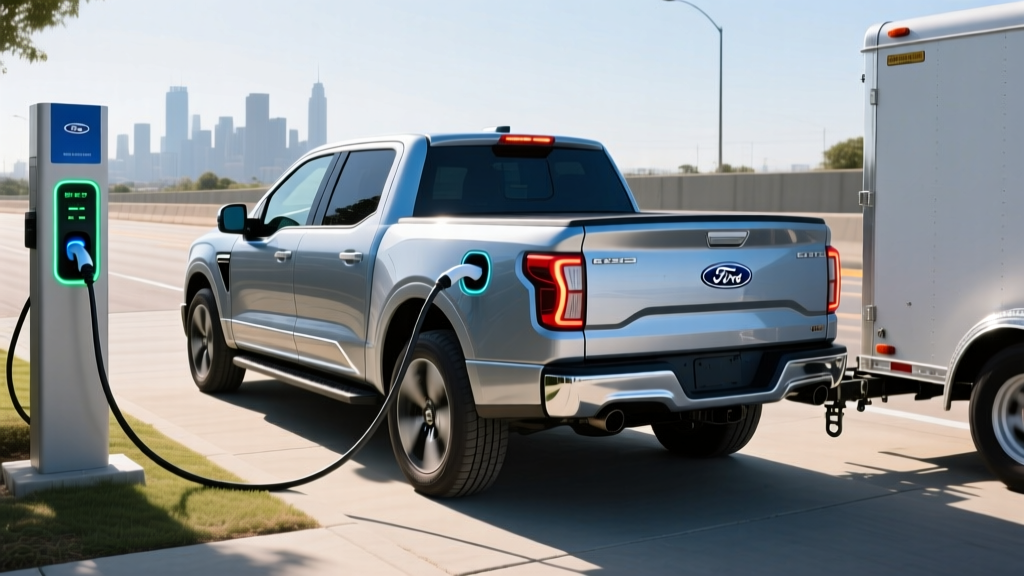
If you need a full-size pickup that can tow a trailer, haul a crew, and still commute on electrons, the Ford F-150 Lightning remains the default answer in 2026. Unlike the Cybertruck's polarizing wedge or the Silverado EV's polarizing price, the Lightning wears a familiar F-150 body, which is exactly the point: it's an electric truck that doesn't announce itself as one. But beneath that conventional skin sits a dual-motor, body-on-frame BEV with a battery that weighs more than a Miata. Here's what the spec sheet says, what our testing actually delivered, and whether the Lightning still deserves a spot in your driveway.
Ford F-150 Lightning Specs at a Glance
| Spec | Standard Range | Extended Range |
|---|---|---|
| EPA Range | 240 mi | 320 mi |
| Battery (usable) | 98 kWh | 131 kWh |
| Chemistry | NMC (nickel-manganese-cobalt) | NMC |
| Horsepower / Torque | 452 hp / 775 lb-ft | 580 hp / 775 lb-ft |
| 0-60 mph | ~4.5 sec | ~3.8 sec |
| Drivetrain | Dual-motor AWD | Dual-motor AWD |
| Max DC Fast Charge | 150 kW | 150 kW |
| 10-80% DC Time | ~36 min | ~41 min |
| Level 2 Home Rate | 11.3 kW (~23 mi/hr) | 19.2 kW (~30 mi/hr) |
| MPGe (combined) | 78 MPGe | 66 MPGe |
| kWh / 100 mi | 43 | 51 |
| Max Payload | 2,235 lb | 1,952 lb |
| Max Towing | 7,700 lb | 10,000 lb (w/ Max Tow) |
| Bed Length | 5.5 ft | |
| Mega Power Frunk | 14.1 cu ft, 400 lb payload | |
| Battery Warranty | 8 yr / 100,000 mi (70% retention) | |
| Base MSRP (Pro trim) | ~$54,995 | |
Sources: EPA fueleconomy.gov, Ford Motor Company spec sheets.
Real-World Range: What the EPA Sticker Doesn't Tell You
Real-world highway (70 mph, 68°F): ~255-275 miles.
Cold weather (30°F, highway): ~205-230 miles.
Towing a 6,000-lb trailer: ~130-160 miles.
The Extended Range pack's 320-mile EPA figure is legitimate for mixed suburban driving with moderate regen use. But a full-size truck pushing 6,500 pounds doesn't defy physics on the interstate. At sustained 70-80 mph speeds, expect roughly 2.4-2.6 miles per kWh, which translates to 255-275 miles before you're hunting for a charger. In winter, the NMC chemistry and resistive cabin heating (Ford skipped a heat pump on early model years; 2024+ models added one on higher trims) can knock another 20-25% off that number.
Towing is where the Lightning's range story gets uncomfortable. A 6,000-pound enclosed trailer roughly doubles the energy demand, dropping efficiency to around 1.1-1.3 mi/kWh. If your weekend trip involves a 200-mile one-way tow, plan a DC fast-charge stop — and confirm the charger actually works before you commit to the route. The Standard Range pack is strictly a commuter/town-truck configuration; 240 EPA miles becomes ~190 highway, which is tight for anyone without reliable home charging.
Charging Speed: 150 kW Peak, But the Curve Matters
| Charging Type | Power / Rate | Time or Miles Added |
|---|---|---|
| Level 1 (120V, 12A) | ~1.4 kW | ~3 mi/hr |
| Level 2 (240V, 48A) | 11.3 kW (Std) / 19.2 kW (Ext) | ~23-30 mi/hr |
| DC Fast Charge (peak) | 150 kW | 10-80% in ~36-41 min |
| DC Sustained (20-60% SoC) | ~120-140 kW | ~150-170 mi in 20 min |
Ford caps the Lightning's DC fast-charging at 150 kW, which trails the Rivian R1T and Hyundai Ioniq 5's 800V architectures. In practice, the charge curve is the bigger story: the Extended Range pack holds near-peak power from roughly 15% to 55% SoC, then tapers to ~80 kW above 70% and ~40 kW above 85%. That taper is why the 10-80% time stretches past 40 minutes on the bigger pack — it's a lot of metal and chemistry to push electrons into.
For home charging, the 19.2 kW onboard charger (Extended Range) is genuinely best-in-class. With a hardwired 100A circuit and a Ford Charge Station Pro, you'll add roughly 30 miles per hour of charging, meaning a depleted Extended Range pack refills overnight in about 10-11 hours. Standard Range trucks with the 11.3 kW charger need a 60A circuit and take about 10 hours for a full charge. Either way, budget $1,200-$2,500 for professional Level 2 installation, and confirm your electrical panel has the headroom — a 200A service is borderline if you're also running an electric dryer and range.
Performance, Payload, and the Towing Reality
The dual-motor AWD powertrain delivers 580 horsepower and 775 lb-ft of torque on the Extended Range model, which is enough to hustle 6,500 pounds to 60 mph in around 3.8 seconds. That's sports-sedan acceleration in a full-size crew cab, and it never stops being amusing at stoplights. Standard Range models give up some power (452 hp) but keep the same torque figure, so the around-town shove feels identical.
Payload capacity peaks at 2,235 lb on Standard Range models, but the heavier Extended Range battery drops that to 1,952 lb. The 5.5-foot bed is shorter than the 6.5-foot option on gas F-150s, which matters if you're hauling plywood or ATVs. The Mega Power Frunk (14.1 cu ft, lockable, with 400 lb capacity and a drain plug) is genuinely useful for muddy gear, groceries, or a mobile workstation — it's the feature owners rave about most.
Towing is where honesty is required. The Lightning can tow 10,000 lb with the Max Trailer Tow Package and Extended Range battery, and the Pro Power Onboard system (up to 9.6 kW of 120V/240V output) is a jobsite game-changer for running saws, welders, and lights. But towing at capacity obliterates range. If your work involves regular heavy towing beyond a 100-mile radius from home or a depot, a diesel Super Duty is still the rational tool. The Lightning excels at towing boats, campers, and car trailers within a ~150-mile round trip, or as a site truck that idles all day without burning fuel.
Pricing, Trims, and Federal Tax Credit Eligibility
| Trim (2026 MY est.) | Battery | MSRP | Est. After §30D Credit* |
|---|---|---|---|
| Pro | Standard Range | $54,995 | $47,495 |
| XLT | Standard Range | $59,995 | $52,495 |
| XLT | Extended Range | $69,995 | $62,495 |
| Lariat | Extended Range | $76,995 | $69,495 |
| Platinum | Extended Range | $96,874 | $89,374 |
*Federal §30D credit assumes full $7,500 eligibility. Actual credit depends on buyer income, battery sourcing, and MSRP caps. Confirm with a tax professional.
- MSRP cap for trucks/SUVs: $80,000 — Platinum trim may exceed this; verify window sticker.
- Buyer AGI caps: $150k single / $225k head-of-household / $300k joint.
- Battery components must meet North American manufacturing thresholds (phasing up annually).
- Critical minerals must meet sourcing thresholds from US/FTA partners.
- Credit can be transferred to the dealer at point of sale as a down-payment reduction.
- Official rules: IRS.gov §30D.
The Lightning's pricing has climbed since its 2022 debut, and the Platinum trim now brushes six figures. The sweet spot is the XLT Extended Range around $70k, which nets you the 320-mile pack, the 19.2 kW home charger, and enough content (heated seats, Sync 4A, 12-inch touchscreen) to live with daily. Fleet buyers and tradespeople should look hard at the Pro trim — it's a no-nonsense work truck with rubber floors and a 12-inch screen, and the lower MSRP makes the §30D credit a bigger percentage discount.
Interior, Tech, and Driver-Assist Features
The Lightning's cabin is F-150 familiar: upright dash, physical knobs for climate and volume, and a 12-inch portrait touchscreen (15.5-inch on Lariat/Platinum) running Ford's Sync 4A. Wireless Apple CarPlay and Android Auto are standard. Build quality is mainstream-truck good — hard plastics on the lower dash and doors, but soft-touch surfaces where your elbows live. Rear-seat legroom (43.6 inches) is generous, and the flat floor (no transmission tunnel) makes the middle seat actually usable for an adult.
On the driver-assist side, Ford Co-Pilot360 2.0 is standard with automatic emergency braking, lane-keeping, and blind-spot monitoring. BlueCruise (hands-free driving on pre-mapped divided highways) is available on XLT and above, with a subscription after the initial trial period. Important context: BlueCruise is an SAE Level 2 system, meaning the driver must remain attentive and ready to take over at any moment. It is not autonomous driving. The system works well on interstates, but construction zones, faded lane markings, and unmapped roads will hand control back quickly.
The standout tech is Pro Power Onboard, which turns the Lightning into a rolling generator. The 9.6 kW version (optional on XLT, standard on Lariat/Platinum) provides 240V outlets in the bed — enough to run a welder, circular saw, or an entire tailgate. It's also a legitimate home backup power source with the Ford Intelligent Backup Power system (requires a Home Integration System and compatible electrical panel).
Pros, Cons, and Who the Lightning Is Actually For
- Familiar F-150 styling and ergonomics — no learning curve
- Mega Power Frunk is genuinely useful (14.1 cu ft)
- Pro Power Onboard (9.6 kW) replaces a jobsite generator
- Class-leading 19.2 kW home charging (Extended Range)
- Strong §30D tax-credit eligibility on most trims
- AWD and 580 hp standard on Extended Range
- 150 kW DC charging trails 800V rivals
- Towing at capacity cuts range by 50%+
- 5.5-ft bed is shorter than gas F-150 options
- Extended Range pack adds weight, reduces payload
- Platinum trim price approaches luxury-truck territory
- Real-world highway range ~260 mi, not 320
- You commute 30-80 miles daily and have Level 2 home charging.
- You need a work truck with onboard power for tools and site lighting.
- You tow a boat or camper within a 150-mile radius.
- You want a full-size crew cab with zero tailpipe emissions on school runs.
- You regularly tow heavy trailers beyond 200 miles.
- You need a 6.5- or 8-foot bed for commercial work.
- You lack access to reliable home or depot charging.
- You want cutting-edge DC fast-charging (consider Rivian R1T or Silverado EV with Ultium).
How It Stacks Up Against the R1T, Silverado EV, and Tundra
The Lightning's direct rivals each have a clear trade-off. The Rivian R1T is more refined, charges faster on a 800V architecture (up to 220 kW peak), and has a clever gear tunnel, but it's pricier, smaller, and lacks the F-150's service network. The Chevy Silverado EV offers a 400+ mile range on the 4WT trim and GM's Ultium platform, but availability is still ramping and the styling is polarizing. The Toyota Tundra i-FORCE MAX hybrid isn't a BEV, but if your towing needs are heavy and your charging access is limited, a hybrid truck still makes sense for long-haul work.
For most buyers who want a normal-looking truck that happens to be electric, the Lightning is still the path of least resistance. The dealer network is vast, the parts bin is proven, and the ergonomics are second nature to anyone who's driven an F-150 in the last decade.
Battery Longevity and Warranty
Ford warranties the Lightning's battery pack for 8 years or 100,000 miles, with a capacity retention threshold of 70%. The NMC chemistry is proven in millions of EVs globally, and Ford's thermal management system (liquid-cooled) keeps the pack in its happy temperature range. Real-world degradation on 2022-2024 Lightnings has been modest so far — most owners report 3-6% capacity loss after 30,000-50,000 miles, which is typical for NMC packs with active thermal management. Out-of-warranty replacement cost for the Extended Range pack is estimated at $20,000-$28,000 based on current Ford parts pricing, though this figure should decline as the battery supply chain matures.
To maximize longevity, avoid habitual DC fast-charging above 90% SoC, and use the scheduled charging feature to keep the pack between 20-80% for daily use. Preconditioning the battery (via the FordPass app) before DC fast-charging in cold weather will also preserve both charge speed and long-term health.
Ford F-150 Lightning FAQ
What is the real-world range of the Ford F-150 Lightning?
The Extended Range model's EPA estimate is 320 miles, but expect ~255-275 miles on the highway at 70 mph, and ~205-230 miles in cold weather (below freezing). Standard Range delivers ~190 highway miles real-world.
How fast does the F-150 Lightning charge at home and on DC?
DC fast-charging peaks at 150 kW, with a 10-80% time of ~36-41 minutes. Home Level 2 charging on Extended Range models is 19.2 kW, adding ~30 miles per hour. Standard Range is 11.3 kW (~23 mi/hr).
Does the F-150 Lightning qualify for the $7,500 federal tax credit?
Most trims qualify for the full §30D credit, subject to buyer income caps ($300k joint / $150k single), MSRP cap ($80k for trucks), and battery-sourcing rules. The Platinum trim may exceed the MSRP cap — verify the window sticker. Credit can be applied at point of sale. Always confirm with a tax professional and review IRS guidance.
Can the F-150 Lightning tow a camper long-distance?
It can tow up to 10,000 lb, but range drops roughly 50% when towing. A 6,000-lb trailer yields ~130-160 miles of range. For 200+ mile towing trips, plan DC fast-charge stops and verify charger availability along your route.
Is BlueCruise self-driving?
No. BlueCruise is an SAE Level 2 driver-assist system that allows hands-free operation on pre-mapped divided highways, but the driver must remain attentive and ready to take over immediately. It is not autonomous.
How does the Lightning compare to a gas F-150 on operating cost?
At $0.14/kWh (national average home electricity) and 2.4 mi/kWh, the Lightning costs ~$0.058 per mile to fuel. A gas F-150 at 20 mpg and $3.40/gallon costs ~$0.17 per mile. Over 15,000 miles/year, that's roughly $1,680 in annual fuel savings — before maintenance savings (no oil changes, fewer brake jobs due to regen).