Ford's 2026 EV Lineup and the Federal Tax Credit Landscape
If you're shopping for a Ford EV in 2026, the first question is often about the Ford EV tax credit — specifically whether the Mustang Mach-E or F-150 Lightning qualifies for the full $7,500 federal incentive under IRS §30D. The answer in 2026 is nuanced: eligibility depends on your income, the vehicle's MSRP, and increasingly complex battery-sourcing requirements that have shifted since the credit rules were overhauled by the Inflation Reduction Act.
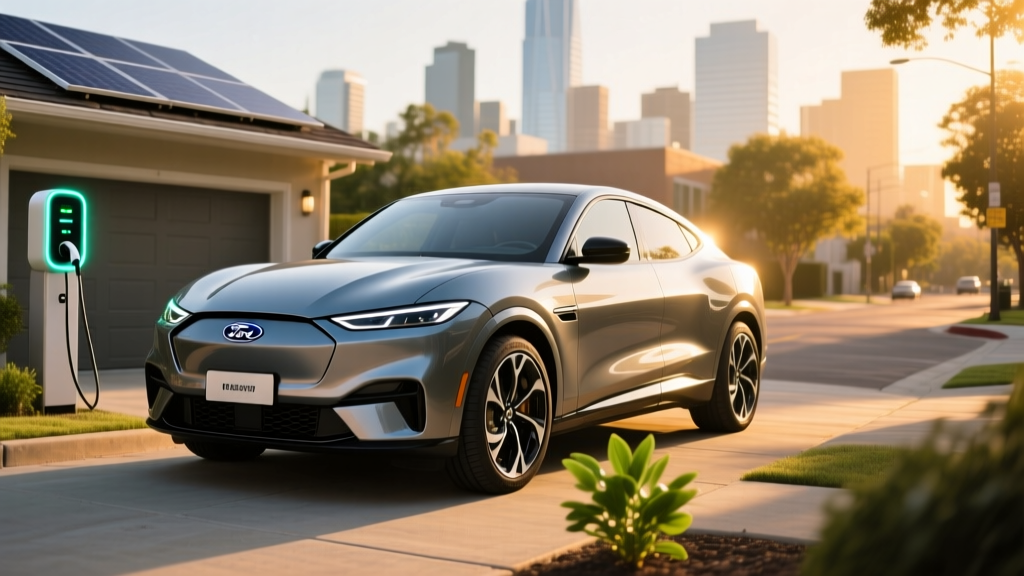
As of the 2026 model year, Ford sells two primary battery-electric vehicles in the U.S.: the Mustang Mach-E (a crossover SUV starting around $42,995) and the F-150 Lightning (a full-size pickup starting around $54,995 for the Pro trim). Both vehicles have faced evolving critical-mineral and battery-component sourcing rules that determine whether they qualify for the full credit, half credit ($3,750), or no credit at all. Ford has worked aggressively to onshore battery production — its BlueOvalSK joint venture with SK On in Kentucky and Tennessee is central to this effort — but the specific trim and build date matter.
This guide breaks down exactly what the 2026 Ford EV tax credit looks like, walks through a realistic 5-year total cost of ownership, and separates the genuine savings from the higher costs that catch new EV owners off guard.
Ford EV Tax Credit 2026: Do You Qualify Under §30D?
The federal EV tax credit under IRS §30D offers up to $7,500 for qualifying new clean vehicles. But "up to" is doing heavy lifting. The credit splits into two halves — $3,750 for meeting critical-minerals sourcing requirements and $3,750 for meeting battery-component manufacturing requirements — and vehicles must satisfy both to reach $7,500.
§30D Eligibility Checklist for 2026 Ford EVs
- MSRP Cap: Vans, SUVs, and pickup trucks (including Mach-E and F-150 Lightning) must have an MSRP at or below $80,000. Sedans are capped at $55,000. Most Mach-E and Lightning trims fall under the $80K threshold, but fully loaded Lightning Platinum or Mach-E GT trims can approach it — check the window sticker.
- Buyer Income Limits (Modified AGI): $300,000 for joint filers, $225,000 for heads of household, $150,000 for single filers. This applies to the tax year you take delivery or the prior year, whichever is lower.
- Critical Minerals Requirement ($3,750): A specified percentage of critical minerals must be extracted or processed in the U.S. or a country with a free-trade agreement, or recycled in North America. The threshold has increased annually since 2024.
- Battery Components Requirement ($3,750): A specified percentage of battery components must be manufactured or assembled in North America. Additionally, vehicles with battery components from a "foreign entity of concern" (FEOC) are disqualified entirely — this rule has tightened significantly by 2026.
- Point-of-Sale Transfer: Since 2024, buyers can transfer the credit to the dealer at purchase, receiving the credit as an immediate price reduction rather than waiting to claim it on their tax return. This is available regardless of tax liability.
- Final Assembly: Vehicle must undergo final assembly in North America. Both the Mach-E (Cuautitlán, Mexico) and F-150 Lightning (Dearborn, Michigan) qualify.
2026 Ford EV credit status (as of publication): The F-150 Lightning with the standard-range battery has generally qualified for the full $7,500 credit thanks to Ford's LFP battery sourcing from CATL for standard-range models meeting critical-minerals thresholds through FTA-partner processing, and BlueOvalSK NMC packs for extended-range trims meeting North American component requirements. The Mustang Mach-E's eligibility has been more variable by trim and build month. Always verify current eligibility on fueleconomy.gov before purchasing, as sourcing changes can shift qualification mid-year.
Important: Tax credit rules are subject to legislative and regulatory changes. Consult a tax professional and the IRS for your specific situation.
5-Year Total Cost of Ownership: Ford Mach-E vs. Gas Equivalent
The tax credit is just one piece of the financial picture. To understand whether a Ford EV actually saves money, we need to model a full 5-year / 75,000-mile ownership cycle against a comparable gas vehicle. For this comparison, we'll use the 2026 Mustang Mach-E Premium RWD (extended-range battery, ~$48,995 MSRP) against a similarly equipped Ford Edge ST-Line AWD (~$44,000 MSRP) as the gas baseline.
| Cost Category | Mach-E Premium ER RWD | Ford Edge ST-Line AWD |
|---|---|---|
| Purchase Price (MSRP) | $48,995 | $44,000 |
| Federal Tax Credit (§30D) | −$7,500 (if eligible) | $0 |
| Net Purchase Price | $41,495 | $44,000 |
| State Registration/Taxes (est.) | $3,200 | $2,800 |
| Fuel / Charging (75K mi) | $4,875 | $9,375 |
| Maintenance (5 years) | $1,800 | $4,200 |
| Insurance (5 years) | $11,250 | $8,500 |
| Depreciation (est. 5-yr) | $19,500 | $16,800 |
| Total 5-Year Cost | $82,120 | $85,675 |
Assumptions: Electricity at $0.16/kWh national average (mix of home Level 2 and occasional DC fast charging), gas at $3.50/gallon, Mach-E efficiency at 3.3 mi/kWh (97 MPGe combined per fueleconomy.gov), Edge at 24 MPG combined. Insurance based on national EV average premium ~15-25% higher than gas equivalent. Depreciation estimated from 2023-2025 EV resale trends. Actual costs vary significantly by region, driving habits, and electricity rates.
Charging vs. Gas: The Real Per-Mile Math
Fuel savings are where EVs consistently deliver, but the magnitude depends heavily on how and where you charge. Here's the concrete math for the Mach-E:
Cost Per Mile: Mach-E vs. Edge
Mach-E (home Level 2 charging at $0.16/kWh):
The 2026 Mach-E Premium ER RWD achieves approximately 3.3 miles per kWh (97 MPGe combined). At $0.16/kWh: $0.048 per mile — or $3,600 over 75,000 miles.
Mach-E (DC fast charging at $0.40/kWh average):
If you rely primarily on public DC fast charging (Electrify America, EVgo), cost rises to: $0.121 per mile — or $9,075 over 75,000 miles. This narrows the gap with gas significantly.
Ford Edge (gasoline at $3.50/gallon, 24 MPG combined):
$0.146 per mile — or $10,950 over 75,000 miles.
The takeaway: Home charging saves roughly $0.10/mile vs. gas — about $7,350 over 75,000 miles. Exclusive DC fast charging saves only ~$0.025/mile — about $1,875 over 75,000 miles. Your charging setup determines whether fuel savings are transformative or marginal.
For the Mach-E specifically, the 91 kWh usable battery (extended range, NMC chemistry) means a full home charge at $0.16/kWh costs roughly $14.56, delivering an EPA-estimated 310-320 miles of range (expect 250-270 miles in real-world highway driving, and 20-30% less in sub-freezing temperatures).
Maintenance Savings: Where EVs Genuinely Cost Less
EV powertrains have far fewer moving parts than internal-combustion engines, and this translates into measurable maintenance savings over five years. No oil changes, no spark plugs, no timing belts, no exhaust system repairs, and significantly reduced brake wear thanks to regenerative braking.
| Maintenance Item | Mach-E (BEV) | Gas SUV (Edge) |
|---|---|---|
| Oil Changes | $0 (none required) | $750 (10 changes @ $75) |
| Brake Pads/Rotors | $300 (regen extends life 2-3x) | $1,200 (2 replacements) |
| Coolant/Fluid Service | $200 | $450 |
| Air Filters (engine) | $0 (no engine air filter) | $200 |
| Cabin Air Filter | $200 | $200 |
| Tire Rotation/Replacement | $1,100 (EVs are heavier; tires wear faster) | $900 |
| Transmission Fluid | $0 | $250 |
| Miscellaneous (wipers, bulbs, etc.) | $250 | $250 |
| Total Estimated | $1,800 | $4,200 |
The Mach-E's battery and electric powertrain are covered by Ford's 8-year / 100,000-mile warranty (with a capacity-retention threshold typically set at 70% state of health). The basic vehicle warranty is 3 years / 36,000 miles. One often-overlooked cost: EVs tend to eat through tires faster due to higher curb weight (the Mach-E ER tips the scales at roughly 4,700 lbs) and instant torque. Budget for premium tire replacements every 35,000-45,000 miles rather than the 50,000-60,000 miles typical of lighter gas crossovers.
Insurance Cost Reality: The EV Premium
Here's where the honest math gets uncomfortable. EV insurance premiums run 15-25% higher than comparable gas vehicles, and the Mach-E is no exception. According to industry data, the average annual premium for a Mach-E hovers around $2,200-$2,400, compared to roughly $1,600-$1,800 for a gas-powered Edge.
Why are EVs more expensive to insure?
- Higher repair costs: EV-specific components (battery packs, power electronics, heat-pump HVAC systems) are expensive to replace after a collision. Even minor rear-end damage can total an EV if the battery enclosure is compromised.
- Specialized labor: Fewer body shops have high-voltage certification, concentrating repair demand and raising labor rates.
- Higher vehicle values: Even after the tax credit, the insured value often reflects the pre-credit MSRP, meaning collision/comprehensive premiums start from a higher base.
- Total-loss thresholds: Insurers are more likely to declare an EV a total loss after battery-adjacent damage, driving up claim severity.
Over five years, that insurance gap adds roughly $2,500-$3,000 in additional cost compared to the gas equivalent. Always get a personalized insurance quote before purchasing — premiums vary enormously by zip code, driving record, and carrier. Some insurers (like Geico and Progressive) have begun offering EV-specific policies that partially close this gap.
Depreciation and Resale Value: The Lingering Question
EV depreciation has been one of the most volatile variables in ownership economics. In 2023-2024, Tesla's aggressive price cuts triggered a broader EV resale-value collapse, with some models losing 40-50% of value in the first two years. By 2026, the market has stabilized somewhat, but EVs still depreciate faster on average than mainstream gas vehicles.
Current 5-year depreciation estimates:
- Mustang Mach-E: ~40-45% depreciation over 5 years (estimated residual value of $22,000-$25,000 from a ~$49,000 net purchase)
- F-150 Lightning: ~35-42% depreciation over 5 years (demand for electric trucks remains stronger, and fleet purchases support resale)
- Comparable gas SUV (Edge/Explorer): ~35-40% depreciation over 5 years
The depreciation gap has narrowed as battery longevity data has improved — real-world data shows most NMC packs retaining 85-90% state of health after 100,000 miles — but buyer skepticism about long-term battery replacement cost ($15,000-$20,000 out of warranty) continues to suppress used EV demand. Ford's 8-year/100,000-mile battery warranty provides some protection for the first owner, but second- and third-owner confidence remains a headwind.
If depreciation is a primary concern, consider leasing. Ford's lease deals on the Mach-E and Lightning often bake in the $7,500 credit as a capitalized-cost reduction, and you transfer the depreciation risk to the lessor. Lease residual values are set at signing, insulating you from market swings.
State, Local, and Utility Incentives Beyond the Federal Credit
Your Location Changes the Math Significantly
The federal §30D credit is just the starting point. Depending on where you live and which utility serves you, additional incentives can meaningfully reduce your net cost:
- California (CVRP): Up to $2,000 rebate for income-qualified buyers, plus potential HOV lane access
- Colorado: State EV tax credit up to $5,000 (varies by vehicle price and buyer income)
- New York (Drive Clean Rebate): Up to $2,000 point-of-sale rebate
- Utility rebates: Many utilities (PG&E, ConEd, Xcel Energy, Austin Energy) offer $500-$1,500 rebates for home Level 2 charger installation, plus time-of-use rates that can cut charging costs by 30-50% by charging overnight
- Home charger tax credits: The §30C Alternative Fuel Vehicle Refueling Property Credit offers up to $1,000 for home charging equipment installation, subject to census-tract eligibility
These programs change frequently and vary by jurisdiction. Check your state energy office and local utility for current offerings. We recommend consulting AFDC's state laws and incentives database for the most current information.
Decision Framework: Is a Ford EV the Right Financial Move?
Buy the Mach-E or Lightning if:
- You qualify for the full $7,500 federal credit (income and MSRP within limits, vehicle meets sourcing requirements)
- You can install a Level 2 home charger (this is non-negotiable for maximizing fuel savings)
- Your daily commute is under 200 miles round-trip (well within real-world range)
- Your state/utility offers additional rebates that stack on top of the federal credit
- You plan to keep the vehicle 5+ years (amortizing the insurance premium and depreciation)
Consider a PHEV or gas vehicle instead if:
- You cannot charge at home or at work (exclusive DC fast charging erodes most fuel savings)
- You exceed the income caps for §30D ($150K single / $300K joint)
- You live in an area with high electricity rates (above $0.25/kWh) and limited public charging
- You plan to sell within 2-3 years (depreciation will likely outweigh operational savings)
- Your insurance quotes come back more than 30% higher than your current gas vehicle
Frequently Asked Questions
How much does it really cost to own a Ford EV over 5 years?
Based on our modeling, a 2026 Mustang Mach-E Premium ER RWD costs approximately $82,000 over 5 years / 75,000 miles when you factor in the purchase price (net of the $7,500 federal credit), electricity, insurance, maintenance, registration, and depreciation. That compares to roughly $85,700 for a similarly priced gas SUV. The savings are real but modest — roughly $3,500 over five years — and they depend heavily on qualifying for the tax credit and having access to affordable home charging.
Does the 2026 Ford F-150 Lightning qualify for the full $7,500 tax credit?
The F-150 Lightning has generally qualified for the full $7,500 credit across most trims, as its MSRP falls well under the $80,000 truck/SUV cap and Ford's BlueOvalSK battery production meets North American component requirements. However, eligibility can shift based on critical-mineral sourcing changes and FEOC restrictions. Always verify on fueleconomy.gov at the time of purchase, and confirm with your dealer that the specific VIN qualifies before signing.
Can I get the tax credit as a point-of-sale discount?
Yes. Since January 2024, buyers can elect to transfer the §30D credit to the dealer at the point of sale. This means the $7,500 (or $3,750 for partial eligibility) comes off the purchase price immediately — you don't need to wait until tax season, and it works even if your tax liability is less than the credit amount. The dealer then claims the credit from the IRS. You still need to meet income requirements, and you'll report the transfer on your tax return (Form 8936).
How much do I actually save on fuel and maintenance with a Mach-E?
With home charging at $0.16/kWh, the Mach-E costs about $0.048/mile to "fuel" vs. $0.146/mile for a 24-MPG gas SUV — a savings of roughly $7,350 over 75,000 miles. Maintenance savings add another $2,400 over five years (no oil changes, reduced brake wear, fewer fluid services). Combined, that's approximately $9,750 in operational savings — but offset by ~$2,750 in higher insurance costs, bringing net savings to roughly $7,000 over five years before accounting for depreciation differences.
Are Ford EVs more expensive to insure than gas vehicles?
Yes, typically by 15-25%. A Mach-E owner can expect to pay roughly $2,200-$2,400 per year in insurance premiums, compared to $1,600-$1,800 for a comparable gas SUV. The higher cost stems from expensive battery and power-electronics repairs after collisions, a smaller pool of certified repair shops, and higher total-loss rates. Over five years, this adds approximately $2,500-$3,000 to your ownership cost. Get quotes from multiple carriers — some insurers now offer EV-specific policies with more competitive rates.
How well do Ford EVs hold their value?
The Mach-E is estimated to depreciate 40-45% over five years, slightly worse than comparable gas SUVs (35-40%). The F-150 Lightning fares somewhat better at 35-42%, supported by stronger truck demand and fleet purchases. EV depreciation has stabilized since the 2023-2024 price-war-driven collapse, but residual values remain pressured by buyer concerns about out-of-warranty battery replacement costs and rapid technology obsolescence. Leasing can mitigate this risk by locking in the residual value at signing.