The Short Answer on the 2027 Ford EV Pickup
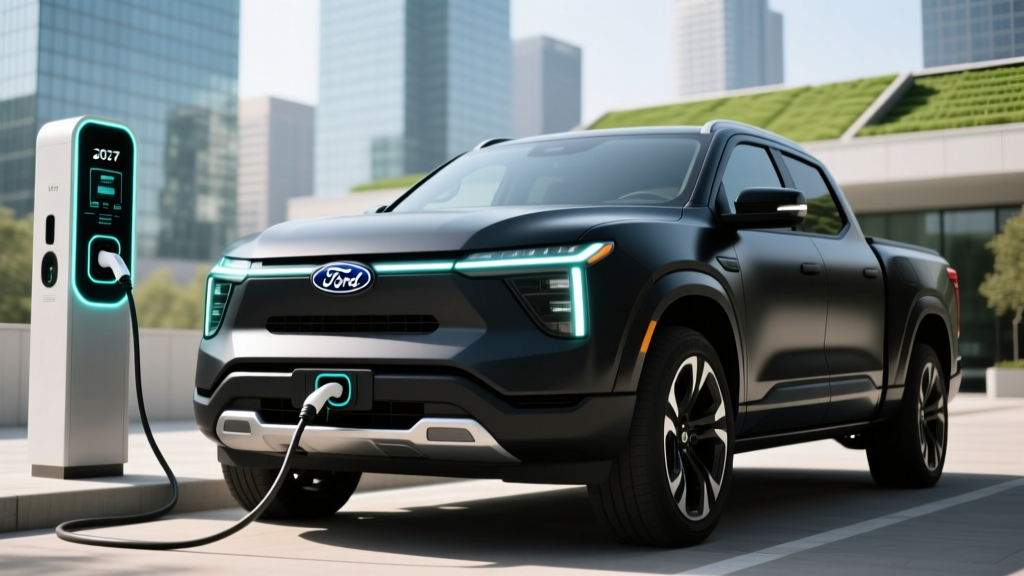
Ford's next-generation electric pickup, expected for the 2027 model year, is built on the company's new universal EV platform designed from the ground up for trucks. Based on Ford's official announcements and supply-chain reports, buyers should expect a target EPA range of 300–350 miles, a starting MSRP in the mid-$40,000s, DC fast charging at up to 350 kW, and a body-on-frame architecture aimed at towing and payload duty. The truck is not yet on sale — all specs below are preliminary and drawn from Ford's public statements, patent filings, and industry reporting through mid-2026. Final EPA certification, pricing, and tax-credit eligibility will be confirmed closer to launch.
What Is Ford Building for 2027?
Ford confirmed in 2024 that it would develop a next-generation electric pickup on a dedicated platform, separate from the aluminum-intensive architecture underpinning the current F-150 Lightning. That Lightning, introduced for the 2022 model year, adapted an existing truck chassis to accommodate batteries — an approach that worked but imposed compromises on interior packaging, weight distribution, and manufacturing cost.
The 2027 truck is Ford's attempt to start from a clean sheet. Key details from Ford's official media communications and earnings calls include:
- Platform: A new "universal" EV architecture that will underpin multiple vehicle types, reducing per-unit battery and structural cost.
- Chemistry: Ford has publicly committed to using LFP (lithium iron phosphate) cells for its mass-market EVs, sourced in part from CATL under a licensing agreement for a Michigan-based plant. LFP offers longer cycle life and lower cost per kWh, though with slightly lower energy density than NMC.
- Body style: A full-size, four-door crew-cab pickup, likely badged under the F-150 nameplate or a new sub-brand designation. Ford has not confirmed final naming.
- Production: Assembly is expected at Ford's BlueOval City campus in Tennessee, with production startup targeted for late 2026 or early 2027.
Projected Range, Battery, and Charging Specs
Because the 2027 truck is not yet EPA-certified, the numbers below represent Ford's stated targets and informed estimates based on the platform's design parameters. Treat them as preliminary.
| Spec | Target / Estimate | Notes |
|---|---|---|
| EPA Range | 300–350 mi | Varies by trim and battery pack size |
| Battery Chemistry | LFP (Lithium Iron Phosphate) | Longer cycle life, lower cost, heavier per kWh |
| Battery Capacity (Usable) | ~110–130 kWh | Estimated based on range targets and LFP density |
| Peak DC Fast Charge | Up to 350 kW | Requires 800V architecture; sustained rate lower |
| 10–80% DC Charge Time | ~20–25 min (est.) | LFP charge curves taper differently than NMC |
| Level 2 Home Charging | ~11.5–19.2 kW | Full charge overnight on 48A circuit |
| 0–60 mph | ~4.0–5.5 sec | Dual-motor AWD assumed for higher trims |
| Towing Capacity | ~8,000–10,000 lb (target) | Ford has emphasized towing as a design priority |
| Starting MSRP | ~$45,000–$50,000 | Base work-truck trim; higher trims $60K+ |
| Battery Warranty | 8 yr / 100,000 mi (expected) | Federal minimum is 8/100K; Ford matches or exceeds this on current EVs |
Real-World Range Reality Check
An EPA estimate of 320 miles does not mean 320 miles in every condition. Based on real-world testing of current full-size electric pickups like the F-150 Lightning and Rivian R1T:
- Highway driving at 70–75 mph: Expect roughly 70–80% of EPA range — so a 320-mile sticker translates to about 225–255 miles of interstate range.
- Cold weather (below 30°F): LFP batteries lose range in cold temperatures. Expect a 20–35% reduction depending on cabin heating use and whether the truck has a heat pump.
- Towing: Pulling a 6,000-lb trailer at highway speed can cut range by 40–50%. This is physics, not a flaw — a gas truck towing the same load sees MPG drop from 20 to 10–12.
If your typical drive is a 60-mile round-trip commute with home charging, even the reduced real-world range is more than sufficient. If you regularly tow long distances or drive rural routes without DC fast chargers, a PHEV or diesel may still be the pragmatic choice.
Cost Breakdown: What Will Ownership Actually Cost?
Here is where the 2027 Ford EV pickup either makes financial sense or doesn't — and it depends heavily on your driving patterns, electricity rate, and whether you can charge at home.
| Cost Category | 2027 Ford EV Pickup (Est.) | 2026 Ford F-150 Gas (2.7L EcoBoost) |
|---|---|---|
| Purchase Price (base MSRP) | $47,000 | $39,000 |
| Federal Tax Credit (§30D) | Up to $7,500* | $0 |
| Effective Purchase Price | ~$39,500 | $39,000 |
| Fuel / Energy (5 yr, 75K mi) | $4,500 (home charging at $0.14/kWh) | $11,250 (at $3.50/gal, 20 MPG combined) |
| Maintenance (5 yr) | ~$1,800 | ~$3,500 |
| Insurance (5 yr avg.) | ~$9,500 | ~$7,500 |
| Depreciation (est. 5 yr) | ~$22,000 | ~$18,000 |
| Total 5-Year Cost | ~$77,300 | ~$79,250 |
*The §30D federal tax credit is subject to MSRP caps ($80,000 for trucks/vans), buyer income limits ($150K single / $300K joint), and battery-sourcing requirements. Credit eligibility for the 2027 model will depend on final battery-cell and critical-mineral supply chains at time of purchase. Consult IRS.gov §30D guidance and a tax professional. Point-of-sale transfer is available at participating dealers.
Key takeaways from this comparison:
- Fuel savings are real and substantial. At national-average electricity and gas prices, the EV saves roughly $6,750 on energy over five years — and more if gas prices rise.
- Insurance costs more for EVs. Current data shows EV pickup insurance premiums running 15–25% higher than comparable gas trucks, driven by higher repair costs and battery replacement risk.
- Depreciation is the wild card. EV depreciation has been steeper than gas trucks in 2024–2025, but a lower starting MSRP and improved battery longevity could narrow this gap by 2027.
- Maintenance favors the EV significantly. No oil changes, no transmission fluid, fewer brake replacements (thanks to regenerative braking), and no exhaust system to fail.
EV Pickup vs. Gas Truck: The Head-to-Head
| Metric | 2027 Ford EV Pickup (Est.) | 2026 F-150 Gas (2.7L V6) |
|---|---|---|
| EPA Range / Tank Range | 300–350 mi | ~500 mi (26 gal tank, 20 MPG) |
| Combined Efficiency | ~2.0–2.4 kWh/mi (~70 MPGe) | ~20 MPG combined |
| "Refuel" Time (10–80%) | ~20–25 min (DC fast charge) | ~5 min (gas station) |
| Home "Refuel" Time (full) | 8–12 hr (Level 2, 11.5 kW) | N/A |
| Max Towing | 8,000–10,000 lb (target) | ~8,400–11,200 lb |
| Payload | ~1,800–2,200 lb (target) | ~1,775–2,445 lb |
| 0–60 mph | ~4.0–5.5 sec | ~6.0–6.8 sec |
| Frunk (Front Trunk) | Yes (~14 cu ft expected) | No |
| Pro Power Onboard / V2L | Yes (up to 9.6 kW expected) | Available (up to 7.2 kW) |
| Tailpipe Emissions | Zero | ~400 g CO₂/mi |
The gas F-150 still wins on total range and refueling speed, especially for towing and long rural trips. The EV pickup wins on acceleration, home fueling convenience, operating cost, onboard power capability, and zero tailpipe emissions. For a work truck that returns to a depot or home charger nightly, the EV's advantages compound. For cross-country towing, the gas truck — or a diesel — remains the pragmatic tool.
Charging at Home: What You Need to Know Before You Buy
Home charging is the single biggest factor in EV satisfaction. If you can install a Level 2 charger, an electric pickup becomes dramatically more convenient than a gas truck — you "refuel" while you sleep, every night, and start every morning with a full battery.
| Item | Cost Range | Details |
|---|---|---|
| Level 2 Charger (hardware) | $400–$700 | 48A hardwired unit (e.g., ChargePoint Home Flex, Emporia Vue) |
| Electrician labor | $500–$1,500 | Varies by run length from panel to garage/carport |
| Electrical permit | $50–$200 | Required in most jurisdictions |
| Panel upgrade (if needed) | $1,500–$3,500 | Needed if your panel lacks capacity for a 60A circuit |
| Total (no panel upgrade) | $950–$2,400 | Most homes with 200A service |
| Total (with panel upgrade) | $2,450–$5,900 | Older homes with 100A service |
For a truck with a ~120 kWh battery, a 48A Level 2 charger (delivering ~11.5 kW) adds roughly 30–35 miles of range per hour of charging. A full charge from 10% to 100% takes about 10–11 hours — perfectly suited to overnight charging on a time-of-use electricity plan.
Important: If you live in an apartment, condo, or home without a garage or dedicated parking spot with electrical access, home Level 2 charging may not be feasible. In that case, you will depend on public DC fast charging and workplace charging, which is more expensive ($0.30–$0.50/kWh at public stations) and less convenient. This is a legitimate barrier, not a minor inconvenience.
Common Misconceptions — Addressed with Facts
| Myth | Fact |
|---|---|
| "EV batteries need replacing every few years and cost $20,000." | Modern EV batteries are designed to last 15–20 years with less than 15% degradation. LFP chemistry specifically shows minimal degradation over 2,000+ charge cycles. Ford's warranty covers the battery for at least 8 years / 100,000 miles at 70% capacity retention. Full replacement is rare and typically only needed after major collision damage. |
| "You can't tow with an electric truck." | You can — the F-150 Lightning is rated for up to 10,000 lb. The trade-off is range reduction while towing (40–50%), which is the same percentage hit a gas truck takes in MPG. For short tows or daily job-site hauls, the EV is excellent. For 300-mile trailer hauls, you will need to plan charging stops. |
| "EVs are worse in cold weather." | EVs do lose range in cold weather (20–35% below freezing), but they start instantly, don't need block heaters, and cabin heating is effective. Preconditioning the battery while plugged in preserves range. Cold-climate EV owners in Minnesota and Canada report high satisfaction — range planning is simply more important in winter. |
| "The power grid can't handle EVs." | Most EV charging happens overnight when grid demand is lowest. A single electric truck charging at 11.5 kW draws roughly the same as an electric clothes dryer. Utilities are upgrading distribution capacity, and smart-charging features allow the truck to charge during off-peak hours automatically. |
| "The $7,500 tax credit applies to everyone." | The §30D credit has strict eligibility rules: buyer income caps ($150K single / $300K joint for new vehicles), MSRP caps ($80,000 for trucks), and battery-sourcing requirements that change annually. Not every EV or every buyer qualifies. Always verify on IRS.gov before relying on the credit in your budget. |
Decision Framework: Should You Wait for the 2027 Ford EV Pickup?
Choose the 2027 Ford EV Pickup If:
- You have access to home Level 2 charging (garage, carport, or dedicated parking with a 240V outlet).
- Your daily driving is under 150 miles round-trip and you rarely tow more than 200 miles one-way.
- You want the lowest operating cost per mile and are willing to accept a higher upfront purchase price offset by the tax credit.
- You value instant torque, quiet operation, Pro Power Onboard, and a large frunk for job-site or adventure use.
- You plan to keep the truck 7+ years, which allows fuel savings to fully offset any higher purchase price and depreciation.
Stick With a Gas or Hybrid F-150 If:
- You regularly tow heavy trailers over 250+ miles and can't afford the time or range penalty of DC fast-charging stops while towing.
- You cannot charge at home and public charging infrastructure in your area is sparse or unreliable.
- You live in an extremely cold climate (consistently below 0°F) and your daily mileage is near the truck's winter-adjusted range limit.
- You need a truck now — the 2027 EV pickup won't reach dealers until late 2026 at the earliest, with full availability likely in early-to-mid 2027.
- Your budget is firmly under $40,000 and you cannot wait for potential price reductions or used-market availability.
Consider the F-150 PowerBoost Hybrid (PHEV) as a Middle Ground:
The current F-150 PowerBoost hybrid offers 25 MPG combined, up to 12,700 lb towing, no range anxiety, and a starting price around $52,000 (well-equipped). It doesn't offer electric-only driving or home charging, but it dramatically cuts fuel costs versus the base gas V6 while maintaining full truck capability. If your use case involves heavy towing and long trips but you still want better efficiency, the hybrid is a proven, available option today.
Frequently Asked Questions
When will the 2027 Ford EV pickup be available to order?
Ford has targeted production startup at BlueOval City in Tennessee for late 2026, with customer deliveries likely beginning in early-to-mid 2027. Reservation or order banks may open in late 2026. Final timing depends on production ramp, supply chain, and market conditions.
Will the 2027 Ford EV pickup qualify for the $7,500 federal tax credit?
It is too early to confirm. The §30D credit requires that battery cells and critical minerals meet specific domestic-sourcing thresholds that tighten each year. Ford's LFP battery strategy includes a CATL-licensed Michigan plant, which may help meet requirements, but final eligibility depends on the supply chain at time of delivery. Check IRS.gov and Ford's official guidance closer to launch. The truck's expected base MSRP (under $80,000) should clear the MSRP cap for trucks.
How does LFP battery chemistry compare to NMC?
LFP (lithium iron phosphate) batteries offer longer cycle life (3,000+ cycles vs. ~1,500 for NMC), better thermal stability, lower cost per kWh, and no cobalt or nickel. The trade-off is lower energy density (meaning a heavier or physically larger pack for the same range) and slightly reduced performance in extreme cold. For a full-size truck where weight and packaging space are less constrained than in a compact car, LFP is a strong choice. Ford has indicated owners can charge LFP batteries to 100% daily without the degradation concerns associated with NMC.
What will it cost to charge the 2027 Ford EV pickup at home?
With a ~120 kWh usable battery and a national average residential electricity rate of $0.16/kWh (as of 2026), a full home charge costs approximately $19.20. That delivers roughly 300 miles of EPA-rated range — equivalent to about $52 worth of gas in a 20-MPG F-150 at $3.50/gallon. Your actual cost depends on your local utility rate and whether you use time-of-use pricing to charge during off-peak hours (often $0.08–$0.12/kWh overnight).
Can I use the 2027 Ford EV pickup to power my home or job site?
Ford's current F-150 Lightning offers Pro Power Onboard (up to 9.6 kW) and available Ford Intelligent Backup Power for home backup via a bidirectional charger. The 2027 truck is expected to continue and expand these features, potentially including V2H (vehicle-to-home) and V2L (vehicle-to-load) capability. This turns the truck into a mobile generator capable of running power tools on a job site or keeping essential home circuits running during an outage for several days.
Is the 2027 Ford EV pickup a self-driving vehicle?
No. Any driver-assistance features on the 2027 truck — such as Ford's BlueCruise — will be SAE Level 2 systems, meaning the driver must remain fully attentive, keep hands on or near the wheel, and supervise the vehicle at all times. Level 2 systems can manage steering and speed on qualified highways, but they do not make the truck autonomous. Only Level 4 services like Waymo operate without a human driver, and those are limited to specific geofenced urban areas in robotaxi configurations — not pickup trucks.