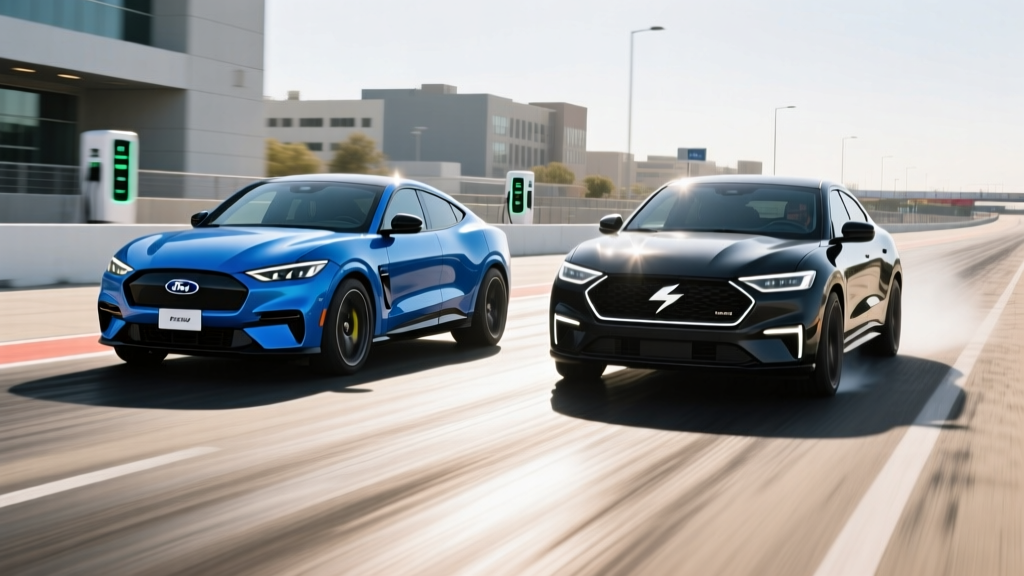
Ford's electric lineup delivers genuine drag-strip performance: the Mustang Mach-E GT Performance Edition hits 0-60 mph in 3.5 seconds with 480 horsepower, while the F-150 Lightning Platinum does it in roughly 4.0 seconds with 580 hp. But using any EV for repeated drag racing carries real consequences — battery thermal stress, accelerated degradation, and potential warranty complications that every owner should understand before lining up at the strip.
Quick Answer: Ford EV Drag Racing
Best performer: Mustang Mach-E GT Performance Edition — 3.5s 0-60, 480 hp, 91 kWh usable battery.
Surprise contender: F-150 Lightning Extended Range — ~4.0s 0-60, 580 hp, 131 kWh usable battery.
Key risk: Repeated hard launches generate extreme battery heat. Ford's battery warranty covers defects and degradation below 70% capacity, but documented abuse (including repeated track use without cooldown) can void coverage.
Bottom line: One or two pulls for fun? Fine. Regular drag racing? You're trading long-term battery health for short-term thrills.
Ford EV Performance Specs: The Numbers That Matter
Let's ground this in hard data. Here's how Ford's current performance EVs stack up against each other and against their gas-powered equivalents:
| Specification | Mach-E GT Perf. Ed. | F-150 Lightning Ext. Range | 2025 Mustang GT (5.0L V8) |
|---|---|---|---|
| 0-60 mph | 3.5 seconds | ~4.0 seconds | 4.3 seconds |
| Horsepower | 480 hp | 580 hp | 480 hp |
| Torque | 634 lb-ft | 775 lb-ft | 415 lb-ft |
| Battery / Engine | 91 kWh NMC (usable) | 131 kWh NMC (usable) | 5.0L Coyote V8 |
| EPA Range / MPG | 280 miles / 84 MPGe | 320 miles / 66 MPGe | ~310 mi / 19 MPG combined |
| Drivetrain | AWD (dual motor) | AWD (dual motor) | RWD |
| Curb Weight | ~4,900 lbs | ~6,400 lbs | ~3,830 lbs |
| Base MSRP (2025) | $62,975 | $76,995 | $44,090 |
| Peak DC Charge Rate | 150 kW | 150 kW | N/A |
| 10-80% DC Charge Time | ~45 minutes | ~41 minutes | |
| Powertrain Warranty | 8 yr / 100,000 mi | 8 yr / 100,000 mi | 5 yr / 60,000 mi |
Sources: fueleconomy.gov, Ford Motor Company
The instant torque advantage is immediately obvious. The Mach-E GT Performance Edition delivers all 634 lb-ft of torque at 0 RPM, which is why it beats the gas Mustang GT to 60 mph despite weighing over 1,000 lbs more. Electric motors don't need to build revs or wait for a transmission to shift — the acceleration is immediate and linear.
The Physics of EV Drag Racing: Why It's Different
Drag racing an EV is fundamentally different from drag racing a gas car, and understanding these differences is critical for anyone considering it.
What EVs Do Better on the Strip
- Instant torque delivery: No turbo lag, no cam profile ramp-up, no torque converter spool. Full torque from the first millisecond.
- No shift interruptions: Single-speed reduction gears mean uninterrupted power delivery. A gas Mustang GT's 10-speed auto still takes 100-200ms per shift — that's measurable time lost over a quarter mile.
- AWD traction: Dual-motor AWD in both the Mach-E GT and Lightning puts power to all four wheels immediately, reducing wheelspin off the line compared to the RWD gas Mustang.
- Consistent performance: EVs don't lose power at altitude the way naturally aspirated engines do. Your Mach-E GT performs the same in Denver as it does in Miami.
What EVs Do Worse on the Strip
- Weight: The F-150 Lightning weighs roughly 6,400 lbs. That mass kills top-end speed and quarter-mile trap times. The gas Mustang GT, at 3,830 lbs, will walk away from either Ford EV past about 90 mph.
- Thermal management limits: Battery packs generate enormous heat under sustained high-current discharge. After 2-3 consecutive hard launches, most EVs will begin throttling power to protect the battery cells.
- Quarter-mile trap speed: The Mach-E GT runs roughly a 12.0-second quarter mile at around 105 mph. A well-driven gas Mustang GT with the Performance Pack can hit low 12s at 110+ mph, and modified examples go far quicker.
- Repeatability: A gas car can run 10-15 passes in a day with basic cooling between runs. An EV will typically need 30-60 minutes of cooldown (or a DC fast charge cycle to precondition the thermal system) between hard pulls.
Ford EV Drag Racing: Myths vs. Facts
| Myth | Fact |
|---|---|
| "EVs can't drag race — they run out of power too fast." | A quarter-mile pass uses roughly 1-3 kWh of energy. You could do 30+ passes on a full Mach-E GT battery. The limit is heat, not energy. |
| "Hard launches will destroy the battery immediately." | One or two pulls won't cause measurable damage. Ford's battery management system (BMS) actively limits discharge current when cell temperatures rise. Chronic abuse, however, accelerates degradation. |
| "The F-150 Lightning is too heavy to be quick." | 580 hp and 775 lb-ft of instant torque move even 6,400 lbs briskly. ~4.0s to 60 mph is faster than most sports sedans from five years ago. |
| "Drag racing voids the warranty automatically." | Not automatically — but Ford can deny warranty claims if data logs show repeated thermal abuse or use outside designed parameters. The Magnuson-Moss Warranty Act protects consumers, but the burden of proof can shift. |
| "EVs are slower than gas cars at the track." | Off the line and through 60 mph, Ford's performance EVs beat most gas equivalents. Past 100 mph, gas cars' higher top-end power and lower weight take over. |
Battery Degradation: The Real Cost of Hard Launches
This is where ownership reality meets strip-day fantasy. Understanding battery degradation is essential for any EV owner, and it's especially important if you plan to push your Ford EV hard.
How Heat Degrades NMC Batteries
Both the Mach-E GT and F-150 Lightning use NMC (nickel manganese cobalt) lithium-ion cells. NMC chemistry offers excellent energy density and power delivery, but it's more sensitive to high temperatures than LFP (lithium iron phosphate) chemistry.
During a hard launch, the battery pack can discharge at rates exceeding 3C (three times its total capacity per hour). This generates significant internal cell heat. If cell temperatures exceed roughly 45-50°C (113-122°F), the BMS begins limiting power output. Sustained or repeated exposure to temperatures above 55°C (131°F) accelerates electrolyte decomposition and cathode degradation.
Here's what that means in practical terms:
- Normal driving degradation: Ford's NMC packs typically lose 5-8% capacity over the first 100,000 miles under normal use.
- Frequent hard acceleration: Owners who regularly perform hard launches without adequate cooldown may see 10-15% degradation over the same mileage.
- Warranty threshold: Ford's battery warranty guarantees the pack will retain at least 70% of original capacity for 8 years or 100,000 miles. If degradation drops below that threshold, Ford will repair or replace the pack — but they can deny the claim if telemetry shows abuse.
Real-World Ownership Tip
If you do take your Mach-E GT or Lightning to a drag strip, follow these practices:
- Limit hard passes to 2-3, then allow at least 30 minutes of idle cooldown (or drive gently).
- Monitor battery temperature through the vehicle's diagnostic screens if available.
- Avoid launching at 100% state of charge — the highest current flows occur at full SoC, generating more heat. Start passes at 70-80% SoC.
- Don't fast-charge immediately after hard driving. Let the pack cool first; the thermal management system will run the cooling loop during charging, but starting a DC fast charge on a hot pack slows the charge rate significantly.
Cost Breakdown: Ford EV Performance Ownership vs. Gas
Performance doesn't exist in a financial vacuum. Here's what owning and operating a performance Ford EV actually costs compared to its gas counterpart:
| Cost Factor (5 Years / 75,000 mi) | Mach-E GT Perf. Ed. | Mustang GT (5.0L V8) | Difference |
|---|---|---|---|
| Base MSRP | $62,975 | $44,090 | EV +$18,885 |
| Federal Tax Credit (§30D)* | Up to $3,750** | $0 | EV -$3,750 |
| Effective Purchase Price | ~$59,225 | $44,090 | EV +$15,135 |
| Fuel / Electricity (75k mi) | ~$4,200 (home L2 @ $0.14/kWh) | ~$9,870 ($3.50/gal, 19 MPG) | EV -$5,670 |
| Maintenance (5 yr) | ~$1,500 | ~$4,200 | EV -$2,700 |
| Insurance (5 yr avg) | ~$12,500 | ~$9,500 | EV +$3,000 |
| Tire Replacement (1 set) | ~$1,400 | ~$1,000 | EV +$400 |
| Estimated Depreciation | ~$28,000 | ~$18,000 | EV +$10,000 |
| 5-Year Total Cost of Ownership | ~$78,825 | ~$67,660 | EV +$11,165 |
* Federal §30D tax credit eligibility depends on buyer income (AGI caps: $150k single / $300k joint), vehicle MSRP caps ($55k cars — the Mach-E GT at $62,975 may exceed this cap; verify current rules at irs.gov). Credit amounts and sourcing requirements change; consult a tax professional.
** The Mach-E GT MSRP may exceed the §30D $55,000 cap for cars (SUVs/trucks are $80,000). Ford classifies the Mach-E as an SUV for tax-credit purposes, potentially qualifying it. Confirm classification and eligibility before purchase.
Charging Cost Reality
The Mach-E GT's 91 kWh usable battery costs roughly $12.74 to charge at home (at the national average of $0.14/kWh). That delivers 280 EPA miles — about $0.045 per mile. The gas Mustang GT at 19 MPG combined and $3.50/gallon costs about $0.184 per mile. Over 75,000 miles, that's a $5,670 fuel savings for the EV.
However, if you rely exclusively on DC fast charging (average $0.35-$0.48/kWh at networks like Electrify America or EVgo), your per-mile cost rises to $0.11-$0.16 — nearly matching gas. Home Level 2 charging access is essential for the EV to deliver meaningful fuel savings.
EV vs. Gas Mustang: Track Day Comparison
| Performance Metric | Mach-E GT Perf. Ed. | Mustang GT (5.0L V8, 10A) | Advantage |
|---|---|---|---|
| 0-30 mph | ~1.5 sec | ~2.1 sec | EV (instant torque) |
| 0-60 mph | 3.5 sec | 4.3 sec | EV |
| Quarter Mile | ~12.0 sec @ 105 mph | ~12.3 sec @ 112 mph | EV (time) / Gas (trap speed) |
| 60-100 mph | ~5.5 sec | ~4.0 sec | Gas (power-to-weight) |
| Consecutive Passes Before Overheat | 2-3 | 8-12 | Gas |
| Cost Per Pass (fuel/electricity) | ~$0.15-$0.50 | ~$1.50-$2.50 | EV |
| Aftermarket Performance Parts | Limited (software tunes) | Extensive (superchargers, cams, headers) | Gas |
| Weight (affects braking, tire wear) | 4,900 lbs | 3,830 lbs | Gas |
The EV wins the launch and the 0-60 sprint, but the gas Mustang GT dominates everywhere else at a dedicated drag strip: repeatability, top-end speed, and aftermarket potential. If your goal is one spectacular stoplight-to-stoplight pull, the Mach-E GT delivers. If your goal is a full day at the track with consistent mid-12-second passes, the gas car is still the better tool.
Decision Framework: Should You Drag Race Your Ford EV?
Choose EV Drag Racing If:
- You want 1-2 impressive pulls for a car meet, video, or personal satisfaction — not a full day at the strip.
- You value instant, drama-free acceleration without needing to mod the vehicle.
- You already own the EV for daily driving and want to experience its performance casually.
- You understand the battery heat risk and accept that repeated hard launches may accelerate degradation beyond warranty coverage.
- You have home Level 2 charging to keep operating costs low.
Choose a Gas Mustang GT If:
- You plan to attend regular track days or drag-strip events and want 10+ consistent passes per day.
- You want to modify the car for more power (forced induction, exhaust, tune).
- You care about quarter-mile trap speed and top-end performance, not just 0-60.
- You want a lighter car that's easier on brakes and tires during repeated hard driving.
- You're buying specifically for motorsport use and want a dedicated track car.
Choose Neither (Consider Alternatives) If:
- You want serious drag racing performance — look at a used Tesla Model S Plaid (0-60 in 1.99s) or a dedicated gas drag car.
- You don't have home charging access — public DC charging costs erode the EV's fuel savings, and arriving at a strip with a hot battery from fast charging compounds thermal issues.
- You live in extreme cold or extreme heat — battery thermal headroom is reduced in both conditions.
Charging and Battery Care for Performance Use
If you do plan occasional performance driving in your Ford EV, how you charge and maintain the battery matters enormously.
Home Charging Setup
A Level 2 home charger (240V, 48A / 11.5 kW) adds roughly 30-35 miles of range per hour to the Mach-E GT and fully recharges it overnight in about 8-9 hours. Professional installation typically costs $800-$2,500 depending on your electrical panel's capacity and the distance from panel to charger location. If your home has a 100A panel, you may need a $1,500-$3,000 panel upgrade to 200A to support a 48A charger — factor this into your budget.
Preconditioning for Performance
Ford's thermal management system works best when the battery is at its optimal operating temperature (roughly 25-35°C / 77-95°F). Before a performance driving session:
- Drive the car normally for 15-20 minutes to bring the battery up to operating temperature.
- Avoid launching from a cold-soaked battery (especially below 40°F), as cold cells have higher internal resistance and generate more heat under load.
- Don't DC fast-charge immediately before hard driving — the charge process itself heats the pack, leaving less thermal headroom for performance.
Frequently Asked Questions
Will drag racing my Mustang Mach-E GT void the warranty?
Not automatically. A single hard launch or two won't trigger a warranty void. However, Ford's powertrain control module logs detailed telemetry including discharge rates, battery temperatures, and acceleration events. If a battery failure occurs and the data shows repeated extreme thermal events consistent with track abuse, Ford may deny the warranty claim under the "use outside designed parameters" clause. The Magnuson-Moss Warranty Act requires the manufacturer to prove the abuse caused the failure, but disputes can require legal intervention.
How much range does a quarter-mile pass use?
Approximately 1-3 kWh per pass, depending on launch intensity and vehicle weight. The Mach-E GT's 91 kWh usable battery could theoretically complete 30+ passes on a single charge. The real constraint is battery temperature, not energy capacity — you'll hit thermal limits long before you run out of range.
Can I install drag radials or slicks on my Mach-E GT?
Physically, yes — you can mount stickier tires on the correct wheel size. But the Mach-E GT's 4,900-lb weight and instant 634 lb-ft of torque will overwhelm most street-legal drag radials quickly. Expect accelerated tire wear regardless, and note that any modification could be cited in a warranty dispute if a drivetrain failure occurs.
Does the F-150 Lightning have a launch mode?
The Lightning doesn't have a dedicated "launch control" button like the Mach-E GT, but its dual-motor AWD system and 775 lb-ft of torque deliver brutal off-the-line performance without any special procedure. Simply brake-torqueing (holding the brake while pressing the accelerator, then releasing the brake) can yield slightly better 0-60 times, though Ford doesn't officially endorse this technique.
How does cold weather affect drag racing performance?
Cold battery cells have higher internal resistance, which means they generate more heat under hard discharge and deliver slightly less peak power. Expect 5-10% slower 0-60 times when the battery is below 40°F. However, cold ambient air also helps cool the battery and motors — so a cold day with a properly preconditioned battery can actually be ideal for 1-2 passes before thermal buildup becomes an issue.
What's the real-world range of the Mach-E GT if I drive aggressively?
The EPA rates the Mach-E GT Performance Edition at 280 miles. In real-world aggressive driving (hard acceleration, highway speeds above 75 mph, minimal regen use), expect 200-220 miles. In cold weather (below 30°F) with aggressive driving, that drops to roughly 170-190 miles. Plan charging stops accordingly.
The Bottom Line for Ford EV Performance Buyers
Ford's electric vehicles deliver legitimately impressive straight-line performance. The Mach-E GT Performance Edition's 3.5-second 0-60 time puts it in sports-car territory, and the F-150 Lightning's ability to hit 60 mph in ~4 seconds while weighing 6,400 lbs borders on absurd. For casual performance use — a quick pull at a car meet, an on-ramp sprint, or a couple of passes at a local test-and-tune night — these EVs deliver thrilling, accessible speed.
But drag racing as a regular activity is a different calculus. The thermal constraints of NMC battery packs, the weight penalty that limits top-end speed, and the potential warranty implications all make dedicated gas cars better tools for serious strip work. If drag racing is your primary motivation, a gas Mustang GT with a Performance Pack offers better repeatability, far more aftermarket support, and no battery-degradation anxiety.
If you already own a Mach-E GT or Lightning and want to experience its performance, go for it — just respect the thermal limits, allow proper cooldown between pulls, and don't make it a weekly habit. Your battery's state of health will thank you.