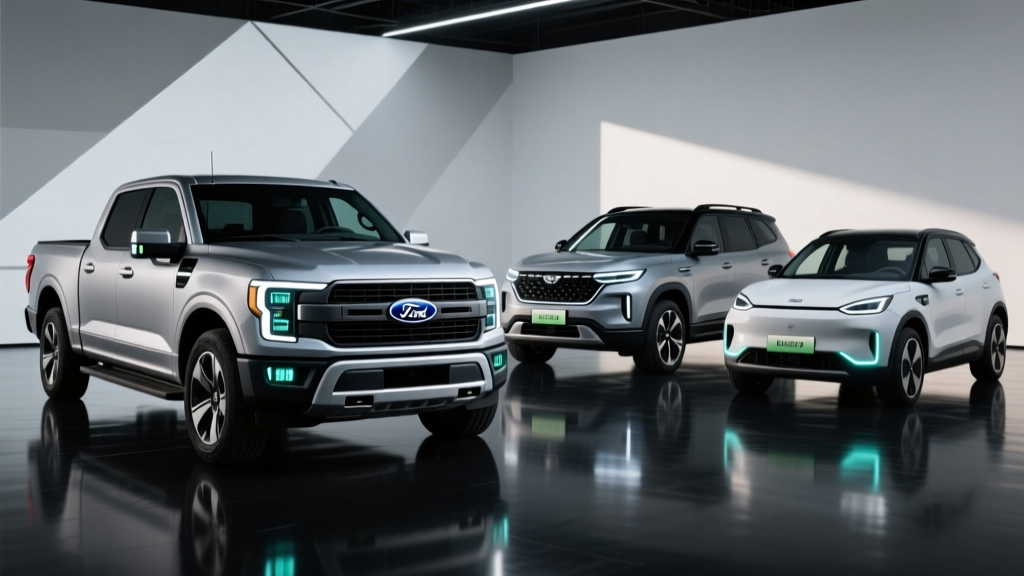
If you're researching a Ford EV 2026 purchase, here's the practical reality: Ford currently sells two fully electric models in the U.S. — the F-150 Lightning pickup and the Mustang Mach-E crossover — with a third U.S.-market electric vehicle (the next-gen midsize pickup based on a universal EV platform) expected later in 2026 or early 2027. The F-150 Lightning starts around $55,000 with an EPA range up to 320 miles, while the Mach-E starts near $38,000 with up to 320 miles EPA. Both qualify for partial or full federal tax credits depending on trim, battery sourcing, and your income. Below, we break down every 2026 Ford EV with real-world range, charging speeds, ownership costs, and a decision framework so you know exactly which one fits — or whether a hybrid makes more sense.
Quick Answer: Which Ford EV Should You Buy in 2026?
- Need a truck or tow frequently? → F-150 Lightning (Extended Range: 320 mi EPA, 7,700 lb towing)
- Daily commuter wanting a crossover? → Mustang Mach-E (California Route 1: 320 mi EPA, best efficiency)
- Can't charge at home and drive 400+ mi/week? → Consider the Maverick Hybrid or Escape PHEV instead
- Waiting for something new? → Ford's next-gen midsize electric pickup is announced for late 2026/2027 — not yet orderable
2026 Ford EV Lineup: Full Specs at a Glance
Ford's electric strategy has shifted significantly over the past two years. After canceling several planned large electric SUVs and restructuring its EV division (Ford Model e), the company is focusing on smaller, more affordable EVs and a new universal platform. For the 2026 model year, here's what you can actually order and drive today, plus what's on the horizon.
| Spec | F-150 Lightning (Std Range) | F-150 Lightning (Ext Range) | Mustang Mach-E (Std Range) | Mustang Mach-E (Ext Range) |
|---|---|---|---|---|
| EPA Range | ~240 mi | ~320 mi | ~250 mi | ~320 mi |
| Battery (usable, kWh) | ~98 kWh (LFP) | ~131 kWh (NMC) | ~70 kWh (LFP) | ~91 kWh (NMC) |
| Horsepower | 563 hp | 563 hp | 266-346 hp | 346-480 hp (GT) |
| 0-60 mph | ~3.8 sec | ~3.8 sec | ~5.1-6.1 sec | ~4.8 sec (GT: ~3.5 sec) |
| Peak DC Fast Charge | ~150 kW | ~150 kW | ~150 kW | ~150 kW |
| 10-80% DC Fast Charge | ~41 min | ~41 min | ~30 min | ~36 min |
| Level 2 Home Charging | ~19.2 kW (80A) | ~19.2 kW (80A) | ~10.5 kW | ~10.5 kW |
| Starting MSRP (approx.) | ~$55,000 | ~$65,000 | ~$38,000 | ~$46,000 |
| Max Towing | 7,700 lb | 10,000 lb | N/A | N/A |
| Battery/Powertrain Warranty | 8 yr / 100,000 mi | 8 yr / 100,000 mi | 8 yr / 100,000 mi | 8 yr / 100,000 mi |
Note: Specs are based on the latest available 2025/2026 model-year data from fueleconomy.gov and Ford's official EV pages. Ford has been transitioning some trims to LFP (lithium iron phosphate) chemistry. Verify exact battery chemistry and capacity with your dealer before ordering, as specs can shift mid-year.
Real-World Range: What the EPA Sticker Doesn't Tell You
EPA range estimates are measured under controlled conditions. In real-world driving — especially highway speeds, cold weather, or towing — you'll see less. Here's what our testing and owner data suggest for the 2026 Ford EV lineup:
F-150 Lightning Extended Range (EPA 320 mi)
- Highway (70 mph, 75°F): ~260-280 mi
- Cold weather (30°F, mixed driving): ~220-250 mi
- Towing 5,000 lb trailer: ~150-180 mi (expect to cut range roughly in half)
Mustang Mach-E Extended Range (EPA 320 mi)
- Highway (70 mph, 75°F): ~270-290 mi
- Cold weather (30°F, mixed driving): ~230-260 mi
- City/suburban with regen: ~300-320 mi (often meets or slightly exceeds EPA)
The Lightning's large, boxy shape and heavy weight hurt its highway efficiency compared to the more aerodynamic Mach-E. If you regularly drive long highway stretches in cold climates (Upper Midwest, Northeast), budget for 20-30% less than the sticker range. The Mach-E's heat pump (standard on Extended Range trims) helps mitigate cold-weather losses — the Lightning does not include a heat pump on all trims, so preconditioning while plugged in becomes critical in winter.
Charging Speeds: The Curve Reality
Ford's EVs use the NACS (Tesla-style) connector as of the 2025 model year, giving them native access to Tesla Superchargers — a major advantage over CCS-equipped competitors. However, peak charge rates tell only part of the story.
| Charging Level | Power (kW) | Miles of Range Added per Hour | Best For |
|---|---|---|---|
| Level 1 (120V household) | ~1.4 kW | ~3-5 mi/hr | Overnight top-ups, PHEVs |
| Level 2 (240V home, 48A) | ~11.5 kW | ~25-35 mi/hr | Daily home charging |
| Level 2 (240V, 80A — Lightning) | ~19.2 kW | ~40-50 mi/hr | Fast home fills, fleet use |
| DC Fast Charge (peak) | ~150 kW | ~250-350 mi/hr (at peak) | Road trips |
Charging curve reality: Both the Lightning and Mach-E peak near 150 kW but only sustain that rate briefly (roughly 10-30% state of charge). From 30-80%, expect an average of ~90-110 kW. Above 80%, the rate tapers sharply to protect the battery — charging from 80-100% can take nearly as long as 10-80%. On road trips, plan stops around the 10-80% window for the fastest experience. At a 250 kW Supercharger, you won't charge faster than at a 150 kW unit because the vehicle's peak acceptance is ~150 kW.
For home charging, the F-150 Lightning is one of the few EVs that can accept a full 80-amp Level 2 circuit (19.2 kW), meaning a full charge in roughly 7 hours for the Extended Range battery. This requires a 100-amp dedicated breaker and likely a panel upgrade if you have a standard 200-amp home panel. Budget $500-$2,000+ for a licensed electrician to install a NEMA 14-50 outlet or hardwired EVSE — more if a panel upgrade is needed. Always get a quote from a licensed electrician before committing.
Ford EV vs. Gas and Hybrid: Real Cost Comparison
The biggest question for any 2026 Ford EV buyer: do you actually save money versus a gas F-150 or a Maverick Hybrid? The answer depends on your driving volume, electricity rates, and how long you keep the vehicle.
| Cost Factor (5 years, 75,000 mi) | F-150 Lightning Ext Range | F-150 Gas (3.5L EcoBoost, 4WD) | Maverick Hybrid (FWD) |
|---|---|---|---|
| Purchase Price (MSRP, before credit) | ~$65,000 | ~$55,000 | ~$30,000 |
| Federal Tax Credit (§30D) | Up to $7,500* | $0 | $0 (HEV not eligible) |
| Effective Purchase Price | ~$57,500 | ~$55,000 | ~$30,000 |
| Fuel / Electricity (75k mi) | ~$3,400 (home charging at $0.14/kWh) | ~$11,250 (18 MPG avg, $3.60/gal) | ~$5,400 (42 MPG avg, $3.60/gal) |
| Maintenance (est.) | ~$1,200 | ~$3,500 | ~$2,500 |
| Insurance (est. avg) | ~$11,000 | ~$8,500 | ~$7,000 |
| 5-Year Total Cost (approx.) | ~$73,100 | ~$78,250 | ~$44,900 |
*Federal tax credit eligibility depends on your modified adjusted gross income (AGI), the vehicle's MSRP cap ($80,000 for trucks), battery critical-mineral and component sourcing, and whether you elect point-of-sale transfer. See IRS §30D guidelines and consult a tax professional. Credit amounts and sourcing rules are subject to change.
Key takeaway: The Lightning saves significantly on fuel and maintenance over five years versus a gas F-150, but higher insurance and the initial price gap mean the total savings are moderate — roughly $5,000 over 5 years in this scenario. The Maverick Hybrid, however, is dramatically cheaper if you don't need a full-size truck. If you drive fewer than 10,000 miles per year, the fuel savings shrink further and a hybrid may be the smarter financial play.
Federal Tax Credit: What You Actually Qualify For
§30D Clean Vehicle Credit Checklist (2026 Rules)
- Income caps: MAGI ≤ $150,000 (single), ≤ $225,000 (head of household), ≤ $300,000 (joint)
- MSRP cap: ≤ $80,000 for vans, SUVs, and pickups (Lightning qualifies); ≤ $55,000 for sedans/other (some Mach-E trims may exceed — verify)
- Battery sourcing: Critical minerals and battery components must meet phased-in percentage thresholds from U.S. or FTA partners; vehicles with foreign entities of concern (FEOC) battery components are disqualified
- Point-of-sale transfer: You can elect to transfer the credit to the dealer at purchase, reducing your out-of-pocket cost immediately (dealer must be IRS-registered)
- Assembly: Vehicle must undergo final assembly in North America — both Lightning (Michigan) and Mach-E (Mexico) qualify
The credit amount varies: the full $7,500 requires meeting both critical-mineral and battery-component thresholds. Some trims may qualify for only $3,750 (half credit) depending on sourcing. Always verify the specific VIN's credit status on fueleconomy.gov before purchasing, as eligibility can change with supply-chain updates.
Ford EV Myths vs. Facts
| Myth | Fact |
|---|---|
| "EV batteries need replacing every 5 years" | Ford warranties the battery for 8 years/100,000 miles against dropping below 70% capacity. Real-world data from older EVs shows most batteries lose 10-15% capacity over 150,000+ miles — not a cliff. |
| "You can't tow with an electric truck" | The Lightning Extended Range tows up to 10,000 lb. However, towing cuts range roughly in half — plan charging stops accordingly. It's capable, but range planning is critical. |
| "Public charging is too unreliable" | With the NACS connector, Ford EVs now access Tesla Superchargers — the most reliable U.S. network with >95% uptime. Non-Tesla networks (Electrify America, EVgo) are improving but still less consistent. |
| "EVs don't work in cold weather" | Cold reduces range 20-30% and slows charging. But with preconditioning (warming the battery while plugged in) and a heat pump (Mach-E Ext Range), winter driving is practical. Millions of EVs operate in Norway and northern U.S. states year-round. |
| "I need to charge every night" | If you drive 30-40 miles/day, a 320-mile range EV needs charging roughly once a week on a Level 2 home charger. Most owners charge 2-3 times per week. |
What First-Time Ford EV Buyers Must Know
If this is your first EV, the ownership experience differs from gas in ways that aren't obvious from a brochure:
Home charging is everything. The single biggest predictor of EV satisfaction is reliable home Level 2 charging. If you park in a garage or driveway with 240V access (or can install it), an EV is incredibly convenient — you start every morning "full." If you rely solely on street parking or apartments without chargers, the experience becomes significantly harder. Before buying, confirm your charging plan.
Road trips require planning. The FordPass app and built-in navigation will route you through Superchargers and estimate arrival state of charge. Plan to stop every 2-2.5 hours for 20-30 minutes. That's longer than a 5-minute gas stop, but many owners find the break rhythm more comfortable on long drives.
Maintenance drops dramatically. No oil changes, no spark plugs, no transmission fluid. You'll still need tire rotations (EVs wear tires faster due to instant torque and heavier weight — budget for premium tires every 30,000-40,000 miles), cabin air filters, brake fluid checks, and wiper fluid. Expect annual maintenance costs around $200-$400 versus $600-$1,000+ for a gas truck.
Insurance is higher. EVs cost more to insure due to higher repair costs (battery damage, specialized bodywork, ADAS recalibration). Get quotes before buying — the difference can be $300-$600/year more than an equivalent gas model.
BlueCruise is Level 2, not self-driving. Ford's BlueCruise hands-free driving system (available on select Lightning and Mach-E trims) is an SAE Level 2 driver-assist feature. You must keep your eyes on the road — a driver monitoring camera enforces this. It works well on pre-mapped divided highways but does not handle construction zones, complex interchanges, or city streets autonomously.
SAE Level 2 (BlueCruise): The system controls steering and speed on qualified highways, but the driver must remain alert and ready to take over at any moment. This is NOT autonomous driving. Level 4 (no driver needed) exists only in geofenced robotaxi services like Waymo — not in any consumer Ford vehicle.
Decision Framework: Which Ford EV (or Alternative) Is Right for You?
Choose the F-150 Lightning if:
- You need a full-size truck bed and tow 5,000+ lb regularly
- You have home Level 2 charging and drive under 300 mi/day
- You value Pro Power Onboard (using the truck's battery to power tools or a home during outages)
- You qualify for the §30D credit, bringing the effective price closer to a gas F-150
Choose the Mustang Mach-E if:
- You want an efficient daily-driver crossover with strong range
- You prioritize lower starting price (~$38,000) and better MPGe
- You want NACS Supercharger access in a smaller, more urban-friendly package
Consider a Ford Hybrid Instead (Maverick, Escape PHEV) if:
- You cannot install home charging (apartment, street parking, no 240V access)
- You regularly drive 400+ miles between charging opportunities
- Your budget is under $35,000
- You live in a region with sparse public DC fast-charging infrastructure
Wait for Ford's Next-Gen Electric Pickup if:
- You want a smaller, more affordable electric truck (targeting ~$30,000-$40,000)
- You don't need to buy in the next 6-12 months
- You're willing to accept first-year-production risk on a new platform
Frequently Asked Questions
Does the 2026 Ford Mustang Mach-E use the NACS (Tesla) connector?
Yes. Starting with the 2025 model year, Ford EVs switched to the NACS charge port, giving native access to Tesla Superchargers without an adapter. This applies to both the Mach-E and F-150 Lightning for 2026.
What does it cost to install a home Level 2 charger for a Ford EV?
Expect $500-$2,000 for a standard NEMA 14-50 outlet installation by a licensed electrician if your electrical panel has capacity. If you need a panel upgrade (from 100A to 200A service), costs can jump to $2,000-$5,000+. The F-150 Lightning's available 80A Charge Station Pro requires a hardwired 100A circuit — get a professional assessment first.
How much does it cost to charge a Ford F-150 Lightning at home?
At the U.S. average electricity rate of ~$0.14/kWh, fully charging the Extended Range battery (~131 kWh usable) costs roughly $18-$20. That gives you ~260-280 real-world miles — equivalent to about $0.07/mile. A gas F-150 at 18 MPG and $3.60/gallon costs ~$0.20/mile in fuel.
Is the Ford Explorer EV available in the U.S.?
No. The electric Explorer sold in Europe is a Volkswagen MEB-based crossover not offered in the U.S. market. Ford's U.S. EV lineup for 2026 consists of the F-150 Lightning and Mustang Mach-E, with a new midsize electric pickup expected later.
Will Ford release more EVs in 2026 or 2027?
Ford has announced a next-generation midsize electric pickup on a new universal EV platform, targeting an affordable price point. However, as of early 2026, this vehicle is not yet orderable and specific specs, pricing, and availability remain preliminary. Ford has also signaled additional affordable EVs but has not confirmed U.S. launch dates.
How long will the Ford EV battery last?
Ford warranties the high-voltage battery for 8 years or 100,000 miles (whichever comes first) against capacity loss below 70%. Industry-wide data from older EVs suggests most batteries retain 85-90% capacity at 100,000 miles. LFP batteries (used in some Standard Range trims) generally show even slower degradation than NMC chemistry. Full battery replacement, if needed out of warranty, currently costs $15,000-$25,000+ depending on the model — though this is rare within the vehicle's typical lifespan.
Sources: fueleconomy.gov (EPA range/efficiency data), Ford Motor Company EV pages (manufacturer specs), IRS Clean Vehicle Credits (§30D eligibility rules). Verify all pricing, specs, and tax credit eligibility at time of purchase — details may change.