The Short Answer on Ford's 2026 EV Lineup
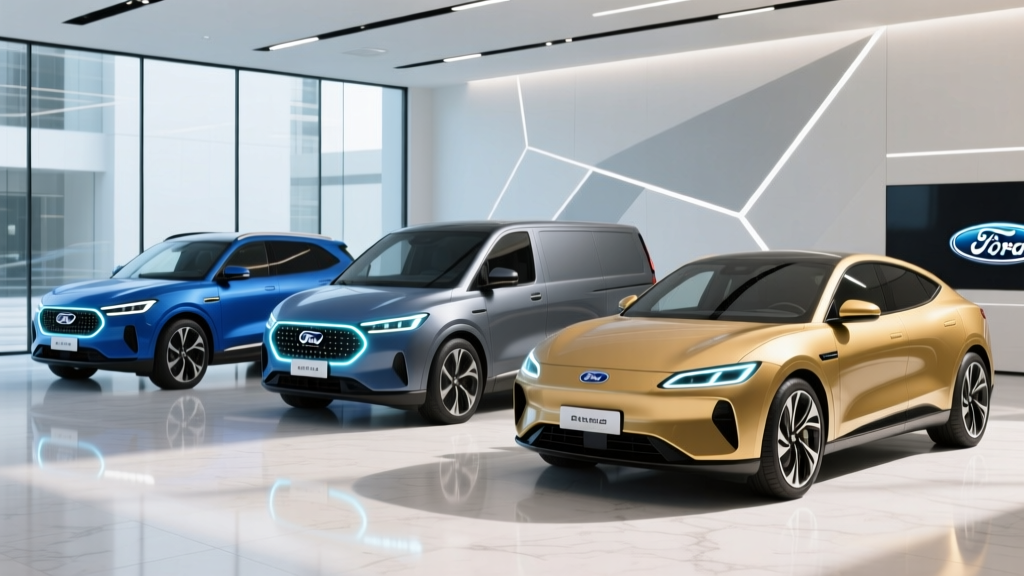
Ford sells three fully electric models for the 2026 model year: the Mustang Mach-E (compact SUV, 250–320 miles EPA range, from ~$39,995), the F-150 Lightning (full-size truck, 240–320 miles EPA, from ~$54,995), and the E-Transit (commercial van, 126 miles EPA, from ~$47,995). The European-market Explorer EV is not sold in the U.S. None of Ford's current 2026 EVs qualify for the full $7,500 federal §30D tax credit due to battery-sourcing and MSRP-cap restrictions, though point-of-sale partial credits may apply depending on your income, trim, and the latest IRS guidance. A Mustang Mach-E GT with a 91 kWh (usable) NMC battery charges at up to 150 kW DC (10–80% in ~33 minutes) and delivers 480 hp and a 4.0-second 0–60.
2026 Ford EV Models at a Glance
Ford's EV strategy has narrowed after canceling several planned next-generation models in late 2024. What remains for 2026 is a focused trio aimed at buyers who want a recognizable nameplate electrified. Here's how they stack up on the numbers that matter.
| Spec | Mustang Mach-E (Select RWD) | Mustang Mach-E GT (AWD) | F-150 Lightning (Std Range) | F-150 Lightning (Ext Range) | E-Transit (Cargo Van) |
|---|---|---|---|---|---|
| EPA Range | 250 mi | 280–320 mi | 240 mi | 320 mi | 126 mi |
| Battery (usable kWh) | 70 kWh (LFP) | 91 kWh (NMC) | 98 kWh (NMC) | 131 kWh (NMC) | 68 kWh (NMC) |
| Peak DC Fast Charge | 115 kW | 150 kW | 120 kW | 150 kW | 115 kW |
| 10–80% DC Time | ~38 min | ~33 min | ~41 min | ~41 min | ~45 min |
| Level 2 Rate (kW) | 10.5 kW | 10.5 kW | 11.3 kW (19.2 opt) | 11.3 kW (19.2 opt) | 10.5 kW |
| Horsepower | 266 hp | 480 hp | 580 hp | 580 hp | 266 hp |
| 0–60 mph | 6.3 s | 4.0 s | 4.5 s | 4.5 s | — |
| Starting MSRP | $39,995 | $54,995 | $54,995 | $69,995 | $47,995 |
| Battery Warranty | 8 yr / 100,000 mi | 8 yr / 100,000 mi | 8 yr / 100,000 mi | 8 yr / 100,000 mi | 8 yr / 100,000 mi |
Sources: fueleconomy.gov, Ford.com 2026 model-year specifications.
Real-World Range Reality Check
EPA figures are a starting point, not a guarantee. Expect the following in actual driving:
- Highway (75 mph sustained): Subtract 10–15% from the EPA sticker. A Mach-E GT Extended Range (320 mi EPA) will realistically deliver 270–290 miles at interstate speeds.
- Cold weather (below 32°F): Subtract 20–30%. The F-150 Lightning Extended Range drops from 320 to roughly 220–250 miles in deep winter, even with preconditioning.
- Towing (F-150 Lightning): Halve the range. Towing a 5,000-lb trailer at highway speeds yields roughly 100–150 miles before needing a charge. This is physics, not a Ford flaw — all electric trucks face the same aerodynamic penalty.
EV vs. Gas: Cost and Capability Compared
The most common comparison for Ford shoppers is the Mach-E versus the gas-powered Ford Escape, and the F-150 Lightning versus the conventional F-150. Let's run the numbers over a realistic 5-year, 75,000-mile ownership period.
| Cost Factor | Mach-E Select RWD (EV) | Escape AWD (Gas) | F-150 Lightning Std (EV) | F-150 XLT 4x4 (Gas) |
|---|---|---|---|---|
| MSRP (base) | $39,995 | $31,995 | $54,995 | $47,495 |
| Fuel/Energy (5 yr) | $2,800 (home L2) | $7,200 (27 MPG, $3.20/gal) | $3,400 (home L2) | $9,800 (20 MPG, $3.20/gal) |
| Maintenance (5 yr) | $1,200 | $3,500 | $1,400 | $3,800 |
| Insurance (5 yr avg) | $8,500 | $6,800 | $9,200 | $7,500 |
| Estimated 5-Yr Total | $52,495 | $49,495 | $68,995 | $68,595 |
| CO₂ (tons, 75k mi) | ~5.5 (grid avg) | ~21.5 | ~6.5 | ~28.5 |
Assumptions: 15,000 miles/year, $0.14/kWh national average for home charging, EPA combined MPG for gas models. Insurance estimates from industry averages — your rate will vary by ZIP code, age, and driving record.
The EV wins on fuel and maintenance but loses on upfront price and insurance premiums. The Mach-E's 5-year cost is within $3,000 of the Escape despite an $8,000 higher sticker. If you qualify for any federal or state incentive, the gap narrows further. The F-150 Lightning and gas F-150 are nearly cost-identical over five years, but the Lightning delivers dramatically more torque (775 lb-ft) and a front trunk (frunk) the gas model lacks.
Charging the 2026 Ford EV Lineup
Ford adopted the North American Charging Standard (NACS) port for the Mach-E and F-150 Lightning beginning with the 2025 model year, meaning 2026 models plug natively into Tesla Superchargers without an adapter. This is a major practical advantage over the CCS-equipped competitors still relying on adapters for Supercharger access.
| Level | Power | Connector | Miles Added per Hour | Best For |
|---|---|---|---|---|
| Level 1 (120V) | 1.4 kW | NACS / J1772 adapter | 3–5 mi/hr | Overnight trickle, PHEVs, emergencies |
| Level 2 (240V, 48A) | 10.5–11.5 kW | NACS / J1772 adapter | 30–40 mi/hr | Daily home charging — full battery overnight |
| Level 2 (240V, 80A) | 19.2 kW | NACS (F-150 Lightning opt.) | 50–60 mi/hr | F-150 Lightning owners with high daily mileage |
| DC Fast (NACS) | 115–150 kW peak | NACS native | ~200–500 mi/hr (peak) | Road trips, Supercharger network |
Home Charging Setup Costs
Most Ford EV owners will want a Level 2 home charger. Here's what to budget:
| Item | Low Estimate | High Estimate |
|---|---|---|
| Level 2 charger (48A, hardwired, NACS) | $400 | $700 |
| Electrician labor (240V/50A circuit) | $500 | $1,500 |
| Permit and inspection | $50 | $300 |
| Panel upgrade (if needed, 200A service) | $1,500 | $3,500 |
| Total (no panel upgrade) | $950 | $2,500 |
| Total (with panel upgrade) | $2,450 | $6,000 |
The Ford Mobile Power Cord (included) can serve as a Level 1 backup, delivering about 3 miles of range per hour on a standard 120V outlet. For daily driving over 40 miles, Level 2 is essential. Always have a licensed electrician assess your panel before purchase — older homes with 100A service may need an upgrade before adding a 50A circuit.
Public Charging: What Ford Owners Get
Ford's BlueOval Charge Network aggregates access to over 90,000 public chargers through the FordPass app, including Electrify America, EVgo, and — critically — the Tesla Supercharger network. With the native NACS port, Mach-E and F-150 Lightning owners pull up to a Supercharger, plug in, and charge without the friction of an adapter. Peak rates of 150 kW mean the Mach-E GT gains roughly 150 miles in 20 minutes at a V3 Supercharger.
Tax Credits and Incentives: What Applies in 2026
The federal §30D EV tax credit remains available but with strict requirements that limit which Ford EVs qualify and for how much.
Federal §30D Credit Checklist (2026)
- MSRP cap: SUVs/trucks ≤ $80,000; sedans ≤ $55,000 (all current Ford EVs fall under the SUV/truck cap)
- Buyer income cap: AGI ≤ $150,000 (single), $225,000 (head of household), $300,000 (joint)
- Battery sourcing: Critical minerals and battery components must meet escalating percentages from U.S. or free-trade-agreement countries — this has been the primary disqualifier for many Ford trims
- Point-of-sale transfer: You can apply the credit as a discount at the dealer rather than waiting for tax filing
- Final assembly: Must occur in North America (all Ford EVs qualify)
Source: IRS.gov — Credits for New Clean Vehicles. Eligibility changes frequently. Always verify current status on the IRS website or with a tax professional before purchasing.
As of early 2026, Ford has not confirmed that any Mach-E or F-150 Lightning trim meets the latest critical-mineral sourcing thresholds for the full $7,500 credit. Some trims may qualify for a partial $3,750 credit. State incentives vary widely — check your state energy office or afdc.energy.gov for local rebates that may stack on top of federal credits.
Myths vs. Facts About Ford EVs
| Myth | Fact |
|---|---|
| "EV batteries need replacing every few years at huge cost." | Ford warranties the traction battery for 8 years / 100,000 miles against degradation below 70% capacity. Real-world data from earlier Mach-E models shows ~5–8% degradation over the first 100,000 miles. Full replacement costs $15,000–$22,000, but most batteries outlast the vehicle. |
| "The Lightning can't actually tow." | The F-150 Lightning is rated for 7,700–10,000 lbs towing (depending on trim). It tows powerfully. The limitation is range: towing cuts effective range roughly in half. Plan charging stops for any tow over 80 miles. |
| "Ford is abandoning EVs." | Ford canceled several planned next-gen electric models in 2024 and shifted some investment to hybrids, but the Mach-E, F-150 Lightning, and E-Transit remain in production with ongoing updates. The 2026 model year continues with incremental battery and software improvements. |
| "Charging takes too long on road trips." | At 150 kW DC, the Mach-E GT goes from 10–80% in ~33 minutes. Combined with a 280–320 mile range, you'll stop every 2.5–3 hours and charge for 30 minutes — roughly a normal rest-stop rhythm. |
| "I can't charge in an apartment." | If you lack home charging, assess public infrastructure first. If your workplace offers Level 2 charging or you live near reliable DC fast chargers, EV ownership is viable. If neither exists, consider a Ford hybrid (Maverick Hybrid, Escape Hybrid) instead. |
Decision Framework: Which Ford Electrified Vehicle Is Right for You?
Choose Based on Your Actual Driving Pattern
Choose the Mustang Mach-E if: You drive under 250 miles daily, have access to Level 2 home or workplace charging, want a sporty compact SUV, and value lower running costs. The Select RWD at $39,995 with LFP battery offers the lowest entry price and longest battery cycle life.
Choose the F-150 Lightning if: You need a full-size truck for work or towing (under 150 miles round-trip for towing), want Pro Power Onboard for job-site electricity, and can install Level 2 charging at home. The Standard Range at $54,995 covers most daily truck use; Extended Range at $69,995 is worth it only if you regularly drive 200+ miles between charges.
Choose a Ford Hybrid instead if: You lack reliable home or workplace charging, frequently tow over 150 miles, drive in extreme cold regularly, or your budget is under $35,000. The Maverick Hybrid (42 MPG combined, from ~$28,000) and Escape Hybrid (39 MPG combined, from ~$35,000) deliver meaningful fuel savings without range or charging constraints.
Wait if: You want Ford's next-generation midsize electric pickup (announced for ~2027) or the three-row electric SUV Ford has referenced for late this decade. These are not yet available for purchase, and specs remain preliminary.
First-Time EV Buyer Essentials
If this is your first electric vehicle, these five points will prevent the most common new-owner surprises:
- kW vs. kWh: Kilowatts (kW) measure power — how fast you charge. Kilowatt-hours (kWh) measure energy — how big the battery is. A 91 kWh battery charged at 150 kW fills faster than a 70 kWh battery at 115 kW.
- The 80% rule: DC fast charging slows dramatically above 80% state of charge to protect battery health. On road trips, charge to 80% and go — the last 20% takes nearly as long as the first 80%.
- Preconditioning: Use the FordPass app to warm the battery before a DC fast charge, especially in cold weather. A preconditioned battery charges significantly faster — the difference between 45 minutes and 30 minutes at a Supercharger in winter.
- Regenerative braking: Ford's one-pedal driving mode recaptures energy when you lift off the accelerator. It takes a week to adjust but extends range and reduces brake wear. Expect brake pads to last 100,000+ miles.
- Insurance: EV insurance premiums run 15–25% higher than comparable gas vehicles due to repair costs and parts pricing. Get a quote before purchasing — it can add $1,500–$3,000 over five years to your total cost.
Frequently Asked Questions
Does the 2026 Mustang Mach-E qualify for the $7,500 federal tax credit?
Eligibility depends on the specific trim's battery sourcing and your income. As of early 2026, Ford has not confirmed full §30D compliance for any Mach-E trim due to critical-mineral sourcing requirements. A partial $3,750 credit may apply. Always verify on the IRS clean vehicle credits page before purchasing.
How long does it take to charge a Ford EV at home?
On a 240V Level 2 charger (48A, ~11.5 kW), the Mach-E Select (70 kWh) charges from empty to full in about 7 hours. The F-150 Lightning Extended Range (131 kWh) takes roughly 12 hours on the standard 11.3 kW charger, or about 7 hours with the optional 19.2 kW onboard charger. Most owners charge overnight and never start the day below 80%.
Can the F-150 Lightning power my house during an outage?
Yes, with the Ford Intelligent Backup Power system (requires the 80A Charge Station Pro and a home integration system installed by a licensed electrician). The Lightning can supply up to 9.6 kW of continuous power, enough to run essential circuits in an average home for up to 3 days. Total installed cost for the bidirectional system is approximately $4,000–$6,000 including hardware and electrician labor.
What happens if the battery degrades?
Ford's battery warranty covers replacement or repair if capacity falls below 70% within 8 years or 100,000 miles. Real-world degradation data from 2021–2024 Mach-E models shows typical loss of 5–8% over 100,000 miles with normal use. LFP batteries (Mach-E Select) generally degrade more slowly than NMC but start with lower energy density. Avoid routinely charging NMC batteries to 100% for daily use — set your charge limit to 80–90% and save 100% for road trips.
Is Ford's BlueCruise self-driving?
No. BlueCruise is a SAE Level 2 driver-assistance system. It handles steering, acceleration, and braking on pre-qualified divided highways (over 130,000 miles of mapped roads in the U.S. and Canada), and a driver-facing camera monitors your attention. However, you must remain alert and ready to take over at any moment. It does not handle construction zones, unmapped roads, or complex urban driving. Only Level 4 robotaxi services like Waymo operate without a human driver — Ford does not currently offer Level 4 capability in any consumer vehicle.
Should I buy or lease a 2026 Ford EV?
Leasing can be advantageous for EVs: you avoid long-term battery-degradation risk, can upgrade as charging tech improves, and the leasing company captures the tax credit (often passing it to you as a lease incentive — ask the dealer). Buying makes sense if you drive over 15,000 miles/year (lease penalties), plan to keep the vehicle 5+ years, or want to build equity. Run both scenarios with your dealer's specific numbers before deciding.