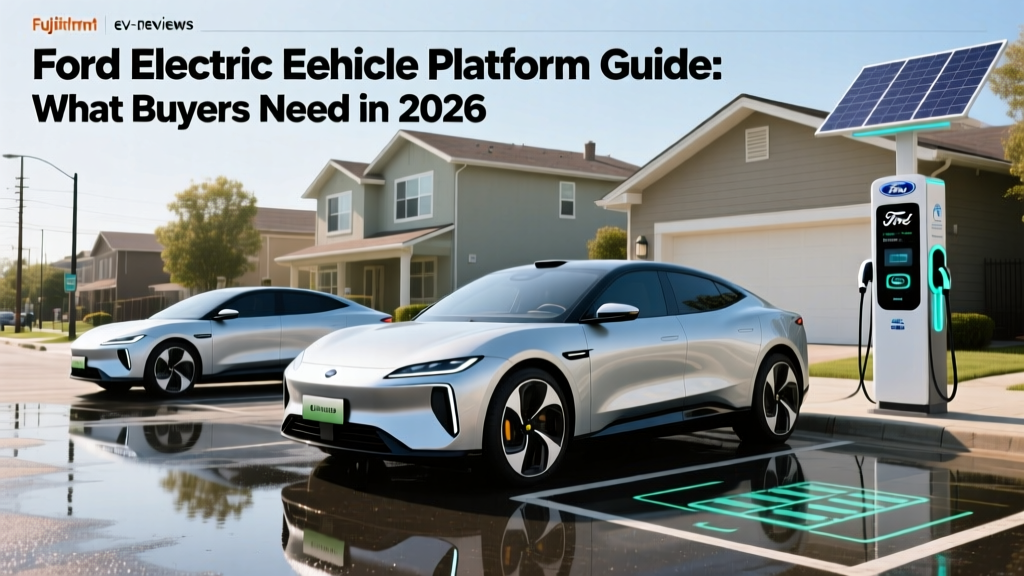
Ford's Electric Vehicle Platform, Explained in 60 Seconds
Ford's electric vehicle platform spans two production architectures in 2026: the body-on-frame platform underpinning the F-150 Lightning full-size pickup, and the unibody Global Electrified Platform (GEP) beneath the Mustang Mach-E crossover. The F-150 Lightning delivers up to 320 miles of EPA range (Extended Range), 775 lb-ft of torque, and a starting MSRP around $54,995. The Mach-E offers up to 320 miles (California Route 1), starts near $42,995, and qualifies for partial or full §30D federal tax credits depending on trim and battery sourcing. Both use the CCS1 connector for DC fast charging and support Level 2 home charging at up to 10.5 kW. Ford's next-generation universal EV platform — announced for a mid-size electric pickup and a three-row SUV — remains in pre-production and is not yet available for purchase.
The Two Production Platforms You Can Actually Buy Today
Ford's current EV strategy rests on two distinct engineering architectures, each serving a fundamentally different buyer. Understanding which platform matches your needs is the single most important decision before configuring a truck or SUV.
| Spec | F-150 Lightning (Extended Range) | Mustang Mach-E (GT Extended Range) |
|---|---|---|
| Platform Type | Body-on-frame (aluminum-intensive) | Unibody Global Electrified Platform (GEP) |
| Battery Chemistry | NMC (nickel manganese cobalt) | NMC (nickel manganese cobalt) |
| Usable Battery Capacity | ~131 kWh | ~91 kWh |
| EPA Range | 320 mi | 290 mi (GT); 320 mi (Cal Route 1 RWD) |
| Real-World Highway Range | ~250–275 mi | ~230–260 mi |
| Cold-Weather Range Loss (est.) | 15–30% below freezing | 15–30% below freezing |
| Peak DC Fast Charge | ~150 kW | ~150 kW |
| 10–80% DC Charge Time | ~41 min | ~38 min |
| Level 2 Home Charge Rate | 10.5 kW (80A Ford Charge Station Pro) | 10.5 kW (48A Mobile Power Cord w/ adapter) |
| Horsepower / Torque | 580 hp / 775 lb-ft | 480 hp / 634 lb-ft (GT) |
| 0–60 mph | ~3.8 sec | ~3.5 sec (GT) |
| Towing Capacity | 10,000 lbs (max) | N/A (not rated for heavy towing) |
| Starting MSRP | $54,995 (XLT Std Range) | $42,995 (Select RWD) |
| Powertrain Warranty | 8 yr / 100,000 mi | 8 yr / 100,000 mi |
Sources: fueleconomy.gov, Ford F-150 Lightning specs, Ford Mustang Mach-E specs. Real-world highway range estimates reflect sustained 70+ mph driving with climate control active. Cold-weather figures apply to temperatures below 32°F without preconditioning.
Ford Electric Vehicle Platform vs. Gas and Hybrid: Real Cost Data
The sticker price of Ford's EVs is higher than comparable gas models, but total cost of ownership over five years tells a different story — especially if you charge at home on residential electricity rates. Here's a side-by-side comparison of the F-150 Lightning XLT versus the gas F-150 XLT SuperCrew 4x4 (3.5L EcoBoost) over 5 years and 75,000 miles.
| Cost Category (5 yr / 75k mi) | F-150 Lightning XLT ER | F-150 XLT Gas (3.5L EcoBoost) |
|---|---|---|
| MSRP (approx.) | $69,995 | $52,500 |
| §30D Federal Tax Credit (est.) | –$7,500* | $0 |
| Effective Purchase Price | $62,495 | $52,500 |
| Fuel / Electricity Cost | ~$3,750 (home charging at $0.14/kWh) | ~$10,300 (18 MPG avg, $3.30/gal) |
| Maintenance | ~$1,200 (tire rotations, cabin filter, wipers) | ~$3,800 (oil changes, transmission fluid, plugs, brakes) |
| Insurance (avg.) | ~$10,500 | ~$8,200 |
| Estimated Depreciation | ~$28,000 | ~$22,000 |
| Total 5-Year Cost | ~$105,945 | ~$96,800 |
*§30D tax credit eligibility depends on MSRP caps (vans/pickups: $80,000), buyer AGI limits ($150k single / $300k joint), and battery critical-mineral sourcing requirements. Confirm with a tax professional and the IRS clean vehicle credits page. Point-of-sale transfer is available at participating dealers.
The Lightning still costs roughly $9,000 more over five years in this scenario, primarily due to steeper depreciation and higher insurance premiums. However, if you tow frequently (the Lightning's instant torque eliminates the turbo lag of the EcoBoost), live in a state with low electricity rates (under $0.10/kWh), or qualify for additional state incentives, the gap narrows significantly — and can flip in the EV's favor.
For the Mach-E versus a gas Ford Edge or Escape, the math is tighter. The Mach-E Select RWD at $42,995 (before any credit) costs roughly the same as a loaded Edge ST over five years when you factor in $6,500 in fuel savings and lower maintenance, even with slightly higher insurance.
Charging Reality: What Ford's Platform Actually Delivers
Ford's current EV platform charges at a peak of approximately 150 kW on DC fast chargers using the CCS1 connector. That's competitive but not class-leading — the Hyundai Ioniq 5 and Kia EV6 peak above 230 kW on 800V architectures. Here's what Ford owners should expect at different charging levels:
| Charging Level | Power (kW) | Miles Added per Hour (F-150 Lightning) | Miles Added per Hour (Mach-E) |
|---|---|---|---|
| Level 1 (120V household outlet) | ~1.4 kW | ~3 mi/hr | ~4 mi/hr |
| Level 2 (240V, 32A mobile cord) | ~7.7 kW | ~18 mi/hr | ~25 mi/hr |
| Level 2 (240V, 80A Charge Station Pro) | ~10.5 kW | ~25 mi/hr | ~34 mi/hr |
| DC Fast Charge (peak 150 kW) | 150 kW | 10–80% in ~41 min | 10–80% in ~38 min |
Charge curve reality: Ford's NMC batteries peak at ~150 kW only between roughly 15–40% state of charge. Above 60%, the charge rate tapers substantially — often dropping below 60 kW past 80%. This means the published 10–80% time is accurate, but an 80–100% top-off can add another 30–40 minutes. For road trips, plan to charge to 80% and move on; the time penalty of charging past 80% is rarely worth it.
Home charging installation cost for a Ford Charge Station Pro (hardwired, 80A circuit) typically runs $1,200–$2,800 for the electrician's labor, panel assessment, and permit — assuming your electrical panel has capacity. A 200-amp panel upgrade, if needed, adds $1,500–$3,000. The Charge Station Pro unit itself costs approximately $1,200.
Common Misconceptions About Ford's EV Platform
| Myth | Fact |
|---|---|
| "The F-150 Lightning can't tow." | Max towing is 10,000 lbs (Extended Range, Max Trailer Tow Package). However, towing at max capacity reduces range by 40–55%, bringing real-world range to ~145–180 miles. Plan charging stops accordingly. |
| "Ford's EV batteries degrade quickly." | Ford warranties the high-voltage battery for 8 years / 100,000 miles against falling below 70% capacity. Real-world data from 2022–2023 Lightning owners shows ~3–6% degradation at 30,000–40,000 miles — well within warranty thresholds. NMC chemistry degrades more from frequent 100% charges; daily charging to 80–90% extends longevity. |
| "You can't drive a Ford EV in winter." | You can, but expect 15–30% range reduction below freezing, depending on cabin heat usage. Both the Lightning and Mach-E include a heat pump (standard on Extended Range models), which recovers 10–15% of that loss versus resistive heating. Preconditioning the battery while plugged in also restores charging speed in cold weather. |
| "Ford is abandoning EVs." | Ford has restructured its EV division (Ford Model e) and delayed some next-gen models, but the Lightning and Mach-E remain in production and continue receiving updates. The universal EV platform for future mid-size trucks and SUVs is delayed to late 2026–2027 but has not been canceled. |
| "The Mach-E qualifies for the full $7,500 tax credit." | Eligibility changes as battery sourcing requirements tighten under §30D. Some Mach-E trims qualify for the full $7,500; others may receive $3,750 (critical minerals only) or nothing, depending on the model year and manufacturing date. Always check the fueleconomy.gov tax credit lookup for the specific VIN. |
Real-World Ownership: What First-Time Ford EV Buyers Must Know
Home charging is non-negotiable for most owners. If you can install a Level 2 charger at home, the Lightning and Mach-E are seamless daily drivers — you wake up every morning with a full "tank." If you rely solely on public charging, the 150 kW peak rate and CCS1 connector mean you're using Electrify America, EVgo, or ChargePoint networks. Reliability on these networks has improved but remains inconsistent; plan for 10–15% of public chargers being out of service at any given time.
The BlueCruise system is Level 2, not self-driving. Ford's hands-free driving assist on pre-qualified divided highways is genuinely useful for reducing fatigue on long trips, but it requires active driver supervision. Your eyes must remain on the road, and the system disengages in construction zones, unmapped roads, and adverse weather. Per NHTSA guidelines, this is SAE Level 2 automation — you are the driver at all times.
⚠️ BlueCruise Limitation Reminder
Ford BlueCruise is a Level 2 driver-assistance system. It does not make the vehicle autonomous. You must keep your eyes on the road and be prepared to take over instantly. It operates only on pre-mapped divided highways (approximately 130,000+ miles of qualified roads in the US and Canada). It is not a substitute for attentive driving.
Insurance costs 15–25% more for both the Lightning and Mach-E compared to their gas counterparts, driven by higher repair costs for battery-adjacent damage and specialized technician requirements. Get quotes before purchasing — some insurers (Geico, Progressive, USAA) have narrowed the gap, while others still price EVs aggressively.
ProPower Onboard (Lightning only) is a genuinely unique platform feature. The F-150 Lightning can output up to 9.6 kW of AC power from its bed and cabin outlets — enough to run power tools at a job site, power a small home during an outage (with a transfer switch installed by an electrician), or run appliances while camping. No gas F-150 offers this without a separate generator.
Decision Framework: Which Ford EV Platform Fits Your Life?
If / Then Buyer Guide
- IF you need a daily-driver truck for commuting, light towing (<5,000 lbs), and job-site power output, AND you can charge at home → F-150 Lightning XLT Extended Range. The 320-mile EPA range covers most commutes with margin, and ProPower Onboard replaces a portable generator.
- IF you tow a large trailer (7,000+ lbs) on trips longer than 150 miles regularly → Consider a gas or hybrid F-150 PowerBoost instead. The Lightning's range drops below 180 miles under heavy towing, making road trips with a trailer a multi-stop affair.
- IF you want a two-row electric crossover for commuting and family use, AND you value driving dynamics → Mustang Mach-E GT. The 3.5-second 0–60 and low center of gravity make it one of the most engaging EVs in its price bracket.
- IF you want maximum range over performance → Mach-E California Route 1 RWD (320 miles EPA, ~$48,000 MSRP). Skip the GT and its 290-mile range penalty.
- IF you live in an apartment without charging access and can't install a home charger → Neither platform is ideal yet. Public charging at 150 kW is workable but adds 2–4 hours per week of charging time. Consider a PHEV like the Ford Escape Plug-In Hybrid (37 miles electric-only range) as a bridge.
- IF you're waiting for Ford's next-gen universal platform (mid-size electric pickup, three-row SUV) → Expect late 2026–2027 availability at the earliest. Current specs are preliminary; do not delay a purchase you need now based on announced vehicles.
5-Year Total Cost of Ownership: Mach-E vs. Gas Escape
| Category | Mustang Mach-E Select RWD | Ford Escape ST-Line (2.0L EcoBoost AWD) |
|---|---|---|
| MSRP | $42,995 | $36,500 |
| §30D Tax Credit (est.) | –$3,750 to –$7,500* | $0 |
| Effective Purchase Price | $35,495–$39,245 | $36,500 |
| Energy Cost (75k mi) | ~$2,400 ($0.14/kWh, 3.3 kWh/mi) | ~$8,900 (26 MPG combined, $3.30/gal) |
| Maintenance (5 yr) | ~$900 | ~$3,200 |
| Insurance (5 yr avg.) | ~$8,800 | ~$7,100 |
| Depreciation (est.) | ~$18,500 | ~$15,000 |
| Total 5-Year Cost | ~$66,095–$69,845 | ~$70,700 |
*Tax credit amount depends on battery sourcing compliance for the specific build date. Check fueleconomy.gov for VIN-level eligibility.
The Mach-E Select RWD breaks even or beats the gas Escape on total cost when the full §30D credit applies — and delivers dramatically better acceleration, lower emissions, and a quieter ride. The gap widens further in states with additional rebates (California's $2,000 CVRP, Colorado's $5,000 state credit, etc.).
Frequently Asked Questions
Does the F-150 Lightning use a dedicated EV platform or a converted gas chassis?
The Lightning uses a heavily modified version of Ford's body-on-frame architecture shared with the 14th-generation F-150. It's not a clean-sheet EV skateboard platform — the frame was re-engineered to house the battery pack between the rails and add independent rear suspension (a first for any F-150). This means it benefits from shared parts and service networks but carries some weight compromises versus a dedicated EV platform. The result is a 6,000+ lb curb weight, which impacts efficiency (2.0–2.2 kWh/mile) compared to lighter dedicated platforms.
What connector does Ford use, and is it changing to NACS?
Current production Lightnings and Mach-Es use the CCS1 connector. Ford has committed to adopting the North American Charging Standard (NACS) — Tesla's connector — on future EV models. Existing CCS1 vehicles will receive a NACS adapter to access Tesla Supercharger stations (V3 and V4). As of early 2026, Ford has begun shipping adapters to existing owners, and Tesla Supercharger access for Ford EVs is active on most V3 stalls (150 kW) with the adapter.
How much does it cost to replace a Ford EV battery out of warranty?
Out-of-warranty high-voltage battery replacement for the F-150 Lightning (131 kWh pack) currently ranges from $20,000–$30,000 including labor, based on dealer parts pricing. The Mach-E's 91 kWh pack runs approximately $15,000–$22,000. These are worst-case scenarios — battery failures within the 8-year/100,000-mile warranty window are covered, and module-level repairs (replacing individual battery modules rather than the full pack) can reduce out-of-warranty costs to $3,000–$8,000. Battery prices continue to decline roughly 8–12% annually.
Can I use the F-150 Lightning to power my house during an outage?
Yes, with the Ford Charge Station Pro and a professionally installed home integration system (such as the Sunrun or Ford-branded transfer setup). The Lightning can output up to 9.6 kW through ProPower Onboard, which can sustain essential home circuits (refrigerator, lights, HVAC fan, sump pump) for approximately 3–10 days depending on the home's load and the truck's state of charge. A full 131 kWh battery at 9.6 kW continuous output provides roughly 13.5 hours of max-draw power, but typical home essential loads average 1.5–3 kW, stretching that to 3+ days. Installation of the transfer switch and integration hardware typically costs $3,000–$5,000 on top of the Charge Station Pro installation.
Is the Ford EV platform reliable compared to Tesla or Hyundai?
Ford's EV platform reliability is mixed. The Mach-E has earned strong marks from Consumer Reports and owner surveys for powertrain reliability, though early models (2021–2022) had software-related recalls. The F-150 Lightning has experienced fewer mechanical issues but has faced recalls related to 12V battery drain and certain software faults. Compared to Tesla's Model Y (which has improved but still sees panel-gap and suspension complaints) and Hyundai's Ioniq 5 (strong reliability but slower dealer network for EV-specific service), Ford's advantage is its massive dealer network — over 2,500 US dealers are EV-certified for service. Check NHTSA recall data for model-specific history.