Quick Answer: Is a $30K Ford Electric Truck Realistic in 2026?
As of mid-2026, Ford does not sell a new electric truck at a $30,000 sticker price. The most affordable Ford EV truck path is the Ford F-150 Lightning, which starts near $52,000 MSRP before incentives, or the upcoming Ford Maverick EV (announced for late 2026/early 2027 production), which Ford has hinted could target the low-$30K range. However, achieving a net $30K cost requires stacking the $7,500 federal §30D tax credit, potential state rebates, and dealer discounts — and even then, only on a base-trim Maverick EV once it reaches dealers.
If you need a Ford electric truck today at the lowest possible net cost, the F-150 Lightning XLT (standard-range) with the point-of-sale credit transfer brings the effective price to roughly $44,500–$47,000. For a true ~$30K net price, you'll need to wait for the Maverick EV or explore the used EV market (where the $4,000 used-EV credit under §25E can help on older Lightning models).
The 2026 Ford Electric Truck Lineup: What Exists and What's Coming
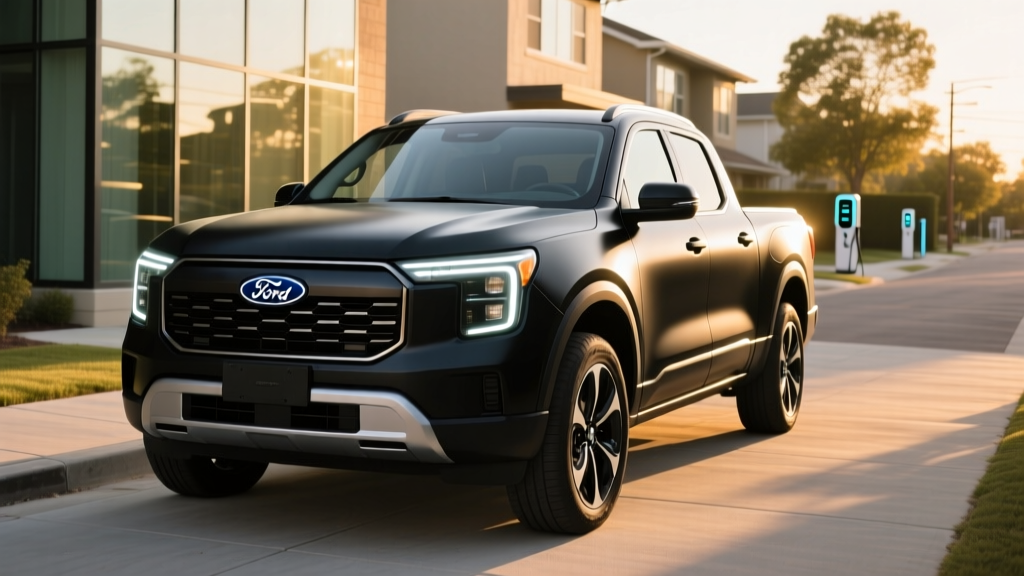
Ford's electric truck strategy in 2026 centers on two vehicles with very different price points and availability timelines:
| Specification | F-150 Lightning (2026) | Maverick EV (Announced) |
|---|---|---|
| Status | On sale now | Announced; production expected late 2026/2027 |
| Base MSRP | ~$52,000 (XLT Std Range) | Targeting low-$30K (unconfirmed) |
| Battery (usable) | 98 kWh (Std) / 131 kWh (Ext) | Estimated 70–80 kWh (preliminary) |
| Chemistry | NMC (nickel manganese cobalt) | Likely LFP for base trim (unconfirmed) |
| EPA Range | 240 mi (Std) / 320 mi (Ext) | Estimated 250–300 mi (preliminary) |
| Peak DC Charge Rate | ~150 kW (Std) / ~170 kW (Ext) | Estimated 120–150 kW (preliminary) |
| 10–80% DC Charge | ~41 min (Std) / ~44 min (Ext) | Estimated 30–40 min (preliminary) |
| Horsepower | 563 hp (Std) / 580 hp (Ext) | Estimated 250–300 hp |
| 0–60 mph | ~3.8 sec (Std) / ~4.0 sec (Ext) | Estimated 6.5–7.5 sec |
| Towing Capacity | 7,700–10,000 lbs | Estimated 2,000–4,000 lbs |
| Battery Warranty | 8 yr / 100,000 mi | Expected 8 yr / 100,000 mi |
| Federal Tax Credit | $7,500 eligible (verify sourcing) | Likely eligible (unconfirmed) |
The F-150 Lightning is a proven, full-size work truck with serious towing capability and real-world validation. The Maverick EV, if it reaches its rumored price target, would be a compact lifestyle truck — think grocery runs and weekend projects, not job-site hauling. These are fundamentally different vehicles serving different buyers.
Real-World Range Reality Check
The F-150 Lightning Extended Range carries a 320-mile EPA sticker, but expect ~240–270 miles on the highway at 70–80 mph, and potentially ~200–220 miles in sub-freezing weather with the heater running. Towing a trailer can cut range by 40–50%. The Standard Range (240 EPA) realistically delivers 180–200 highway miles in moderate conditions. Plan your road trips around these numbers, not the sticker.
Cracking the $30K Code: Tax Credits, Incentives, and Net Cost Math
The phrase "Ford electric truck 30K" usually reflects a buyer hoping to net $30,000 out-of-pocket after incentives. Here's the math as it stands under current IRS §30D rules for 2026:
Federal §30D New Clean Vehicle Credit — 2026 Requirements
- Credit amount: Up to $7,500 ($3,750 for critical minerals + $3,750 for battery components)
- MSRP cap (trucks/vans/SUVs): Vehicle base price must not exceed $80,000
- Buyer income cap: AGI ≤ $300,000 (married filing jointly) / $150,000 (single)
- Battery sourcing: Critical minerals and component requirements phase up yearly — verify current-year compliance on irs.gov
- Point-of-sale transfer: You can transfer the credit to the dealer at purchase, reducing your out-of-pocket cost immediately (rather than waiting for tax filing)
- One vehicle per VIN: Credit applies once per vehicle, and you're limited to one new EV credit per year
| Cost Scenario | F-150 Lightning XLT Std Range | Maverick EV Base (Estimated) |
|---|---|---|
| Base MSRP | $52,000 | $32,000 (est.) |
| Federal §30D Credit | −$7,500 | −$7,500 (est.) |
| State Rebate (example: CA) | −$0 to −$2,000 | −$0 to −$2,000 |
| Destination & Delivery | +$1,995 | +$1,500 (est.) |
| Net Estimated Cost | $44,495–$46,495 | $24,000–$26,000 (est.) |
The Maverick EV is the only realistic path to a net ~$30K Ford electric truck, and only if Ford prices the base trim aggressively and it qualifies for the full $7,500 credit. The F-150 Lightning, even with maximum incentives, lands in the mid-$40K range.
Used EV alternative: Under IRS §25E, a used F-150 Lightning (model year 2022–2024) purchased from a dealer for under $25,000 could qualify for a used-EV credit of up to $4,000 (30% of sale price, capped at $4,000), with lower income caps ($150K joint / $75K single). This is a viable path to a ~$21K–$25K net cost on a used Lightning with moderate mileage.
EV Truck vs Gas Truck: 5-Year Ownership Cost Breakdown
Comparing the F-150 Lightning XLT (Standard Range) against the gas-powered F-150 XLT SuperCrew 4×4 (3.5L EcoBoost) over five years and 75,000 miles:
| Cost Category (5 yr / 75K mi) | F-150 Lightning EV | F-150 Gas (3.5L EcoBoost) |
|---|---|---|
| Purchase Price (after credit) | $46,500 | $49,500 |
| Fuel / Electricity | $4,200 (home charging at $0.14/kWh) | $10,500 (at $3.50/gal, 20 MPG combined) |
| Maintenance | $1,500 (no oil changes, fewer brake jobs with regen) | $3,800 (oil, filters, brakes, spark plugs) |
| Insurance (avg) | $9,500 ($1,900/yr avg — EVs typically 15–25% higher) | $7,500 ($1,500/yr avg) |
| Estimated Depreciation | $22,000 | $18,000 |
| Total 5-Year Cost | $83,700 | $89,300 |
| Cost Per Mile | $1.12 | $1.19 |
The Lightning breaks even or pulls ahead on total cost primarily through fuel and maintenance savings, despite higher insurance and depreciation. Your actual numbers depend heavily on local electricity rates, gas prices, annual mileage, and whether you charge at home. According to fueleconomy.gov, the Lightning achieves roughly 66–70 MPGe combined, translating to about $0.056/mile on residential electricity versus $0.175/mile for the gas F-150.
Real-World Ownership: What First-Time EV Truck Buyers Must Know
Home Charging Is Non-Negotiable for Most Owners
The economics above assume 80%+ home charging. Without a Level 2 home charger, you'll rely on public DC fast charging, which costs $0.35–$0.50/kWh at networks like Electrify America or EVgo — erasing most fuel savings versus gas. A Level 2 home installation (240V, 48A circuit for ~11.5 kW) typically costs $800–$2,500 for the charger and electrician, assuming your panel has capacity. A 200-amp panel upgrade adds $1,500–$3,000.
| Charging Level | Power | Miles Added/Hour | Use Case |
|---|---|---|---|
| Level 1 (120V outlet) | ~1.4 kW | ~3–5 mi/hr | Overnight top-ups; impractical for full-size trucks |
| Level 2 (240V home) | 7.7–11.5 kW | ~20–30 mi/hr | Daily charging; full overnight refill |
| DC Fast Charge | 50–150+ kW | ~150–300+ mi/hr | Road trips; 10–80% in 35–45 min |
Cold Weather and Highway Driving Shrink Range
EV batteries lose efficiency in cold temperatures. At 20°F, expect 20–35% range reduction compared to the EPA sticker, depending on whether the truck uses a heat pump (the Lightning uses resistive heating on earlier models, which draws more energy). Highway driving at 75+ mph also cuts range by 10–15% versus the EPA combined cycle, which includes city driving where regenerative braking recovers energy.
Towing with an Electric Truck: The Range Cliff
If you plan to tow regularly, understand that a loaded 5,000-lb trailer can reduce the Lightning's range to 120–150 miles from a full charge. Electric trucks are exceptional for towing torque (instant, no gear hunting) but range-sensitive. For frequent long-distance towing, a diesel or hybrid truck may still be more practical.
Myths vs Facts: Clearing Up Ford Electric Truck Misconceptions
| Myth | Fact |
|---|---|
| "EV batteries need replacing every 5 years" | Ford warranties the Lightning battery for 8 years/100,000 miles with a minimum 70% capacity retention threshold. Real-world data from 2022 Lightnings shows ~5–8% degradation after 60,000 miles. |
| "You can't tow with an electric truck" | The F-150 Lightning is rated for 7,700–10,000 lbs. The limitation isn't capability — it's range while towing (expect 40–50% reduction). |
| "EVs cost more to insure, always" | EV insurance premiums are typically 15–25% higher due to repair costs and battery replacement risk, but gap is narrowing. Shop quotes before buying. |
| "The $7,500 tax credit is automatic" | You must meet income caps, MSRP caps, and battery sourcing requirements. Not every EV qualifies every year. Verify on irs.gov and with your tax professional before relying on the credit. |
| "Level 2 driver assist means self-driving" | Ford's BlueCruise is SAE Level 2 — you must remain attentive with hands on or near the wheel. It handles highway lane-keeping and adaptive cruise, but you are always the driver. |
SAE Automation Level: Ford BlueCruise
Ford BlueCruise (available on the F-150 Lightning) is an SAE Level 2 driver-assistance system. It provides hands-free driving on pre-mapped divided highways, but the driver must remain alert and ready to take over at any time. A driver-facing camera monitors attention. This is not autonomous driving — it's an advanced cruise control and lane-centering system. Only Level 4 services (like Waymo robotaxis in limited cities) operate without a human driver.
Decision Framework: Which Path Gets You a Ford Electric Truck at ~$30K?
Choose Your Path
Choose the F-150 Lightning now if:
- You need a full-size truck with 7,700+ lb towing today
- Your budget can stretch to ~$45K net after incentives
- You have (or can install) Level 2 home charging
- You drive under 250 miles/day and can charge overnight
Wait for the Maverick EV if:
- A net ~$30K price is a hard requirement
- You need a compact truck for commuting, light hauling, and urban use
- You can wait until late 2026 or 2027 for production and delivery
- 2,000–4,000 lb towing capacity is sufficient for your needs
Consider a used F-150 Lightning (2022–2024) if:
- You want a Lightning at $21K–$25K net (with the $4,000 §25E used credit)
- You're comfortable with 30,000–60,000 miles on the odometer
- Your AGI is under $150K (joint) or $75K (single) for the used-EV credit
- You can find a qualifying dealer sale (private-party sales don't qualify)
Frequently Asked Questions
Does Ford currently sell an electric truck under $30,000?
No. As of 2026, the most affordable new Ford electric truck is the F-150 Lightning XLT Standard Range at approximately $52,000 MSRP. After the $7,500 federal credit and potential state incentives, the net cost is roughly $44,500–$47,000. A $30K net price may become achievable with the upcoming Maverick EV, but that vehicle is not yet in production.
Will the Ford Maverick EV really cost $30,000?
Ford has signaled an aggressive entry price for the Maverick EV, and industry analysts expect a base trim in the low-$30K MSRP range. With the $7,500 federal credit, the net price could drop to roughly $24,000–$26,000. However, final pricing, trim availability, and tax credit eligibility won't be confirmed until closer to the on-sale date (expected late 2026 or early 2027).
How does the F-150 Lightning compare to a gas F-150 on fuel costs?
Charging at home at $0.14/kWh, the Lightning costs roughly $0.056 per mile in electricity. A gas F-150 EcoBoost at 20 MPG combined with $3.50/gallon fuel costs about $0.175 per mile. Over 15,000 miles per year, that's $840 vs $2,625 — a savings of about $1,785 annually. Public DC fast charging at $0.40/kWh narrows this gap significantly to roughly $0.16/mile.
Can I install a Level 2 charger in my garage?
Most homes with a 200-amp electrical panel can support a 48-amp Level 2 charger (requiring a 60-amp breaker circuit). Installation costs typically range from $800–$2,500 including the charger unit and electrician labor. Older homes with 100-amp panels may need a $1,500–$3,000 panel upgrade. Always get a quote from a licensed electrician before committing.
What happens to the battery after the warranty expires?
Ford's EV battery warranty covers 8 years or 100,000 miles with a 70% capacity retention threshold. Industry data suggests NMC batteries (used in the Lightning) typically retain 80–85% capacity after 150,000 miles. Full battery replacement costs range from $12,000–$20,000 out of warranty, though individual module replacement is sometimes possible at lower cost. LFP batteries (expected in the Maverick EV base trim) generally show slower degradation and longer cycle life.
Is the F-150 Lightning eligible for the $7,500 tax credit in 2026?
Eligibility depends on current-year battery sourcing requirements under §30D, which tighten annually. The Lightning has qualified in prior years, but you must verify current eligibility on fueleconomy.gov and confirm your income falls under the AGI caps ($300K joint / $150K single). Consult a tax professional before relying on the credit.