If you've been searching for a detailed look at the BMW i4 2025 interior, you're likely weighing whether BMW's electric gran coupe delivers a premium cabin experience without sacrificing everyday EV practicality. The i4 has always occupied a unique niche: it's essentially an electric 4 Series Gran Coupe, sharing its CLAR platform with the ICE counterpart rather than riding on a dedicated EV skateboard. That decision shapes everything from the interior packaging to the driving dynamics — and it's the lens through which we evaluate the 2025 model year update.
For 2025, BMW refreshed the i4 with updated styling, a revised Curved Display running iDrive 8.5, and minor equipment shuffles across the eDrive35, eDrive40, and M50 trims. But the powertrain fundamentals — the 81.5 kWh NMC battery, the 200 kW DC fast-charging ceiling, and the EPA range figures — carry over. Below, we break down every number that matters to a buyer, from real-world range to tax credit math, before diving deep into the interior that gives this article its name.
2025 BMW i4 at a Glance: Key Specifications
| Spec | eDrive35 | eDrive40 | M50 |
|---|---|---|---|
| EPA Range | 256–307 mi | 290–318 mi | 227–271 mi |
| Battery (usable) | 81.5 kWh (net), NMC chemistry | ||
| Drivetrain | RWD (single motor) | RWD (single motor) | AWD (dual motor) |
| Horsepower | 281 hp | 335 hp | 536 hp |
| 0–60 mph | 5.8 sec | 5.5 sec | 3.7 sec |
| Max DC Fast Charge | 200 kW (CCS1), 205 kW (NACS w/ adapter) | ||
| 10–80% DCFC Time | ~31 minutes | ||
| Level 2 Home Charging | 11 kW (up to ~30 mi/hr) | ||
| MPGe (combined) | 98–111 MPGe | 97–109 MPGe | 83–97 MPGe |
| Base MSRP | $52,200 | $57,900 | $69,700 |
| Battery Warranty | 8 years / 100,000 miles | ||
Source: EPA fueleconomy.gov and BMW Group PressClub. Range varies by wheel size and trim. 2025 model year pricing includes destination.
Real-World Range: What the EPA Sticker Doesn't Tell You
EPA Estimate: Up to 318 miles (eDrive40 with 18" wheels)
Real-World Expectation: ~250–280 miles on mixed highway driving; ~200–230 miles in sustained cold weather (below 32°F) at highway speeds.
The eDrive40's headline 318-mile EPA figure is achievable in moderate temperatures with a mix of city and suburban driving where regenerative braking recovers energy. On a 70-mph highway cruise in 40°F weather, expect roughly 230–250 miles before the low-battery warnings begin. The M50, with its dual motors, stickier rubber, and heavier curb weight (~4,900 lbs), drops to around 200–220 real-world highway miles in similar conditions.
The i4's NMC (nickel manganese cobalt) battery chemistry provides strong energy density but is more temperature-sensitive than LFP. BMW's thermal management system does precondition the pack during navigation-routed DC fast charging, but if you arrive at a charger without preconditioning in cold weather, your peak charge rate will be throttled significantly — sometimes to under 50 kW until the pack warms. Always use the iDrive navigation to route to a charger when possible.
Efficiency on the eDrive40 hovers around 31–34 kWh/100 mi in mixed driving, which is competitive with the Tesla Model 3 Long Range but slightly behind the Hyundai Ioniq 6's exceptional 25–27 kWh/100 mi. That difference translates to roughly $50–$80 more per year in electricity for a 12,000-mile driver at the national average of $0.17/kWh.
Charging Speed: DC Fast Charging and Home Level 2
| Charging Level | Power / Rate | Time / Miles Added |
|---|---|---|
| Level 1 (120V outlet) | ~1.4 kW | ~4–5 miles per hour |
| Level 2 (240V home, 48A) | 11 kW | ~30 miles per hour; full charge in ~9 hrs |
| DC Fast Charge (CCS1) | Peak 200 kW | 10–80% in ~31 min; ~164 mi in 31 min |
| DC Fast Charge (NACS adapter) | Up to 205 kW | Similar to CCS1; enables Tesla Supercharger access |
The i4's 200 kW peak DC fast-charge rate is adequate but no longer class-leading. Competitors like the Hyundai Ioniq 5 (peak 240 kW, 10–80% in ~18 minutes) and the Porsche Taycan (peak 270+ kW with 800V architecture) charge noticeably faster on long road trips. The i4's charge curve holds near peak only between roughly 15–45% State of Charge, then tapers progressively. From 80–100%, expect an additional 25–30 minutes — plan accordingly and stick to the 10–80% window on road trips.
For home charging, the 11 kW onboard charger is a strong point. A 48-amp Level 2 home station (hardwired, requiring a 60-amp circuit) will fully replenish the 81.5 kWh pack in about 9 hours — easily overnight. BMW includes a Flexible Fast Charger (combo cable) with the vehicle that handles both 120V and 240V outlets, though at 240V it's limited to 32A (~7.7 kW) unless you invest in a dedicated wallbox like the BMW Wallbox or a third-party unit such as the ChargePoint Home Flex or Emporia Vue.
BMW i4 2025 Interior: Materials, Tech, and Space
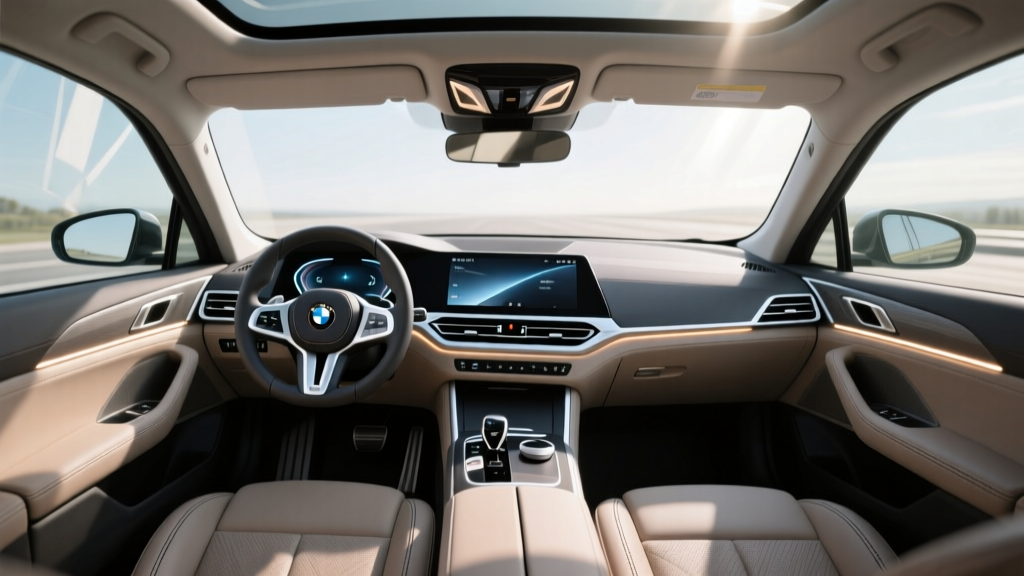
The headline reason buyers cross-shop the i4 against the Tesla Model 3, Hyundai Ioniq 5, or Polestar 2 is the cabin. The 2025 i4 interior carries forward BMW's driver-focused luxury ethos with some meaningful tech updates.
The Curved Display and iDrive 8.5
The centerpiece is BMW's Curved Display: a 12.3-inch digital instrument cluster seamlessly merged with a 14.9-inch touchscreen under a single curved glass panel, angled toward the driver. For 2025, it runs iDrive 8.5, which reintroduces a dedicated home screen with widget-style quick-access tiles — a welcome improvement over iDrive 8's buried menus. Wireless Apple CarPlay and Android Auto are standard, as is the "Hey BMW" voice assistant, which handles navigation, climate, and media commands with reasonable accuracy.
Physical controls persist: a volume knob, steering-wheel buttons, and the iDrive rotary controller on the center console. This blend of touch and tactile is exactly what many luxury EV buyers want — and what Tesla's minimalist approach deliberately omits.
Materials and Build Quality
Standard upholstery is Sensatec (BMW's synthetic leather), which is durable and convincingly leather-like. The optional Vernasca leather ($1,450) adds genuine hide with perforation options. Dashboard and door panel surfaces use a mix of soft-touch materials, open-pore wood or aluminum trim, and stitched Sensatec on the upper dash. Panel gaps are tight, and the cabin feels assembled with the precision BMW is known for. Compared to the Model 3's spartan interior or the Ioniq 5's retro-modern aesthetic, the i4 reads as traditionally luxurious.
Passenger and Cargo Space
Here's where the shared ICE platform shows its limitations. The i4's floor-mounted battery raises the floor slightly, and the transmission tunnel hump (a relic of the CLAR architecture) intrudes on rear middle-seat footroom.
- Front headroom: 40.0 inches
- Front legroom: 42.3 inches
- Rear headroom: 36.6 inches (tight for 6-foot+ passengers due to the sloping roofline)
- Rear legroom: 35.3 inches (adequate but less than a Model 3's 35.3" or an Ioniq 5's 39.4")
- Cargo (rear seats up): 16.6 cu ft (liftback design aids loading)
- Cargo (rear seats folded): 45.6 cu ft
- Frunk: None — the CLAR platform uses the front space for power electronics
The 16.6 cu ft liftback cargo area is practical and comparable to the Model 3 (23 cu ft including the deeper trunk), though the i4 lacks any front trunk. If you regularly haul rear passengers or bulky cargo, the Ioniq 5 or Model 3 offer more interior volume. For a couple or a commuter who values cabin refinement over maximum space, the i4's proportions work well.
Driver Assistance and Standout Features
The i4 comes standard with BMW's Active Driving Assistant, which includes forward collision warning, automatic emergency braking, lane departure warning, and blind-spot detection. The optional Driving Assistance Professional Package ($1,700) adds adaptive cruise control with stop-and-go, lane centering, and extended traffic jam assist.
SAE Automation Level: Level 2 (partial automation). The driver must remain fully engaged with hands on the wheel and eyes on the road at all times. This is a driver-assist system, not a self-driving system.
Available features include the Parking Assistant Professional (with surround-view cameras and automated parking), a head-up display, a Harman Kardon 17-speaker surround-sound system, and ambient lighting with over 40 color combinations. The optional glass roof ($1,000) floods the cabin with light, though it does reduce rear headroom slightly.
Pricing, Trims, and Federal Tax Credit Eligibility
The 2025 BMW i4 is offered in three trims. Here's what the pricing and credit picture looks like:
| Trim | Base MSRP | As-Tested (typical) | Federal §30D Credit | Effective Price |
|---|---|---|---|---|
| eDrive35 | $52,200 | $55,000–$58,000 | Up to $7,500* | ~$47,500* |
| eDrive40 | $57,900 | $62,000–$68,000 | Up to $7,500* | ~$54,500* |
| M50 | $69,700 | $75,000–$82,000 | Up to $7,500* | ~$67,500* |
*Federal tax credit eligibility under IRS §30D is subject to multiple requirements. As of 2025, the BMW i4 (built in Munich, Germany) faces significant battery-component and critical-mineral sourcing hurdles. Buyers should verify current eligibility on the IRS qualified vehicles list before purchasing. The credit can be transferred to the dealer as a point-of-sale discount if eligible.
- MSRP cap: Sedans must be under $55,000 MSRP — the eDrive35 qualifies on price; eDrive40 and M50 may exceed the cap depending on options. (Note: The i4 is classified as a sedan for §30D purposes.)
- Buyer income cap: Modified AGI must not exceed $150,000 (single), $225,000 (head of household), or $300,000 (joint).
- Battery sourcing: At least a percentage of battery components must be manufactured/assembled in North America, and critical minerals must be sourced from the US or FTA partners. The i4, assembled in Germany, has historically struggled with these requirements.
- Point-of-sale transfer: If eligible, you can transfer the credit to the dealer for an upfront price reduction rather than claiming it on your tax return.
Bottom line on the credit: Do not assume the i4 qualifies for the full $7,500. Check the fueleconomy.gov tax credit tracker and consult a tax professional before counting on it in your purchase math.
How Does the BMW i4 Compare to Key Rivals?
The i4 competes in the $50,000–$75,000 electric sedan/coupe segment. Here's how it stacks up against the three most common cross-shops:
| Attribute | BMW i4 eDrive40 | Tesla Model 3 LR | Hyundai Ioniq 5 LR | Polestar 2 LR |
|---|---|---|---|---|
| EPA Range | 318 mi | 341 mi | 303 mi | 276 mi |
| 0–60 mph | 5.5 sec | 4.2 sec | 5.1 sec | 5.8 sec (single motor) |
| Peak DCFC | 200 kW | 250 kW | 240 kW | 200 kW |
| 10–80% Time | ~31 min | ~25 min | ~18 min | ~30 min |
| Cargo Volume | 16.6 cu ft | 23 cu ft | 27.2 cu ft | 14.4 cu ft |
| Starting MSRP | $57,900 | $47,740 | $46,650 | $51,300 |
| Interior Luxury | ★★★★★ | ★★★☆☆ | ★★★★☆ | ★★★★☆ |
Choose the BMW i4 if: You prioritize traditional luxury interior quality, physical controls, BMW driving dynamics, and brand prestige — and you don't need class-leading range or charging speed.
Choose the Tesla Model 3 LR if: Maximum range, Supercharger network access, lower price, and over-the-air updates are your top priorities — and you're comfortable with minimal interior styling and touchscreen-only controls.
Choose the Hyundai Ioniq 5 if: You want the fastest charging in the segment, a flat floor, generous cargo space, and strong value — with a more distinctive design than the i4.
Pros, Cons, and Who Should Buy the i4
Pros
- Premium interior materials and build quality rivaling anything in the segment
- iDrive 8.5 with physical knobs and rotary controller — excellent ergonomics
- Engaging driving dynamics with well-tuned adaptive suspension (optional)
- Liftback cargo design adds versatility vs. traditional sedans
- 11 kW Level 2 onboard charger for fast home replenishment
- Strong 8-year/100,000-mile battery warranty
Cons
- DC fast-charging speed (200 kW peak, 31 min 10–80%) trails key rivals
- No front trunk (frunk) — CLAR platform limitation
- Rear seat space is tighter than competitors, especially headroom
- Center tunnel hump compromises middle-seat comfort
- Federal tax credit eligibility is uncertain due to German assembly and battery sourcing
- eDrive40 and M50 may exceed the §30D $55,000 sedan MSRP cap with options
Who the i4 Suits Best
Ideal buyer: A luxury-oriented commuter who drives 30–60 miles daily, has reliable Level 2 home charging, values cabin refinement and brand cachet, and takes road trips infrequently enough that the 31-minute DCFC time isn't a dealbreaker. The i4 rewards drivers who appreciate steering feel, adaptive damping, and the tactile satisfaction of BMW's control layout.
Less ideal for: Families needing maximum rear-seat space, frequent long-distance road-trippers who want the fastest charging possible, or buyers whose purchase math depends on the full $7,500 federal credit.
Frequently Asked Questions
What is the real-world range of the 2025 BMW i4?
The EPA rates the eDrive40 at up to 318 miles. In real-world mixed highway driving at moderate temperatures, expect 250–280 miles. In sustained cold weather (below freezing) at highway speeds, that drops to roughly 200–230 miles. The eDrive35 and M50 will deliver proportionally less.
How fast does the BMW i4 charge at home and on DC fast chargers?
On a 48-amp Level 2 home charger, the i4 charges at 11 kW, adding about 30 miles per hour and fully replenishing in roughly 9 hours. On a DC fast charger, it peaks at 200 kW and charges from 10–80% in about 31 minutes. The charge curve tapers significantly above 80%.
Does the 2025 BMW i4 qualify for the $7,500 federal EV tax credit?
Eligibility is uncertain and changes periodically. The i4 is assembled in Munich, Germany, which complicates the battery-component and critical-mineral sourcing requirements under §30D. Additionally, the eDrive40 and M50 may exceed the $55,000 MSRP cap for sedans when optioned. Always check the fueleconomy.gov qualified vehicle list and consult a tax professional before relying on the credit.
Is the BMW i4 worth buying over the Tesla Model 3 or Hyundai Ioniq 5?
It depends on your priorities. The i4 wins on interior luxury, build quality, driving dynamics, and ergonomics. The Model 3 wins on range, price, and Supercharger access. The Ioniq 5 wins on charging speed, cargo space, and value. None is universally "best" — the i4 is the right choice if cabin quality and brand experience are paramount.
What battery chemistry does the BMW i4 use?
The i4 uses an NMC (nickel manganese cobalt) lithium-ion battery with 81.5 kWh of usable capacity. NMC offers high energy density but is more sensitive to extreme temperatures than LFP chemistry. BMW covers the battery with an 8-year/100,000-mile warranty against degradation below 70% capacity.
Does the i4 have a front trunk (frunk)?
No. Because the i4 shares BMW's CLAR platform with the gasoline 4 Series, the front compartment houses power electronics and the HVAC system rather than offering cargo space. This is one of the trade-offs of the shared-platform approach versus a dedicated EV architecture.