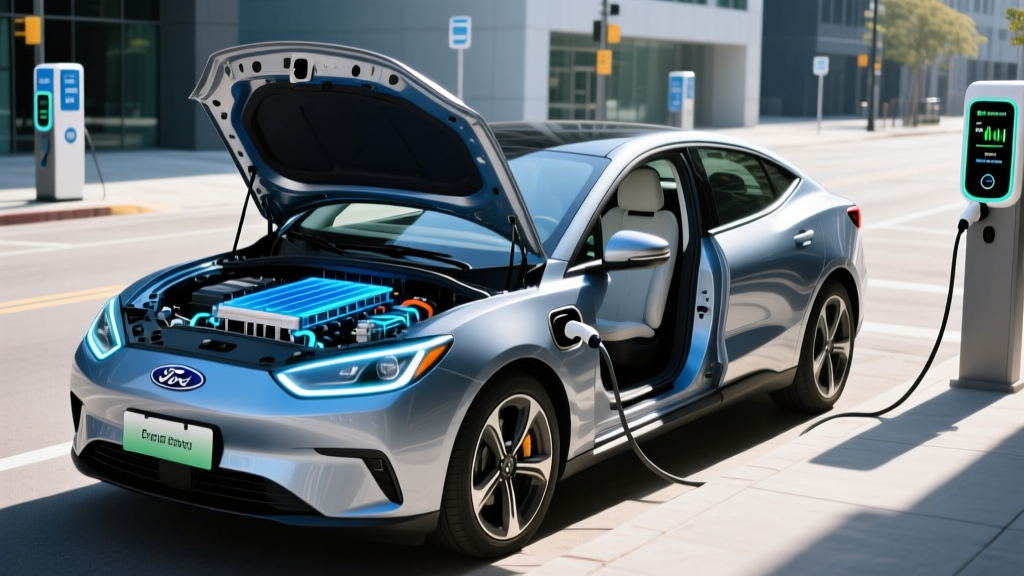
Quick Answer: What Does a Ford Electric Car Malfunction Mean?
A "Ford electric car malfunction" warning — often displayed as "Propulsion System Fault," "Stop Safely Now," or "Electrical System Service Required" — typically points to one of four issues: (1) a 12V auxiliary battery failure (the most common trigger, affecting an estimated 30–40% of early Mach-E complaints), (2) a high-voltage battery contactor or BMS (battery management system) fault, (3) an onboard charger or DC-DC converter malfunction, or (4) a software/firmware glitch requiring an OTA (over-the-air) update or dealer reflash.
Most actionable first step: Check your 12V battery health via the FordPass app or a multimeter (should read 12.4–12.7V at rest). A weak 12V battery causes cascading error codes across the high-voltage system even when the main traction battery is perfectly healthy. Replacement costs $200–$350 at a dealer, or ~$150 DIY.
The Most Common Ford EV Malfunctions — Ranked by Frequency
Based on NHTSA complaint databases, Ford owner forums, and service bulletins through the 2025–2026 model years, here are the faults that Mach-E and F-150 Lightning owners actually encounter, with real diagnostic context and repair cost ranges.
1. 12V Battery Failure Triggering HV System Warnings
Ford's EVs rely on a conventional 12V lead-acid (or AGM) battery to power the vehicle's computers, contactors, and infotainment — even though propulsion comes from the high-voltage pack. When the 12V battery degrades below ~11.8V, the car cannot reliably close the high-voltage contactors, triggering "Propulsion System Fault" or a complete no-start condition.
- Symptoms: Multiple dash warnings simultaneously, inability to shift into Drive, blank instrument cluster, FordPass connectivity loss
- Fix cost: $150–$350 (battery + labor)
- Warranty coverage: 12V battery covered under 3-year/36,000-mile bumper-to-bumper
- Prevention: Keep the vehicle plugged in when parked for extended periods; the DC-DC converter maintains the 12V battery when the car is connected to a charger
2. High-Voltage Battery Contactor Recall (Mach-E Extended Range)
Ford issued recalls for certain 2021–2022 Mustang Mach-E Extended Range models where the high-voltage battery contactors could overheat during repeated DC fast charging or wide-open-throttle events. A failed contactor can cause a sudden loss of propulsion — the most serious category of "malfunction" an EV can display.
- Symptoms: Sudden power loss while driving, "Stop Safely Now" warning, wrench icon
- Fix: Software update to limit contactor stress + hardware replacement if damage detected. Covered under recall at no cost.
- Affected models: 2021–2022 Mach-E Extended Range (check VIN at nhtsa.gov/recalls)
- Post-fix reliability: Updated contactor monitoring has largely resolved the issue in 2023+ model years
3. Onboard Charger (OBC) Failure
The onboard charger converts AC power from your Level 2 home charger to DC for the battery. When it fails, the car charges extremely slowly or not at all on AC power, though DC fast charging may still work.
- Symptoms: Level 2 charging stalls or runs at 1–2 kW instead of the expected 10.5 kW (Mach-E) or 19.2 kW (F-150 Lightning), "Charging System Fault" message
- Fix cost: $1,200–$2,500 out of warranty; covered under the 5-year/60,000-mile powertrain warranty
- Diagnosis tip: If DC fast charging works normally but Level 2 fails, the OBC is the likely culprit
4. Software and OTA Update Glitches
Ford's SYNC 4A infotainment and vehicle control modules occasionally encounter firmware bugs after OTA updates — phantom warnings, inaccurate range estimates, or temporary loss of features like BlueCruise (Ford's Level 2 hands-free driver-assist system).
- Fix: Often resolved by a soft reset (hold volume knob + next-track button for 10 seconds) or the next OTA patch. Persistent issues require a dealer module reflash ($0 under warranty).
Real Cost of Ownership: Ford EV vs. Gas Equivalent
Malfunction anxiety is real — but context matters. Let's compare the total ownership economics of a 2025 Ford Mustang Mach-E Premium (the most popular trim) against its closest gas counterpart, the Ford Edge ST-Line, over 5 years and 75,000 miles.
| Cost Category | Mustang Mach-E Premium AWD | Ford Edge ST-Line AWD |
|---|---|---|
| Base MSRP | $48,995 | $44,440 |
| Federal §30D Tax Credit (est.) | –$3,750 to $7,500* | $0 |
| Effective Purchase Price | $41,495–$45,245 | $44,440 |
| Fuel / Electricity (75k mi) | $2,800–$4,100** | $8,600–$10,200 |
| Maintenance (5 yr) | $1,200–$1,800 | $3,500–$4,500 |
| Insurance (5 yr avg) | $9,500–$11,500 | $7,800–$9,500 |
| Estimated Repairs (out-of-warranty risk) | $500–$2,000 | $800–$1,500 |
| Total 5-Year Cost | $55,495–$64,645 | $65,140–$70,140 |
* §30D credit eligibility depends on buyer income caps ($150K single / $300K joint), MSRP caps ($55K for SUVs), and battery critical-mineral sourcing requirements. Always verify current-year rules at irs.gov and consult a tax professional.
** Electricity cost assumes $0.14–$0.20/kWh home charging and 3.0–3.5 mi/kWh Mach-E efficiency. Gas assumes 24 MPG combined at $3.20–$3.80/gal.
The takeaway: the Mach-E costs more upfront for insurance and carries higher out-of-warranty repair risk for the HV system, but the fuel and maintenance savings are substantial — typically $5,000–$8,000 over five years. The tax credit, when eligible, narrows or eliminates the purchase-price gap entirely.
Ford EV Reliability vs. Gas Cars: What the Data Shows
The perception that EVs are less reliable than gas cars comes largely from early-model-year growing pains. Here's how Ford's current EV lineup stacks up with concrete data:
| Metric | Mach-E / F-150 Lightning | Ford Edge / F-150 Gas |
|---|---|---|
| Moving drivetrain parts | ~20 (motor, reduction gear) | ~2,000+ (engine, transmission, exhaust) |
| Scheduled maintenance items | Cabin filter, tire rotation, brake fluid check | Oil, filter, spark plugs, transmission fluid, coolant flush, belts |
| Brake pad life (regen braking) | 100,000–150,000+ mi | 30,000–60,000 mi |
| HV Battery warranty | 8 yr / 100,000 mi (≥70% capacity) | N/A |
| Powertrain warranty | 5 yr / 60,000 mi | 5 yr / 60,000 mi |
| NHTSA complaints (2024 model year, through early 2026) | Moderate (mostly 12V, software) | Low-moderate (transmission, engine) |
| Average annual repair cost (out of warranty) | $600–$1,100 | $500–$800 |
EVs have far fewer mechanical wear items — no oil changes, no timing belts, no exhaust systems. But when something does fail in the high-voltage system, the repair bill is higher and requires a certified EV technician. The trade-off: lower routine maintenance costs offset by higher per-incident repair risk, heavily mitigated by the 8-year battery warranty.
What to Do When Your Ford EV Shows a Malfunction Warning
Here's a practical, step-by-step diagnostic flowchart based on the specific warning message you see:
Diagnostic Decision Framework
- IF "Propulsion System Fault" + car won't shift to Drive:
- → Check 12V battery voltage (multimeter or FordPass). If below 12.0V, replace 12V battery.
- → If 12V is healthy, check for open recalls at nhtsa.gov/recalls using your VIN.
- → Schedule dealer diagnostic — likely HV contactor or BMS issue.
- IF "Stop Safely Now" while driving:
- → Pull over immediately. This indicates imminent propulsion loss.
- → Call Ford Roadside Assistance (included 5yr/60k mi). Tow to nearest EV-certified dealer.
- → Do NOT attempt to restart and continue driving.
- IF Level 2 charging won't start but DC fast charging works:
- → Try a different Level 2 station to rule out charger-side fault.
- → If problem persists across stations, suspect onboard charger (OBC) failure. Dealer diagnostic required.
- IF range estimate drops suddenly or erratically:
- → Perform a SYNC soft reset (volume + next-track, 10 seconds).
- → Drive normally for 2–3 charge cycles — the BMS recalibrates SoC estimation over time.
- → If range loss exceeds 15% vs. original EPA rating within warranty period, request a battery State of Health (SoH) check at the dealer.
- IF BlueCruise or driver-assist features show faults:
- → Clean all cameras and radar sensors (front grille, windshield header).
- → Ensure SYNC software is current (Settings → System Updates).
- → These are Level 2 driver-assist systems — you must remain fully engaged regardless of system status.
Common EV Malfunction Myths — Busted with Facts
| Myth | Fact |
|---|---|
| "A malfunction warning always means the main battery is dying." | In most cases, it's the 12V auxiliary battery, a software bug, or a sensor fault — not the high-voltage traction battery. Ford's HV battery degradation averages 5–8% over 100,000 miles based on fleet data, well within the 70% capacity warranty threshold. |
| "EV repairs always cost thousands." | 12V battery replacement: $150–$350. Software fixes: $0 under warranty. OBC replacement: $1,200–$2,500 (covered 5yr/60k). Only HV battery replacement runs $15,000–$22,000 — and that's covered for 8 years/100,000 miles. |
| "I can't drive a Ford EV if I live in a cold climate." | Cold weather reduces range 20–30% at 20°F due to battery chemistry and cabin heating load. The Mach-E's heat pump (standard on 2023+ models) recovers roughly 10% of that loss. Real-world winter range for the Extended Range AWD: ~210–230 miles vs. the EPA-rated 290–312 miles. |
| "OTA updates cause more problems than they fix." | Some OTA updates have introduced bugs (notably SYNC 4A glitches in 2022–2023), but critical drivetrain and safety fixes — including the contactor recall remedy — are delivered via OTA. Skipping updates leaves known faults unresolved. |
| "The F-150 Lightning battery will need replacing before 100k miles." | Ford's liquid-cooled NMC battery packs are engineered for 200,000+ mile service life. The 8-year/100,000-mile warranty guarantees ≥70% capacity retention. Real-world fleet data from commercial Lightning users shows ~6–9% degradation at 80,000 miles. |
Preventing Malfunctions: A Ford EV Owner's Maintenance Checklist
EVs need less maintenance than gas cars, but "less" doesn't mean "none." Here's what actually prevents the most common Ford EV faults:
- Keep it plugged in when parked. The DC-DC converter maintains the 12V battery whenever the vehicle is connected to any charger — even a standard 120V outlet (Level 1). This single habit prevents the #1 cause of phantom malfunction warnings.
- Install a quality Level 2 home charger. A 48-amp, 240V hardwired charger (like the Ford Charge Station Pro or a reputable third-party unit) delivers ~10.5 kW to the Mach-E and up to 19.2 kW to the Lightning. Budget $800–$2,000 for installation depending on panel capacity and run length. A 200-amp electrical panel is usually sufficient; older homes may need a $1,500–$3,000 panel upgrade.
- Rotate tires every 6,000–8,000 miles. EVs are heavier (the Mach-E weighs ~4,700 lbs) and deliver instant torque, accelerating tire wear. Budget $150–$250 per rotation; expect tire replacement at 30,000–45,000 miles.
- Replace cabin air filter annually ($30–$60 DIY). No engine air filter to worry about.
- Check brake fluid every 2 years. Regenerative braking saves your pads, but brake fluid absorbs moisture over time regardless of use.
- Don't skip OTA updates. Schedule them overnight when the car is plugged in. Critical safety and reliability patches are distributed this way.
- Use DC fast charging judiciously. For daily driving, Level 2 home charging is ideal. Frequent DC fast charging (150+ kW) accelerates battery wear slightly — Ford's BMS manages this with thermal preconditioning and charge-curve tapering above 80% SoC, but limiting DCFC to road trips maximizes long-term battery health.
Should You Buy a Ford EV Despite Malfunction Risks?
The honest answer depends on your specific situation. Here's the framework I use when advising readers:
Buy a Ford Mach-E or Lightning IF:
- You have access to home Level 2 charging (or can install it) — this eliminates 80%+ of daily charging friction and keeps the 12V battery healthy.
- You drive under 300 miles/day and can plan road-trip charging stops around Ford's BlueOval Charge Network or Tesla Supercharger access (Mach-E with NACS adapter, 2024+).
- You value the 8-year/100,000-mile HV battery warranty as a safety net against catastrophic repair costs.
- You qualify for some or all of the §30D federal tax credit, narrowing the price gap with gas equivalents.
- You accept that EV insurance premiums run 15–25% higher than comparable gas vehicles.
Consider a Hybrid (Ford Escape PHEV or Maverick Hybrid) Instead IF:
- You lack reliable home or workplace charging access.
- You regularly drive 400+ miles in rural areas with sparse DC fast-charging infrastructure.
- You live in an extreme-cold climate (sustained sub-zero temps) and cannot accept 25–35% winter range reduction.
- You want lower upfront cost and lower insurance premiums without the EV learning curve.
Wait or Look Elsewhere IF:
- You're buying a used 2021–2022 Mach-E Extended Range without confirming the contactor recall was performed — verify VIN at nhtsa.gov/recalls.
- You need a vehicle with minimal dealer-dependency — Ford's EV-certified dealer network is still expanding, and rural service access lags behind Tesla's mobile-ranger model.
Frequently Asked Questions
Is it safe to drive a Ford EV with a malfunction warning light on?
It depends on the specific warning. A yellow wrench icon or "Service Required" message generally means schedule a dealer visit soon but driving is acceptable. A red "Stop Safely Now" or "Pull Over" warning means stop immediately — this indicates a fault that could cause sudden propulsion loss. When in doubt, pull over and call Ford Roadside Assistance.
How much does it cost to replace a Ford EV battery out of warranty?
A full high-voltage battery replacement for the Mustang Mach-E runs approximately $15,000–$20,000; for the F-150 Lightning, $18,000–$22,000 including labor. However, these are worst-case figures — module-level repairs (replacing individual cell groups rather than the full pack) can cost $2,000–$6,000. And in practice, very few Ford EV batteries have required full replacement under normal use. The 8-year/100,000-mile warranty covers capacity loss below 70%.
Does the FordPass app help diagnose malfunctions?
Yes, partially. FordPass shows 12V battery state of charge, HV battery SoC, tire pressures, and can push OTA updates. It will also surface specific fault codes in some cases. However, it does not replace a proper OBD-II-equivalent EV diagnostic scan at the dealer, which reads the full high-voltage system log.
Are Ford EVs more or less reliable than Tesla?
Based on IIHS data and consumer surveys through 2025, Tesla vehicles (particularly Model 3 and Model Y) show slightly better long-term powertrain reliability, benefiting from a more mature platform and vertically integrated service network. Ford's Mach-E and Lightning have improved significantly since the 2021–2022 model years, but Ford's dealer-dependent service model means repair turnaround can be slower in areas without EV-certified technicians. Tesla's advantage is shrinking as Ford expands its EV-trained dealer network.
What's the real-world range of the 2025 Mustang Mach-E Extended Range AWD?
The EPA rates it at 290–312 miles depending on wheel size (19" vs. 20"). In real-world mixed driving at 70°F, expect 260–285 miles. At highway speeds (75+ mph), expect 230–260 miles. In cold weather (20°F), expect 200–230 miles — the standard heat pump on 2023+ models helps, but resistive cabin heating still draws 2–4 kW. Always plan road trips around 80% of the EPA figure for a safety margin.
Can I charge my Ford EV at Tesla Superchargers?
Yes. Starting in 2024, Ford EVs gained access to Tesla's Supercharger network using a Ford-provided NACS adapter (for CCS-equipped 2021–2024 models) or a native NACS port (2025+ models). The Mach-E charges at up to 150 kW on V3 Superchargers; the F-150 Lightning at up to 150–210 kW depending on configuration. This dramatically expands fast-charging access, particularly in rural corridors.