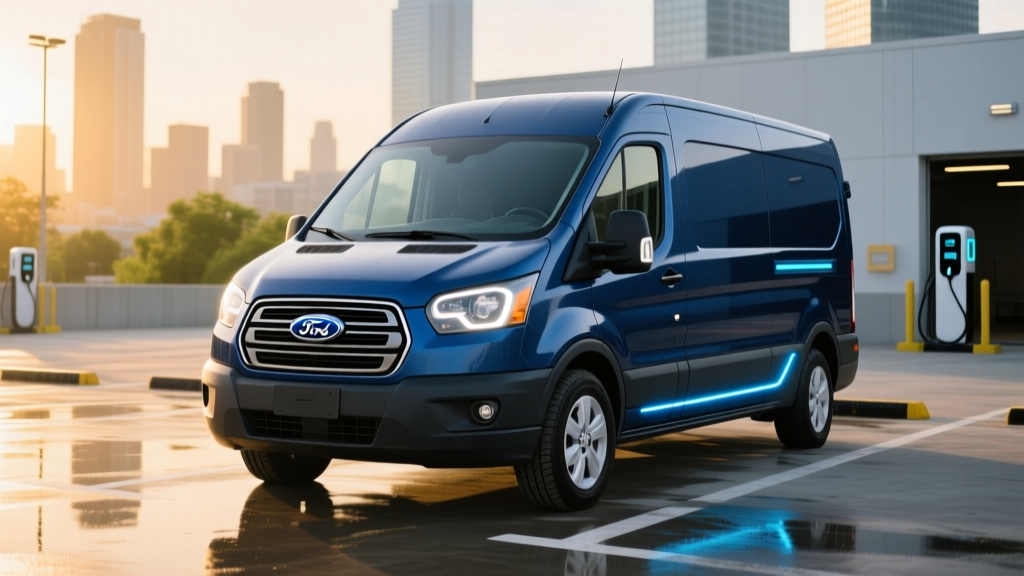
Quick Answer: The 2026 Ford E-Transit is a purpose-built electric cargo van with a 126-mile EPA-estimated range, a 68 kWh usable LFP battery, and DC fast charging up to 115 kW (10–80% in ~45 minutes). Starting around $55,000 MSRP before incentives, it targets urban delivery fleets and tradespeople with predictable daily routes under 100 miles. It costs more upfront than a gas Transit (~$46,000) but can save $3,000–$5,000 annually in fuel and maintenance for high-mileage commercial users. It is not a long-haul vehicle — it's a route-optimized work tool.
Who the Ford Transit Electric Is Actually For
The E-Transit isn't trying to replace every gas van on the road. Ford engineered it around a specific use case: last-mile delivery, urban service routes, and trade work where daily mileage is predictable and the vehicle returns to a depot or job site each night. Think Amazon Delivery Service Partners, florists, HVAC technicians, electricians, and municipal fleets.
If your typical workday involves 60–90 miles of stop-and-go urban driving with a return to base for overnight Level 2 charging, the E-Transit aligns almost perfectly with your operational pattern. If you regularly drive 200+ miles between job sites or operate in rural areas with sparse charging infrastructure, the gas-powered Transit remains the pragmatic choice.
Ford sells the E-Transit in three roof heights (low, medium, high) and three body lengths (regular, long, extended), plus a cutaway version for upfitting. Cargo volume peaks at 487.3 cubic feet in the high-roof extended model — essentially the same usable space as the equivalent gas Transit, because Ford placed the battery pack under the floor to preserve the cargo area.
E-Transit Range, Battery, and Charging Specs
| Specification | 2026 Ford E-Transit (T-350 High Roof) |
|---|---|
| EPA-Estimated Range | 126 miles (cargo van); varies by roof/length |
| Battery Chemistry | LFP (Lithium Iron Phosphate) |
| Usable Battery Capacity | 68 kWh |
| Motor Output | 266 hp (198 kW), 317 lb-ft torque |
| 0–60 mph | ~8.0 seconds (unladen) |
| Max DC Fast Charge Rate | 115 kW (peak) |
| 10–80% DC Fast Charge | ~45 minutes |
| Level 2 AC Charge Rate | 10.5 kW (onboard charger) |
| Level 2 Full Charge Time | ~8 hours (0–100%) |
| EPA Efficiency | ~2.0 kWh/mile (~1.0 MPGe combined equivalent) |
| Max Payload | ~3,880 lbs (low-roof cargo van) |
| Pro Power Onboard | Available 2.4 kW / 7.2 kW (120V/240V outlets) |
| Battery Warranty | 8 years / 100,000 miles |
| Base MSRP (T-350 Cargo Van) | ~$55,000 |
Real-World Range Reality: The 126-mile EPA figure applies to the cargo van with moderate load and ideal conditions. Expect 95–110 miles of real-world range in mixed urban/highway driving with a half-load. In cold weather (below 32°F), LFP batteries lose roughly 20–30% of usable range, dropping effective range to 75–95 miles. Highway driving at 70+ mph also cuts range significantly — the E-Transit's boxy aerodynamics punish efficiency at speed. Plan routes around 80–90 miles to maintain a safety buffer.
The choice of LFP (lithium iron phosphate) chemistry is deliberate for commercial use. LFP cells tolerate daily 100% charging without the accelerated degradation concerns of NMC chemistries, and they offer longer cycle life — critical for fleet vehicles that charge every night. The trade-off is lower energy density (hence the modest 126-mile range from a 68 kWh pack) and reduced cold-weather performance compared to NMC.
E-Transit vs. Gas Transit: Total Cost of Ownership
The purchase price gap is real, and fleet buyers need to run the math carefully. Here's a 5-year / 75,000-mile total cost of ownership comparison for a typical urban delivery operation (15,000 miles/year, mostly city driving):
| Cost Category | E-Transit (T-350) | Gas Transit (T-350 EcoBoost) |
|---|---|---|
| Base MSRP | $55,000 | $46,000 |
| Federal §30D Commercial Credit | Up to $7,500* | $0 |
| Effective Purchase Price | ~$47,500 | $46,000 |
| Fuel/Energy (75k mi, 5 yrs) | $4,500–$6,000 (electric) | $13,500–$16,500 (gas @ $3.50/gal, 14 MPG) |
| Maintenance (5 yrs) | $1,500–$2,500 | $4,000–$5,500 |
| Insurance (5 yrs) | $12,000–$15,000 | $10,000–$13,000 |
| Estimated Resale (5 yrs) | $18,000–$22,000 | $16,000–$20,000 |
| 5-Year Net TCO | $47,500–$58,000 | $57,500–$69,000 |
*Federal §30D commercial clean vehicle credit eligibility depends on battery sourcing, critical mineral requirements, and vehicle MSRP caps. Businesses should consult IRS guidance at irs.gov and a tax professional for specific eligibility. The commercial credit (§45W) has different rules than the consumer §30D credit and may offer broader applicability for fleet purchases.
The fuel savings are the headline: at $0.13/kWh (national average commercial rate) and 2.0 kWh/mile, electricity costs roughly $0.26/mile. A gas Transit at 14 MPG combined and $3.50/gallon costs $0.25/mile — but that's optimistic. Real-world urban gas Transit fuel economy often drops to 11–12 MPG under load, pushing cost to $0.29–$0.32/mile. The gap widens further in stop-and-go delivery routes where regenerative braking on the E-Transit recaptures energy that a gas van simply wastes as brake heat.
Maintenance savings are substantial and well-documented. The E-Transit eliminates oil changes, transmission fluid, spark plugs, and exhaust system repairs. Brake wear drops significantly thanks to regenerative braking — fleet operators report brake pad life extending 2–3x compared to gas equivalents.
Charging Infrastructure: What Fleet Buyers Must Plan
The E-Transit's viability hinges entirely on reliable charging access. Here's the honest breakdown of what's required:
Depot / Home Base Charging (Level 2)
Every E-Transit needs a dedicated Level 2 charging station. The 10.5 kW onboard charger means a full charge from empty takes roughly 8 hours — perfect for overnight turnaround. Budget for:
| Item | Cost Range |
|---|---|
| Level 2 EVSE (40–48A, hardwired) | $500–$1,200 per unit |
| Electrical panel upgrade (if needed, 200A service) | $2,000–$5,000 |
| Electrician labor (240V/50A circuit, conduit run) | $1,500–$4,000 per charger |
| Permits and inspection | $200–$800 |
| Total per charging stall | $2,200–$11,000 |
For a 5-van fleet, expect $15,000–$40,000 in total charging infrastructure investment, heavily dependent on existing electrical capacity. Commercial properties with 480V three-phase service can install multiple chargers more efficiently. Consult a licensed commercial electrician for site-specific quotes — panel capacity is the single biggest variable.
Public DC Fast Charging
The E-Transit supports DC fast charging at up to 115 kW via the NACS connector (Ford transitioned to NACS for the 2025+ model years, with CCS adapter compatibility for legacy infrastructure). At 115 kW peak, a 10–80% session takes approximately 45 minutes. However, the charge curve tapers significantly above 80% — expect a full 10–100% session to take closer to 65–70 minutes.
For fleet operations, DC fast charging should be a contingency, not a daily strategy. Public charging costs $0.30–$0.48/kWh at commercial DC stations, which erases most of the fuel-cost advantage over gas. Use it for mid-day top-ups on unusually long route days.
Pro Power Onboard: The E-Transit's Hidden Advantage
One feature that distinguishes the E-Transit from the gas version is available Pro Power Onboard — a built-in power export system that turns the van's 68 kWh battery into a mobile generator. Available in 2.4 kW or 7.2 kW configurations, it provides 120V and 240V outlets in the cargo area and at the rear bumper.
For tradespeople, this eliminates the need for a separate portable generator. A 7.2 kW Pro Power system can simultaneously run a chop saw, job-site lights, battery chargers for cordless tools, and a small air compressor — all without engine noise, exhaust fumes, or fuel runs. An HVAC technician can power diagnostic equipment at a residential job site without idling in the driveway. A caterer can run warming equipment at an event venue.
At 7.2 kW continuous output, you can run most job-site tools for a full workday and still have enough battery to drive 50+ miles home. Ford estimates that running Pro Power at 2.4 kW for 8 hours consumes roughly 19 kWh — about 28% of the battery. Plan accordingly.
Common Misconceptions About the E-Transit
| Myth | Fact |
|---|---|
| "126 miles of range isn't enough for any real business." | The average urban delivery route covers 60–90 miles/day. The EPA data and Ford's fleet telematics show ~75% of commercial van routes fall within this range. It's purpose-built, not range-limited. |
| "Electric vans can't handle heavy payloads." | The E-Transit's max payload is ~3,880 lbs (low-roof), comparable to many gas Transit configurations. Cargo volume is identical because the battery sits under the floor. |
| "LFP batteries degrade quickly." | LFP chemistry typically offers 3,000+ full charge cycles before reaching 80% capacity. At 15,000 miles/year, that's well over 300,000 miles before meaningful degradation. Ford's 8-year/100,000-mile battery warranty backs this up. |
| "Charging infrastructure is too expensive to install." | A single Level 2 charger costs $2,200–$5,000 installed in most commercial settings with adequate panel capacity. Federal and state incentives (IRA §30C alternative fuel infrastructure credit, up to $100,000 per item for businesses) can offset 30% of installation costs. |
| "It's slower and less capable than a gas van." | 266 hp and 317 lb-ft of instant torque make the E-Transit quicker off the line than the base 3.5L V6 gas Transit (275 hp but less low-end torque). The single-speed transmission eliminates shift lag in stop-and-go traffic. |
Fleet Decision Framework: Should You Buy the E-Transit?
Choose the E-Transit if:
- Your daily routes are under 100 miles with predictable patterns
- Vehicles return to a depot or fixed location nightly for charging
- You operate primarily in urban/suburban areas with stop-and-go driving
- You can install Level 2 charging at your base of operations
- You value Pro Power Onboard for job-site power export
- Your fleet qualifies for federal/state commercial EV incentives
- You plan to keep vehicles 5+ years to recoup the upfront premium through fuel/maintenance savings
Stick with the gas Transit if:
- Your daily mileage regularly exceeds 150 miles
- You operate in rural areas or regions with extreme cold (sustained below 10°F)
- You cannot install charging infrastructure at your base
- Your routes are highly variable and unpredictable day-to-day
- You need towing capacity (E-Transit is not rated for significant towing; gas Transit tows up to 7,500 lbs)
- You plan to replace vehicles within 3 years (insufficient time to recoup cost premium)
For mixed fleets, a practical approach is deploying E-Transits on dedicated short-haul urban routes while keeping gas Transits for long-haul, rural, or heavy-towing assignments. Many fleet operators find a 60/40 or 70/30 EV-to-gas split optimizes both cost and operational flexibility.
Frequently Asked Questions
Does the E-Transit qualify for the $7,500 federal tax credit?
It depends on how you purchase and your business structure. For commercial fleet purchases, the §45W Clean Vehicle Credit (up to $7,500 for vehicles under 14,000 lbs GVWR) applies to businesses and has different eligibility rules than the consumer §30D credit — notably, it is not subject to the same buyer income caps or MSRP limits, though battery sourcing and critical mineral requirements still apply. Consult the IRS commercial vehicle credit guidelines and a qualified tax professional to confirm eligibility for your specific situation.
How does cold weather affect the E-Transit's range?
LFP batteries are more susceptible to cold-weather range loss than NMC chemistry. In sustained temperatures below 32°F, expect a 20–30% range reduction — dropping from 126 EPA miles to roughly 88–100 miles. Below 10°F, losses can reach 35–40%. Ford's thermal management system includes battery preconditioning, which mitigates some loss if you activate it before departure while still plugged in. For fleets in northern climates (Minnesota, Maine, Alaska), plan winter routes around 70–80 miles maximum.
Can I charge the E-Transit on a standard 120V outlet?
Technically yes, via Level 1 charging at roughly 1.3 kW — but this adds only about 2–3 miles of range per hour. A full charge would take 50+ hours, which is operationally useless for a daily-driven commercial vehicle. Level 2 (240V, 10.5 kW) is the practical minimum, delivering a full overnight charge in about 8 hours.
What is the E-Transit's maintenance schedule?
Ford recommends service every 15,000 miles or 12 months, primarily covering tire rotation, cabin air filter, brake inspection, and coolant level checks. There are no oil changes, transmission fluid services, spark plug replacements, or emissions inspections. Fleet operators report 40–60% lower scheduled maintenance costs compared to gas Transits over a 5-year ownership period.
How does the E-Transit handle on the highway?
The E-Transit is stable at highway speeds, with a low center of gravity from the under-floor battery pack reducing body roll compared to the gas version. However, highway driving at 70+ mph is where range suffers most — the boxy aerodynamic profile and heavy curb weight (~6,000+ lbs) push consumption above 2.5 kWh/mile at sustained highway speed. This van is optimized for 25–55 mph urban routes, not interstate cruising.
Is the Ford E-Transit available with AWD?
No. The 2026 E-Transit is rear-wheel drive only. If your operation requires all-wheel drive for snow, mud, or unpaved job sites, the gas Transit AWD variant remains the only option in the Transit lineup.
Sources: EPA Fuel Economy, Ford Commercial Vehicles, IRS Clean Vehicle Credits.