Quick Verdict: The Tesla Model 3 in 2026
The Tesla Model 3 remains the benchmark compact electric sedan for buyers who prioritize driving dynamics, charging infrastructure access, and over-the-air software evolution. For the 2026 model year, Tesla continues to refine the "Highland" refresh introduced in late 2023, offering two primary trims — the Long Range AWD and the Performance AWD — alongside periodic Standard Range RWD availability. The Model 3's efficiency, Supercharger network access, and the increasingly discussed Tesla driving score (a metric tied to Full Self-Driving usage and insurance) make it a compelling, if polarizing, choice in a segment now crowded with the Hyundai Ioniq 6, BMW i4, and Polestar 2.
This review covers real-world range expectations, charging speeds, the FSD driving score system, pricing after federal tax credits, and whether the Model 3 still earns its spot against newer rivals.
Range, Battery, and Efficiency
The 2026 Tesla Model 3 Long Range AWD carries an EPA-estimated range of 341 miles on a full charge, powered by a 79 kWh usable battery pack using NMC (nickel-manganese-cobalt) chemistry. The Performance trim drops slightly to 315 miles EPA due to stickier tires and more aggressive tuning. Standard Range RWD variants (when available) use a ~60 kWh LFP (lithium iron phosphate) pack rated around 272 miles EPA.
EPA Sticker: 341 miles (Long Range AWD)
Highway (70 mph, moderate climate): ~285–305 miles. Tesla's aerodynamic efficiency (drag coefficient 0.219) helps on the highway, but sustained high speeds still consume 10–15% more than the EPA combined cycle.
Cold Weather (below 32°F): ~240–270 miles. The Model 3's heat pump is among the best in the industry, but battery chemistry and cabin heating still exact a 20–25% penalty in deep winter conditions.
City/Commuting: ~320–340 miles. Regenerative braking recovers significant energy in stop-and-go traffic, often exceeding EPA city estimates.
Efficiency is rated at 132 MPGe combined (Long Range AWD), translating to roughly 25 kWh per 100 miles — one of the most efficient all-wheel-drive EVs on the market. For context, the Hyundai Ioniq 6 SE Long Range achieves 140 MPGe but with RWD only.
| Spec | Long Range AWD | Performance AWD |
|---|---|---|
| EPA Range | 341 miles | 315 miles |
| Battery (usable) | 79 kWh (NMC) | 79 kWh (NMC) |
| Efficiency | 132 MPGe / 25 kWh/100mi | 121 MPGe / 28 kWh/100mi |
| 0–60 mph | 4.2 seconds | 2.9 seconds |
| Horsepower | ~384 hp | ~510 hp |
| Drivetrain | Dual-motor AWD | Dual-motor AWD |
| Top Speed | 125 mph | 163 mph |
| Cargo Volume | 23 cu ft (trunk + frunk) | 23 cu ft (trunk + frunk) |
| Rear Legroom | 35.2 inches | 35.2 inches |
| Base MSRP | $47,740 | $54,990 |
Charging: DC Fast, Level 2, and the Supercharger Advantage
The Model 3 Long Range and Performance support a peak DC fast-charge rate of 250 kW on V3 Superchargers (and compatible CCS/NACS stations). In practice, the charge curve peaks around 250 kW up to approximately 40% state of charge, then tapers progressively. A 10–80% charge takes approximately 25–28 minutes under optimal battery preconditioning.
| Charging Level | Power / Rate | Speed |
|---|---|---|
| Level 1 (120V household) | ~1.4 kW | ~4 miles per hour |
| Level 2 (240V home, 48A) | 11.5 kW | ~44 miles per hour |
| DC Fast Charge (V3 Supercharger) | Peak 250 kW | 10–80% in ~25–28 min |
| DC Fast Charge (V4 Supercharger) | Peak 250 kW (current Model 3 limit) | 10–80% in ~25–28 min |
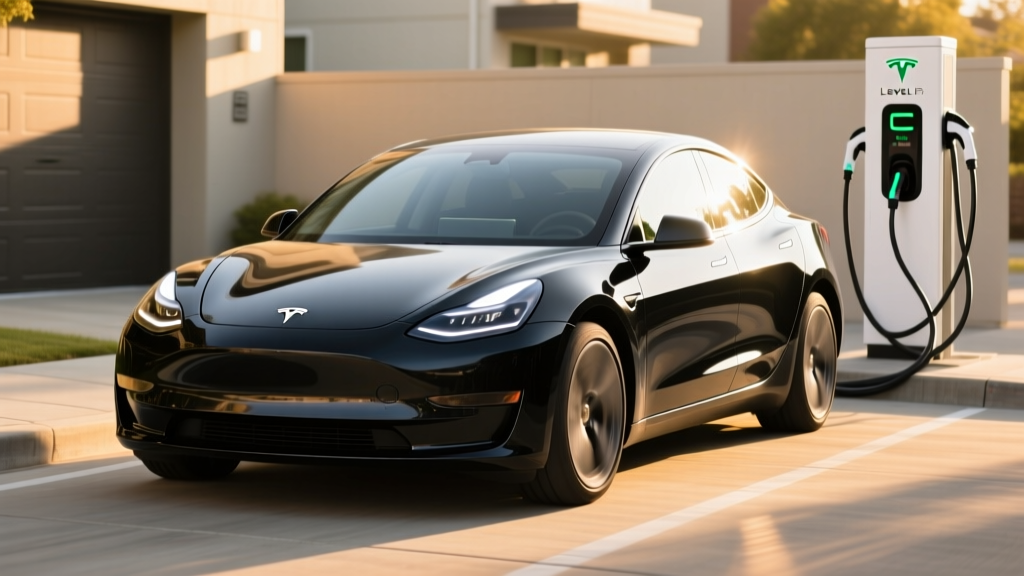
For home charging, Tesla's Wall Connector at 48 amps delivers 11.5 kW, adding roughly 44 miles of range per hour — enough to fully replenish the Long Range battery in about 7 hours overnight. The onboard charger is limited to 11.5 kW (48A), so installing a 60A or 80A circuit provides no additional benefit for the Model 3 specifically.
Preconditioning is essential for achieving peak charge rates. Navigate to a Supercharger using the built-in navigation, and the car will warm the battery to optimal temperature during the final 10–20 miles of approach. Arriving without preconditioning (e.g., at a non-navigated CCS station via adapter) can add 5–8 minutes to a 10–80% session in cool weather.
The Model 3 uses the NACS (North American Charging Standard) connector natively — the same plug now adopted by Ford, GM, Rivian, and most major automakers through 2025. This grants access to Tesla's Supercharger network, which as of early 2026 includes over 6,500 V3/V4 stations across North America with industry-leading uptime. For non-Tesla CCS chargers (Electrify America, EVgo), a NACS-to-CCS adapter is included with the vehicle.
Performance and Driving Dynamics
The Long Range AWD delivers a 0–60 mph time of 4.2 seconds with approximately 384 combined horsepower from its dual-motor setup. The Performance trim drops that to 2.9 seconds with ~510 hp, adaptive dampers, and a track-oriented chassis tune.
Both trims benefit from Tesla's low center of gravity (battery pack mounted under the floor) and precise steering calibration. The Model 3's ride quality improved substantially with the Highland refresh — new suspension bushings, acoustic glass, and improved sound deadening closed the gap with the BMW i4 in refinement. That said, the Performance trim's 19-inch wheels and low-profile tires transmit more road imperfection than some buyers expect in a $55,000 sedan.
The Tesla Driving Score: What It Is and Why It Matters
The Tesla driving score is a metric generated by Tesla's Full Self-Driving (Supervised) software, rated on a scale of 0 to 100. It evaluates driver behavior across several categories:
- Forward collision warnings: How frequently the system detects imminent front-impact risk
- Hard braking: Sudden deceleration events beyond normal regen or friction braking
- Aggressive turning: Lateral G-force events during cornering
- Forced Autopilot disengagements: Instances where the driver ignores warnings to keep hands on the wheel, requiring the system to disengage and pull over
- Time in FSD mode: Percentage of drive time using FSD vs. manual driving
The driving score is primarily relevant for two reasons:
- Tesla Insurance: In states where Tesla offers its own insurance product, the driving score directly influences monthly premiums. Drivers maintaining scores above 90 may see premiums 20–30% lower than conventional insurers, while scores below 70 can result in higher rates than market average.
- FSD Beta/Supervised access: Tesla has historically gated access to the latest FSD versions behind a minimum driving score threshold (typically 80+ over a rolling evaluation period). Drivers with lower scores may need to complete additional supervised miles before receiving updates.
Tesla's Full Self-Driving (Supervised) is a SAE Level 2 driver-assistance system. The driver must remain fully engaged, keep hands on the wheel (or demonstrate attentiveness via the cabin camera), and be prepared to take over at any moment. It is not a Level 4 autonomous system like Waymo's driverless robotaxi service. The "Supervised" designation, added by Tesla in 2024, reflects this legal and technical reality.
In real-world use, maintaining a high Tesla driving score requires deliberate habits: smooth acceleration and braking, consistent use of turn signals (the system monitors this), and avoiding situations that trigger forward collision warnings (e.g., following too closely in heavy traffic). Many owners report scores in the 85–95 range during routine commuting, with scores dipping during aggressive highway merging or unfamiliar urban driving.
Pricing, Tax Credits, and Ownership Costs
As of the 2026 model year, the Tesla Model 3 is priced as follows:
- Long Range AWD: $47,740 MSRP (before destination)
- Performance AWD: $54,990 MSRP (before destination)
| Trim | MSRP | §30D Credit (if eligible) | Effective Price |
|---|---|---|---|
| Long Range AWD | $47,740 | Up to $7,500 | ~$40,240 |
| Performance AWD | $54,990 | Up to $7,500 | ~$47,490 |
Federal tax credit eligibility under IRS §30D is subject to several requirements that buyers must verify before assuming the full $7,500:
- MSRP Cap: The vehicle's base MSRP must not exceed $55,000 for sedans. The Long Range qualifies; the Performance at $54,990 is right at the threshold — any added options that push the vehicle price above $55,000 may disqualify it.
- Buyer Income Cap: Modified adjusted gross income (MAGI) must not exceed $150,000 (single), $225,000 (head of household), or $300,000 (married filing jointly).
- Battery Sourcing: The vehicle must meet critical minerals and battery component requirements that phase in progressively through 2032. As of 2026, Tesla's US-built battery packs and cathode supply chains (primarily from Nevada and partner facilities) are generally compliant, but buyers should verify the specific VIN's eligibility at fueleconomy.gov before purchase.
- Point-of-Sale Transfer: As of 2024, buyers can transfer the credit to the dealer at the point of sale, effectively reducing the purchase price by $7,500 at checkout rather than waiting for a tax refund. This requires the dealer to be registered with the IRS Energy Credits Online system.
For a comprehensive breakdown of state and local incentives (which vary significantly by jurisdiction — California's CVRP, Colorado's innovative motor vehicle credits, and others), consult your state's energy office or a qualified tax professional.
Interior, Tech, and Practicality
The Model 3's interior is defined by minimalism: a single 15.4-inch center touchscreen handles infotainment, climate, navigation, and vehicle settings. There is no traditional instrument cluster — speed and range are displayed in the upper corner of the main screen. The Highland refresh added ventilated front seats, ambient lighting, rear-seat ventilation controls, and a rear 8-inch touchscreen for passengers.
Cargo space totals 23 cubic feet (trunk + front trunk/frunk), competitive with the BMW i4 (16.6 cu ft trunk only) but less than the Hyundai Ioniq 6 (12.3 cu ft trunk — its sloping roofline sacrifices utility). Rear legroom measures 35.2 inches, adequate for adults under 6 feet but tighter than a midsize sedan like the Tesla Model S or Hyundai Ioniq 5.
Standout tech features include:
- Over-the-air updates: Tesla regularly ships software updates that add features (new games, UI refinements, efficiency improvements) without dealer visits
- Sentry Mode: 360-degree camera recording when the car is parked, with cloud-stored incident clips
- Dog Mode / Camp Mode: Climate control presets for leaving pets in the car or sleeping in the vehicle overnight
- Phone-as-key: Bluetooth-based passive entry, eliminating the need for a fob
Notable drawbacks: the lack of physical buttons (even for glovebox release or mirror adjustment) frustrates some drivers. The glass roof, while beautiful, can create cabin heat in direct summer sun despite UV/IR tinting. And Tesla's build quality, while improved, still shows occasional panel-gap inconsistencies that luxury-brand competitors avoid.
Warranty and Long-Term Ownership
Tesla provides the following warranty coverage for the 2026 Model 3:
- Basic Vehicle: 4 years / 50,000 miles
- Battery and Drive Unit: 8 years / 120,000 miles (Long Range and Performance) with a minimum 70% capacity retention guarantee over the warranty period
Battery degradation data from Tesla's 2024 Impact Report indicates that Model 3/Y packs retain approximately 85% of original capacity after 150,000 miles — well above the warranty threshold. NMC chemistry in the Long Range/Performance trims shows slightly faster initial degradation (2–3% in the first year) compared to LFP packs in the Standard Range, but both chemistries stabilize by year 3–4.
Insurance costs for the Model 3 vary widely. Tesla's own insurance product (available in most states) uses the real-time driving score to set premiums, with safe drivers reporting monthly rates of $100–$140 for the Long Range. Conventional insurers often quote higher — $160–$220/month — due to Tesla's higher repair costs after collision (specialized aluminum repair, recalibration of cameras/sensors).
Pros and Cons
- Best-in-class Supercharger network access (6,500+ stations, high uptime)
- Industry-leading efficiency (132 MPGe combined for AWD)
- Strong real-world range (285–305 mi highway)
- 250 kW DC fast charging with reliable preconditioning
- Continuous OTA software improvements
- Competitive pricing after §30D tax credit (~$40K for Long Range)
- No physical buttons — all controls via touchscreen
- Build quality still inconsistent vs. BMW, Hyundai
- Performance trim's firm ride may not suit all buyers
- FSD requires $8,000 one-time purchase or $99/month subscription
- Insurance can be expensive without Tesla's driving-score-based product
- Rear visibility compromised by sloping rear glass and no rear wiper
Who Should Buy the 2026 Tesla Model 3?
The Model 3 is best suited for:
- Tech-forward commuters who value OTA updates, phone-as-key, and FSD for highway driving (with supervision)
- Road-trip enthusiasts who rely on the Supercharger network for cross-country travel — no other EV ecosystem matches its coverage and reliability in 2026
- Efficiency-focused buyers who want maximum miles per kWh without sacrificing all-wheel-drive capability
- Drivers in Tesla Insurance states who maintain high driving scores and can benefit from usage-based premiums
Consider alternatives if you prioritize: traditional luxury build quality (BMW i4), maximum rear-seat space (Hyundai Ioniq 5), or a more conventional interior with physical controls (Polestar 2).
Frequently Asked Questions
What is the real-world range of the 2026 Tesla Model 3 Long Range?
The EPA rates it at 341 miles combined. In real-world highway driving at 70 mph in moderate temperatures, expect 285–305 miles. In cold weather (below 32°F), plan for 240–270 miles. City commuting with regenerative braking can approach or exceed the EPA estimate.
How fast does the Model 3 charge at home and on the road?
At home on a 240V Level 2 charger (48A), the Model 3 charges at 11.5 kW, adding ~44 miles of range per hour — a full charge takes about 7 hours. On a V3 Supercharger (250 kW DC), a 10–80% charge takes approximately 25–28 minutes with proper battery preconditioning.
Does the 2026 Tesla Model 3 qualify for the $7,500 federal tax credit?
The Long Range AWD at $47,740 MSRP generally qualifies, assuming the buyer meets income caps ($150K single / $300K joint) and the vehicle's battery sourcing meets 2026 critical-mineral requirements (most US-built Model 3s do). The Performance at $54,990 is at the sedan MSRP cap — added options may push it over $55,000 and disqualify it. Always verify eligibility at fueleconomy.gov and consult a tax professional.
How does the Tesla driving score affect insurance costs?
In states where Tesla offers its own insurance, the driving score (0–100) directly influences monthly premiums. Scores above 90 typically result in premiums 20–30% below market average, while scores below 70 may increase costs. The score evaluates hard braking, aggressive turning, forward collision warnings, and forced Autopilot disengagements.
Is the Tesla Model 3 worth buying vs. the Hyundai Ioniq 6 or BMW i4?
Choose the Model 3 if Supercharger access, efficiency, and software features are top priorities. The Ioniq 6 offers slightly better efficiency (140 MPGe RWD) and a more spacious rear seat, but its charging network (Electrify America) is less reliable. The BMW i4 provides superior build quality and a traditional luxury interior, but at a $10,000+ premium and with less range (307 mi EPA for the eDrive40). For most buyers in 2026, the Model 3's combination of range, charging speed, and price-after-credit remains hard to beat.
What is the battery warranty, and how long will the Model 3 battery last?
Tesla warranties the battery for 8 years / 120,000 miles with a minimum 70% capacity retention guarantee. Real-world data from Tesla's fleet shows approximately 85% retention at 150,000 miles, suggesting the pack will outlast the warranty period with meaningful range remaining. Battery replacement (if needed out of warranty) currently costs $12,000–$16,000 at Tesla service centers, though prices are expected to decline as the supply of refurbished packs grows.