Quick Verdict: The E-Transit Is a Route-Specific Tool, Not a Universal Van
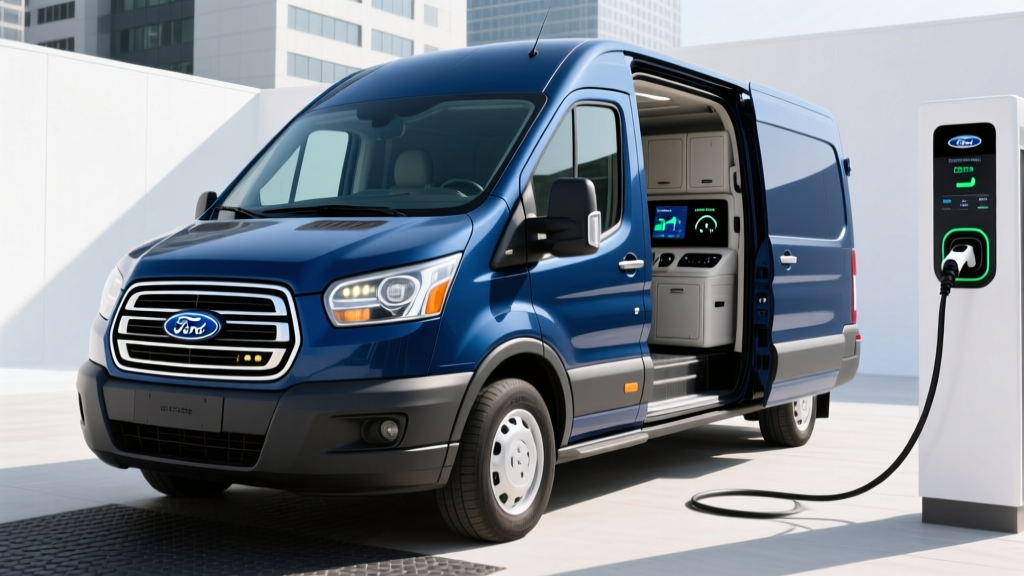
The 2026 Ford E-Transit is not trying to be a long-haul electric vehicle. It's a purpose-built, last-mile commercial cargo van designed for predictable daily routes under 100 miles. With a 126-mile EPA-estimated range (low-roof, cutaway variant), a 68 kWh usable lithium-ion NMC battery, and DC fast charging peaking at 115 kW, the E-Transit excels when fleet managers match the van to its operational envelope. Ask it to do 200-mile intercity runs in January, and you'll be stranded. Keep it on urban delivery loops with overnight depot charging, and it delivers lower per-mile operating costs than any gas-powered Transit variant Ford sells.
EPA-estimated range: 126 miles (low-roof cargo van, 2026 model year per fueleconomy.gov).
Real-world expectation: 90–110 miles with a full payload on mixed city/highway routes. Expect 70–85 miles in sub-freezing temperatures with HVAC running. The E-Transit's range is highly sensitive to cargo weight, speed, and ambient temperature — route planning must account for a 25–35% buffer.
2026 Ford E-Transit Specifications at a Glance
| Specification | Value |
|---|---|
| EPA-estimated range | 126 mi (low-roof cargo) |
| Battery capacity (usable) | 68 kWh |
| Battery chemistry | NMC (nickel manganese cobalt) |
| Max DC fast charge rate | 115 kW peak |
| 10–80% DC fast charge time | ~45 minutes |
| Level 2 AC charge rate | 10.5 kW (48A) |
| Level 2 full charge time | ~8 hours (0–100%) |
| Motor output | 266 hp (198 kW) |
| Torque | 317 lb-ft |
| Drivetrain | Rear-wheel drive (single motor) |
| 0–60 mph (unladen) | ~8.0 seconds (est.) |
| Top speed | ~75 mph (electronically limited) |
| EPA efficiency | 2.0 kWh/mi (~2.0–2.2 kWh/mi loaded) |
| MPGe (combined) | ~108 MPGe (EPA est.) |
| Max payload capacity | Up to 3,880 lbs (cutaway); ~3,330 lbs (cargo van low roof) |
| Cargo volume (low roof) | 246.7 cu ft |
| Cargo volume (high roof, extended) | 487.3 cu ft |
| Wheelbase options | 130 in (regular) / 148 in (long) |
| Battery/powertrain warranty | 8 years / 100,000 miles |
| Bumper-to-bumper warranty | 3 years / 36,000 miles |
| Starting MSRP (T-150 cargo, low roof) | $46,895 |
| As-tested range (T-350 high roof, extended) | $55,000–$62,000+ |
Range Reality: Why 126 Miles Is Enough (If You Plan Right)
The headline number — 126 miles EPA — triggers range anxiety in passenger EV buyers accustomed to 250+ mile stickers. But the E-Transit operates in a fundamentally different context. According to Ford's fleet data, the average commercial van in the U.S. drives 74 miles per day. For urban delivery, tradesperson, and municipal fleets, the E-Transit's range covers a full shift with margin.
The critical variables that compress real-world range:
- Payload weight: A fully loaded E-Transit (3,000+ lbs of cargo) can reduce range by 15–25% versus the unladen EPA test cycle.
- Highway speed: Aerodynamic drag on a boxy cargo van is brutal above 55 mph. Sustained 70-mph driving drops efficiency to roughly 2.5 kWh/mi, cutting effective range to under 90 miles.
- Cold weather: At 20°F, NMC battery internal resistance increases and cabin/climate demands draw additional power. Expect a 30–40% range reduction — meaning a worst-case winter range of roughly 75–85 miles with a moderate load.
- Route topography: Hilly urban routes (San Francisco, Pittsburgh) consume significantly more energy than flat suburban corridors, though regenerative braking recovers some energy on descents.
Bottom line: If your daily route exceeds 90 miles round-trip with payload, or if you operate in extreme cold without depot charging mid-route, the E-Transit is a poor fit. If your route is 40–80 miles with predictable stops and overnight charging, the math works.
Charging Speed: Depot Charging Is the Primary Use Case
| Charging Level | Power / Rate | Time | Use Case |
|---|---|---|---|
| Level 1 (120V, 12A) | ~1.4 kW | ~48+ hours (0–100%) | Emergency/top-up only |
| Level 2 (240V, 48A) | 10.5 kW | ~8 hours (0–100%) | Overnight depot charging |
| DC Fast Charge (CCS) | 115 kW peak | ~45 min (10–80%) | Mid-day top-up, opportunity charging |
The E-Transit's 115 kW peak DC fast-charge rate is modest by 2026 passenger EV standards (where 200–350 kW is common), but it's functional for commercial operations. On a CCS-equipped public charger or a fleet depot DC unit, you'll add roughly 45 miles of range in 15 minutes during the peak portion of the charge curve. The charge rate tapers noticeably above 70% state of charge — a typical 10–80% session takes approximately 45 minutes.
For most fleet operators, Level 2 overnight charging is the primary refueling method. At 10.5 kW, a depleted 68 kWh battery fully replenishes in about 8 hours — perfectly aligned with an overnight shift gap. Fleet managers should budget for Level 2 infrastructure: commercial-grade 48-amp chargers (e.g., ChargePoint CT4000 or EV Box BusinessLine) typically cost $3,000–$6,000 per port installed, plus potential electrical panel upgrades for multi-van depots.
The E-Transit uses the CCS1 connector for DC fast charging and the J1772 connector for Level 2 AC. Ford has not announced a NACS adapter program for the E-Transit as of early 2026, so Tesla Supercharger access is not available — a limitation worth noting for fleets in areas where Electrify America or EVgo coverage is sparse.
Performance and Drivetrain: Adequate for the Mission
The E-Transit's single rear-mounted electric motor produces 266 horsepower and 317 lb-ft of torque. That's roughly comparable to Ford's 3.5L V6 gas Transit, but the instant torque delivery makes the E-Transit feel more responsive from stops — particularly useful in stop-and-go urban delivery routes. The 0–60 mph time of approximately 8 seconds (unladen) is irrelevant in commercial use; what matters is low-speed acceleration with payload, which is strong thanks to electric motor characteristics.
Key drivetrain notes:
- RWD only: No all-wheel-drive option is available. Snow-belt fleets should spec winter tires and evaluate route traction carefully.
- Top speed limited to ~75 mph: Ford electronically governs the E-Transit to preserve range and align with commercial fleet speed policies. This makes it unsuitable for highway-dominant routes where maintaining 75+ mph with traffic flow is expected.
- Regenerative braking: The E-Transit offers selectable regen levels, but does not offer true one-pedal driving in the way passenger EVs do. Drivers accustomed to gas Transit braking behavior will find the transition easy.
Cargo Configurations, Dimensions, and Upfitting
The E-Transit mirrors the gas-powered Transit's body-style versatility, which is a major selling point for fleet standardization:
- Cargo van: Three roof heights (low, medium, high) and two wheelbase lengths (130 in, 148 in). Cargo volume ranges from 246.7 cu ft (low roof, regular wheelbase) to 487.3 cu ft (high roof, extended wheelbase).
- Cutaway: For upfitting with box bodies, flatbeds, or utility beds. Max payload up to 3,880 lbs.
- Chassis cab: For custom commercial bodies (shuttle, service body, etc.).
The battery pack is mounted under the floor, preserving the gas Transit's cargo dimensions and load height. This is a critical advantage over competitors who sacrifice cargo space for battery placement. Floor clearance and between-the-wheel-wells width remain identical to the ICE Transit — existing shelving and rack systems transfer directly.
Pro Power Onboard (available 2.0 kW or 7.2 kW) turns the E-Transit into a mobile generator for job-site power tools, a feature tradespeople value highly. At 7.2 kW, you can run a chop saw, compressor, and job-site lights simultaneously without a separate generator.
Pricing, Trim Levels, and Federal Tax Credit Eligibility
| Trim / Configuration | Base MSRP | Est. After §30D Credit* |
|---|---|---|
| T-150 Cargo Van (Low Roof, 130" WB) | $46,895 | ~$39,395 |
| T-250 Cargo Van (Medium Roof, 148" WB) | $49,995 | ~$42,495 |
| T-350 Cargo Van (High Roof, 148" WB) | $53,195 | ~$45,695 |
| T-350 Cutaway (148" WB) | $51,495 | ~$43,995 |
| T-350 HD Cutaway (148" WB, DRW) | $54,295 | ~$46,795 |
*Federal tax credit estimates assume full $7,500 eligibility under IRS §30D. Eligibility depends on MSRP caps (commercial vans: $80,000 cap), buyer/fleet tax liability, battery critical-mineral and component sourcing requirements, and applicable income limits for individual purchasers. Commercial fleet buyers may qualify under §45W (commercial clean vehicle credit) instead of §30D. Always verify current-year eligibility with a tax professional and reference IRS.gov clean vehicle credit guidance.
The E-Transit's MSRP falls comfortably under the $80,000 cap for vans/pickups/SUVs under §30D. For individual owner-operators (e.g., independent delivery contractors), the $7,500 point-of-sale transfer can bring the effective purchase price below $40,000 for a base T-150 — competitive with a similarly equipped gas Transit once you account for fuel and maintenance savings.
Total cost of ownership advantage: Ford estimates the E-Transit saves fleet operators approximately $1,700 per year in fuel costs versus a gas Transit (based on 15,000 miles/year and national average electricity vs. gasoline pricing). Maintenance savings are significant: no oil changes, no transmission fluid, reduced brake wear from regen. Over a 5-year/75,000-mile ownership cycle, TCO savings of $10,000–$15,000 are realistic for high-utilization fleets.
Technology, Driver Assists, and Daily Usability
The 2026 E-Transit features Ford's SYNC 4 infotainment system on a 12-inch touchscreen with wireless Apple CarPlay and Android Auto, cloud-connected navigation, and over-the-air update capability. For fleet managers, the embedded FordPass Connect modem enables telematics: real-time vehicle location, state of charge monitoring, geofencing alerts, and driver behavior scoring.
Ford Co-Pilot360 is standard, including:
- Pre-Collision Assist with Automatic Emergency Braking (AEB)
- Lane-Keeping System
- Rear View Camera
- Auto High-Beam Headlamps
- Blind Spot Information System (BLIS) with trailer coverage (optional)
Adaptive cruise control with stop-and-go is available — useful for highway portions of a route, though the driver must remain fully engaged at all times (this is a SAE Level 2 driver-assistance system, not autonomous driving).
Notable drawbacks:
- No NACS/Tesla Supercharger compatibility (limits public fast-charging options in some regions)
- Modest DC fast-charge speed (115 kW) means longer mid-day stops than passenger EVs
- Cabin materials are hard plastics throughout — durable, but utilitarian
- No crew-cab or passenger-wagon EV variant available in the U.S. market
- Range drops sharply with heavy payload at highway speed — route planning is non-negotiable
- Low operating cost vs. gas Transit (~$1,700/yr fuel savings)
- Identical cargo dimensions to ICE Transit — upfitting transfers directly
- Pro Power Onboard (up to 7.2 kW) eliminates job-site generator
- Strong instant torque for loaded stop-and-go driving
- Eligible for $7,500 federal tax credit (§30D) and many state incentives
- 8-year/100,000-mile battery warranty
- Ford dealer/service network is the largest in the U.S.
- 126-mile EPA range limits use to short, predictable routes
- No AWD option — winter traction depends entirely on tires
- 115 kW peak DC charge rate is slow by 2026 standards
- No NACS adapter — Supercharger network access unavailable
- 75-mph top-speed limiter restricts highway-dominant routes
- Upfront MSRP is $10,000–$15,000 more than equivalent gas Transit
- Cold-weather range loss (30–40%) further constrains winter operations
Who Should Buy the 2026 Ford E-Transit?
Buy the E-Transit if:
- Your daily route is under 90 miles round-trip with predictable stops
- You have depot or home-base overnight Level 2 charging
- You operate in urban or suburban environments (sub-55 mph average speed)
- You want to reduce fleet operating costs and meet sustainability mandates
- You value Pro Power Onboard for job-site tool power
- You're an owner-operator delivery contractor who can use the §30D credit
Look elsewhere if:
- Your routes regularly exceed 120 miles per day
- You need highway-dominant operation at 70+ mph
- You operate in extreme cold without mid-route charging access
- You need AWD for unplowed rural routes or mountain passes
- You require NACS/Supercharger access for public fast charging
The closest competitor is the Mercedes-Benz eSprinter (2026: 200-mile EPA range with the larger battery option, ~$58,000+ MSRP), which offers more range but at a significantly higher price. For most last-mile delivery applications, the E-Transit's lower entry price and Ford's dealer network make it the pragmatic choice — provided the route math works.
Frequently Asked Questions
What is the real-world range of the Ford E-Transit?
The EPA rates the 2026 E-Transit low-roof cargo van at 126 miles. In real-world use with a typical commercial payload (1,500–2,500 lbs), expect 90–110 miles on mixed city/highway routes. In cold weather (below 32°F), plan for 70–85 miles. Route planning with a 25–35% buffer below the EPA figure is essential for reliable daily operations.
How fast does the E-Transit charge at home and on the road?
On a 48-amp Level 2 home or depot charger (240V), the E-Transit charges at 10.5 kW, fully replenishing the 68 kWh battery in about 8 hours — ideal for overnight turnaround. On a DC fast charger (CCS connector), it peaks at 115 kW, reaching 10–80% in approximately 45 minutes. Level 1 (standard 120V outlet) adds roughly 2 miles per hour and is only suitable for emergency top-ups.
How much does the E-Transit cost after the federal tax credit?
The base T-150 cargo van starts at $46,895 MSRP. With the full $7,500 federal §30D clean vehicle credit (available as a point-of-sale transfer to the dealer), the effective price drops to approximately $39,395. Eligibility depends on battery sourcing requirements, buyer income limits (for individual purchasers), and tax liability. Commercial fleet buyers may qualify under §45W instead. Consult a tax professional and check current IRS guidance before purchasing.
Does the E-Transit qualify for the federal EV tax credit?
As of early 2026, the E-Transit qualifies for up to $7,500 under §30D for eligible individual buyers, or up to $7,500 under §45W for commercial fleet purchasers. The van's MSRP is well under the $80,000 cap for vans. However, the credit's battery-component and critical-mineral sourcing requirements are strict and subject to change. Verify current eligibility at IRS.gov before relying on the credit in your purchase decision.
Is the E-Transit worth buying versus a gas Ford Transit?
If your route is under 90 miles daily with overnight charging access, yes — the E-Transit's lower fuel and maintenance costs typically pay back the ~$12,000 price premium over a gas Transit within 4–5 years of commercial use. If your routes exceed 120 miles, involve sustained highway driving, or operate in extreme cold without mid-route charging, the gas Transit (or a diesel Transit for heavy towing) remains the more practical tool.
What is the E-Transit's battery warranty?
Ford covers the E-Transit's high-voltage battery and electric powertrain components for 8 years or 100,000 miles, whichever comes first. The warranty covers defects and capacity loss below 70% of original capacity. The bumper-to-bumper warranty is 3 years/36,000 miles. For fleet buyers, Ford also offers extended service plans through Ford Pro.
Can I use the E-Transit for towing?
The E-Transit's maximum towing capacity is rated at 7,500 lbs (properly equipped, cutaway/chassis cab configurations). However, towing at or near max capacity will dramatically reduce range — expect a 40–50% reduction. Towing is viable for short, local jobs but not for highway-distance trailer hauls.