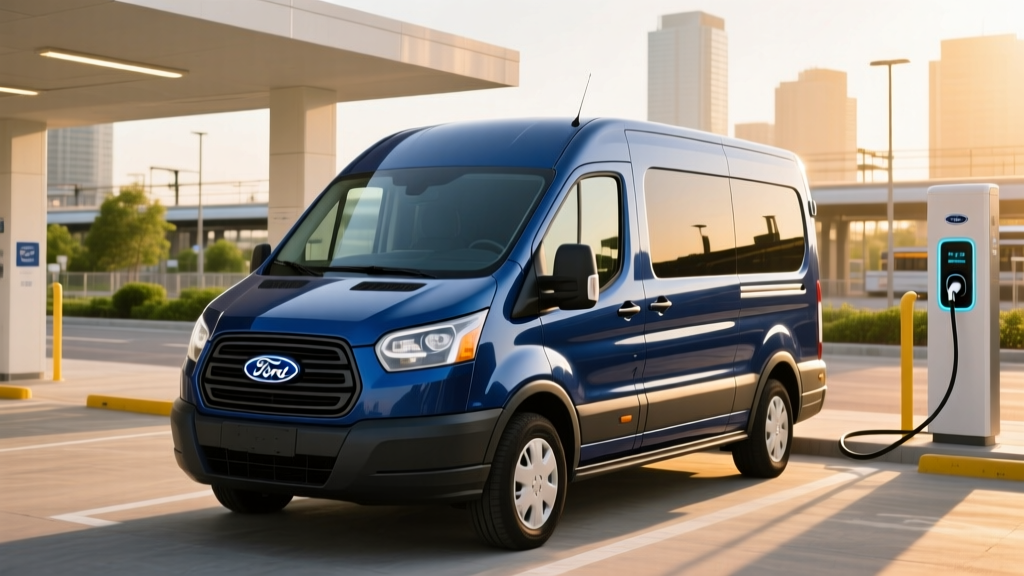
The Ford E-Transit remains the default electric work van for North American fleets and small businesses entering commercial electrification. But the purchase decision rarely comes down to the sticker price alone. For most buyers, Ford E-Transit finance options — cash purchase, commercial loan, lease, or Ford Pro's bundled service packages — determine whether the math works against a gas-powered Transit.
This guide breaks down the 2026 E-Transit's real specifications, what financing actually looks like at current commercial rates, how the federal commercial clean vehicle credit (§45W) applies, and where the total cost of ownership pencils out versus where it doesn't. We'll cover the van's genuine capabilities — and limitations — so you can model your own payback period with real numbers.
2026 Ford E-Transit: Core Specifications at a Glance
Before running finance scenarios, here are the exact figures that matter for any commercial EV purchase decision. The 2026 E-Transit carries over the updated battery pack introduced for the 2024 model year, with modest software efficiency improvements.
| Specification | 2026 Ford E-Transit (Low Roof, 130" WB) |
|---|---|
| Base MSRP (Cargo Van, Low Roof 130" WB) | $47,895 |
| As-Tested (High Roof, 148" WB, Cutaway) | $56,200–$62,500 |
| Battery Capacity (usable) | 68 kWh (NMC lithium-ion) |
| EPA Estimated Range | 126 miles (Low Roof Cargo Van) |
| EPA Efficiency | 2.0 kWh/mile (approx. 50 MPGe combined) |
| Motor Output | 266 hp (198 kW), 317 lb-ft torque |
| Drivetrain | Rear-wheel drive (single motor) |
| 0–60 mph | ~8.5 seconds (unladen) |
| Max Payload | Up to 3,880 lbs (varies by config) |
| Max Cargo Volume | 487.3 cu ft (High Roof, 148" WB Extended) |
| DC Fast Charge (peak) | 115 kW (CCS1) |
| 10–80% DC Fast Charge Time | ~45 minutes |
| Level 2 AC Charge Rate | 10.5 kW (onboard charger) |
| Battery Warranty | 8 years / 100,000 miles |
| Bumper-to-Bumper | 3 years / 36,000 miles |
Understanding Ford E-Transit Finance Options
Commercial vehicle financing operates differently from consumer auto loans. Most E-Transit buyers are businesses, and the available finance structures reflect that. Here are the primary paths:
Cash Purchase or Capital Outlay
For fleets with available capital, an outright purchase at $47,895 (base cargo van) allows full depreciation under IRS Section 179 or bonus depreciation rules. The vehicle becomes a depreciable business asset immediately. This is the simplest path but ties up working capital that might be deployed elsewhere in the business.
Commercial Auto Loan
As of early 2026, commercial vehicle loan rates typically range from 6.5% to 9.5% APR depending on business credit profile, time in operation, and down payment. A 60-month term on a $50,000 E-Transit at 7.5% APR yields a monthly payment of approximately $1,004. Total interest paid over the term: ~$10,240. Longer 72- or 84-month terms reduce the monthly burden but increase total cost.
Commercial Lease
Leasing through Ford Pro or a commercial lessor typically structures as a closed-end lease with a residual value set at 36 or 48 months. Expect monthly lease payments in the $650–$850 range for a base cargo van, depending on mileage allowance (typically 12,000–15,000 miles/year for commercial leases) and money factor. Leasing preserves capital and shifts residual-value risk to the lessor — relevant given ongoing uncertainty about long-term EV resale values.
Ford Pro Financed Service Bundles
Ford Pro increasingly bundles vehicle financing with telematics software (Ford Pro Intelligence), mobile service, and charging infrastructure into a single monthly payment. This "all-in" approach can simplify budgeting but makes direct cost comparison harder. Request an itemized breakdown before committing.
Federal Tax Credits: §45W Commercial Clean Vehicle Credit
This is where commercial E-Transit finance differs most from consumer EV purchases. Businesses do not claim the consumer §30D credit. Instead, the relevant incentive is the §45W Commercial Clean Vehicle Credit, governed by different rules.
- Credit Amount: Up to $7,500 for vehicles under 14,000 lbs GVWR (the E-Transit qualifies)
- Eligible Entities: Businesses, tax-exempt organizations, and qualified governmental units
- No MSRP Cap: Unlike §30D, §45W has no manufacturer's suggested retail price ceiling
- No Income Cap: Business income limits do not apply as they do for consumer credits
- Battery Sourcing Requirements: The vehicle must meet critical mineral and battery component sourcing thresholds — confirm with your Ford Pro dealer and tax professional
- Per-Vehicle Limitation: The credit is limited to the vehicle's incremental cost over a comparable ICE vehicle, up to $7,500
- Transferability: §45W does not currently allow point-of-sale transfer like §30D — the credit is claimed on the business's tax return
For a tax-exempt organization (nonprofit, municipality, tribal government), §45W can be claimed as a direct payment from the IRS — effectively a cash rebate. This is a significant advantage for entities with no tax liability. Consult IRS guidance on §45W and a qualified tax professional before modeling this into your finance plan.
| Scenario | Base MSRP | Est. §45W Credit | Effective Cost |
|---|---|---|---|
| Cargo Van, Low Roof (cash purchase) | $47,895 | Up to $7,500 | ~$40,395 |
| Cargo Van, High Roof 148" WB | $53,500 | Up to $7,500 | ~$46,000 |
| Cutaway (upfit-ready) | $52,000 | Up to $7,500 | ~$44,500 |
Note: Actual credit amount depends on the incremental cost calculation and current-year sourcing compliance. State and local incentives (e.g., utility rebates, CARB vouchers in California) may stack on top. Check AFDC's state incentive database for jurisdiction-specific programs.
Charging Infrastructure: What You Need and What It Costs
The E-Transit's 10.5 kW onboard AC charger and 115 kW peak DC fast-charge capability define how you'll operate it. For most fleet applications, overnight Level 2 depot charging is the primary strategy, with DC fast charging reserved for opportunity top-ups during shifts.
| Charging Level | Power | Charge Time (10–100%) | Miles Added per Hour |
|---|---|---|---|
| Level 1 (120V, standard outlet) | ~1.4 kW | ~50+ hours | ~2–3 mi/hr |
| Level 2 (240V, 48A circuit) | 10.5 kW (van-limited) | ~7.5 hours | ~18–20 mi/hr |
| DC Fast Charge (CCS1) | 115 kW peak | ~45 min (10–80%) | N/A (burst charging) |
Depot Charging Installation Costs
For a fleet depot installing multiple Level 2 chargers, expect $3,000–$7,000 per stall for equipment and basic electrical work (assuming adequate panel capacity). For a single-van small business, a commercial-grade Level 2 station (e.g., ChargePoint CT4000 or Ford Pro charge solutions) runs $2,500–$4,500 installed, including a dedicated 60A/240V circuit. If your facility requires a panel upgrade or transformer work, add $5,000–$15,000.
The E-Transit's 10.5 kW onboard charger is adequate for overnight replenishment — 7.5 hours from near-empty covers a full workday's driving for most last-mile routes. However, it's slower than some competitors (the BrightDrop Zevo 600 accepts up to 11.5 kW AC). If your routes require mid-day opportunity charging, the 115 kW DC capability adds roughly 45 miles of range in a 15-minute stop, tapering significantly above 80% state of charge.
Operating Cost Per Mile: E-Transit vs. Gas Transit
The finance case for the E-Transit hinges on operating cost savings over the vehicle's service life. Here's how the per-mile economics compare for a typical last-mile delivery operation:
| Cost Category | E-Transit (per mile) | Gas Transit 3.5L V6 (per mile) |
|---|---|---|
| Energy/Fuel (national avg.) | $0.08–$0.12 | $0.22–$0.28 |
| Maintenance (est.) | $0.05–$0.07 | $0.10–$0.14 |
| Tires (heavier van) | $0.03 | $0.03 |
| Insurance (est.) | $0.06–$0.09 | $0.05–$0.08 |
| Total Operating Cost/mile | ~$0.22–$0.31 | ~$0.40–$0.53 |
At 25,000 miles per year (typical urban delivery route), the E-Transit saves approximately $4,500–$5,500 annually in fuel and maintenance compared to the gas Transit. Over a 5-year/125,000-mile service life, that's $22,500–$27,500 in operating savings — enough to offset most of the purchase-price premium even before tax credits.
Key caveats: these figures assume depot charging at commercial electricity rates ($0.12–$0.18/kWh). If your operation relies heavily on public DC fast charging ($0.35–$0.55/kWh at many networks), the energy cost advantage narrows significantly. The E-Transit's economics depend on predictable, low-cost overnight charging.
Technology, Driver Assists, and Daily Usability
The E-Transit shares its SYNC 4 infotainment platform with the broader Ford commercial lineup, featuring a 12-inch touchscreen with wireless Apple CarPlay and Android Auto, over-the-air updates, and Ford Pro Intelligence telematics integration. The telematics suite provides real-time vehicle location, state-of-charge monitoring, geofencing, driver behavior scoring, and predictive maintenance alerts — essential for fleet managers running multiple units.
Standard driver-assistance features include:
- Pre-Collision Assist with Automatic Emergency Braking
- Lane-Keeping System with Lane-Keeping Aid
- Blind Spot Information System (BLIS) with trailer coverage
- Rear View Camera with dynamic hitch assist
- Available 360-Degree Camera with split-view display
The most notable daily usability feature is Pro Power Onboard (available), which provides up to 2.4 kW of 120V AC power from the van's battery through bed-mounted and cab outlets. This eliminates the need for a separate generator at job sites — a genuine advantage for tradespeople running power tools, lighting, or equipment without idling a gas engine.
Notable drawbacks include the modest range (limiting route flexibility), the absence of an all-wheel-drive option (problematic for northern-climate operations), and the relatively slow DC fast-charge rate compared to passenger EVs. The E-Transit is purpose-built for predictable, depot-based routes — it is not a road-trip vehicle.
Who Should Buy the E-Transit (And Who Shouldn't)
- Your routes are under 80 miles per day with predictable stops
- You have depot or home-base overnight charging access
- You operate in a city or metro area with low-speed, stop-and-go driving (where regen braking maximizes efficiency)
- You want to eliminate idling emissions in dense urban areas or indoor facilities
- Pro Power Onboard replaces a generator in your workflow
- Your state or utility offers additional commercial EV incentives
- Your daily routes exceed 100 miles without reliable mid-day charging
- You operate in extreme cold (below 10°F) for extended periods without heated garage storage
- You need all-wheel drive for snow/ice traction
- Your business cannot absorb the higher upfront cost or longer payback period
- You tow — the E-Transit has no rated towing capacity
Competitor Comparison: E-Transit vs. BrightDrop Zevo vs. Mercedes eSprinter
The E-Transit competes in a small but growing segment. Here's how it stacks up against the two primary alternatives for 2026:
| Specification | Ford E-Transit | BrightDrop Zevo 600 | Mercedes-Benz eSprinter |
|---|---|---|---|
| Base MSRP | $47,895 | ~$55,000 | ~$56,000 |
| EPA Range | 126 mi | ~160 mi (est.) | ~150 mi (est.) |
| Battery (usable) | 68 kWh | ~85 kWh | ~113 kWh |
| Max Cargo Volume | 487 cu ft | 615 cu ft | 533 cu ft |
| DC Fast Charge | 115 kW | ~120 kW | ~115 kW |
| Dealer/Service Network | Extensive | Limited (direct) | Moderate |
The E-Transit wins on price and dealer/service accessibility — Ford's commercial dealer network dwarfs BrightDrop's direct-sales model and Mercedes-Benz's Sprinter-specific service centers. The trade-off is range: both competitors offer approximately 25–35 more miles of EPA-rated range, which can matter for route flexibility. If your operation can absorb the higher cost and you need that extra range, the eSprinter or Zevo 600 may justify the premium. For cost-conscious fleets with shorter routes, the E-Transit remains the value proposition.
Frequently Asked Questions
What is the real-world range of the Ford E-Transit?
The EPA rates the low-roof E-Transit at 126 miles. Real-world range depends heavily on payload, speed, and temperature. Expect 100–110 miles on mixed routes at moderate speeds in mild weather, dropping to 75–90 miles in winter conditions with heating loads. For fleet planning, budget 80 miles of usable range in worst-case scenarios.
How fast does the E-Transit charge at home and on DC fast chargers?
On a 240V Level 2 charger (10.5 kW), the E-Transit charges from empty to full in approximately 7.5 hours — adequate for overnight depot replenishment. On a DC fast charger (115 kW peak via CCS1), it reaches 10–80% in about 45 minutes. Charging speed tapers significantly above 80%, so plan DC stops around the 10–80% window for efficiency.
Does the Ford E-Transit qualify for the federal EV tax credit?
Yes, but through the §45W Commercial Clean Vehicle Credit, not the consumer §30D credit. Eligible businesses and tax-exempt organizations can claim up to $7,500 per vehicle, subject to incremental-cost calculations and battery-sourcing requirements. Tax-exempt entities may claim it as a direct payment. Always verify current-year eligibility with a tax professional and reference IRS §45W guidance.
How much does the E-Transit cost after tax credits?
With the base MSRP at $47,895 and a maximum §45W credit of $7,500, the effective purchase price can drop to approximately $40,395 — before any state incentives, utility rebates, or depreciation benefits. Higher-trim and extended-wheelbase configurations start at $53,500–$62,500, with the same $7,500 credit ceiling applying.
Is the E-Transit worth buying versus a gas Transit?
For predictable, depot-charged routes under 80 miles daily, the E-Transit's operating cost savings ($4,500–$5,500/year in fuel and maintenance) typically offset the purchase premium within 3–4 years. For longer routes, cold-climate operations, or businesses without overnight charging access, the gas Transit remains the more practical and lower-risk choice. Model your specific route distances, electricity rates, and annual mileage before deciding.
What are the biggest pros and cons of the E-Transit?
- Lowest base MSRP in the electric van segment ($47,895)
- Extensive Ford Pro dealer and mobile service network
- Pro Power Onboard eliminates jobsite generator needs
- Significant fuel and maintenance cost savings vs. gas Transit
- Strong telematics and fleet management integration
- Eligible for up to $7,500 commercial tax credit + state incentives
- 126-mile EPA range limits route flexibility (real-world ~80–100 mi)
- No all-wheel-drive option
- 115 kW DC fast charge is slower than many passenger EVs
- Higher insurance costs than gas equivalent
- No towing capability
- Cold-weather range loss is significant (~25–30%)
What is the E-Transit's battery warranty?
Ford covers the high-voltage battery for 8 years or 100,000 miles, whichever comes first, against defects and excessive capacity loss (typically defined as dropping below 70% of original capacity). The powertrain (motor, reduction gear) shares this coverage. The standard bumper-to-bumper warranty is 3 years / 36,000 miles.
Can I install a Level 2 charger at my business for the E-Transit?
Yes. A commercial-grade Level 2 station on a dedicated 60A/240V circuit typically costs $2,500–$4,500 installed for a single stall, assuming adequate electrical panel capacity. For multi-vehicle fleets, per-stall costs may decrease with shared infrastructure. Work with a licensed electrician familiar with commercial EV charging installations and check with your utility about demand charges and commercial EV rate plans.
The Ford E-Transit's finance case is strongest for businesses with short, predictable routes, access to low-cost overnight charging, and the ability to leverage the §45W commercial credit. It's not the longest-range or fastest-charging electric van available, but at $47,895 before incentives — backed by Ford's commercial service infrastructure — it remains the most accessible entry point into fleet electrification for small and mid-size operations. Run your own numbers against your specific route profile, electricity rates, and available incentives before committing.