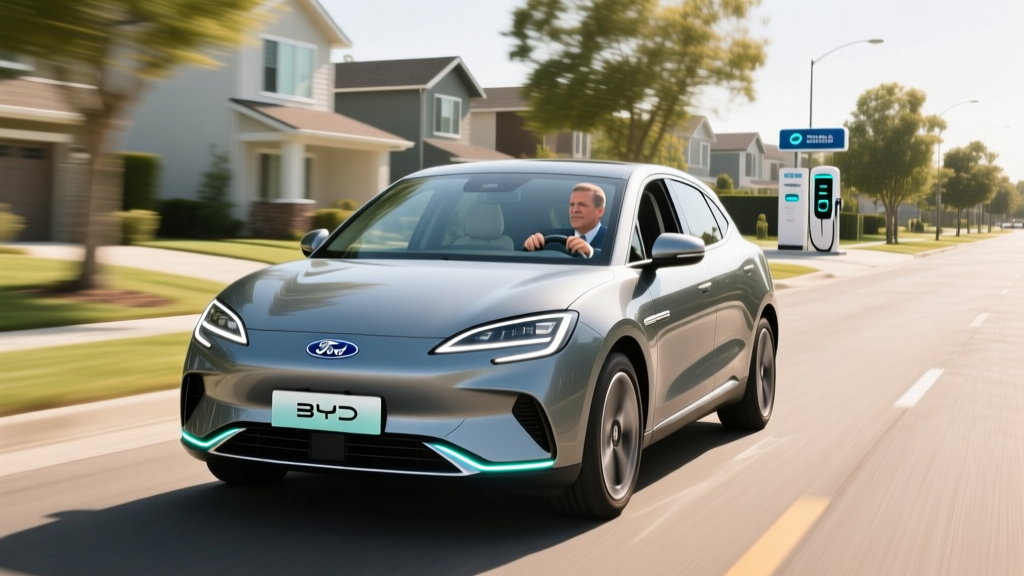
When Ford CEO Jim Farley climbed behind the wheel of a BYD Seagull during a 2024 trip to China, his candid reaction made headlines across the auto industry. "This is a wake-up call," Farley told analysts after the test drive, noting the build quality, tech integration, and aggressive pricing of BYD's smallest electric car. The phrase "Ford CEO drives BYD" quickly became shorthand for a broader reckoning: Chinese EV makers had closed the gap — and in some areas, lapped the competition.
But what does this moment actually mean for US-based EV shoppers in 2026? The BYD Seagull is not sold in the United States, and steep tariffs (currently 100% on Chinese-built EVs) keep it that way for the foreseeable future. Yet the Seagull's engineering and pricing benchmark directly shapes what Ford, GM, Hyundai, and others bring to market. To understand the ripple effects, we need to look at the Seagull's hard specs — and then compare them against the affordable EVs you can actually buy in America.
Why the BYD Seagull Spooked Detroit
The BYD Seagull (also marketed as the BYD Dolphin Mini in some export markets) is a subcompact, five-door battery electric hatchback. In China, it starts at roughly ¥69,800 — about $9,700 USD at current exchange rates. That price point alone was enough to send shockwaves. But Farley's concern wasn't just about cost; it was about how much car BYD delivered at that cost.
The Seagull rides on BYD's e-Platform 3.0, uses the company's proprietary Blade Battery (a cell-to-pack lithium iron phosphate / LFP design), and features a 12.8-inch rotating center touchscreen, NFC phone-as-key, and a full suite of ADAS sensors. It's not a stripped-down compliance car — it's a feature-dense urban EV that happens to cost less than a used golf cart in the US.
For Ford — which has been restructuring its EV division (Ford Model e) and delaying or canceling several next-generation electric models — the Seagull represented exactly the kind of cost-optimized, high-volume EV that American automakers have struggled to produce profitably.
BYD Seagull: Full Spec Breakdown
Because the Seagull is not EPA-rated for US sale, the figures below come from BYD's published Chinese-market specifications and independent testing by CarNewsChina and other outlets. Where relevant, I've noted how these translate to real-world US driving conditions.
| Specification | Vitality Edition (Base) | Freedom Edition (Top) |
|---|---|---|
| Battery Capacity (usable) | 30.08 kWh | 38.88 kWh |
| Battery Chemistry | LFP (BYD Blade, cell-to-pack) | |
| CLTC Range | 305 km (190 mi) | 405 km (252 mi) |
| Estimated EPA-equivalent Range | ~150 mi | ~195 mi |
| Motor Output | 55 kW (74 hp) / 135 Nm (100 lb-ft) | |
| 0-100 km/h (0-62 mph) | ~11.0 seconds | |
| Top Speed | 130 km/h (81 mph) | |
| Drivetrain | FWD, single motor | |
| Max DC Fast Charge | 30 kW | 40 kW |
| 10-80% DCFC Time | ~30 minutes (claimed) | |
| AC Level 2 Charge Rate | 6.6 kW (~22 mi/hr at 4 mi/kWh) | |
| Length / Width / Height | 147.2 in / 67.7 in / 60.8 in | |
| Wheelbase | 97.6 in | |
| Cargo Volume (rear seats up) | ~8.5 cu ft (est.) | |
| Base Price (China) | ~$9,700 USD | ~$12,000 USD |
Charging Reality: What the Numbers Actually Mean
The Seagull's charging speeds are where the "affordable EV" trade-off becomes visible. With a peak DC rate of just 30-40 kW (depending on trim), this is not a road-trip vehicle. Here's the breakdown:
| Vehicle | Max DC kW | 10-80% Time | Level 2 Rate | Mi/hr at L2 |
|---|---|---|---|---|
| BYD Seagull (Freedom) | 40 kW | ~30 min | 6.6 kW | ~22 |
| Chevrolet Equinox EV (2026) | 150 kW | ~20 min | 11.5 kW | ~36 |
| Hyundai Kona Electric (2026) | 100 kW | ~43 min | 10.9 kW | ~34 |
| Nissan Leaf (2025, 60 kWh) | 100 kW | ~45 min | 6.6 kW | ~22 |
| Tesla Model 3 RWD (2026) | 170 kW | ~25 min | 11.5 kW | ~44 |
The Seagull's 40 kW peak means a 10-80% session takes roughly 30 minutes — acceptable for urban errands but painfully slow for interstate travel. By contrast, the Chevy Equinox EV's 150 kW peak cuts that to about 20 minutes, and it supports NACS (Tesla connector) natively for 2026, opening up the Supercharger network. For American buyers who regularly drive more than 100 miles in a day, charging speed matters far more than sticker price.
How Ford Is Responding: The $25,000 EV Push
Farley's Seagull test drive wasn't an isolated event — it was part of a broader competitive intelligence effort that has since reshaped Ford's EV strategy. In late 2024 and into 2025, Ford pivoted away from several large, expensive next-gen EV programs and redirected investment toward a new, smaller, more affordable electric platform. The goal: a roughly $25,000-$30,000 electric crossover that can compete on cost with incoming Chinese models globally, even if those models are tariffed out of the US market.
As of early 2026, Ford's "skunkworks" affordable EV team (led by former Tesla engineer Alan Clarke) has confirmed a next-gen small EV is in development, targeting a 2027 model year launch. Details remain preliminary, but the vehicle is expected to feature:
- An LFP battery option for lower-cost trims
- NACS charging port (Supercharger access from day one)
- Targeted EPA range of 250+ miles
- DC fast charging at 150+ kW
- A starting MSRP near $25,000 (before any tax credits)
Until that vehicle arrives, Ford's current EV lineup — the Mustang Mach-E and F-150 Lightning — occupies a completely different price and size segment than the Seagull. The Mach-E starts around $38,000 for 2026, and the Lightning begins near $55,000. Neither competes with BYD's urban micro-car.
What You Can Actually Buy: US Affordable EV Alternatives
Since the BYD Seagull isn't available in the US (and won't be under current 100% tariff policy), here's how the most affordable EVs you can buy in 2026 stack up for budget-minded shoppers:
| Model | EPA Range | Battery (kWh) | 0-60 mph | Base MSRP | §30D Credit Eligible? |
|---|---|---|---|---|---|
| Chevy Equinox EV LT | 319 mi | 85 kWh (NMC) | 7.9s | $33,600 | Yes (up to $7,500) |
| Hyundai Kona Electric SE | 261 mi | 64.8 kWh (NMC) | 7.8s | $32,975 | No (Korea-built) |
| Tesla Model 3 RWD | 272 mi | 60 kWh (LFP) | 5.8s | $38,990 | Yes (up to $7,500) |
| Nissan Leaf S (60 kWh) | 212 mi | 60 kWh (NMC) | 7.4s | $30,190 | No (Japan-built) |
Tax Credit Caveats: The federal §30D credit of up to $7,500 is subject to MSRP caps ($55,000 for cars, $80,000 for SUVs/trucks), buyer income limits ($150K single / $300K joint AGI), and stringent battery-sourcing and critical-minerals requirements that change annually. As of 2026, vehicles must have a sufficient percentage of battery components manufactured or assembled in North America, and critical minerals must be sourced from the US or FTA partners. Always verify current eligibility on IRS.gov before purchasing, and consider consulting a tax professional. The credit can now be transferred to the dealer at point of sale, effectively reducing your purchase price upfront.
The Tariff Wall: Why BYD Can't Just Ship to America
The US currently imposes a 100% tariff on Chinese-built electric vehicles — a policy enacted in 2024 and maintained through 2026. This means a $10,000 BYD Seagull would effectively cost $20,000+ at the port, before dealer markup, compliance modifications, or warranty infrastructure. Even at $20,000, it would undercut most competitors, which is precisely why the tariff exists.
BYD has explored building vehicles in Mexico, Brazil, Thailand, and Europe to serve regional markets. However, US trade policy has preemptively closed the Mexico backdoor: vehicles manufactured in Mexico by Chinese-owned companies face the same punitive tariff unless a specific trade agreement exemption is negotiated (none exists as of early 2026).
The practical result: American buyers will not see a BYD Seagull on dealer lots in 2026. The competitive pressure it exerts is real, but it flows through forcing Western automakers to cut costs — not through direct purchase.
What This Means for Your Next EV Purchase
If Farley's "Ford CEO drives BYD" moment has a tangible impact on your wallet, it will show up in two ways over the next 2-3 years:
- Lower prices on compact EVs: Ford, Stellantis, and GM are all accelerating sub-$30,000 EV programs. The Chevy Equinox EV at $33,600 (and potentially $26,100 after the full tax credit) is the first result of this pressure.
- More LFP battery adoption: BYD's success with LFP Blade Batteries has validated the chemistry for cost-sensitive models. Expect more US-market EVs to offer LFP trims — trading some cold-weather range and energy density for a lower purchase price and longer cycle life (LFP cells typically handle 3,000+ full cycles vs. ~1,500 for NMC).
- Choose the Chevy Equinox EV if you want the best value-to-range ratio available now, with 319 miles EPA, NACS charging, and likely §30D eligibility bringing the effective price near $26,000.
- Choose the Tesla Model 3 if you prioritize charging speed (170 kW DC), Supercharger network access, and don't mind paying ~$39K (before credit).
- Wait for Ford's affordable EV (est. 2027) if you're loyal to the Blue Oval and want a sub-$30K electric crossover with modern charging and LFP optionality — but understand that specs are preliminary and launch timelines have slipped before.
- Don't wait for BYD — it is not coming to the US market under current trade policy.
Pros and Cons: The Seagull vs US Alternatives
BYD Seagull — Pros (if available)
- Unbeatable base price (~$10K-$12K)
- LFP Blade Battery — excellent cycle life and thermal stability
- Surprisingly complete tech suite (rotating 12.8" screen, NFC key)
- Compact size ideal for dense urban parking
- BYD's vertical integration keeps costs low
BYD Seagull — Cons (US reality)
- Not available in the US — 100% tariff blocks import
- Low DC charge rate (30-40 kW) — poor road-trip usability
- ~195 mi EPA-equiv range — limits use to urban commuting
- 74 hp motor — sluggish by US highway-merging standards
- No US dealer network, warranty, or crash-test data (NHTSA/IIHS)
- Cargo space (~8.5 cu ft) is minimal even for the subcompact class
Frequently Asked Questions
Did the Ford CEO really drive a BYD?
Yes. Ford CEO Jim Farley personally test-drove a BYD Seagull during a visit to China in 2024 and publicly described it as a competitive wake-up call for Western automakers. He has since referenced BYD's cost efficiency and vertical integration in multiple earnings calls and strategy briefings.
Can I buy a BYD Seagull in the United States in 2026?
No. The US imposes a 100% tariff on Chinese-built EVs, and BYD has no US dealer network, no NHTSA/IIHS crash-test certifications, and no announced plans to sell in the American market under current trade conditions.
What is the real-world range of the BYD Seagull?
The top-trim Freedom Edition claims 405 km (252 mi) on China's CLTC cycle. Converted to EPA-equivalent testing, expect roughly 195 miles in mild conditions. In winter (below freezing), LFP chemistry suffers greater capacity loss than NMC, so plan for 135-155 miles of real range in cold weather.
How fast does the Seagull charge?
DC fast charging peaks at 40 kW (Freedom Edition), reaching 10-80% in approximately 30 minutes. Level 2 AC charging runs at 6.6 kW, adding roughly 22 miles of range per hour. These speeds are slow by 2026 US standards — the Chevy Equinox EV charges at 150 kW DC, and the Tesla Model 3 at 170 kW.
Does the BYD Seagull qualify for the US federal EV tax credit?
No. The §30D credit requires vehicles to be assembled in North America (with final assembly verification via the VIN). A Chinese-built BYD does not qualify regardless of battery sourcing. See fueleconomy.gov for the full list of eligible vehicles.
What affordable EV should I buy instead?
For maximum range per dollar in 2026, the Chevrolet Equinox EV LT at $33,600 (319 mi EPA, 150 kW DCFC, NACS port) is the strongest value — especially if you qualify for the full $7,500 §30D credit, bringing the effective price to roughly $26,100. For charging speed and network access, the Tesla Model 3 RWD remains the benchmark.
Will Ford release a competitor to the BYD Seagull?
Ford has confirmed a next-generation affordable EV is in development, targeting a ~$25,000 starting price and a 2027 model-year launch. Specs are preliminary, but the vehicle is expected to offer 250+ miles of range, 150+ kW DC charging, and an LFP battery option. This is Ford's direct response to the competitive pressure from BYD and other Chinese EV makers.