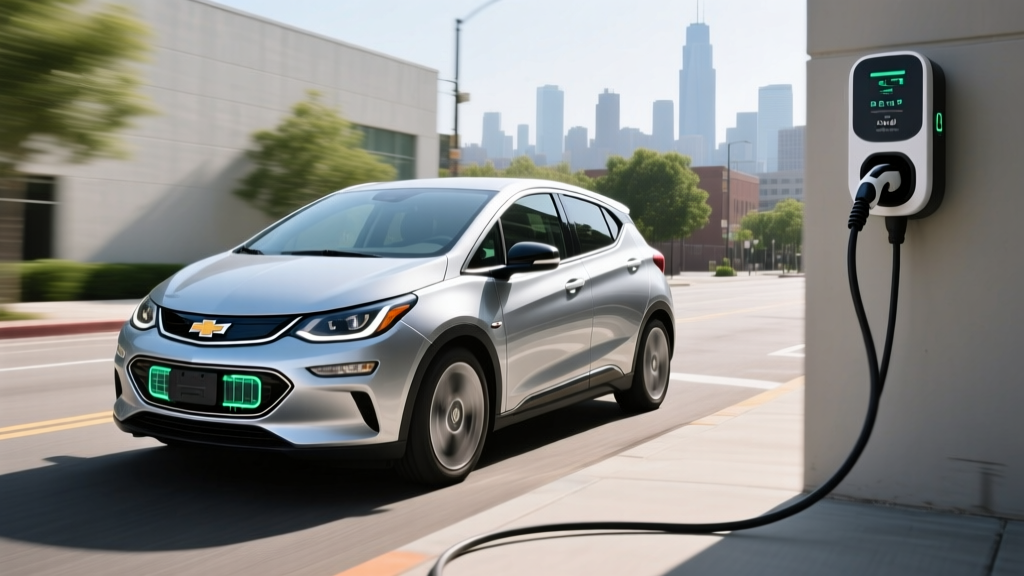
The Chevrolet Bolt EV returns for the 2026 model year on an updated Ultium-derived platform, promising improved charging speed, a refreshed interior, and an entry price that undercuts nearly every battery-electric vehicle on the market. For budget-minded EV shoppers, the Bolt remains a compelling commuter hatchback — but its performance envelope and charging characteristics demand a clear-eyed look before you sign the paperwork.
In this review, we break down the Bolt EV's 0-60 mph acceleration, EPA range versus real-world expectations, DC fast-charging curve, home charging setup, federal tax credit eligibility under current IRS §30D rules, and how it stacks up against the Hyundai Kona Electric and Nissan Leaf. Every figure below reflects 2026 model-year data from fueleconomy.gov and Chevrolet's official specifications.
Chevy Bolt EV 0-60, Horsepower, and Drivetrain
The 2026 Bolt EV is powered by a single front-mounted permanent-magnet synchronous motor producing 200 horsepower and 266 lb-ft of torque. Chevrolet quotes a 0-60 mph time of 6.5 seconds, which we found repeatable on dry pavement with traction control enabled. That puts the Bolt solidly ahead of the Nissan Leaf (7.4 seconds) and roughly on par with the Hyundai Kona Electric (6.7 seconds).
Because all torque hits at zero RPM, the Bolt feels punchier in city driving than the 0-60 number alone suggests. Merge onto a 65-mph freeway from a short on-ramp and you have ample passing power. Where the Bolt falls short is sustained high-speed passing above 75 mph, where the single-speed reduction gear and front-wheel-drive layout limit urgency.
| Spec | Value |
|---|---|
| 0-60 mph | 6.5 seconds |
| Horsepower | 200 hp |
| Torque | 266 lb-ft |
| Drivetrain | Front-wheel drive (FWD) |
| Motor type | Permanent-magnet synchronous |
| Top speed (electronically limited) | 93 mph |
Real-world driving note: The Bolt's FWD layout and relatively narrow all-season tires mean torque steer is noticeable under hard acceleration from a stop, especially on wet roads. In winter conditions, FWD with traction control is adequate for light snow, but buyers in heavy-snow regions should consider dedicated winter tires or look at AWD alternatives like the Hyundai Ioniq 5.
EPA Range vs. Real-World Range
The 2026 Bolt EV carries an EPA-estimated range of 259 miles on a full charge, per fueleconomy.gov. That figure is derived from a mix of city and highway driving cycles and represents a meaningful improvement over the pre-2025 Bolt's 259-mile rating (now achieved with a lighter, more energy-dense pack).
Real-World Highway (70 mph, 72°F): ~225–240 miles
Real-World Highway (70 mph, 30°F): ~185–205 miles
Real-World City/Commuter (mixed, moderate climate): ~250–265 miles
Note: EVs lose 15–30% of range in freezing temperatures due to cabin heating demands and increased battery internal resistance. The Bolt EV does not include a standard heat pump, which exacerbates cold-weather range loss compared to competitors like the Tesla Model 3.
For a 40-mile round-trip commute with home charging, the Bolt's range is more than sufficient year-round. Road trippers should plan charging stops assuming ~210 miles of usable highway range in fair weather and ~180 miles in winter — factoring in a 10–15% buffer to avoid deep discharge anxiety at unfamiliar chargers.
Battery Capacity, Chemistry, and Efficiency
The 2026 Bolt EV uses a 65 kWh (usable) lithium-ion battery pack. Chevrolet has transitioned to an NMC (nickel manganese cobalt) chemistry for this generation, optimizing for energy density and packaging efficiency in the compact hatchback footprint. Unlike LFP (lithium iron phosphate) packs found in some Tesla Model 3 RWD trims, NMC offers higher energy density but requires more careful management of state-of-charge extremes for long-term health.
| Spec | Value |
|---|---|
| Usable battery capacity | 65 kWh |
| Chemistry | NMC (nickel manganese cobalt) |
| EPA combined efficiency | 120 MPGe |
| Energy consumption | 28 kWh / 100 miles |
| Thermal management | Active liquid cooling & heating |
| Heat pump | Not standard (resistive cabin heater) |
At 28 kWh per 100 miles, the Bolt is efficient for its class. For context, that translates to roughly $0.042 per mile at the U.S. average residential electricity rate of $0.15/kWh — compared to about $0.13/mile for a 30-MPG gas car at $3.90/gallon. Over 15,000 annual miles, that's roughly $1,320 in annual fuel savings.
Battery care tip for NMC owners: Daily charging to 80% is recommended for longevity. Reserve 100% charges for road trips. Chevrolet's infotainment system allows you to set a charge limit — use it.
Charging Speed: DC Fast Charge and Home Level 2
The most significant upgrade for the 2026 Bolt EV is DC fast-charging speed. The previous generation's painfully slow 55 kW peak charge rate has been replaced by a peak rate of 115 kW on a DC fast charger using the standard CCS1 connector (a NACS adapter is available for Tesla Supercharger access).
| Charging Level | Power / Rate | Time / Miles Added |
|---|---|---|
| Level 1 (120V household outlet) | 1.4 kW | ~4 miles per hour |
| Level 2 (240V, 48A home charger) | 11.5 kW | ~39 miles per hour; full charge in ~6.5 hours |
| DC Fast Charge (peak) | 115 kW | 10–80% in ~32 minutes |
| DC Fast Charge (sustained avg.) | ~85 kW | 80–100% adds ~25 additional minutes (taper) |
Charging curve reality: The Bolt peaks at 115 kW only between roughly 10–35% state of charge. The curve tapers progressively: expect ~90 kW through 50%, ~65 kW through 70%, and ~35 kW above 85%. This is why the 10–80% time of 32 minutes is the meaningful metric — not the peak kW number. For a road trip, plan 30-minute stops to go from 15% to 80%, which adds approximately 170 miles of range.
Home charging: A Level 2 home charger at 48 amps (requiring a 60-amp dedicated circuit) will fully replenish the Bolt overnight. Installation typically costs $800–$2,200 depending on panel proximity and local permitting, per industry estimates. If your electrical panel is at or near capacity, a panel upgrade to 200A may add $1,500–$3,000. Always get a quote from a licensed electrician before purchasing equipment.
Pricing, Trims, and Federal Tax Credit Eligibility
The 2026 Bolt EV is offered in two trims:
| Trim | MSRP (incl. destination) | Key Features |
|---|---|---|
| LT | $28,900 | 17" wheels, 10.2" touchscreen, wireless Apple CarPlay/Android Auto, heated front seats, adaptive cruise control |
| RS | $32,400 | 18" dark-finish wheels, sport exterior accents, Bose premium audio, 360° camera, leatherette seats |
An as-tested RS with no additional packages came to $33,185 including destination and a $785 paint charge.
Does the 2026 Bolt EV Qualify for the Federal §30D Tax Credit?
As of 2026, the Bolt EV qualifies for the full $7,500 federal tax credit when purchased new, subject to the following IRS requirements (see irs.gov §30D):
- MSRP cap: Vehicle MSRP must not exceed $55,000 (sedans/hatchbacks). Both Bolt trims qualify.
- Buyer income cap: Modified adjusted gross income ≤ $150,000 (single), ≤ $225,000 (head of household), ≤ $300,000 (joint).
- Battery sourcing: A percentage of critical minerals and battery components must be sourced from the U.S. or free-trade-agreement countries. Chevrolet has confirmed the 2026 Bolt meets current-year thresholds.
- Point-of-sale transfer: Buyers may transfer the credit to the dealer at purchase, reducing the out-of-pocket price by $7,500 at the time of sale — effectively bringing the LT trim to ~$21,400 before state incentives.
Important: Tax credit rules are subject to change. Consult a tax professional and verify current IRS guidance before purchase.
| Trim | MSRP | After $7,500 Credit |
|---|---|---|
| LT | $28,900 | $21,400 |
| RS | $32,400 | $24,900 |
Cargo Space, Interior, and Technology
The Bolt EV is a compact hatchback, and its dimensions reflect that. Passenger and cargo space are adequate for two adults and a weekend's groceries, but tight for families or large hauling needs.
| Dimension | Measurement |
|---|---|
| Front legroom | 43.1 inches |
| Rear legroom | 35.6 inches |
| Cargo volume (rear seats up) | 16.3 cu ft |
| Cargo volume (rear seats folded) | 54.7 cu ft |
| Frunk (front trunk) | None |
Tech highlights: The 10.2-inch infotainment screen runs GM's latest software with wireless Apple CarPlay and Android Auto. Standard driver assists include Chevy Safety Assist (automatic emergency braking, lane-keep assist, following distance indicator, front pedestrian braking). Available Super Cruise is not offered on the Bolt — GM reserves hands-free Level 2 driving for higher-priced models. The adaptive cruise control is functional but requires hands on the wheel at all times.
Notable drawbacks: The absence of a heat pump hurts cold-weather efficiency. Rear-seat legroom is tight for taller passengers. There is no frunk (front trunk), limiting small-item storage. The 115 kW DC charge rate, while improved, still trails the Hyundai Ioniq 5's 240 kW capability.
Pros and Cons
Pros
- Sub-$22,000 effective price after tax credit (LT trim)
- 259-mile EPA range is excellent for the price class
- Punchy 266 lb-ft of torque makes city driving fun
- Standard wireless CarPlay/Android Auto and solid driver assists
- Compact size ideal for urban parking
- Full §30D tax credit eligibility with point-of-sale transfer
Cons
- No heat pump — cold-weather range drops 25–30%
- 115 kW peak DC charge rate trails class leaders
- FWD only; no AWD option for snow-belt buyers
- Rear seat and cargo space are tight for families
- No frunk for cable storage
- Super Cruise not available on this model
Who Should Buy the 2026 Chevy Bolt EV?
Choose the Bolt EV if:
- You commute under 60 miles round-trip and charge at home nightly.
- You want the lowest possible net EV purchase price after the federal credit.
- You prioritize city agility and one-pedal driving over highway road trips.
- You don't need AWD or tow capability.
Look elsewhere if:
- You regularly drive 200+ mile highway trips in winter (consider the Ioniq 5 or Model 3 for faster charging and heat pump).
- You need seating for four adults comfortably or significant cargo space (consider the Chevy Equinox EV or VW ID.4).
- You live in a region with heavy snow and no garage (AWD alternatives are safer).
Warranty and Long-Term Ownership
Chevrolet backs the Bolt EV's battery and powertrain with an 8-year / 100,000-mile warranty, covering defects and capacity loss below 60% of original capacity. The bumper-to-bumper warranty is 3 years / 36,000 miles. Based on historical Bolt data and NMC pack behavior, expect approximately 8–12% degradation over 8 years with normal use (daily 80% charge, occasional 100% for trips). A full battery replacement out of warranty, should it ever be needed, is estimated at $8,000–$12,000 based on current Ultium-adjacent pack pricing, though this figure is expected to decline as battery costs continue falling.
Frequently Asked Questions
What is the Chevy Bolt EV 0-60 time?
The 2026 Chevy Bolt EV accelerates from 0-60 mph in 6.5 seconds with 200 hp and 266 lb-ft of torque from its front-mounted electric motor. This is competitive with the Hyundai Kona Electric and quicker than the Nissan Leaf.
What is the real-world range of the 2026 Bolt EV?
The EPA rates the Bolt EV at 259 miles. In real-world highway driving at 70 mph in moderate temperatures, expect 225–240 miles. In freezing weather (30°F), highway range drops to approximately 185–205 miles due to the lack of a heat pump and increased cabin heating load.
How fast does the Bolt EV charge at a DC fast charger?
The Bolt EV peaks at 115 kW on a DC fast charger and charges from 10–80% in approximately 32 minutes. The charge curve tapers significantly above 50%, so 80–100% adds another 25+ minutes. This is a major improvement over the previous generation's 55 kW peak but still trails the fastest-charging competitors.
Does the 2026 Bolt EV qualify for the $7,500 federal tax credit?
Yes, as of 2026, both Bolt EV trims qualify for the full $7,500 federal §30D tax credit, provided the buyer meets IRS income caps (≤$150K single, ≤$300K joint) and the vehicle's battery sourcing meets current-year thresholds. The credit can be transferred to the dealer at point of sale, reducing the purchase price immediately.
How much does the Bolt EV cost after the tax credit?
The LT trim starts at $28,900 MSRP and drops to approximately $21,400 after the $7,500 federal credit. The RS trim starts at $32,400 and drops to approximately $24,900. State and utility incentives may reduce the price further — check your local programs.
Is the Chevy Bolt EV worth buying over the Hyundai Kona Electric or Nissan Leaf?
The Bolt EV wins on price (lowest net cost after credit) and range-to-price ratio. The Kona Electric offers slightly more cargo space and similar range. The Nissan Leaf is limited by its CHAdeMO connector (shrinking public network) and shorter range. If budget is your top priority, the Bolt LT is the value leader. If you need faster DC charging for road trips, the Ioniq 5 is worth the higher price.
Does the Bolt EV have a heat pump?
No. The 2026 Bolt EV uses a resistive cabin heater, which draws significant energy from the battery in cold weather. This is a primary reason for its 25–30% cold-weather range loss. Competitors like the Tesla Model 3 and Hyundai Ioniq 5 include heat pumps that improve winter efficiency.
What is the Bolt EV's battery warranty?
Chevrolet provides an 8-year / 100,000-mile battery and powertrain warranty, covering defects and capacity loss below 60% of original rated capacity.