The Bottom Line: Why Ford's CEO Keeps Talking About Chinese EVs
Ford CEO Jim Farley has repeatedly singled out Chinese EV manufacturers — particularly BYD — as the most significant competitive threat to legacy automakers. His concern is rooted in hard numbers: BYD and rivals like NIO, Xpeng, and Geely produce EVs that undercut Western competitors by 30–50% on cost while matching or exceeding them on battery technology, software, and interior quality. For American EV buyers in 2026, this matters because tariffs currently block these vehicles from the US market, but their global pricing pressure is already reshaping what Ford, GM, and others can charge. The practical takeaway: expect aggressive pricing on domestic EVs, faster feature rollouts, and a widening gap between what you can buy in the US versus the rest of the world.
What Ford's CEO Actually Said About Chinese EVs
Jim Farley's warnings about Chinese EV competition are not casual remarks — they reflect a strategic alarm that has reshaped Ford's entire electrification roadmap. In multiple public appearances and earnings calls through 2024 and 2025, Farley described Chinese EVs as "a clear and present danger" to Western automakers, specifically citing BYD's vertical integration, battery cost advantages, and rapid iteration cycles.
Farley has driven a Xiaomi SU7 — a Chinese EV not sold in the US — and publicly praised its execution, calling it a "formidable" product. He has noted that BYD builds vehicles at a cost structure roughly 30% lower than Western OEMs, largely because BYD manufactures its own batteries (the single most expensive EV component), controls its supply chain from raw lithium to finished cells, and benefits from Chinese government subsidies and scale.
The result? BYD's Seagull, a compact EV sedan, sells in China for approximately $10,000 USD equivalent. Even adjusted for US safety regulations, feature expectations, and shipping, analysts estimate a US-spec Seagull could land around $20,000–$25,000 — a price point no current American-market EV touches. Ford's cheapest EV, the Mustang Mach-E, starts at $36,495 for 2026. The gap is enormous.
How Chinese EVs Compare: The Numbers That Scare Detroit
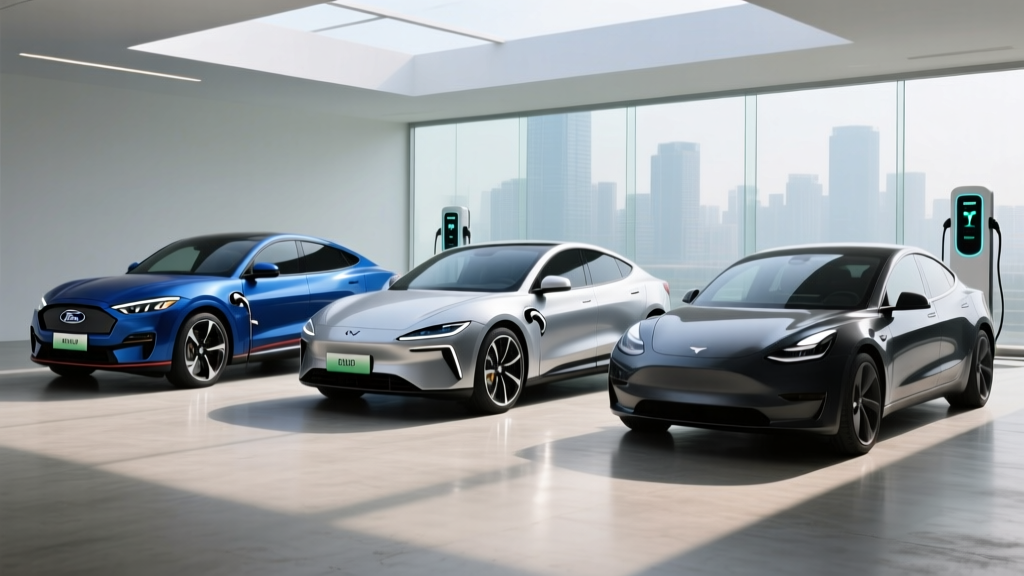
The competitive threat isn't just about price — it's about spec-for-spec value. Here's how a representative Chinese EV stacks up against comparable American-market options:
| Spec | BYD Seal (Global) | Tesla Model 3 LR | Ford Mach-E Select |
|---|---|---|---|
| Base Price (USD equiv.) | ~$38,000 (global) / not sold in US | $44,130 | $36,495 |
| Battery Capacity | 82.5 kWh (LFP Blade) | 75 kWh (NMC) | 70 kWh (NMC) |
| EPA-Equiv. Range | ~320 mi (WLTP 354 mi) | 363 mi (EPA) | 250 mi (EPA) |
| Peak DC Charge Rate | 150 kW | 250 kW | 150 kW |
| 10–80% Charge Time | ~26 min | ~25 min | ~32 min |
| 0–60 mph | 5.9 sec | 4.4 sec | 6.3 sec |
| Horsepower | 313 hp | 346 hp | 266 hp |
| Battery Warranty | 8 yr / 100,000 mi | 8 yr / 120,000 mi | 8 yr / 100,000 mi |
The BYD Seal delivers competitive range, solid charging speed, and respectable performance at a global price point that undercuts both the Model 3 and Mach-E — and that's before considering BYD's lower-tier models. The EPA's EV technology overview confirms that LFP batteries like BYD's Blade cell offer superior cycle life and thermal stability compared to NMC, though with slightly lower energy density.
Why You Can't Buy a BYD in the US (and When That Might Change)
As of 2026, Chinese-built EVs face a combined US tariff of 100% on Chinese-manufactured vehicles — a policy enacted in 2024 and maintained through the current administration. This effectively doubles the landed cost of any Chinese EV, eliminating the price advantage that makes them disruptive.
However, the landscape is shifting in ways that matter for US buyers:
- BYD is building factories in Mexico, Thailand, Brazil, Hungary, and Indonesia. A Mexican production facility could theoretically bypass some tariff structures under USMCA rules, though political resistance is intense.
- Chinese battery tech is leaking into Western supply chains. Ford itself licensed CATL's (a Chinese company) LFP battery technology for its Michigan battery plant — a move Farley defended as essential for cost competitiveness.
- Other markets are flooded with Chinese EVs, which pressures global pricing and forces Western OEMs to cut costs or lose market share in Europe, Southeast Asia, and South America.
For the US buyer, the near-term reality is clear: you won't be test-driving a BYD Seagull at your local dealer in 2026. But the pricing pressure is already here, reflected in aggressive lease deals, price cuts, and Ford's own pivot toward smaller, cheaper EV platforms.
Real Costs: What You'll Actually Spend on a US-Market EV in 2026
With Chinese EVs walled off by tariffs, American buyers are choosing among domestic, Korean, Japanese, and German options. Here's what ownership actually costs for a mainstream EV versus a comparable gas vehicle:
| Cost Category | Ford Mach-E Select | Toyota RAV4 LE (Gas) |
|---|---|---|
| MSRP | $36,495 | $30,090 |
| Federal Tax Credit (§30D) | –$3,750 (partial, battery sourcing) | $0 |
| Effective Purchase Price | $32,745 | $30,090 |
| Fuel/Energy (5 yr, 75,000 mi) | $4,125 (home charging, $0.13/kWh avg) | $9,375 (27 MPG combined, $3.50/gal) |
| Maintenance (5 yr) | $1,800 | $3,200 |
| Insurance (5 yr avg) | $9,500 | $7,200 |
| Depreciation (est. 5 yr) | $14,000 | $11,500 |
| Total 5-Year Cost | $62,170 | $61,365 |
The numbers are close — and that's the point. Without access to sub-$25,000 Chinese EVs, US buyers are paying a premium for electrification that narrows the savings gap significantly. The Mach-E wins on fuel and maintenance but loses on insurance and depreciation. Your actual results depend heavily on local electricity rates, whether you can charge at home (critical), and your state's incentive structure.
Key caveat on the §30D tax credit: The federal EV credit is not a flat $7,500 for everyone. Under current IRS rules, eligibility depends on MSRP caps ($55,000 for sedans, $80,000 for SUVs/trucks), buyer income limits ($150K single / $300K joint), and stringent battery component and critical mineral sourcing requirements. Many 2026 EVs qualify for only $3,750 or $0 due to battery sourcing rules. Always verify eligibility before purchasing.
Common Misconceptions About Chinese EVs and US Pricing
| Myth | Fact |
|---|---|
| "Chinese EVs are cheap because they're low quality." | BYD, NIO, and Xpeng vehicles score well in Euro NCAP crash tests. BYD's LFP Blade Battery passes nail-penetration tests without thermal runaway. Quality gaps have largely closed since 2020. |
| "If tariffs were removed, I could buy a $15,000 EV tomorrow." | Even at zero tariff, US-market compliance (FMVSS safety standards, EPA certification, dealer network, crash testing, software localization) adds $5,000–$10,000 per vehicle. A realistic US-spec BYD Seagull would start around $20,000–$22,000. |
| "Ford and GM can't compete on price, so EVs will stay expensive." | Ford is actively restructuring its EV division (Ford Model e) to cut costs. The next-gen Ford EV platform targets a $25,000–$30,000 price point by 2027–2028, using lessons from CATL battery licensing and simplified manufacturing. |
| "Chinese EVs have worse range and charging." | BYD's e-Platform 3.0 vehicles offer 300+ mile range and 150 kW DC charging. NIO offers battery swap technology. Zeekr's 800V architecture charges at 400+ kW. The tech is competitive or superior in several areas. |
| "Tariffs protect American jobs." | Tariffs protect domestic manufacturing but also keep EV prices higher for consumers. The Congressional Budget Office and multiple trade analyses note that tariff costs are largely passed to buyers. The net employment effect is debated. |
What This Means for Your EV Purchase Decision
The Chinese EV situation creates a specific decision landscape for American buyers in 2026. Here's a practical framework:
Should You Buy an EV Now or Wait?
Buy now if:
- You have home Level 2 charging access (240V, 32A+ circuit) — this is non-negotiable for convenient ownership.
- Your daily commute is under 80 miles round-trip (covers 95% of drivers within any current EV's real-world range).
- You qualify for at least a partial §30D credit (check income caps and battery sourcing on the IRS site).
- You find a lease deal under $399/month — many OEMs are subsidizing leases to move inventory in response to competitive pressure.
- You live in a region with reliable public DC fast charging (Electrify America, Tesla Supercharger network) for road trips.
Wait 12–24 months if:
- You're targeting a sub-$30,000 EV — Ford's next-gen small EV and GM's Equinox EV lower trims are approaching this price point by 2027.
- You rely exclusively on street parking with no charging access — wait until your city's curb-side charging infrastructure matures.
- You live in a cold climate (sustained sub-20°F winters) and need 300+ real-world miles — current EVs lose 20–30% range in extreme cold; solid-state or next-gen LFP improvements are coming.
- You want to see if tariff negotiations open any Chinese EV access (unlikely but possible under trade deal scenarios).
The Ownership Reality Check: What First-Time EV Buyers Must Know
Whether you choose Ford, Tesla, Hyundai, or any other current-market brand, these ownership truths apply universally — and they're the factors Chinese EV marketing conveniently sidesteps in international markets:
Home charging is make-or-break. A Level 2 home charger (7.7–11.5 kW) adds roughly 25–44 miles of range per hour of charging. Most EV owners do 80%+ of their charging at home. Without it, EV ownership becomes a chore of public charger hunting. Budget $500–$2,000 for a quality Level 2 unit (ChargePoint Home Flex, Emporia Vue, or Tesla Wall Connector) plus $800–$2,500 for electrician installation depending on your panel capacity and run distance.
Real-world range is not EPA range. The EPA test cycle is generous. Expect 10–15% less range at sustained highway speeds (70–80 mph), and 20–30% less in sub-freezing temperatures. A Mach-E with a 250-mile EPA rating delivers roughly 210–225 miles highway in mild weather and 175–200 miles in winter. Plan trips around the lower number.
DC fast charging follows a curve, not a constant rate. A vehicle rated for "150 kW peak" does not charge at 150 kW for the entire session. Peak rate typically applies between 10–40% state of charge. Above 80%, charging slows dramatically to protect battery health — sometimes to under 40 kW. A "10–80% in 32 minutes" spec tells the real story; "0–100% in 75 minutes" reveals the taper.
Insurance costs 15–30% more for EVs. Higher repair costs, specialized parts, and battery replacement risk drive premiums up. Get quotes before purchasing. IIHS safety ratings can help you identify EVs with better crash-test performance, which partially offsets insurance costs.
Battery degradation is real but manageable. Modern NMC batteries lose roughly 5–10% capacity over 100,000 miles. LFP batteries (used by BYD, Tesla Model 3 RWD, and Ford's upcoming platforms) degrade even less — typically 3–5% over the same distance. All major OEMs warrant 70% capacity retention for 8 years / 100,000 miles minimum.
The Bigger Picture: How Chinese Competition Helps You (Even With Tariffs)
Paradoxically, the Chinese EV threat that alarms Ford's CEO is the best thing that could happen to American EV buyers. Here's why:
Ford has responded to BYD's cost advantage by accelerating its own cost-cutting. The company is investing in LFP battery production (cheaper than NMC, longer-lasting), simplifying vehicle platforms, and targeting a next-generation EV architecture that can produce vehicles at BYD-competitive costs. GM is pursuing similar strategies with its Ultium platform cost reductions.
Meanwhile, Hyundai/Kia — already offering some of the best value in the US EV market with the Ioniq 5 and EV6 — are under additional pressure to keep pricing aggressive. Tesla has cut prices repeatedly since 2023 in direct response to BYD's global market share gains.
The net effect: American EV buyers in 2026 are getting more range, faster charging, better software, and lower prices than they would in a market without Chinese competitive pressure. You can't buy a BYD, but BYD's existence is making every EV you can buy slightly better and slightly cheaper.
Will Chinese EVs ever be sold in the United States?
Not in the near term. The 100% tariff on Chinese-built vehicles, combined with political opposition and national security concerns around connected vehicle software, makes direct Chinese EV sales unlikely before 2028 at the earliest. However, Chinese battery technology and components are already entering US supply chains through licensing deals and joint ventures.
Is it safe to buy a Ford EV given the company's financial pressure from Chinese competitors?
Yes. Ford's EV division is under financial pressure, but the company is profitable overall and has committed to its EV roadmap. Battery warranties are backed by the full corporation, not just the EV division. The Mustang Mach-E and F-150 Lightning have established service networks and parts availability.
What's the cheapest EV I can actually buy in the US right now?
The 2026 Nissan Leaf S starts at $28,140 with a 149-mile EPA range and a 40 kWh battery. The Chevrolet Equinox EV LT starts around $33,400 with 319 miles of range. Neither qualifies for the full §30D credit under current battery sourcing rules. These represent the floor of US EV pricing — a floor that Chinese EVs could theoretically push down to $20,000 if tariff barriers were removed.
Does Ford use Chinese battery technology in its EVs?
Yes, indirectly. Ford licensed LFP battery cell technology from CATL (Contemporary Amperex Technology Co. Limited), a Chinese company, for its Marshall, Michigan battery plant. This is a licensing arrangement — CATL provides the technology and equipment, Ford manufactures the cells. This reduces Ford's battery costs while technically maintaining US production.
Should I wait for cheaper EVs or buy now?
If your current vehicle is reliable and you have no urgent need, waiting 18–24 months will likely yield more sub-$30,000 options as Ford's next-gen platform, GM's expanded Equinox EV lineup, and potentially new entrants hit the market. If you need a vehicle now and have home charging, current pricing — especially lease deals — is the most competitive it has ever been in the US market.