The short answer: In early 2025, leaked images and design renders of Ford's canceled three-row electric SUV surfaced across automotive forums and social media, revealing a sleek, mid-size electric crossover that was intended to compete with the Kia EV9 and Hyundai Ioniq 9. Ford officially killed the program in late 2024 as part of a broader strategic pivot away from large battery-electric vehicles toward hybrids and smaller, more affordable EVs. The revealed design showed a vehicle with an estimated 300+ mile EPA range, ~100 kWh battery, and a target starting price around $50,000–$55,000. For family EV shoppers in 2026, this vehicle will not reach production — but the leak offers a clear window into what Ford considered viable, and it sharpens the question: what should three-row EV buyers actually purchase today?
What the Leaked Design Actually Showed
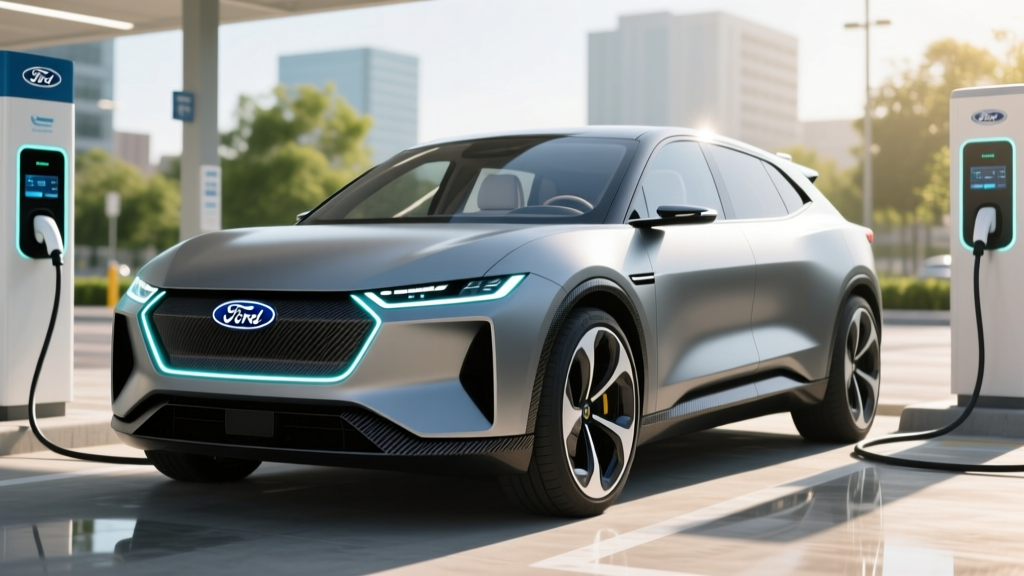
The images that circulated depicted a production-intent three-row SUV with a fastback-leaning roofline, a full-width light bar, and flush door handles — styling cues consistent with Ford's current EV design language seen on the Mustang Mach-E and F-150 Lightning. Based on reporting from Reuters and industry analysis, the vehicle was being developed on Ford's next-generation flexible EV architecture and was slated for a late-2025 or early-2026 launch.
Key projected specifications from pre-cancellation reporting and the leaked materials included:
| Spec | Projected / Leaked Estimate |
|---|---|
| Seating | Three rows, 6- or 7-passenger |
| Battery capacity | ~100 kWh usable (NMC chemistry) |
| EPA range (target) | 300–320 miles |
| Peak DC fast charge rate | ~200–250 kW |
| 10–80% charge time (est.) | ~22–28 minutes |
| Drivetrain | RWD base / AWD available |
| Target MSRP | $50,000–$55,000 (base) |
| Production location | Oakville Assembly (Ontario) — retooled |
None of these figures were finalized at the time of cancellation, and Ford never published official EPA data for the vehicle. They represent engineering targets based on supplier reporting and platform capability, not certified specifications.
Why Ford Killed the Three-Row EV — and What That Means for Buyers
Ford's decision to cancel the three-row electric SUV was driven by several converging factors that every prospective EV buyer should understand:
- Demand shift: Large, expensive EVs have underperformed sales expectations industry-wide. Buyers in the $50,000+ segment are increasingly choosing plug-in hybrids (PHEVs) and conventional hybrids over pure battery-electric vehicles, particularly for family haulers where road-trip flexibility matters.
- Battery cost reality: A 100 kWh NMC battery pack at 2024–2025 pricing (roughly $110–$130/kWh at the cell level) meant the vehicle's cost structure couldn't hit the $50K target without significant margin compression.
- Hybrid pivot: Ford announced it would invest heavily in hybrid powertrains, including a three-row hybrid SUV, as a bridge strategy. The company's internal data showed hybrid buyers report higher satisfaction and fewer range-anxiety concerns than first-time EV buyers in the family-SUV segment.
- Competition: The Kia EV9 launched at $54,900 with up to 304 miles of EPA range, immediately setting a high bar. Hyundai's Ioniq 9 followed with competitive pricing. Ford would have entered a crowded, price-competitive field late.
For buyers, the cancellation signals that the three-row EV market in 2026 has consolidated around a handful of proven models rather than expanding with new entrants. Your choices are more defined — and in some ways, simpler — than they would have been if Ford had launched.
Your Real 2026 Alternatives: Three-Row EVs You Can Actually Buy
Since Ford's canceled three-row electric SUV will never reach a showroom, here is what family buyers can actually purchase today, with real numbers:
| Model | EPA Range | Battery (kWh) | Peak DC kW | 10–80% Min | Base MSRP | §30D Credit Eligible? |
|---|---|---|---|---|---|---|
| Kia EV9 (LR RWD) | 304 mi | 99.8 (NMC) | 210 kW | ~24 min | $54,900 | Partial — check battery sourcing |
| Hyundai Ioniq 9 (LR) | ~310 mi | ~110 (NMC) | ~240 kW | ~20 min | $53,500 | Partial — check battery sourcing |
| Tesla Model X (LR) | 335 mi | ~100 (NMC) | 250 kW | ~18 min | $79,990 | No — exceeds $80K SUV cap |
| Rivian R1S (Dual Max) | 352 mi | ~149 (NMC) | ~200 kW | ~35 min | $79,900 | No — exceeds $80K SUV cap |
Real-world range caveat: Expect 15–25% range reduction on all of these vehicles in sustained highway driving at 75+ mph, and an additional 20–30% loss in sub-freezing temperatures. A 304-mile Kia EV9 in January highway driving in Minneapolis may deliver as little as 210–230 miles before needing a charge. Plan road trips around 200-mile segments in cold climates.
Three-Row EV vs. Gas vs. Hybrid: The Cost Comparison
Many family shoppers cross-shopping Ford's (now canceled) electric SUV were also considering the Ford Explorer Hybrid or the gas-only Explorer. Here is how the economics actually stack up over 5 years and 75,000 miles of mixed driving:
| Cost Category | Kia EV9 LR AWD ($60K) | Ford Explorer Hybrid (~$48K) | Ford Explorer Gas (~$40K) |
|---|---|---|---|
| Purchase price (after credits) | ~$55,000–$60,000 | ~$48,000 | ~$40,000 |
| Fuel/energy (75K mi) | ~$3,400 (home L2 @ $0.14/kWh) | ~$7,500 (26 MPG avg @ $3.40/gal) | ~$10,600 (21 MPG avg @ $3.40/gal) |
| Maintenance (5 yr) | ~$1,200 | ~$3,500 | ~$4,200 |
| Insurance (5 yr avg) | ~$12,500 | ~$9,800 | ~$9,200 |
| Estimated depreciation | ~$22,000 | ~$16,000 | ~$14,500 |
| 5-Year Total Cost | ~$94,100 | ~$84,800 | ~$78,500 |
Key takeaway: The EV saves substantially on fuel and maintenance, but the higher purchase price, steeper depreciation (EV resale values remain volatile), and elevated insurance premiums (typically 15–30% higher than ICE equivalents per III.org data) erode much of that advantage over 5 years. The break-even point for a three-row EV vs. a hybrid typically arrives around year 7–8 for most households — or sooner if you have access to free or subsidized workplace charging.
First-Time EV Buyer: What You Must Know Before Committing
If the Ford leak sparked your interest in a three-row electric SUV, here are the non-obvious ownership realities that spec sheets don't highlight:
Home Charging Is Non-Negotiable for Most Owners
Over 80% of EV charging happens at home. A Level 2 home charger (240V, 32–48 amps / 7.7–11.5 kW) adds roughly 25–35 miles of range per hour and fully replenishes a 100 kWh battery overnight. Installation costs typically range from $800–$2,500 if your electrical panel has capacity, but can jump to $4,000–$7,000 if a panel upgrade (100A to 200A service) is needed. If you live in an apartment, condo, or street-parking situation without charging access, a three-row EV for family road trips becomes significantly less practical.
DC Fast Charging Is Not What the Peak Number Suggests
A vehicle rated for "210 kW peak" DC fast charging does not sustain 210 kW for the full session. Charging curves taper significantly above 50–60% state of charge (SoC). A realistic 10–80% session on a Kia EV9 at a 350 kW Electrify America or Tesla Supercharger station averages around 100–130 kW sustained, taking 22–28 minutes. Above 80%, speed drops dramatically — sometimes to under 30 kW — to protect battery longevity. Plan road-trip stops around 10–80% charges; charging to 100% at a DC station is rarely time-efficient.
The §30D Federal Tax Credit Is Not Guaranteed
Under current IRS §30D rules, the federal EV tax credit of up to $7,500 requires meeting multiple criteria:
- MSRP cap: SUVs must be at or below $80,000 MSRP
- Income cap: AGI ≤ $300K (joint), $225K (head of household), $150K (single)
- Battery sourcing: Critical minerals and battery components must meet phased-in domestic/free-trade-partner sourcing thresholds — many Korean-built EVs (including certain Kia/Hyundai trims) only qualify for partial credit ($3,750) or none depending on the model year and assembly location
- Point-of-sale transfer: As of 2024, you can transfer the credit to the dealer for an immediate price reduction at purchase, but you must still meet income requirements at tax filing time or repay the credit
Always verify eligibility on the IRS website and consult a tax professional before assuming the full $7,500 applies to your purchase.
Common Misconceptions About Three-Row EVs
| Myth | Fact |
|---|---|
| "A 300-mile range means I can drive 300 miles before stopping." | EPA range assumes mixed driving at moderate speeds. Sustained 75 mph highway driving typically yields 75–85% of EPA range. In cold weather (below 32°F), expect 60–75% of EPA range. Plan for 200–230 real-world highway miles in most conditions. |
| "I'll save $10,000+ in 5 years going electric." | Fuel and maintenance savings are real ($4,000–$7,000 over 5 years), but higher purchase price, insurance, and depreciation often offset $3,000–$6,000 of that. Net savings depend heavily on your local electricity rate, annual mileage, and whether you qualify for tax credits. |
| "EV batteries need replacing after 100K miles." | Modern NMC and LFP batteries are warrantied for 8 years/100,000 miles at ≥70% capacity retention (federally mandated minimum). Real-world degradation data from Recurrent and other fleet studies show most EVs retain 85–92% capacity at 100K miles. Full battery replacement is rare and typically costs $8,000–$18,000 out of warranty. |
| "All three-row EVs qualify for the $7,500 tax credit." | Many do not. The Tesla Model X and Rivian R1S exceed the $80K MSRP cap. Korean-built models face battery-sourcing restrictions. Always check the fueleconomy.gov tax credit database for the specific model and trim. |
| "I can tow just as much with an EV SUV." | Towing severely reduces EV range — often by 40–55%. A 304-mile EV9 towing a 3,500-lb trailer may deliver under 170 miles per charge. Gas and hybrid SUVs lose efficiency too, but refueling infrastructure makes this less disruptive. |
Decision Framework: Should You Buy a Three-Row EV, Hybrid, or Gas SUV?
Choose a three-row EV (Kia EV9, Hyundai Ioniq 9) if:
- You have reliable Level 2 home charging (garage or driveway with 240V outlet)
- Your daily driving is under 80 miles round-trip with occasional road trips
- You qualify for at least partial federal/state EV tax credits
- You value low running costs and minimal maintenance over lowest upfront price
- You live in a region with moderate winters or have a second vehicle for deep-cold road trips
Choose a three-row hybrid (Toyota Grand Highlander Hybrid, Ford Explorer Hybrid) if:
- You lack reliable home charging access
- You regularly drive 300+ miles between stops or tow frequently
- You want the lowest total cost of ownership with zero range-anxiety risk
- You live in a cold climate where EV range loss is a year-round concern
- Upfront purchase price is a primary constraint
Choose a three-row PHEV (when available — e.g., upcoming plug-in Grand Highlander) if:
- You want 30–40 miles of daily electric commuting with gas flexibility for road trips
- You can charge at home but don't want to rely on public DC charging infrastructure
- You want to reduce fuel consumption by 50–70% without full EV commitment
Frequently Asked Questions
Will Ford ever build a three-row electric SUV?
Ford has not announced a replacement for the canceled program as of 2026. The company's current strategy emphasizes smaller, more affordable EVs (a next-generation mid-size pickup and a $30K-class compact) alongside an expanding hybrid lineup. If Ford returns to the three-row EV segment, it would likely be later in the decade with lower battery costs. For now, the Kia EV9 and Hyundai Ioniq 9 are the primary mainstream alternatives.
Is the Kia EV9 a good substitute for what Ford's canceled SUV would have been?
Yes, and in several respects it exceeds what Ford's leaked design projected. The EV9 Long Range RWD delivers an EPA-verified 304 miles from a 99.8 kWh NMC battery, supports 210 kW peak DC fast charging (10–80% in approximately 24 minutes), and offers genuine third-row space that accommodates adults on short trips. Its main limitations are cold-weather range loss (expect ~220 miles in sub-freezing highway driving) and partial §30D credit eligibility depending on battery sourcing for your specific model year and trim.
How much does it cost to charge a 100 kWh three-row EV at home?
At the US average residential electricity rate of approximately $0.16/kWh (EIA 2025 data), a full 0–100% charge of a 100 kWh battery costs about $16. For a typical 75-mile daily commute consuming ~25 kWh, daily home charging costs roughly $4.00 — compared to about $10.50 for a 21 MPG gas SUV at $3.40/gallon. Annual fuel savings for 15,000 miles of driving average $2,000–$2,800, depending on local rates.
Do three-row EVs have enough cargo space compared to gas SUVs?
The Kia EV9 offers 20.2 cu ft behind the third row, 43.5 cu ft behind the second row, and 81.7 cu ft with both rear rows folded — competitive with the gas Ford Explorer (18.2 / 47.9 / 87.8 cu ft). EVs often have slightly less maximum cargo volume due to battery packaging, but many offer a front trunk (frunk) for additional storage. For most families, the difference is negligible in daily use.
What happens to the battery warranty if I buy a three-row EV?
Federal law mandates that EV batteries carry a minimum warranty of 8 years / 100,000 miles for capacity retention (typically defined as maintaining ≥70% of original capacity). Kia backs the EV9 battery with a 10-year / 100,000-mile warranty. Hyundai offers the same. These warranties are among the strongest in the industry and provide meaningful protection against premature degradation.
The leaked images of Ford's canceled three-row electric SUV are a fascinating look at what might have been — but for family EV shoppers in 2026, the actionable path is clear. The Kia EV9 and Hyundai Ioniq 9 are real, tested, available vehicles with verified EPA ranges, established charging networks, and competitive pricing. Whether they save you money over a hybrid depends on your charging access, driving patterns, climate, and tax situation. Run your own numbers using the framework above, and don't let a compelling design render override the practical math of EV ownership.