The Foldable Electric Vehicle Market in 60 Seconds
The foldable electric vehicle market in 2026 centers on ultra-compact, folding-frame micro-EVs and electric bikes designed for last-mile commuting, apartment living, and multi-modal transit. Most products cluster into two categories: folding electric bicycles ($900–$3,200; 20–60 mi pedal-assist range; 15–28 mph top speed) and folding micro-EVs/scooters with enclosed or semi-enclosed cabins ($4,500–$14,000; 30–75 mi range; 25–45 mph). These vehicles are not highway-capable, do not qualify for the federal §30D EV tax credit (which applies to four-wheeled vehicles over 1,400 lbs GVWR with ≥4 kWh batteries), and occupy a regulatory gray zone between bicycles, low-speed vehicles (LSVs), and neighborhood electric vehicles (NEVs). If you need real highway range, weather protection, and crash safety, a standard compact EV like the Chevrolet Equinox EV or Nissan LEAF remains the practical choice. If your commute is under 15 miles, you lack home charging for a full-size EV, or you need multimodal transit (train + last mile), a foldable electric vehicle can fill a genuine gap.
What "Foldable Electric Vehicle" Actually Means in 2026
The term "foldable electric vehicle" is used loosely across the industry, and that ambiguity is the first thing buyers must sort out. In 2026, the foldable EV market breaks into three distinct product tiers:
Tier 1: Folding Electric Bicycles (E-Bikes)
The largest segment by volume. Brands like Brompton Electric, Rad Power Bikes (RadMini folding), Lectric, and Fiik offer 20-inch or 16-inch wheel folding e-bikes with hub motors (250W–750W nominal), removable lithium batteries (300–500 Wh, typically NMC chemistry), and pedal-assist top speeds of 20 mph (Class 1/2) or 28 mph (Class 3). These fold in 10–30 seconds to roughly 34" × 22" × 26" and weigh 37–55 lbs. Prices range from $900 (entry-level single-speed) to $3,200 (premium multi-speed with torque sensor).
Tier 2: Folding Electric Scooters and Kick-Scooters
Companies like Segway-Ninebot, Unagi, and Fluid Freeride produce folding electric scooters with 250W–1,000W motors, 250–750 Wh batteries, and top speeds of 15–40 mph. Folded dimensions are roughly 43" × 17" × 19". Prices: $400–$2,500. Range: 12–40 miles depending on motor draw and rider weight.
Tier 3: Folding or Collapsible Micro-EVs (Enclosed/Semi-Enclosed)
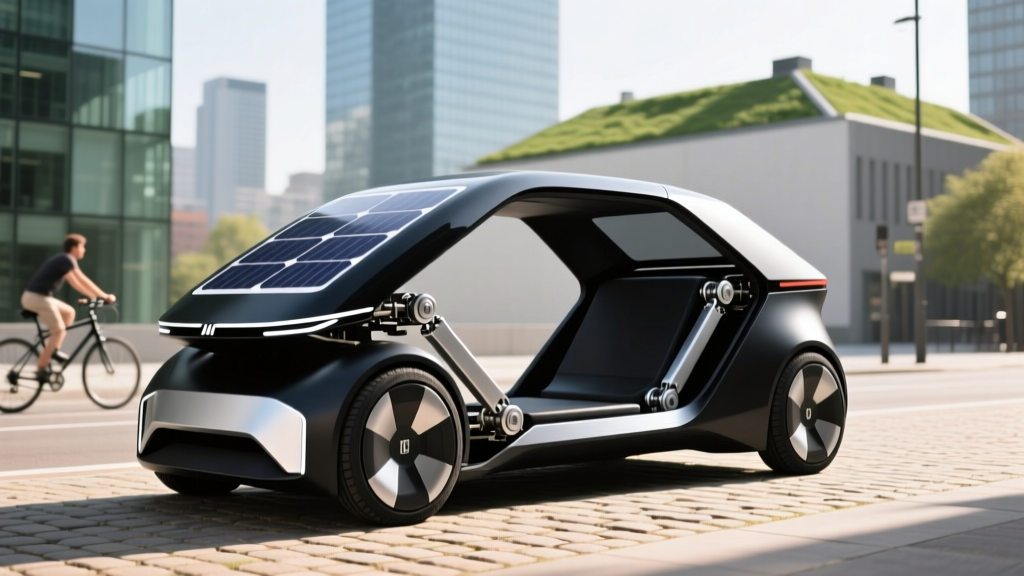
This is the most ambiguous and least mature segment. A handful of Chinese-market and European-market vehicles — such as the City Transformer CT-1 (a width-adjusting micro-EV that narrows from 1.4m to 1.0m for parking, though it does not fold in the traditional sense), and various Alibaba-sourced foldable NEVs — claim "foldable" or "collapsible" designs. In the US market, none of these have achieved meaningful retail availability or NHTSA FMVSS certification as of early 2026. Prices, where available internationally, range from $4,500–$14,000. Range: 30–75 miles. Top speed: 25–45 mph (LSV/NEV class). These vehicles are not legal for highway use in any US state.
Foldable EV Categories at a Glance (2026)
| Category | Price Range | Battery (Wh) | Real-World Range | Top Speed | Folded Size | Weight |
|---|---|---|---|---|---|---|
| Folding E-Bike (Class 1/2) | $900–$2,200 | 300–500 Wh | 15–35 mi (assist) | 20 mph | ~34×22×26 in | 37–50 lbs |
| Folding E-Bike (Class 3) | $1,500–$3,200 | 400–700 Wh | 25–60 mi (assist) | 28 mph | ~36×24×28 in | 42–55 lbs |
| Folding E-Scooter | $400–$2,500 | 250–750 Wh | 12–40 mi | 15–40 mph | ~43×17×19 in | 26–52 lbs |
| Folding Micro-EV (LSV/NEV) | $4,500–$14,000 | 5–12 kWh | 30–75 mi | 25–45 mph | Varies (semi-fold) | 400–900 lbs |
| Standard Compact EV (baseline) | $28,000–$42,000 | 50–85 kWh | 200–320 mi (EPA) | 90–120 mph | Does not fold | 3,500–4,600 lbs |
Cost Breakdown: Foldable EV vs. Gas Car vs. Standard EV
The appeal of the foldable electric vehicle market is cost — but the comparison only works if you're replacing the right kind of trip. A foldable e-bike or scooter replaces short urban commutes, not highway driving. Here's how the numbers stack up for a 10-mile daily round-trip commute over 5 years (250 work days/year = 12,500 total miles):
5-Year Commute Cost: 10-Mile Daily Round Trip
| Cost Factor | Folding E-Bike ($1,800) | Gas Car (30 MPG, $3.40/gal) | Compact EV ($35,000, 3.5 mi/kWh) |
|---|---|---|---|
| Purchase Price | $1,800 | $26,000 (used) | $35,000 (before credit) |
| Federal Tax Credit | $0 | $0 | Up to $7,500 (§30D, if eligible) |
| Energy/Fuel Cost | $125 (electricity @ $0.16/kWh) | $4,717 | $571 |
| Maintenance (5 yr) | $350 (tires, brake pads, chain) | $3,200 | $1,100 |
| Insurance (5 yr) | $0–$600 (optional) | $6,500 | $7,200 |
| Registration/Taxes | $0–$150 | $750 | $1,500 |
| 5-Year Total | $2,275–$3,025 | $41,167 | $37,871–$45,371 |
Notes: Gas car and EV totals include depreciation implicitly via purchase price. Insurance for e-bikes is optional and varies by state. EV insurance premiums are ~10–15% higher than gas equivalents per industry data. Electricity cost assumes home charging at national average. IRS §30D eligibility depends on MSRP caps, buyer income, and battery sourcing — not all buyers qualify.
The savings are dramatic — but only if the foldable EV actually replaces the car trip. If you still need a car for weekends, weather days, and highway trips, the foldable EV becomes an addition, not a replacement, and total household cost rises.
Real-World Ownership: What First-Time Buyers Miss
Range Reality vs. Sticker Claims
A 500 Wh e-bike battery rated for "up to 40 miles" will deliver that range only under ideal conditions: flat terrain, 150-lb rider, low pedal-assist level, no headwind, 70°F ambient temperature. In real-world commuting with a 190-lb rider, moderate hills, throttle-heavy use, and 40°F winter mornings, expect 45–60% of the advertised range — roughly 18–24 miles from a "40-mile" battery. This mirrors the same EPA-vs-real-world gap seen in full-size EVs, just more pronounced due to smaller battery buffers.
Charging: No Infrastructure Needed (Mostly)
One genuine advantage of foldable EVs: they charge from any standard 120V household outlet. A 500 Wh e-bike battery charges from 0–100% in approximately 3.5–5 hours using the included 2A charger (roughly 100W draw). There is no Level 2 home installation cost, no panel upgrade, no electrician visit. You can charge at your desk, in your apartment, or at a coffee shop. This eliminates the single largest barrier to standard EV ownership for apartment dwellers.
Battery Chemistry and Longevity
Most folding e-bikes and scooters in 2026 use NMC (nickel manganese cobalt) lithium-ion cells for energy density at low weight. Expect 500–800 full charge cycles before the battery degrades to 80% state of health (SoH). At one full cycle per day, that's roughly 1.5–2.2 years before noticeable range loss. Replacement batteries cost $250–$600 depending on capacity and brand. A few premium models (notably from Lectric and some European brands) now offer LFP (lithium iron phosphate) batteries, which trade slightly more weight for 2,000+ cycle life and better thermal stability. If you plan to keep the vehicle 5+ years, LFP is worth seeking out.
Climate and Weather Limitations
Foldable electric vehicles are fair-weather transportation. Rain, snow, ice, and sub-30°F temperatures create real problems:
- Cold reduces range by 25–40% — lithium batteries lose efficiency below 40°F, and cabin heating (on micro-EVs) draws heavily from small packs
- 20-inch and smaller wheels handle potholes, wet leaves, and tram tracks poorly compared to car tires
- No crash structure — e-bikes and scooters offer zero crumple zones, no airbags, and no IIHS crash-test ratings
- Most folding mechanisms are not rated for sustained use in salt/wet conditions — hinge corrosion is a known failure point in coastal and snow-belt cities
Legal and Regulatory Patchwork
Folding e-bikes classified as Class 1 or 2 (≤20 mph motor-assisted) are legal on most US bike paths and roads. Class 3 (≤28 mph) face restrictions on some multi-use paths. Folding e-scooters are governed by a patchwork of city and state rules — legal in some jurisdictions, banned on sidewalks in others. Micro-EVs classified as LSVs (≤25 mph) require registration, insurance, and a driver's license in most states, and are restricted to roads with speed limits ≤35 mph. Check your local DOT or DMV before purchasing any Tier 2 or Tier 3 vehicle.
Common Misconceptions About Foldable EVs
| Myth | Fact |
|---|---|
| "Foldable EVs qualify for the $7,500 federal tax credit" | Federal §30D credits apply to four-wheeled vehicles with GVWR <14,000 lbs, ≥4 kWh battery, and meeting MSRP/income/sourcing rules. E-bikes and scooters do not qualify. Some states and localities offer separate e-bike rebates ($300–$1,500) — check energy.gov and your state energy office. |
| "A foldable e-bike replaces my car" | Only for specific trip profiles: <15 mi round trip, fair weather, no cargo/passenger needs, secure parking at destination. Most households still need a car or access to one for 40–60% of trips. |
| "The battery will last 5+ years no problem" | NMC batteries in daily-use e-bikes typically hit 80% SoH at 500–800 cycles (~1.5–2.2 years at daily charging). Budget for a $300–$600 replacement in years 2–4. LFP batteries last longer (2,000+ cycles) but cost more upfront. |
| "It folds, so I can take it on any train or bus" | Most transit agencies allow folding e-bikes and scooters, but weight (40–55 lbs) and lithium battery rules vary. Amtrak allows e-bikes with batteries under a certain size; airlines restrict lithium batteries over 100 Wh in checked luggage. Always check carrier policy. |
| "Folding micro-EVs are just around the corner in the US" | Several concepts have been announced (City Transformer, various Chinese NEVs), but FMVSS certification, dealer networks, and crash-safety compliance remain major barriers. As of 2026, no folding micro-EV has achieved mainstream US retail availability. |
Who Should (and Shouldn't) Buy Into the Foldable EV Market
Decision Framework: Is a Foldable EV Right for You?
Choose a folding e-bike or scooter IF:
- Your one-way commute is under 12 miles and uses surface streets or bike lanes
- You live in an apartment or condo without EV charging access
- You combine transit (train/bus) with a last-mile solution
- You have secure indoor storage (theft is the #1 cause of e-bike loss)
- Your climate allows 7+ months of outdoor cycling/scooting per year
- You're spending under $3,000 and want zero infrastructure investment
Choose a standard compact EV (Equinox EV, LEAF, Bolt, Model 3) IF:
- You need highway capability (65+ mph sustained), crash protection, and all-weather operation
- Your daily driving exceeds 30 miles round trip
- You carry passengers or cargo regularly
- You have access to Level 2 home charging (or can install it)
- You want to leverage the §30D federal tax credit (up to $7,500 for qualifying new EVs, or up to $4,000 for qualifying used EVs under §25E)
Wait on folding micro-EVs IF:
- You're in the US market — FMVSS-certified options are not yet available at scale
- You need NHTSA crash-test data and standard safety equipment
- You want dealer-supported service and warranty infrastructure
Practical Buying Checklist for Foldable EVs in 2026
If you've decided a folding e-bike or scooter fits your commute, use this spec-driven checklist before purchasing:
- Battery Wh, not "range miles" — compare battery capacity in watt-hours. A 500 Wh battery is roughly 25–35 real-world miles on pedal assist. Ignore marketing range claims.
- Motor wattage (nominal, not peak) — 250W is adequate for flat cities; 500W+ for hills. Nominal rating matters more than peak.
- Chemistry: NMC vs. LFP — NMC is lighter; LFP lasts 3–4× more cycles. Prioritize LFP if weight is manageable.
- Folded dimensions and weight — measure your elevator, trunk, closet, and train rack. A "foldable" 55-lb e-bike is still 55 lbs to carry up stairs.
- Brake type — hydraulic disc brakes outperform mechanical discs and rim brakes, especially in wet conditions. Non-negotiable for Class 3 (28 mph) use.
- IP rating — IP54 minimum for rain resistance. IP65+ if you'll ride in heavy rain.
- Warranty — frame: 2+ years; battery: 1+ year (500+ cycles); motor: 2+ years. Brands offering less are signaling low confidence.
- Local e-bike rebate eligibility — some cities (Denver, Portland, Burlington) and states (California, Colorado, Massachusetts) offer $300–$1,500 point-of-sale rebates on e-bikes. Check your municipality.
Frequently Asked Questions
Are foldable electric vehicles street-legal in the US?
It depends on the vehicle class. Class 1 and 2 folding e-bikes (≤20 mph motor assist) are legal on most roads and bike paths under federal consumer product rules (CPSC). Class 3 e-bikes (≤28 mph) are road-legal but restricted on some multi-use trails. Folding e-scooters are governed by state and city ordinances — legal in most cities but with varying sidewalk and helmet rules. Folding micro-EVs classified as Low-Speed Vehicles (LSVs) require registration, insurance, and a driver's license and are limited to roads with speed limits ≤35 mph.
Can I take a foldable e-bike on an airplane?
Federal aviation rules (FAA) restrict lithium batteries over 100 Wh in carry-on and ban them entirely in checked luggage. Most folding e-bike batteries are 300–700 Wh — far over the limit. You cannot fly with the battery installed or as separate luggage. Some riders ship the battery via ground freight and fly with the bike frame only. Folding e-scooters face the same restriction.
How much does it cost to charge a folding e-bike per month?
At the US average electricity rate of ~$0.16/kWh, charging a 500 Wh battery daily costs approximately $0.08/day or $2.40/month. Over a year: ~$29. This is roughly 95% cheaper per mile than a 30 MPG gas car at $3.40/gallon.
Do folding e-bikes hold their resale value?
Resale values for folding e-bikes are moderate: expect 40–55% of purchase price at 2 years, depending on brand, battery health, and cosmetic condition. Premium brands (Brompton, Tern) retain value better than generic imports. Battery SoH is the single largest resale factor — a degraded battery knocks $200–$400 off the price.
Is a foldable e-bike safer than an e-scooter?
Neither has crash-test data. However, e-bikes generally offer better stability (larger wheels, lower center of gravity, seated position) and more predictable braking than stand-up e-scooters. E-scooter emergency room visits have been well-documented in urban injury studies. For riders over 40 or those with balance concerns, a folding e-bike is the lower-risk choice.
Will foldable micro-EVs ever become mainstream in the US?
Possibly, but significant barriers remain: FMVSS crash-safety certification (designed for full-size vehicles), airbag and seatbelt requirements, dealer/service network establishment, and insurance underwriting. European and Chinese markets have adopted micro-EVs more readily due to different regulatory frameworks. US buyers should not expect a broad selection of certified folding micro-EVs before 2028 at the earliest.
Bottom Line: Niche Tool, Not a Car Replacement
The foldable electric vehicle market in 2026 offers real value for a specific buyer: the urban commuter with a short, fair-weather trip, no home EV charging, and a need for compact, portable, multi-modal transportation. A $1,500–$2,500 folding e-bike can save $3,000–$5,000 over five years compared to driving a gas car for the same commute — and it charges from any wall outlet with zero infrastructure investment. But foldable EVs are supplements to car ownership, not replacements, for the vast majority of US households. The folding micro-EV segment (the closest thing to a "foldable car") remains pre-market in the US, with no FMVSS-certified options available at retail. Buy a folding e-bike for the right use case and it's a brilliant tool. Buy one expecting it to replace your car and you'll be disappointed within the first rainy week.