Is Tesla Actually Building a Flying Car?
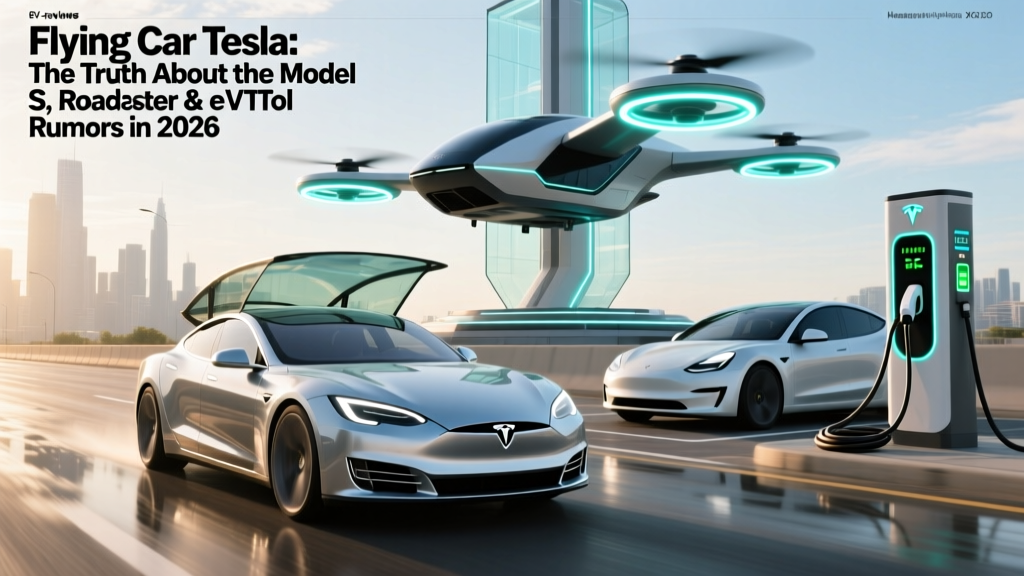
If you've searched for a flying car Tesla lately, you're not alone. Social media and speculative tech forums are awash with renderings of a Tesla-branded eVTOL (electric vertical takeoff and landing) aircraft or a hovering Roadster. The reality, as of early 2026, is straightforward: Tesla does not manufacture, sell, or have an officially announced flying car program.
What Tesla does produce is the fastest-accelerating production sedan on the planet — the 2026 Model S Plaid — and a next-generation Roadster that Elon Musk once teased with a "SpaceX Package" involving cold-gas thrusters. Neither of these vehicles flies. But the persistent search interest in a Tesla flying car reveals something useful about what buyers actually want: futuristic tech, extreme performance, and the feeling of driving something from another decade. Let's ground this conversation in real, purchasable hardware and look at what Tesla actually offers to buyers chasing that next-gen thrill, along with where the eVTOL industry actually stands.
2026 Tesla Model S: The Closest Thing to a Tesla "Spaceship"
Since no Tesla flying car exists, the Model S Plaid remains the brand's halo performance vehicle and the most technologically extreme sedan you can actually buy. Here's the full spec breakdown for the 2026 model year.
| Spec | Long Range | Plaid |
|---|---|---|
| EPA Range | 402 mi | 396 mi |
| Battery (usable) | ~95 kWh, NMC | ~95 kWh, NMC |
| Drivetrain | Dual-Motor AWD | Tri-Motor AWD |
| Horsepower | 670 hp | 1,020 hp |
| 0–60 mph | 3.1 sec | 1.99 sec |
| Top Speed | 155 mph | 200 mph |
| Max DC Fast Charge | 250 kW (CCS/NACS) | 250 kW (CCS/NACS) |
| 10–80% DC Charge | ~30 min | ~30 min |
| Level 2 Home Charge | 11.5 kW (~44 mi/hr) | 11.5 kW (~44 mi/hr) |
| MPGe (combined) | 120 MPGe | 116 MPGe |
| Base MSRP | $74,990 | $89,990 |
| Battery Warranty | 8 yr / 150,000 mi | 8 yr / 150,000 mi |
Source: EPA fueleconomy.gov and Tesla's official specifications page.
Charging Speed: How Fast Can the Model S Actually Replenish?
| Charging Level | Power | Miles Added per Hour | Notes |
|---|---|---|---|
| Level 1 (120V household) | ~1.4 kW | ~4–5 mi/hr | Emergency/top-up only |
| Level 2 (240V home Wall Connector) | 11.5 kW | ~44 mi/hr | Full charge in ~9 hours |
| DC Fast (Tesla Supercharger V3) | Up to 250 kW | ~200 mi in 15 min | Peak rate; tapers above 50% SoC |
| DC Fast (CCS station, adapter) | Up to 250 kW | Similar to Supercharger | Requires CCS adapter (now included) |
The Model S peaks at 250 kW on DC fast charging. That's a strong rate, though it's worth noting that some competitors — including the Hyundai Ioniq 5 and Porsche Taycan — hit 350 kW on 800-volt architectures. The Model S sustains its peak rate through roughly 40% state of charge, then the charge curve tapers significantly. A 10–80% session takes approximately 30 minutes at a V3 Supercharger, which is adequate for road trips but no longer class-leading in 2026.
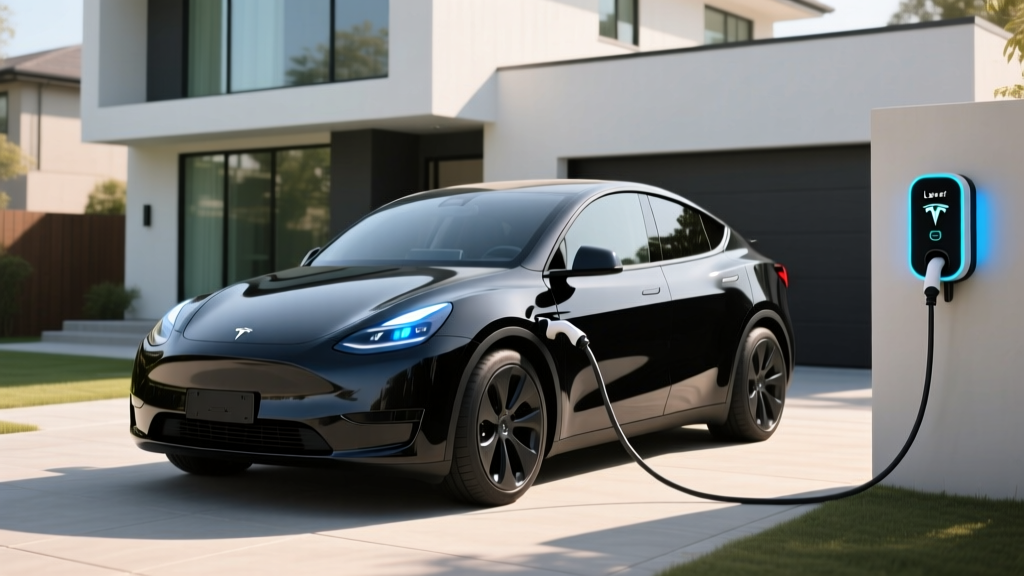
For daily use, a home Level 2 Tesla Wall Connector ($425 for the unit, plus $500–$2,000 for professional installation depending on your electrical panel) is the practical choice. At 11.5 kW, you'll add roughly 44 miles of range per hour of charging, easily replenishing a day's commute overnight.
The Roadster "SpaceX Package" — Did Tesla Ever Promise Flight?
The flying car Tesla rumors trace back to two sources. First, Elon Musk's repeated (and often delayed) next-generation Tesla Roadster, originally announced in 2017 with a target 0–60 time of 1.9 seconds and a 620-mile range. Second, Musk's 2019 tweet mentioning an optional "SpaceX Package" that would use cold-gas thrusters to improve cornering, braking, and — yes — theoretically allow the car to "hover." That concept was never an actual flying car; it described small compressed-air jets for performance enhancement, not sustained flight.
As of 2026, the new Roadster remains listed on Tesla's website as upcoming with no firm delivery date. Preliminary specs suggest a starting price around $200,000 and a claimed 620-mile range, but these figures are unverified by the EPA and should be treated as estimates. The "SpaceX Package" has not been detailed in any official engineering release. Tesla has never filed for FAA certification on any aircraft, and the company's focus remains firmly on scaling Cybertruck production, launching a more affordable compact model, and expanding its energy storage business.
What About Real eVTOL "Flying Cars" in 2026?
The actual flying car industry — properly called eVTOL — is advancing independently of Tesla. Companies like Joby Aviation, Archer Aviation, and Volocopter are pursuing FAA type certification for passenger-carrying electric air taxis. Joby, backed by Toyota, has completed extensive flight testing and targets initial commercial service in select cities by late 2026 or 2027. These are not personal vehicles you'll park in your garage; they're air-taxi services, similar to Uber but airborne, with expected per-seat pricing in the range of helicopter rides initially.
None of these eVTOL companies are affiliated with Tesla. If you're searching for a flying car Tesla because you want a personal electric aircraft, that product category simply does not exist from any automaker as of 2026. What does exist are increasingly capable ground-based EVs that deliver extraordinary performance and technology.
Pricing, Tax Credits & Ownership Costs
| Trim | Base MSRP | As-Tested (typical) | §30D Credit Eligible? |
|---|---|---|---|
| Long Range | $74,990 | $78,000–$82,000 | Subject to sourcing & income rules |
| Plaid | $89,990 | $93,000–$100,000 | Subject to sourcing & income rules |
The IRS §30D Clean Vehicle Credit offers up to $7,500 for qualifying new EVs, but eligibility for the 2026 Model S depends on several factors that shift year to year:
- MSRP cap: Sedans must have an MSRP at or below $55,000. The Model S exceeds this cap, meaning it does not qualify for the new-vehicle §30D credit under current rules.
- Buyer income limits: Even if the price cap were met, adjusted gross income cannot exceed $150,000 (single) or $300,000 (joint).
- Battery sourcing & critical minerals: A percentage of battery components must be manufactured or assembled in North America, and critical minerals must be sourced from the U.S. or free-trade-agreement partners.
The practical result: the 2026 Model S does not qualify for the $7,500 federal tax credit because its MSRP is well above the $55,000 sedan cap. Buyers seeking a Tesla with federal credit eligibility should look at the Model 3, which starts under $40,000 and may qualify depending on battery sourcing requirements for the specific build month. Always verify current eligibility on the IRS website or with a tax professional before purchasing.
Interior, Tech & Daily Livability
The 2026 Model S interior remains minimalist and screen-centric. A 17-inch center touchscreen controls virtually all vehicle functions, supplemented by a 12.3-inch driver display and a rear-seat entertainment screen. The cabin seats five adults with the following dimensions:
- Front legroom: 42.7 inches
- Rear legroom: 35.4 inches
- Cargo volume (rear trunk + frunk): 28.0 cu ft (rear) + 3.1 cu ft (frunk) = ~31 cu ft total
- With rear seats folded: ~58 cu ft
The yoke steering wheel remains standard (a conventional round wheel is available as a no-cost option). Tesla's infotainment system includes built-in navigation with real-time Supercharger routing, streaming media, and gaming — the car's AMD Ryzen processor handles titles like Cyberpunk 2077 while parked.
Driver assistance: The Model S ships with Tesla's Basic Autopilot (adaptive cruise, lane centering). Full Self-Driving (Supervised) is available as a $8,000 add-on or $99/month subscription. This is a SAE Level 2 system — it requires active driver supervision at all times and is not autonomous driving. Tesla's FSD has improved significantly in city environments, but it remains a driver-assist tool, not a replacement for an attentive operator.
Pros, Cons & Who Should Buy the Model S
Pros
- Class-leading 402-mile EPA range (Long Range)
- 1.99-second 0–60 in Plaid — fastest production sedan
- Access to Tesla's Supercharger network (20,000+ stalls in North America)
- Over-the-air updates continuously add features
- Strong resale value relative to luxury EV peers
- Generous 8-year/150,000-mile battery warranty
Cons
- Does not qualify for §30D federal tax credit (MSRP cap)
- 250 kW peak DC charge rate trails 800V competitors
- Yoke steering divisive; build quality inconsistent
- No Apple CarPlay or Android Auto
- Insurance premiums 20–40% above average for class
- Repair costs high; body-shop network still limited
Who this EV suits best: The Model S is ideal for tech-forward buyers who want maximum range and acceleration in a premium sedan, frequently road-trip using the Supercharger network, and don't need the cargo space of an SUV. It's less suited for budget-conscious shoppers (the tax credit gap is significant), buyers who prefer traditional luxury materials (BMW i7, Mercedes EQS), or those needing three-row seating.
Frequently Asked Questions
Is there a flying car from Tesla available to buy?
No. Tesla does not manufacture or sell any flying vehicle. The company makes ground-based electric vehicles (Model S, 3, X, Y, Cybertruck). Rumors of a Tesla eVTOL or hover-capable Roadster are unsubstantiated as of 2026.
What is the real-world range of the 2026 Tesla Model S?
The EPA rates the Long Range at 402 miles and the Plaid at 396 miles. Real-world highway driving at 75 mph yields approximately 330–360 miles. In freezing temperatures, expect 280–320 miles. Preconditioning the battery before fast charging helps maintain efficiency.
How fast does the Model S charge at home and on the road?
At home on a Level 2 Tesla Wall Connector (11.5 kW), the Model S adds about 44 miles of range per hour, fully charging overnight in roughly 9 hours. On a DC fast charger, it peaks at 250 kW and charges from 10–80% in approximately 30 minutes.
Does the 2026 Model S qualify for the $7,500 federal EV tax credit?
No. Under current IRS §30D rules, new sedans must have an MSRP at or below $55,000 to qualify. The Model S starts at $74,990, exceeding this cap. The Model 3 may qualify depending on trim and battery sourcing.
Is the Tesla Model S worth buying versus the Lucid Air or Porsche Taycan?
The Model S wins on range (402 mi vs. Lucid Air Pure's 419 mi, but with broader Supercharger access) and acceleration (Plaid's 1.99s 0–60). The Lucid Air offers a more luxurious interior and available 420+ mile range. The Porsche Taycan charges faster (up to 320 kW on 800V) and delivers superior handling dynamics but sacrifices range. Choose the Model S for the Supercharger network and tech ecosystem; choose the Air for luxury and efficiency; choose the Taycan for driving engagement.
Will Tesla ever make a flying car?
Tesla has made no official announcement regarding any aircraft or eVTOL program. Elon Musk's companies (SpaceX) work in aerospace, but Tesla's public filings, earnings calls, and product roadmap contain no flying vehicle. If this changes, it will be announced through official Tesla channels — not social media speculation.
For the latest on federal EV incentive rules, visit the IRS Clean Vehicle Credits page. For safety ratings, check the NHTSA ratings database.