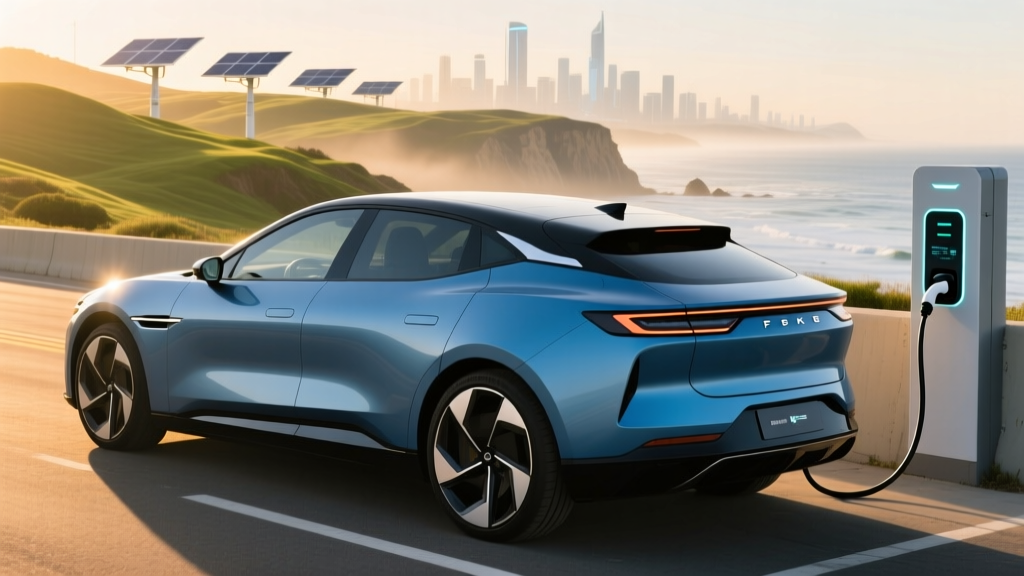
The Fisker Ocean One launched as the flagship trim of Henrik Fisker's second automotive venture, promising a compelling mix of range, sustainable materials, and distinctive design. As a limited-production launch edition, the Ocean One was positioned above the Extreme and Ultra trims, offering the full-feature experience with the largest battery pack available. Whether you're evaluating one on the secondary market or comparing it against current rivals, this profile covers every spec that matters to an EV buyer.
EPA Estimated Range: 360 miles (Extreme/One AWD with 113 kWh pack)
Real-World Expectation: 280–310 miles at sustained highway speeds (70–80 mph); 240–270 miles in sub-freezing winter conditions. The large NMC battery provides a generous buffer, but aerodynamic drag and cold-weather chemistry limitations apply universally. Expect closer to 330–340 miles in mixed city/suburban driving with moderate regen use.
Fisker Ocean One: Key Specifications at a Glance
| Specification | Fisker Ocean One (AWD) |
|---|---|
| EPA Range | 360 miles |
| Battery Capacity | 113 kWh usable (NMC lithium-ion, "Hyper Range") |
| Drivetrain | Dual-motor AWD |
| Horsepower | 550 hp (Earth mode); 275 hp (Sport base) |
| 0–60 mph | 3.7 seconds (Earth/Boost mode) |
| Max DC Fast Charge | ~250 kW peak |
| 10–80% DC Charge Time | ~33 minutes (est.) |
| Level 2 Home Charging | 11 kW onboard charger (~32 mi/hr) |
| Efficiency | ~87 MPGe combined; ~39 kWh/100 mi |
| Cargo Volume | ~32 cu ft (rear seats up); ~65 cu ft (folded) |
| Base MSRP (at launch) | $68,999 (Ocean One); $61,499 (Extreme) |
| Battery/Powertrain Warranty | 6 years / 60,000 miles (original); post-bankruptcy coverage uncertain |
Battery Chemistry, Capacity, and Degradation Outlook
The Ocean One uses the "Hyper Range" battery pack — a 113 kWh (usable) NMC (nickel manganese cobalt) lithium-ion battery supplied by CATL. NMC chemistry offers higher energy density than LFP (lithium iron phosphate), which is why Fisker achieved 360 miles of EPA range without an excessively heavy pack. However, NMC cells are more sensitive to sustained high states of charge and extreme temperatures than LFP alternatives.
Degradation expectations: NMC packs typically lose 8–12% capacity over the first 100,000 miles under normal use. Fisker's original battery warranty was 6 years/60,000 miles with a 70% capacity retention threshold — notably shorter than the industry-standard 8 years/100,000 miles offered by Tesla, Hyundai, and Ford. Following Fisker Inc.'s Chapter 11 bankruptcy filing in June 2024, warranty enforcement has become uncertain. Owners should budget for potential out-of-pocket battery diagnostics and replacements, which for a 113 kWh NMC pack could range from $18,000–$28,000 if sourced through third-party suppliers.
Owner tip: To maximize NMC longevity, keep daily charging between 20–80% SoC, use the 100% charge only before long trips, and precondition the battery before DC fast charging in cold weather.
Charging Speeds: DC Fast, Level 2, and the Real-World Curve
| Charging Level | Power (kW) | Miles Added per Hour | Notes |
|---|---|---|---|
| Level 1 (120V household) | ~1.4 kW | ~4 mi/hr | Emergency/trickle only; 90+ hrs for full charge |
| Level 2 (240V home/public) | 11 kW (onboard max) | ~32 mi/hr | Full charge in ~10–11 hrs; ideal for overnight |
| DC Fast Charge | ~250 kW peak | Up to ~750 mi/hr (peak) | 10–80% in ~33 min; tapers significantly above 80% |
The Ocean One's DC fast-charging capability peaks at approximately 250 kW on a compatible CCS1 station. However, as with all large NMC packs, the charging curve is not flat. Peak speeds are sustained roughly between 10–40% SoC. Between 40–70%, expect 150–180 kW. Above 80%, the BMS throttles aggressively to protect cell health — often dropping below 50 kW. This means a 10–90% charge will take closer to 50 minutes, not the 33-minute 10–80% figure.
Connector note: The Ocean One ships with a CCS1 port. With the industry shift toward NACS (Tesla's connector), Fisker had committed to a NACS adapter, but post-bankruptcy availability of official adapters is limited. Third-party CCS-to-NACS adapters (such as those from Lectron or A2Z) are available for ~$200–$300, enabling access to Tesla Supercharger V3/V4 stations.
Level 2 home charging: The 11 kW onboard charger is competitive. On a 48-amp Level 2 home station (such as a ChargePoint Home Flex or Tesla Wall Connector), you'll recover roughly 32 miles of range per hour, meaning a depleted-to-full overnight charge is realistic for most daily driving patterns. A 240V/60A circuit installation typically costs $800–$2,000 depending on panel proximity and local permitting, per U.S. Department of Energy estimates.
Performance and Driving Dynamics
In Earth mode (the performance drive setting), the dual-motor AWD powertrain delivers 550 horsepower and launches the Ocean One from 0–60 mph in a claimed 3.7 seconds. That puts it in the same acceleration bracket as a Tesla Model Y Performance and notably quicker than a Ford Mustang Mach-E GT. Base Sport mode limits output to 275 hp for efficiency-oriented driving.
The Ocean One's ride quality drew praise in early reviews for its compliant suspension tuning — a deliberate choice that prioritizes comfort over sportiness. The steering is light and numb by enthusiast standards, but acceptable for the family-SUV buyer. At 5,400+ lbs curb weight, you feel the mass during aggressive cornering, but the low center of gravity (battery pack under the floor) keeps body roll manageable.
Regenerative braking: The Ocean offers adjustable regen but does not provide true one-pedal driving to a full stop in all modes. Expect to use the friction brakes at low speeds more than in a Tesla or Hyundai Ioniq 5.
Interior Space, Cargo, and Standout Tech
The Ocean is a midsize two-row SUV with generous interior volume. Rear legroom measures approximately 38.5 inches — adequate for adults on longer trips. Cargo space behind the second row is roughly 32 cubic feet, expanding to about 65 cubic feet with the 60/40 split rear seats folded. There is no front trunk (frunk), a notable omission in a segment where the Hyundai Ioniq 5 and Ford Mach-E both offer one.
Standout tech features:
- California Mode: All windows (including the rear hatch glass and "Solar Tailgate" rear window) lower simultaneously for an open-air experience — a genuine differentiator.
- Revolve Screen (17.1-inch): The center touchscreen rotates between a landscape "Control" mode and a portrait "Hollywood" mode for media consumption while parked. Interface responsiveness was inconsistent in early firmware versions.
- Solar Roof (Fisker Intelligent Solar Roof): Integrated solar cells on the roof can add up to ~1,500 miles of range per year under ideal sun conditions (~5 miles/day). Real-world gains vary enormously by climate and parking habits.
- Sustainable materials: Recycled plastics, reclaimed rubber, and vegan upholstery throughout. Build quality was mixed in early-production units.
Notable drawbacks:
- Infotainment software bugs (improved via OTA updates, but long-term support is now uncertain post-bankruptcy).
- No frunk reduces total utility versus competitors.
- Limited service center network — Fisker relied on mobile service and third-party partnerships, many of which have dissolved.
- ADAS suite (Fisker Intelligent Pilot) uses a camera-and-radar setup rated at SAE Level 2. It is not autonomous driving — the driver must remain fully engaged at all times.
Pricing, Trim Levels, and Federal Tax Credit Eligibility
| Trim | Original MSRP | Estimated Used Price (2026) | Federal Credit Eligibility |
|---|---|---|---|
| Ocean Sport (FWD) | $37,499 | $18,000–$24,000 | Used EV credit (§25E): up to $4,000 if buyer income qualifies |
| Ocean Ultra (AWD) | $52,999 | $25,000–$33,000 | Used EV credit (§25E): up to $4,000 |
| Ocean Extreme (AWD) | $61,499 | $30,000–$40,000 | Used EV credit (§25E): up to $4,000 |
| Ocean One (AWD) | $68,999 | $32,000–$42,000 | Used EV credit (§25E): up to $4,000 |
Critical tax credit note: The Fisker Ocean is no longer eligible for the new-vehicle §30D federal tax credit ($7,500) because Fisker Inc. ceased production and the company is not an active manufacturer. However, buyers purchasing a pre-owned Ocean may qualify for the §25E Used Clean Vehicle Credit — up to $4,000 or 30% of the sale price (whichever is less). Eligibility requires:
- Vehicle sale price must be $25,000 or less (this may disqualify higher-trim Ocean One/Extreme examples priced above that threshold).
- Buyer adjusted gross income must not exceed $75,000 (single), $112,500 (head of household), or $150,000 (joint filers).
- Vehicle must be at least two model years old.
- Must be purchased from a licensed dealer (private-party sales do not qualify).
- The credit can be transferred to the dealer at point of sale as an immediate price reduction.
Consult a tax professional and review current IRS §25E guidelines before purchasing, as rules and dealer participation may vary.
Fisker Ocean One vs. Key Competitors: Is It Worth Buying?
✅ Pros
- Class-leading 360-mile EPA range
- Distinctive design with California Mode open-air feature
- Solar roof adds modest passive range
- Strong 3.7-second 0–60 acceleration
- Sustainable interior materials
- Significant depreciation = deep value on the used market
❌ Cons
- Fisker Inc. bankrupt — warranty/service network dissolved
- Shorter-than-industry battery warranty even when active (6yr/60k)
- Infotainment software historically buggy
- No frunk
- Spare parts availability increasingly uncertain
- Resale value remains depressed and unpredictable
- ADAS features may lose OTA support
Decision framework:
- You prioritize maximum range and are comfortable accepting elevated ownership risk.
- You can source one under $25,000 to qualify for the §25E used-EV credit.
- You have access to reliable third-party EV service in your area.
- You value distinctive design and the solar/open-air features over mainstream reliability.
- You need dependable warranty coverage and an established service network.
- You plan to own the vehicle 5+ years and want predictable long-term support.
- You rely on OTA software updates and active ADAS development.
- You want a proven charging network (NACS/Supercharger) without adapters.
Who Is the Fisker Ocean One Best Suited For?
The Ocean One makes the most sense for a tech-forward commuter or small family who values range above all else and is willing to accept the risks of owning a vehicle from a defunct manufacturer. It's a strong road-trip EV thanks to the 360-mile range and capable DC fast charging — but the lack of a robust service network makes it a risky choice for anyone who can't tolerate unexpected downtime or out-of-pocket repair costs.
It is not ideal for buyers who want a worry-free ownership experience, those who tow frequently (no official tow rating was ever published for AWD models), or anyone in a region without independent EV-savvy mechanics.
Frequently Asked Questions
What is the real-world range of the Fisker Ocean One?
The EPA rates the Ocean One (AWD, 113 kWh pack) at 360 miles. In real-world highway driving at 70–80 mph, expect 280–310 miles. In winter conditions below 32°F, range can drop to 240–270 miles due to battery chemistry limitations and cabin heating demands. City driving with regenerative braking yields results closer to the EPA sticker, around 330–340 miles.
How fast does the Fisker Ocean One charge?
On a DC fast charger, the Ocean One peaks at approximately 250 kW, achieving a 10–80% charge in roughly 33 minutes under ideal conditions. Above 80%, charging slows dramatically to protect the NMC cells. At home on a Level 2 (240V) charger at 11 kW, you'll add about 32 miles of range per hour, fully recharging overnight in 10–11 hours.
Does the Fisker Ocean One qualify for the federal EV tax credit?
No — not the new-vehicle §30D credit, since Fisker is no longer manufacturing. However, a used Ocean One purchased from a licensed dealer for $25,000 or less may qualify for the §25E Used Clean Vehicle Credit (up to $4,000), subject to buyer income limits. Many Ocean One examples sell above $25,000, which would disqualify them. Always verify current IRS rules before purchasing.
Is the Fisker Ocean One worth buying in 2026 vs. a Tesla Model Y or Hyundai Ioniq 5?
It depends on your risk tolerance. The Ocean One offers more EPA range (360 mi) than a Model Y Long Range (~310 mi) or Ioniq 5 (~303 mi) and can be had at steep discounts. However, Fisker's bankruptcy means no active warranty support, uncertain parts supply, and no OTA update pipeline. If long-term reliability and service infrastructure matter, the Model Y or Ioniq 5 are safer choices. If you want maximum range at a bargain price and can self-manage maintenance risk, the Ocean One is compelling.
What happens if the Fisker Ocean One battery needs replacement?
With Fisker's service network dissolved, battery replacement would need to be handled by an independent EV specialist or through CATL-sourced cells via third-party suppliers. Estimated cost for a full 113 kWh NMC pack replacement is $18,000–$28,000 including labor. This is a significant financial risk that buyers should factor into total cost of ownership calculations.
Can the Fisker Ocean One use Tesla Superchargers?
Not natively — the Ocean One has a CCS1 port. However, third-party CCS-to-NACS adapters (approximately $200–$300) enable access to Tesla Supercharger V3 and V4 stations. Charging speeds will be limited by the adapter's rated capacity and the Ocean's BMS, typically achieving 150–200 kW at V3 stalls.
Sources: EPA fuel economy data via fueleconomy.gov; IRS tax credit guidelines at irs.gov; Fisker Inc. original press specifications. Pricing and availability reflect secondary-market conditions as of early 2026. Always verify current tax credit rules with a qualified tax professional.