The Purple Rivian R1S at a Glance
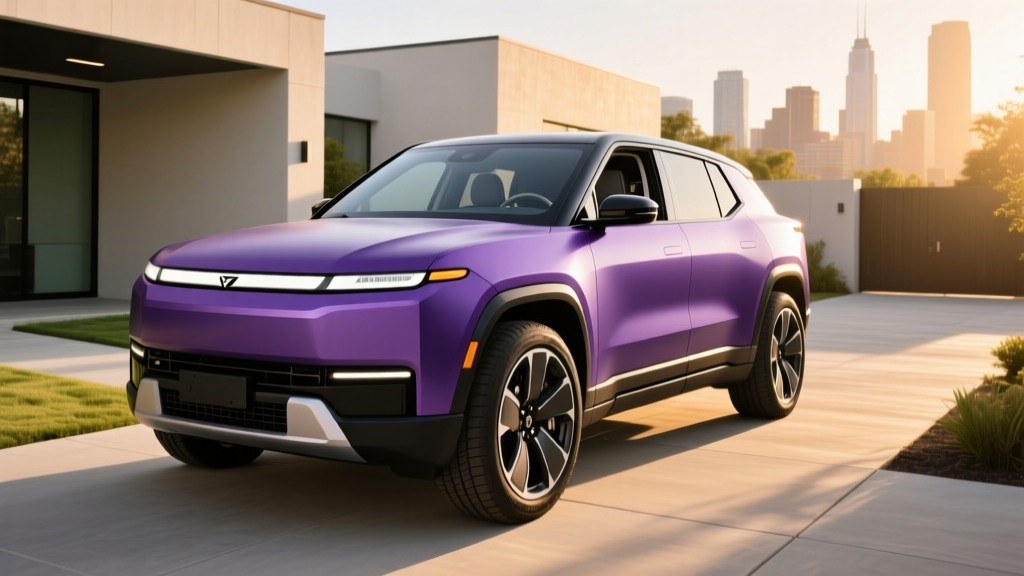
The Rivian R1S has always been a head-turner among three-row electric SUVs, but nothing grabs attention at a charging station quite like a purple Rivian R1S. Rivian's exclusive El Cap Granite and limited-run colorways have cultivated a following, and the custom-order paint program means a deep violet or aubergine R1S is one of the most distinctive vehicles on the road in 2026. Beyond the paint, the R1S is a serious, data-rich electric utility vehicle — and this review breaks down every number that matters.
| Specification | R1S Dual-Motor (Max Pack) | R1S Tri-Motor | R1S Quad-Motor |
|---|---|---|---|
| EPA Range | 410 miles | 390 miles | 370 miles |
| Battery (usable) | ~149 kWh (NMC) | ~149 kWh (NMC) | ~149 kWh (NMC) |
| Horsepower | 665 hp | 850 hp | 1,025 hp |
| 0–60 mph | 4.5 sec | 3.6 sec | 2.9 sec |
| Drivetrain | AWD (Dual-Motor) | AWD (Tri-Motor) | AWD (Quad-Motor) |
| Max DC Charge Rate | 220 kW | 220 kW | 220 kW |
| 10–80% DC Time | ~42 min | ~42 min | ~42 min |
| Level 2 Charge Rate | 11.5 kW | 11.5 kW | 11.5 kW |
| Towing Capacity | 7,700 lbs | 7,700 lbs | 7,700 lbs |
| Base MSRP (2026) | $99,000 | $109,000 | $125,000 |
Source: Rivian official specifications and fueleconomy.gov.
Real-World Range: What the EPA Sticker Doesn't Tell You
EPA Estimated: 410 miles (Dual-Motor Max Pack)
Real-World Expectation: 320–360 miles on highway road trips at 70–75 mph; 280–310 miles in sub-freezing temperatures with cabin heat.
The 410-mile EPA figure on the Dual-Motor Max Pack is among the highest of any production three-row SUV sold in the U.S. However, the R1S is a 6,900-pound vehicle with the aerodynamic profile of a traditional SUV, not a teardrop. In real-world highway testing at sustained 75 mph speeds, efficiency drops to roughly 2.2–2.4 kWh/mile, yielding a practical range of 330–360 miles on a full charge in mild weather.
Cold weather compounds this. Lithium-ion NMC chemistry loses roughly 15–25% of usable range at 20°F, and the R1S's large cabin volume demands significant energy for heating — even with its standard heat pump. Expect 280–310 real-world miles in winter conditions. Preconditioning the battery before DC fast charging is critical in cold weather; the R1S does this automatically when you navigate to a charger in the infotainment system, warming the pack to optimize charge acceptance.
The Standard Pack (105 kWh usable, ~270 miles EPA) is available on lower trims for buyers who primarily commute and want a lower entry price, but the Max Pack is the configuration most long-distance travelers should target.
Charging Speed: DC Fast, Level 2, and the Curve Reality
| Charging Level | Power / Rate | Estimated Speed |
|---|---|---|
| Level 1 (120V household) | ~1.4 kW | ~3–4 miles/hour |
| Level 2 (240V home/work) | 11.5 kW (48A) | ~25 miles/hour |
| DC Fast Charge (peak) | 220 kW | 10–80% in ~42 minutes |
| DC Fast Charge (sustained avg) | ~150 kW avg | ~180 miles in 30 minutes |
Rivian quotes a peak DC fast-charge rate of 220 kW on the Max Pack, but as with all EVs, that peak is not sustained across the entire session. The charge curve tapers significantly above 60% state of charge (SoC), dropping to under 100 kW past 80%. A 10–80% session takes approximately 42 minutes at a 350 kW-capable station, and a 10–90% session stretches closer to 60 minutes. For road-trip planning, budget 30–35 minutes per stop to go from 15% to 75% — the sweet spot where the curve is flattest and charging is fastest.
At home on a Level 2 wall connector (Rivian's own or a third-party unit like ChargePoint or Grizzl-E), the 11.5 kW onboard charger adds roughly 25 miles of range per hour. A full 10–100% charge from a depleted Max Pack takes about 14 hours on Level 2 — easily achievable overnight. Note that installing a 60-amp circuit (to deliver the full 48A/11.5 kW) requires a licensed electrician and a panel with sufficient headroom; many homes with 100-amp service will need a panel upgrade costing $1,500–$3,000.
Rivian uses the NACS (Tesla-style) connector on all 2026 R1S vehicles, granting native access to the Tesla Supercharger network — the most reliable and extensive DC fast-charging network in the U.S. — without an adapter.
Performance and Drivetrain
Even the "base" Dual-Motor R1S produces 665 horsepower and hits 0–60 mph in 4.5 seconds — quicker than most sports sedans from a decade ago. The Tri-Motor (850 hp, 3.6 sec) and Quad-Motor (1,025 hp, 2.9 sec) exist in supercar territory while carrying seven passengers and towing 7,700 pounds.
The Quad-Motor's independent motor-per-wheel architecture enables torque vectoring across all four corners, which translates to remarkable traction on loose surfaces and a genuinely engaging driving dynamic on twisty roads. The air suspension offers adjustable ride height — from a low "Park" mode for easier entry to over 14 inches of ground clearance in off-road mode, rivaling dedicated off-road SUVs.
Regenerative braking is adjustable via steering-wheel paddles and can be set strong enough for near one-pedal driving in city traffic. The brake pedal feel is firm and linear — a notable improvement over early-production R1S models.
Interior Space, Cargo, and Practicality
The R1S seats up to seven passengers across three rows. Realistically, the third row accommodates children or adults on short trips; legroom in the third row is 30.4 inches, which is tight for adults on long drives. Second-row captain's chairs (standard on most trims) offer generous 38.9 inches of legroom and are the most comfortable seats in the cabin.
Cargo volume is competitive:
- Behind third row: 10.4 cu ft (enough for a few grocery bags or a small suitcase)
- Behind second row (third row folded): 46.7 cu ft
- Behind first row (all rear seats folded): 78.4 cu ft
- Front trunk (frunk): 11.0 cu ft — a sealed, drainable compartment ideal for muddy gear or ice
The R1S lacks the under-floor rear cargo well that some competitors offer, but the frunk partially compensates. The gear tunnel — a signature Rivian feature running through the vehicle between the rear wheels — is not available on the R1S (it's exclusive to the R1T pickup).
Pricing, Trims, and Federal Tax Credit Eligibility
| Configuration | 2026 Base MSRP | Estimated After §30D Credit* |
|---|---|---|
| R1S Dual-Motor Standard Pack | $79,900 | $72,400 (if eligible) |
| R1S Dual-Motor Max Pack | $99,000 | $91,500 (if eligible) |
| R1S Tri-Motor Max Pack | $109,000 | $101,500 (if eligible) |
| R1S Quad-Motor Max Pack | $125,000 | $117,500 (if eligible) |
*Federal tax credit eligibility is complex and varies by buyer. See checklist below.
The R1S is a premium vehicle, and the price reflects that. A custom purple paint option — whether through Rivian's standard color palette or the exclusive "Colors" program — typically adds $0–$2,500 depending on the selection. As-tested pricing for a well-equipped Dual-Motor Max Pack with premium interior and adventure package routinely lands between $105,000 and $112,000 before incentives.
IRS §30D Federal EV Tax Credit Checklist (2026 rules):
- SUV MSRP cap: Vehicle must have an MSRP at or below $80,000. Only the R1S Dual-Motor Standard Pack qualifies; Max Pack, Tri-Motor, and Quad-Motor trims exceed the cap and are ineligible.
- Buyer income cap: Modified AGI must not exceed $300,000 (married filing jointly), $225,000 (head of household), or $150,000 (single).
- Battery sourcing: A percentage of critical minerals and battery components must be sourced from the U.S. or FTA partners. Rivian has worked to localize its supply chain, but buyers should verify current-year compliance on the IRS qualifying vehicle list at irs.gov.
- Point-of-sale transfer: Eligible buyers can transfer the credit to the dealer at purchase, reducing the upfront price by up to $7,500 rather than waiting for a tax refund.
In practice, only the base Standard Pack R1S Dual-Motor at $79,900 MSRP clears the $80,000 SUV cap. Buyers eyeing the Max Pack for its 410-mile range should plan their purchase without relying on the federal credit. State and utility incentives may still apply — check afdc.energy.gov for local programs.
Efficiency: MPGe and Energy Consumption
The R1S Dual-Motor Max Pack earns an EPA-rated 73 MPGe combined (approximately 46 kWh per 100 miles). This is respectable for a 6,900-lb three-row SUV but significantly lower than a sedan like the Tesla Model S or Hyundai Ioniq 6. At the U.S. average electricity rate of ~$0.17/kWh, driving 100 miles costs roughly $7.82 — compared to about $14.50 for a gas SUV averaging 20 MPG at $2.90/gallon.
Efficiency degrades noticeably at sustained highway speeds above 75 mph and when towing. Expect consumption to rise to 55–65 kWh/100mi when towing a 5,000-pound trailer, effectively halving range.
Warranty Coverage
Rivian provides the following warranty on the 2026 R1S:
- Battery pack: 8 years / 175,000 miles (retains ≥70% capacity)
- Drive system (motors, power electronics): 8 years / 175,000 miles
- Bumper-to-bumper: 5 years / 60,000 miles
- Corrosion perforation: 12 years / unlimited miles
The 175,000-mile battery warranty is among the most generous in the industry, surpassing the federal minimum requirement of 8 years/100,000 miles. Rivian's 70% capacity retention threshold is standard; if your Max Pack degrades below ~104 kWh usable within the warranty period, Rivian will repair or replace the battery.
Technology, Driver Assistance, and Standout Features
The R1S runs Rivian's proprietary software stack on a 15.6-inch center touchscreen with a clean, responsive interface. Wireless Apple CarPlay and Android Auto are standard. Over-the-air (OTA) updates are frequent and substantive — Rivian has added features like enhanced camp mode, improved regenerative braking profiles, and new drive modes post-delivery.
Driver assistance is handled by Rivian Driver+, a Level 2 system (per SAE classification) that combines adaptive cruise control and lane-centering on highways. It requires the driver to remain engaged with hands on the wheel and eyes on the road at all times. It is not a self-driving system. In testing, Driver+ performs competently on well-marked interstates but can be hesitant in construction zones and on faded lane markings — typical of all Level 2 systems on the market.
Standout features unique to the R1S include:
- Camp Kitchen: An optional slide-out kitchen system designed for the R1S's cargo area (partnered with Snow Peak).
- Powered tonneau-style cargo cover and integrated air suspension leveling for camping.
- Vehicle-to-load (V2L): Power external devices (up to ~1.9 kW) from the vehicle's battery — useful for camping, tailgating, or emergency backup.
- Highway Assist with automatic lane change: Initiated by the turn signal when Driver+ is active.
Notable drawbacks include the lack of Apple CarPlay integration deeper into the vehicle's native navigation (it runs in a separate window), limited third-row USB-C ports, and the absence of a rear-seat entertainment screen as standard equipment.
Who the Purple Rivian R1S Is For
The purple Rivian R1S — or any R1S — is best suited for:
- Active families who need three rows, cargo flexibility, and the ability to tow a camper or boat on weekends.
- Outdoor enthusiasts who value ground clearance, all-weather AWD traction, V2L capability, and the frunk for gear storage.
- Buyers who want exclusivity — the R1S is still a relatively rare sight compared to the Tesla Model X or even the BMW iX, and a custom purple paint job amplifies that individuality.
It is not the best choice for budget-conscious buyers, those who need maximum third-row comfort for adults, or anyone whose daily commute is under 20 miles (a PHEV may offer better economics in that scenario).
Pros
- Class-leading 410-mile EPA range (Max Pack)
- Genuine off-road capability with air suspension
- 7,700-lb towing capacity
- NACS connector = native Tesla Supercharger access
- 8-year/175,000-mile battery warranty
- V2L capability for camping and backup power
- Distinctive design and custom color options
Cons
- Only base trim qualifies for §30D tax credit
- Tight third-row legroom for adults
- Efficiency drops significantly when towing
- Premium price — $80K–$125K+ depending on config
- Level 2 driver assist requires full driver attention
- Home charging may require electrical panel upgrade
FAQ
What is the real-world range of the purple Rivian R1S?
The EPA rates the R1S Dual-Motor Max Pack at 410 miles. In real-world highway driving at 70–75 mph, expect 330–360 miles in mild weather and 280–310 miles in freezing temperatures. The Standard Pack delivers about 270 miles EPA, or roughly 215–230 miles real-world highway.
How fast does the R1S charge at home and on the road?
On a DC fast charger, the R1S Max Pack peaks at 220 kW and charges from 10–80% in approximately 42 minutes. At home on a Level 2 (240V, 48A) charger, it adds about 25 miles per hour, fully replenishing overnight in roughly 14 hours.
Does the Rivian R1S qualify for the federal EV tax credit?
Only the Dual-Motor Standard Pack at $79,900 MSRP falls under the $80,000 SUV cap required by IRS §30D rules. Max Pack, Tri-Motor, and Quad-Motor trims exceed the cap and are ineligible for the federal credit. Income limits and battery-sourcing requirements also apply — verify at irs.gov.
Is the Rivian R1S worth buying over the Tesla Model X or Kia EV9?
The R1S wins on off-road capability, towing (7,700 lbs vs. the EV9's 4,400 lbs), and build quality. The Tesla Model X offers faster Supercharger access (though the R1S now has native NACS) and a more mature software ecosystem. The Kia EV9 is significantly cheaper ($55K–$70K) with comparable passenger space but less range and no real off-road pretension. If you need rugged utility and distinctive styling, the R1S is the strongest choice.
What does a custom purple paint job cost on the R1S?
Rivian's exclusive color offerings vary by model year and program. Standard colors carry no premium, while "Colors" program selections and custom-order paints can add $0–$2,500. Availability of specific purple or violet shades depends on the current palette — contact Rivian directly or check the configurator for current offerings.
How long will the R1S battery last?
Rivian warranties the battery for 8 years or 175,000 miles at ≥70% capacity retention. Based on NMC chemistry degradation curves and real-world data from early-production R1S vehicles, most owners can expect 85–90% capacity retention after 100,000 miles with normal use. Avoiding frequent charges to 100% and minimizing DC fast charging in extreme cold will extend longevity.