Important context for 2026 readers: Fisker Inc. filed for Chapter 11 bankruptcy in mid-2024 and ceased vehicle production. The Fisker Ocean is no longer manufactured, and new inventory is unavailable. This review evaluates the Ocean as it was delivered for the 2023–2024 model years to help prospective buyers assess used or residual-new examples, understand the interior's strengths and weaknesses, and weigh the ownership risks that come with a discontinued EV from a defunct automaker.
Quick Verdict: A Spacious, Inventive Cabin Let Down by Corporate Collapse
The Fisker Ocean interior was one of the most ambitious in the EV SUV segment. With class-leading cargo volume, a solar roof that trickled in extra range, sustainable materials, and a rotating infotainment screen, it aimed to out-innovate the Tesla Model Y, Hyundai IONIQ 5, and Ford Mustang Mach-E on cabin experience alone. On paper, the 360-mile EPA range (Extreme trim) and 250 kW DC fast-charging were compelling. But Fisker's bankruptcy means no new vehicles, uncertain software support, orphaned parts supply, and a severely compromised ownership proposition. The interior is genuinely impressive — the question is whether that's enough to justify the risk.
Fisker Ocean Spec Sheet at a Glance
| Attribute | Sport / Ultra (Std Range) | Ultra (Hyper Range) | Extreme (Hyper Range) |
|---|---|---|---|
| EPA Range | 250 miles | 340 miles | 360 miles |
| Battery (usable / gross) | ~75 kWh / ~80 kWh (LFP) | ~106 kWh / ~113 kWh (NMC) | ~106 kWh / ~113 kWh (NMC) |
| Drivetrain | FWD, single motor | AWD, dual motor | AWD, dual motor |
| Horsepower | 275 hp | 540 hp | 550 hp |
| 0–60 mph | ~6.9 sec | ~3.9 sec | ~3.7 sec |
| Max DC Fast Charge | ~170 kW | ~250 kW | ~250 kW |
| 10–80% DC Time | ~34 min | ~30 min | ~30 min |
| Level 2 Home Charge | 11 kW (~30 mi/hr) | 11 kW (~30 mi/hr) | 11 kW (~30 mi/hr) |
| MPGe (combined) | ~97 MPGe | ~92 MPGe | ~92 MPGe |
| Original Base MSRP | $37,499 | $49,999 | $68,999 |
| Battery/Powertrain Warranty | 6 years / 75,000 miles (original, now largely void) | ||
Fisker Ocean Interior: Materials, Layout, and Livability
The Ocean's cabin was designed around what Fisker called a "California mode" ethos — airy, sustainable, and tech-forward. The dashboard uses a mix of recycled plastics, reclaimed rubber, and vegan leather alternatives. Fit and finish on early-build examples was inconsistent (panel gaps, rattles reported by owners), though later 2024 builds showed improvement.
Seating and Passenger Space
The Ocean seats five. Front headroom is generous thanks to the available glass solar roof, and the flat EV floor gives rear-seat passengers a comfortable foot position. Rear legroom measures approximately 38.4 inches — competitive with the Model Y (40.5 in) and slightly behind the IONIQ 5 (39.4 in). The rear bench is flat and wide enough for three adults on shorter trips, though the center position is firm.
Cargo Volume and Practicality
This is where the Ocean interior genuinely excels. Behind the second row, you get approximately 32.5 cubic feet of cargo space — more than the Model Y (30.2 cu ft) and Mach-E (29.7 cu ft). Fold the rear seats and that expands to roughly 65.3 cubic feet. There is no front trunk (frunk); Fisker used that space for HVAC and power electronics.
Infotainment and the Revolve Screen
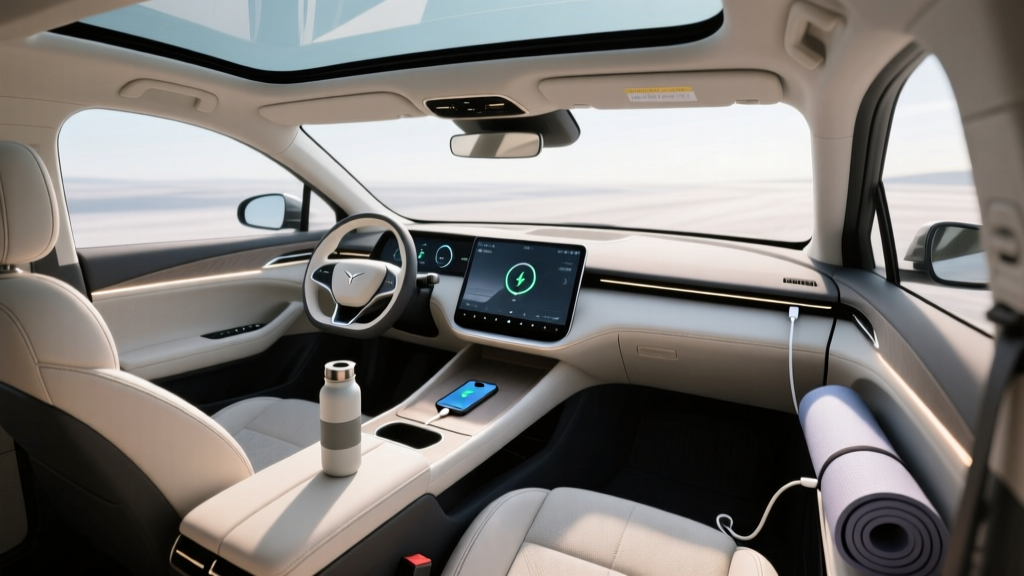
The centerpiece is a 17.1-inch rotating touchscreen Fisker called the "Revolve" display. In "Control Mode" it's landscape-oriented for driving; rotate it to "Hollywood Mode" (portrait) for media playback while parked. The concept is clever, but the execution was plagued by slow response times, buggy navigation, and an interface that reviewers found unintuitive compared to Tesla's or Hyundai's systems. A digital driver cluster and a small secondary screen below supplement the main display.
Standout Interior Features
- Solar Roof (Extreme trim): Photovoltaic cells embedded in the roof added up to ~1,500 miles of range per year under ideal conditions — roughly 4 miles per day of sunlight. A neat party trick, not a range solution.
- California Mode: All windows (including rear quarter glass and the rear hatch glass) lower simultaneously for a convertible-like open-air experience. The rear hatch glass powers down into the tailgate — a genuinely unique feature.
- Sustainable Materials: Recycled nylon carpeting, repurposed rubber, and animal-free upholstery throughout.
- Taco Tray: A fold-out tray integrated into the center console — quirky but occasionally useful.
Notable Interior Drawbacks
- Build-quality inconsistency across early production units
- Infotainment lag and software instability (many OTA updates failed or introduced new bugs)
- No frunk reduces under-hood storage utility
- Rear visibility compromised by thick C-pillars (no rear wiper on some trims)
- With Fisker defunct, replacement interior trim parts are increasingly difficult to source
Real-World Range vs. EPA Estimates
EPA (Extreme trim): 360 miles
Real-world highway (70 mph, moderate temps): ~290–310 miles
Cold-weather (below 32°F, highway): ~240–270 miles
City/mixed driving: ~320–340 miles
The Ocean Extreme's 360-mile EPA rating was among the highest of any production EV SUV when launched. In practice, the large NMC battery delivers strong city efficiency where regenerative braking recovers energy, but highway driving at 70+ mph cuts range by 15–20%. Cold weather compounds this — expect a 25–30% reduction in freezing temperatures, consistent with NMC chemistry's behavior. The Hyper Range Ultra (340 EPA) sees similar proportional losses.
Charging Performance: DC Fast and Home Level 2
The Ocean's charging architecture was competitive at launch but not class-leading by 2026 standards. Here's how it breaks down:
| Level | Power / Rate | Speed / Time | Connector |
|---|---|---|---|
| Level 1 (120V household) | ~1.4 kW | ~4 miles per hour | J1772 |
| Level 2 (240V home/public) | 11 kW | ~30 miles per hour | J1772 / CCS1 |
| DC Fast Charge (Hyper Range) | Peak 250 kW | 10–80% in ~30 min | CCS1 |
| DC Fast Charge (Std Range) | Peak ~170 kW | 10–80% in ~34 min | CCS1 |
A critical real-world note: the 250 kW peak on Hyper Range trims is not sustained. Like most EVs, the Ocean's charge curve tapers significantly above 60–70% state of charge. Expect average charging power of roughly 140–160 kW across a full 10–80% session. At an Electrify America or EVgo 350 kW station, you'll add roughly 180 miles in 20 minutes under optimal battery-preconditioned conditions.
The Ocean ships with a CCS1 connector. With the industry's shift to NACS (Tesla's connector), CCS1 adapters for Tesla Superchargers are available from third-party manufacturers, but compatibility should be verified before purchase. Home Level 2 charging at 11 kW means a full overnight charge from 10–100% takes roughly 10–11 hours on the Hyper Range battery — adequate for daily use.
Pricing, Tax Credits, and the Used-Market Reality
| Trim | Original MSRP | Current Used Market (2026 est.) | Federal §30D Credit |
|---|---|---|---|
| Sport (Std Range) | $37,499 | $18,000–$24,000 | Not eligible (new); §25E used credit may apply |
| Ultra (Hyper Range) | $49,999 | $25,000–$33,000 | Not eligible (new); §25E used credit may apply |
| Extreme (Hyper Range) | $68,999 | $35,000–$45,000 | Not eligible (new); §25E used credit may apply |
Because Fisker is defunct and no new Oceans are being produced, the IRS §30D new clean vehicle credit is no longer applicable. However, buyers purchasing a used Ocean may qualify for the §25E previously owned clean vehicle credit — up to $4,000 or 30% of the sale price (whichever is lower), subject to income caps ($75,000 single / $150,000 joint) and a sale price cap of $25,000. This means only lower-priced used Sport or Ultra examples may qualify, and only through qualified dealers. Consult a tax professional for eligibility specifics.
Who Is the Fisker Ocean For (and Who Should Avoid It)?
- You find a well-priced used example and accept orphan-vehicle risk
- You prioritize cargo space and open-air cabin features over brand stability
- You have home Level 2 charging and rarely rely on public DC fast-charging
- You value the sustainable-materials interior aesthetic
- You need reliable warranty coverage or dealer service access
- You depend on over-the-air software updates and app connectivity
- You want a proven ownership track record and strong resale value
- You road-trip frequently and need dependable public charging support
How It Compares: Ocean vs. Key Competitors
For buyers cross-shopping the used Fisker Ocean interior against current alternatives:
| Attribute | Fisker Ocean Extreme | Tesla Model Y LR | Hyundai IONIQ 5 LR AWD | Ford Mustang Mach-E ER AWD |
|---|---|---|---|---|
| EPA Range | 360 mi | 320 mi | 290 mi | 312 mi |
| Cargo (rear seats up) | 32.5 cu ft | 30.2 cu ft | 27.2 cu ft | 29.7 cu ft |
| DC Fast Charge Peak | 250 kW | 250 kW | 350 kW | 150 kW |
| Manufacturer Status | Defunct | Active | Active | Active |
| Warranty Backing | None | 4yr/50k + 8yr/120k battery | 5yr/60k + 10yr/100k battery | 3yr/36k + 8yr/100k battery |
The Ocean's interior volume and range are competitive or superior, but the lack of manufacturer support is a dealbreaker for most buyers. The EPA's fueleconomy.gov listings confirm the Ocean's efficiency ratings, but real-world ownership now operates entirely outside warranty protection.
Frequently Asked Questions
What is the real-world range of the Fisker Ocean?
The Extreme trim's 360-mile EPA rating translates to roughly 290–310 miles at highway speeds in moderate temperatures, and 240–270 miles in freezing cold. The Standard Range Sport trim (250 EPA) delivers approximately 200–220 miles highway.
How fast does the Fisker Ocean charge?
Hyper Range trims peak at 250 kW on DC fast chargers, achieving 10–80% in approximately 30 minutes. Standard Range peaks around 170 kW (10–80% in ~34 min). Home Level 2 charging at 11 kW adds roughly 30 miles per hour.
Does the Fisker Ocean qualify for any federal tax credit?
Not the §30D new-vehicle credit — Fisker is defunct and no new units are produced. The §25E used-vehicle credit (up to $4,000) may apply to used purchases under $25,000 from qualified dealers, subject to buyer income limits. Verify current rules at IRS.gov.
Is the Fisker Ocean worth buying in 2026?
Only at a steep discount and only if you accept significant ownership risk: no warranty backing, uncertain software/connectivity longevity, and parts scarcity. The interior and range are genuinely compelling, but the orphan-vehicle status makes it a speculative purchase best suited for EV enthusiasts with mechanical aptitude and tolerance for risk.
What are the biggest pros and cons of the Fisker Ocean interior?
Pros: Class-leading cargo space, unique California Mode open-air feature, solar roof (Extreme), sustainable materials, spacious rear seat, rotating 17.1-inch display concept.
Cons: No frunk, inconsistent build quality, buggy infotainment software, no manufacturer support for repairs or updates, parts increasingly scarce, no rear wiper on some trims.
What happened to Fisker's warranty?
Fisker's original 6-year/75,000-mile battery and powertrain warranty is effectively void following the company's bankruptcy. Some third-party extended warranty providers may offer limited coverage, but comprehensive EV powertrain protection is difficult to secure for a discontinued model.