Tesla PowerHub and Megapack: What's Actually in the Box?
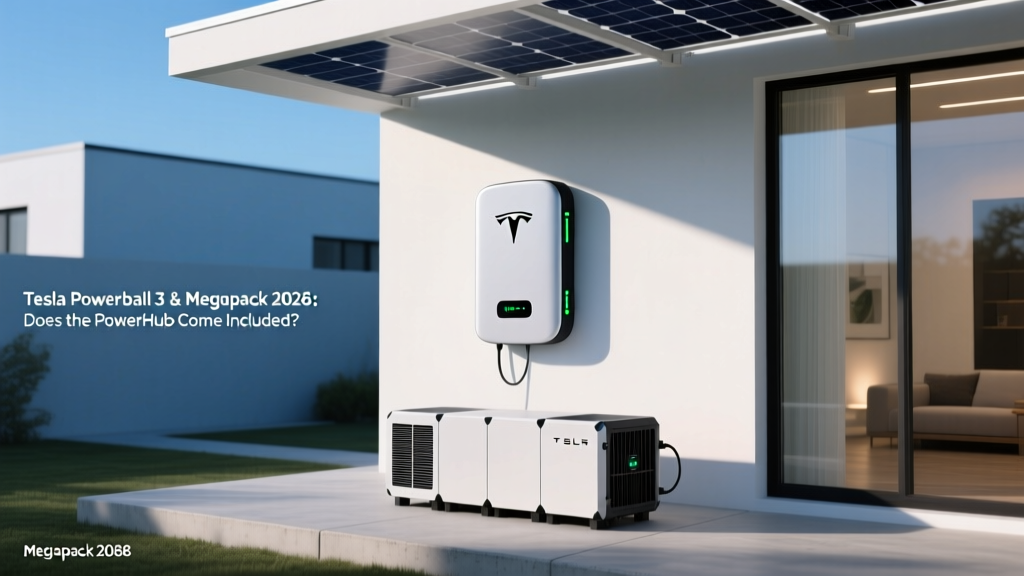
If you've been researching Tesla's utility-scale energy storage lineup, you've likely encountered the question: is the Tesla PowerHub included with Megapack? The short answer is yes — but the details matter enormously depending on whether you're evaluating a Megapack 2 XL installation for a utility project or a Powerwall 3 setup for residential use. The PowerHub serves as the integrated bi-directional inverter and gateway controller, and its inclusion varies by product tier and configuration.
Before we unpack the technical specifics, it's critical to clarify something upfront: Megapack and Powerwall serve fundamentally different markets. Megapack is Tesla's utility-scale battery energy storage system (BESS), sold to grid operators, utilities, and large commercial developers. Powerwall 3 is the residential counterpart. The PowerHub branding has evolved across Tesla's product lines, and in 2026, it most commonly refers to the integrated power electronics module within Megapack 2 XL units as well as the gateway component in Powerwall 3 systems.
Megapack 2 XL: Specs, Capacity, and the PowerHub Role
The Megapack 2 XL is Tesla's current flagship utility-scale battery, and understanding what's included requires understanding its architecture. Each Megapack 2 XL enclosure contains:
- Battery modules: Lithium iron phosphate (LFP) cells, chosen for their longer cycle life, thermal stability, and lower cost compared to NMC chemistry
- Integrated PowerHub (inverter/PCS): A bi-directional power conversion system built directly into the enclosure — this is the "PowerHub" component
- Thermal management system: Liquid cooling and heating for optimal cell temperature across climates
- Switchgear and controls: Integrated disconnects and the Megapack controller for grid interconnection
The key point: yes, the PowerHub power conversion electronics are included within each Megapack 2 XL unit. You do not need to procure a separate inverter system. Tesla designs Megapack as a fully integrated, turnkey BESS — the battery cells, inverter, thermal management, and controls all ship in a single enclosure roughly the size of a standard shipping container.
| Specification | Value |
|---|---|
| Energy Capacity (per unit) | ~3.9 MWh (usable) |
| Power Output (per unit) | ~1.25 MW continuous |
| Battery Chemistry | LFP (Lithium Iron Phosphate) |
| Round-Trip Efficiency | ~92% (AC-to-AC) |
| Enclosure Dimensions | ~44 ft L × 8 ft W × 9.5 ft H |
| Weight | ~84,000 lbs |
| Operating Temperature | -22°F to 122°F (-30°C to 50°C) |
| Cycle Life (to 70% capacity) | ~6,000+ cycles |
| Warranty | 15 years (performance guarantee) |
| PowerHub/Inverter Included? | Yes — integrated bi-directional PCS |
Powerwall 3: The Residential PowerHub Explained
For residential customers, the Powerwall 3 (introduced in late 2023 and refined through 2025-2026) represents Tesla's most integrated home battery yet. Unlike earlier Powerwall 2 systems that required a separate Gateway for grid isolation and backup transfer, the Powerwall 3 integrates the inverter and gateway functions directly into the unit.
This integrated inverter — sometimes colloquially referred to as the "PowerHub" in community forums and installer discussions — delivers 11.5 kW of continuous power output per unit. That's a significant jump from the Powerwall 2's ~5 kW continuous output, meaning a single Powerwall 3 can now run most household loads during an outage, including central air conditioning.
| Specification | Value |
|---|---|
| Energy Capacity | 13.5 kWh (usable) |
| Continuous Power Output | 11.5 kW |
| Peak Power Output | ~15 kW (short burst) |
| Battery Chemistry | NMC (Nickel Manganese Cobalt) |
| Integrated Inverter | Yes — bi-directional, no external inverter needed |
| Integrated Gateway | Yes — built-in backup transfer switch |
| Round-Trip Efficiency | ~90% |
| Operating Temperature | -4°F to 122°F (-20°C to 50°C) |
| Warranty | 10 years, unlimited cycles (when used with solar) |
| Stackable | Yes — up to 4 units per system |
| Base Installed Price (est.) | ~$12,000–$16,000 per unit (incl. install) |
The practical takeaway: if you're buying a Powerwall 3 in 2026, the inverter and backup gateway are built in. You do not need to purchase a separate Tesla Gateway or external inverter. Your installer will still need to handle the electrical panel interconnection, transfer switch wiring, and any required utility coordination — but the core power electronics ship inside the Powerwall 3 enclosure.
Pricing Breakdown: Megapack vs. Powerwall in 2026
These are two very different products at very different price points, and the "PowerHub included" question has different financial implications for each.
Megapack 2 XL Pricing
Tesla does not publish a single-unit consumer MSRP for Megapack — it's sold through Tesla's energy sales team on a project basis, typically in multi-megawatt-hour deployments. However, based on publicly disclosed utility contracts and industry reporting, the estimated cost for Megapack 2 XL in 2026 is approximately:
- Per-unit cost: ~$1.0–$1.3 million (installed, depending on project scale and site complexity)
- Per-kWh cost: ~$250–$340/kWh (installed, at scale)
- Typical project size: 50–500+ MWh (dozens to hundreds of Megapack units)
At this scale, the integrated PowerHub/inverter represents meaningful cost savings versus procuring separate battery and inverter systems from different vendors. Tesla's vertically integrated approach eliminates inverter procurement, compatibility engineering, and multi-vendor commissioning.
Powerwall 3 Residential Pricing
| Configuration | Equipment Cost | Installation Cost | Total (Before Credits) |
|---|---|---|---|
| 1× Powerwall 3 | ~$9,500–$10,500 | ~$2,500–$5,500 | ~$12,000–$16,000 |
| 2× Powerwall 3 | ~$19,000–$21,000 | ~$3,500–$7,000 | ~$22,500–$28,000 |
| 3× Powerwall 3 | ~$28,500–$31,500 | ~$4,500–$8,500 | ~$33,000–$40,000 |
Because the inverter and gateway are integrated, you're not paying for separate components — the equipment cost above includes all power electronics. For comparison, a competitor setup using a separate battery + inverter + gateway can add $2,000–$4,000 in additional hardware.
Federal Tax Credits: §30D Doesn't Apply, but §25D Does
A common point of confusion: the federal EV tax credit (IRS §30D) does not apply to Tesla Powerwall or Megapack products. These are stationary energy storage systems, not vehicles.
However, residential Powerwall 3 installations paired with solar energy systems may qualify for the Residential Clean Energy Credit (IRS §25D), which provides a 30% federal tax credit on the total installed cost of solar panels and battery storage through 2032. Key details:
- Credit rate: 30% of total installed cost (equipment + labor)
- Eligibility: Battery storage must be installed in a U.S. residence you own
- Standalone battery: Since 2023, battery storage of 3 kWh or greater qualifies for §25D even without a new solar installation, per the Inflation Reduction Act
- No dollar cap: Unlike §30D's $7,500 vehicle cap, §25D has no maximum credit limit
- Income cap: None — §25D has no adjusted gross income restrictions
For a single Powerwall 3 installed at ~$14,000, the §25D credit would be approximately $4,200, bringing the net cost to ~$9,800. Always consult a tax professional to confirm your eligibility — see the IRS §25D guidance for current rules.
For Megapack utility-scale projects, the relevant incentives are the §48 Investment Tax Credit (ITC) and potentially the §45X domestic manufacturing credit, both of which have complex eligibility requirements involving prevailing wage, apprenticeship, and domestic content bonus adders. These require specialized tax and energy counsel.
Who Should Buy Megapack vs. Powerwall?
Megapack 2 XL — Best For:
- Utility companies and independent power producers
- Grid-scale renewable energy firming (solar + storage)
- Peak shaving and demand response programs
- Microgrid and island grid stabilization
- Projects requiring 10+ MWh of storage capacity
Powerwall 3 — Best For:
- Homeowners with rooftop solar seeking backup power
- Residences in areas with frequent grid outages (CA, TX, FL)
- Time-of-use rate arbitrage (charge off-peak, discharge at peak)
- EV owners wanting to charge from stored solar energy at night
- Homeowners wanting whole-home backup without a generator
Biggest Pros and Cons
✓ Pros
- PowerHub included: No separate inverter or gateway purchase needed (both Megapack and Powerwall 3)
- LFP chemistry (Megapack): Superior cycle life and thermal safety vs. NMC
- High power output (Powerwall 3): 11.5 kW continuous runs most homes, including HVAC
- Integrated ecosystem: Seamless operation with Tesla Solar and the Tesla app
- Strong warranty: 15-year Megapack, 10-year unlimited-cycle Powerwall 3
- §25D credit eligible: 30% federal credit for residential installations
✗ Cons
- Long lead times: Powerwall 3 installations can have 3–6 month wait depending on region
- Installation cost variability: Older homes may need panel upgrades ($2,000–$5,000+)
- NMC chemistry (Powerwall 3): Shorter cycle life than LFP; thermal management critical
- Megapack not consumer-available: Sold only to utility/commercial developers, not individual buyers
- Proprietary ecosystem: Deep integration with Tesla app limits third-party monitoring options
- Permitting complexity: Some jurisdictions have slow interconnection approval processes
Is It Worth It vs. Competitors?
For utility-scale storage, Megapack competes with systems from Fluence (Siemens/AES), BYD Cube, and Sungrow. Megapack's advantage remains its integrated design — the PowerHub inverter, battery, and controls ship as one unit, reducing commissioning time and multi-vendor risk. The trade-off is vendor lock-in: you're committed to Tesla's service ecosystem for the system's 15+ year lifespan.
For residential storage, Powerwall 3 competes with the Enphase IQ 5P, FranklinWH aPower, and Generac PWRcell. The Powerwall 3's 11.5 kW continuous output is among the highest in its class, and the integrated inverter/gateway simplifies installation. However, the Enphase IQ 5P offers modular scalability and a 15-year warranty, and FranklinWH provides whole-home energy management with more granular circuit-level control.
Frequently Asked Questions
Is the Tesla PowerHub a separate product I need to buy?
No. In both Megapack 2 XL and Powerwall 3, the power conversion electronics (inverter, gateway functions) are integrated into the battery enclosure. You do not purchase a separate "PowerHub" unit. The term "PowerHub" is sometimes used informally to describe these integrated power electronics, but it is not a standalone SKU you add to your order.
Can I buy a single Megapack for my home?
No. Megapack is a utility-scale product sold exclusively to energy developers, utilities, and large commercial customers through Tesla's energy sales team. It requires high-voltage grid interconnection, environmental permitting, and is not designed or certified for residential use. For home storage, Tesla offers the Powerwall 3.
Does the Powerwall 3 qualify for the $7,500 EV tax credit?
No. The §30D federal EV tax credit applies only to qualifying electric vehicles, not stationary battery storage. However, Powerwall 3 qualifies for the §25D Residential Clean Energy Credit at 30% of installed cost with no dollar cap, provided it's installed in your U.S. residence. Consult a tax professional for your specific situation.
How long does a Powerwall 3 last before needing replacement?
Tesla warrants the Powerwall 3 for 10 years with unlimited cycles when paired with solar. Real-world degradation depends on usage patterns — daily full-depth cycling will degrade cells faster than shallow partial cycles. Most installers and analysts expect 12–15+ years of useful service before capacity drops below 70% of original.
What happens during a grid outage with Megapack vs. Powerwall?
Powerwall 3's integrated gateway automatically detects grid loss and transitions your home to battery power within seconds — you typically won't notice the switch. Megapack systems are designed for grid-support functions and may or may not provide backup to individual homes depending on how the utility has configured the system. Megapack is a grid asset, not a home backup system.