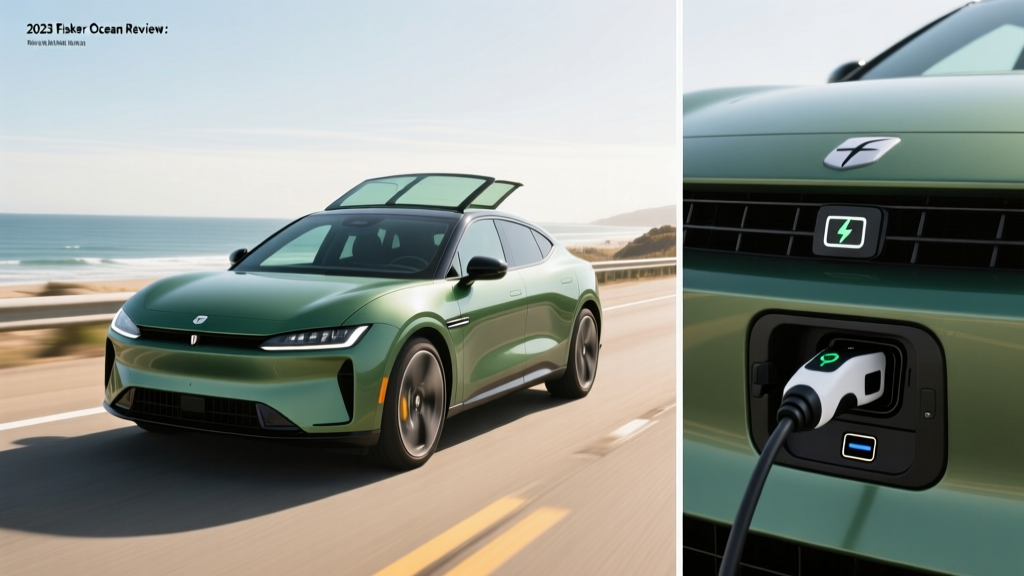
The 2025 Fisker Ocean was designed to be a compelling long-range electric SUV with striking design, a solar roof, and a headline-grabbing EPA range figure. But between its initial announcement and what would have been its 2025 model year, Fisker Inc. filed for Chapter 11 bankruptcy in June 2024, halting production and leaving the vehicle's future in serious doubt. This review examines the Fisker Ocean's specifications as they were published, the real-world ownership risks following the company's collapse, and whether any remaining inventory represents a viable purchase.
Quick Verdict: A Cautionary Tale in EV Startup Risk
On paper, the Fisker Ocean offered impressive specifications: up to 360 miles of EPA-estimated range on the Extreme trim, a massive 113 kWh battery, and a starting price that undercut most competitors. In reality, Fisker's bankruptcy means no warranty support, no software updates, no parts pipeline, and a deeply uncertain future for the roughly 10,000+ vehicles that were built. If you're evaluating a leftover or used Fisker Ocean, this review gives you the data you need — along with the risks you must weigh.
EPA Estimated: 360 miles (Extreme trim, FWD) / 283 miles (Sport trim)
Real-World Highway (70 mph, moderate climate): Expect ~290–320 miles on Extreme; ~230–250 on Sport
Cold Weather (below 32°F): Subtract 20–30%, yielding ~250–290 miles (Extreme) / ~195–225 miles (Sport)
Range varies significantly by driving style, temperature, and terrain. The Ocean's large, heavy platform works against highway efficiency.
Battery, Powertrain, and Performance Specifications
The Fisker Ocean was offered with two distinct battery and powertrain configurations across its trim lineup. The high-volume Sport trim used a smaller LFP (lithium iron phosphate) battery with single-motor front-wheel drive, while the Ultra and Extreme trims received a much larger NMC (nickel manganese cobalt) pack with dual-motor all-wheel drive.
| Spec | Sport (Base) | Ultra | Extreme / One |
|---|---|---|---|
| Battery Chemistry | LFP (CATL) | NMC (CATL) | NMC (CATL Hyper Range) |
| Battery Capacity (usable) | ~71 kWh | ~113 kWh | ~113 kWh |
| EPA Range | 250 mi (later revised to 231 mi) | 340 mi | 360 mi |
| Drivetrain | FWD (single motor) | AWD (dual motor) | AWD (dual motor) |
| Horsepower | 275 hp | 540 hp | 550+ hp |
| 0–60 mph | ~7.2 sec | ~3.9 sec | ~3.7 sec |
| MPGe (combined) | ~97 MPGe | ~85 MPGe | ~84 MPGe |
| Efficiency (kWh/100 mi) | ~35 kWh | ~40 kWh | ~40 kWh |
LFP vs. NMC — what it means for Ocean buyers: The Sport's LFP battery is more resistant to degradation and can be charged to 100% regularly without concern, but it's heavier per kWh and offers less range. The Ultra and Extreme's NMC pack delivers far more range and energy density but benefits from staying between 20–80% State of Charge (SoC) for daily use. Both chemistries are supplied by CATL.
Charging Speed: DC Fast Charging and Home Level 2
Charging was one area where the Fisker Ocean showed its startup limitations. While the specs were competitive on paper, real-world charging infrastructure compatibility and software maturity were ongoing issues during the vehicle's brief production run.
| Charging Level | Sport (71 kWh LFP) | Ultra / Extreme (113 kWh NMC) |
|---|---|---|
| Level 1 (120V, 1.4 kW) | ~3–4 mi/hr | ~3–4 mi/hr |
| Level 2 (240V, 11.5 kW) | ~25 mi/hr (full charge ~7 hr) | ~30 mi/hr (full charge ~11 hr) |
| DC Fast Charge (peak) | ~170 kW | ~250 kW (announced) |
| 10–80% DCFC Time | ~33 min | ~30 min (est.) |
| Connector | CCS1 | CCS1 |
Charging curve reality: The 113 kWh NMC pack's peak 250 kW rate is not sustained across the entire 10–80% window. Expect peak rates only between roughly 10–40% SoC, tapering significantly above 60%. This is typical for large NMC packs — the bigger the battery, the more total energy must be pushed during the taper phase, meaning the 30-minute estimate assumes optimal battery preconditioning and a capable 350 kW charger. At a 150 kW Electrify America station, plan for 45–55 minutes for a 10–80% session on the Ultra/Extreme.
The Ocean uses the CCS1 connector standard. With the industry's ongoing shift toward NACS (Tesla's connector), CCS1 adapters for Tesla Superchargers may become available through third parties, but Fisker's bankruptcy means no official adapter program will materialize.
Interior Space, Cargo, and Practicality
The Fisker Ocean is a midsize two-row SUV with generous interior dimensions that compete directly with the Tesla Model Y, Ford Mustang Mach-E, and Hyundai Ioniq 5. Fisker emphasized sustainable materials throughout the cabin, including recycled plastics and vegan upholstery.
- Cargo volume (behind rear seats): ~32.5 cu ft
- Cargo volume (seats folded): ~65.3 cu ft
- Front legroom: ~41.5 inches
- Rear legroom: ~38.4 inches
- Frunk (front trunk): Not available — the Ocean has no front storage compartment
- Solar roof (California Mode): The Extreme/One trim includes a full-length solar roof with a "California Mode" that opens all side windows simultaneously for open-air driving. The solar panel adds approximately 1,500 miles of range per year under ideal conditions (parked outdoors in sunny climates).
Notable drawback: The absence of a frunk is a missed opportunity for a dedicated EV platform. Early reviews also noted that the large 17.1-inch rotating infotainment screen, while visually striking, suffered from software bugs and slow response times — issues that will never receive OTA fixes given the bankruptcy.
Pricing, Tax Credits, and the Bankruptcy Discount
Fisker's pricing strategy was aggressive from launch, and the company's financial collapse in mid-2024 led to extreme fire-sale pricing on remaining inventory. Here's how the pricing landscape looked at the time of Fisker's shutdown:
| Trim | Original MSRP | Fire-Sale Price (mid-2024) | §30D Credit Eligible? |
|---|---|---|---|
| Sport | $37,499 | ~$24,999 | Unlikely (sourcing rules) |
| Ultra | $58,999 | ~$37,999 | Unlikely (sourcing rules) |
| Extreme | $68,999 | ~$43,999 | Unlikely (sourcing rules) |
| One (Launch Ed.) | $68,999 | ~$43,999 | Unlikely (sourcing rules) |
Federal tax credit (§30D) reality: Under current IRS rules, the Fisker Ocean almost certainly does not qualify for the up-to-$7,500 federal EV tax credit. The credit requires battery components and critical minerals to meet North American sourcing thresholds that tighten annually. Fisker's batteries were sourced from CATL (China), and the company's bankruptcy means no one is pursuing compliance certifications. Additionally, the point-of-sale transfer option requires a registered dealer — and Fisker's dealer network has dissolved.
Used EV credit (§25E): If you find a used Fisker Ocean from a licensed dealer for $25,000 or less, you may qualify for up to $4,000 under the used clean vehicle credit (30% of sale price, capped at $4,000), subject to income limits ($75K single / $150K joint). Consult a tax professional and verify VIN eligibility on fueleconomy.gov.
Warranty, Support, and the Bankruptcy Problem
This is the most critical section for any prospective Fisker Ocean buyer. Fisker Inc. originally offered competitive warranty terms:
- Basic vehicle warranty: 6 years / 60,000 miles
- Battery and powertrain warranty: 10 years / 100,000 miles (with a capacity retention threshold of ~70%)
- Roadside assistance: 6 years / 60,000 miles
The bankruptcy problem: With Fisker in Chapter 11 (and subsequently moving toward liquidation), these warranties are effectively unenforceable. There is no active service network, no parts supply chain, and no over-the-air (OTA) software update capability. Owners report difficulty finding repair facilities willing to work on the vehicle, and collision repair parts are essentially unavailable. Insurance companies may total vehicles for minor damage due to parts scarcity.
- No warranty support — Fisker's bankruptcy voids practical warranty enforcement
- No OTA software updates — bugs and security vulnerabilities will never be patched
- No parts pipeline — body panels, trim pieces, and proprietary components are unavailable
- Insurance complications — some carriers refuse to insure Fisker vehicles or charge steep premiums
- Resale value collapse — the Ocean has depreciated far beyond normal EV depreciation curves
Driver Assistance and Technology
The Fisker Ocean shipped with a suite of driver-assistance features branded as "Fisker Intelligent Pilot." This is an SAE Level 2 system — meaning the driver must remain fully engaged, with hands on or near the wheel, at all times. It is not autonomous or "self-driving."
The system can manage steering and acceleration/braking simultaneously under driver supervision. The driver must monitor the road and be prepared to take over instantly. This is comparable to Tesla Autopilot, GM Super Cruise (with limitations), and Ford BlueCruise — not to Level 4 robotaxi services like Waymo.
Key tech features included:
- 17.1-inch rotating center touchscreen (portrait/landscape modes)
- Digital instrument cluster
- Head-up display (Ultra/Extreme)
- Adaptive cruise control with stop-and-go
- Lane-keeping assist and lane-centering
- Automatic emergency braking with pedestrian detection
- 360-degree camera system
- "California Mode" solar roof with one-touch all-window opening (Extreme/One only)
The infotainment system ran a custom Android-based OS. Early reviews noted sluggish response times, navigation errors, and connectivity issues — problems that are now permanent given the end of OTA support.
Fisker Ocean vs. Competitors: Is It Worth Buying?
Even at fire-sale prices, the Fisker Ocean competes against established EVs with active manufacturer support. Here's how it stacks up against key rivals in the midsize electric SUV segment:
| Attribute | Fisker Ocean Extreme | Tesla Model Y LR AWD | Hyundai Ioniq 5 Limited |
|---|---|---|---|
| EPA Range | 360 mi | 320 mi | 290 mi |
| Battery (kWh) | 113 NMC | ~75 NMC | 77.4 NMC |
| Peak DCFC | 250 kW | 250 kW | 238 kW |
| 0–60 mph | 3.7 sec | 4.8 sec | 5.1 sec |
| Warranty Support | ❌ None (bankruptcy) | ✅ Active | ✅ Active |
| OTA Updates | ❌ Discontinued | ✅ Active | ✅ Active |
| Supercharger Access | ❌ No NACS adapter | ✅ Native | ✅ Via adapter |
| Parts Availability | ❌ Scarce | ✅ Readily available | ✅ Readily available |
- Consider it ONLY if: You're getting an extreme discount (under $30K for Extreme), have access to CCS charging at home, are comfortable self-insuring against catastrophic battery failure, and treat the purchase as a depreciating asset with no recourse.
- Do NOT buy if: You rely on a single vehicle for daily commuting, need warranty protection, want Supercharger access, or cannot absorb a potential $15,000+ battery replacement cost out of pocket.
- Choose Tesla Model Y if: You want Supercharger access, OTA updates, strong resale value, and proven service infrastructure.
- Choose Hyundai Ioniq 5 if: You want 800V ultra-fast charging, a 10-year/100,000-mile warranty backed by an active manufacturer, and competitive pricing with tax credit eligibility.
Pros and Cons
✅ Pros
- Class-leading 360-mile EPA range (Extreme)
- Distinctive design with sustainable interior materials
- Solar roof adds passive range (Extreme/One)
- Spacious cabin with generous rear legroom
- Fire-sale pricing makes it one of the cheapest 300+ mile EVs available
- Strong dual-motor performance (3.7 sec 0–60)
❌ Cons
- Company bankrupt — no warranty, no support, no updates
- Parts are scarce to nonexistent for body and proprietary components
- CCS1-only with no path to NACS/Supercharger access
- Software bugs are permanent with OTA discontinued
- Insurance may be expensive or unavailable
- Resale value has collapsed further than comparable EVs
- No frunk; cargo space is average, not class-leading
- Efficiency (kWh/100mi) is poor due to heavy curb weight (~5,400 lbs)
Frequently Asked Questions
What is the real-world range of the Fisker Ocean?
The EPA rates the Extreme trim at 360 miles and the Sport at 231 miles (revised downward from initial estimates). In real-world highway driving at 70 mph in moderate temperatures, expect roughly 290–320 miles from the Extreme and 195–215 from the Sport. Cold weather (below freezing) reduces these figures by 20–30%. The Ocean's heavy curb weight of approximately 5,400 lbs works against it on the highway, where aerodynamic drag and mass compound energy consumption.
How fast does the Fisker Ocean charge at home and on DC fast chargers?
On a home Level 2 charger (240V, 11.5 kW), the Ocean adds approximately 25–30 miles of range per hour, meaning a full charge of the 113 kWh pack takes roughly 10–11 hours. On DC fast chargers, the Ultra/Extreme peaks at around 250 kW, achieving a 10–80% charge in approximately 30 minutes at a 350 kW station. At a more common 150 kW charger, plan for 45–55 minutes. The Sport trim peaks at roughly 170 kW DC.
Does the Fisker Ocean qualify for the federal EV tax credit?
Almost certainly not. Under IRS §30D rules, the credit requires battery components and critical minerals to meet escalating North American sourcing thresholds. The Ocean's CATL batteries are sourced from China, failing the critical minerals requirement. Additionally, with Fisker dissolved, there is no registered dealer to process the point-of-sale transfer. The used EV credit (§25E) of up to $4,000 may apply if you buy from a licensed dealer for $25,000 or less and meet income caps ($75K single / $150K joint). Always verify eligibility with a tax professional.
Can I still get the Fisker Ocean serviced?
Service is extremely limited. Fisker's authorized service network dissolved with the bankruptcy. Some independent EV repair shops and mobile technicians may handle basic maintenance (cabin filters, brake fluid, tire rotation), but proprietary diagnostics, battery module replacement, and body repair are significant challenges. Fisker's service partnership with Cox Automotive was terminated. Owners should identify a willing independent shop before purchasing.
Is the Fisker Ocean safe?
Fisker claimed the Ocean was designed to meet or exceed NHTSA and Euro NCAP standards, but the vehicle was never officially crash-tested by NHTSA or the IIHS before the company's collapse. Without published crash-test ratings, safety remains an unverified variable. The vehicle does include standard automatic emergency braking, lane-keeping assist, and multiple airbags.
Is the Fisker Ocean worth buying in 2025 or 2026?
Only at extreme discounts and only for buyers who fully understand the risks. At under $30,000 for an Extreme trim with 360 miles of range, the price-per-mile-of-range is unmatched. But you're buying an orphan vehicle with no warranty, no software updates, no parts pipeline, and potentially expensive insurance. For most buyers, a Tesla Model Y, Hyundai Ioniq 5, or Kia EV6 — all backed by active manufacturers with service networks and Supercharger/adapter access — is a far safer investment, even at a higher purchase price.
What happens if the battery fails?
A full battery pack replacement for the 113 kWh NMC system would likely cost $15,000–$25,000+ if parts could even be sourced. The 71 kWh LFP pack in the Sport would be somewhat less, but CATL packs are not commonly serviced by independent shops in the U.S. With no warranty coverage, this is a total out-of-pocket expense. LFP chemistry degrades more slowly than NMC, so the Sport's battery may prove more durable long-term — but any catastrophic failure (cell short, BMS fault) is a financial disaster without warranty backing.