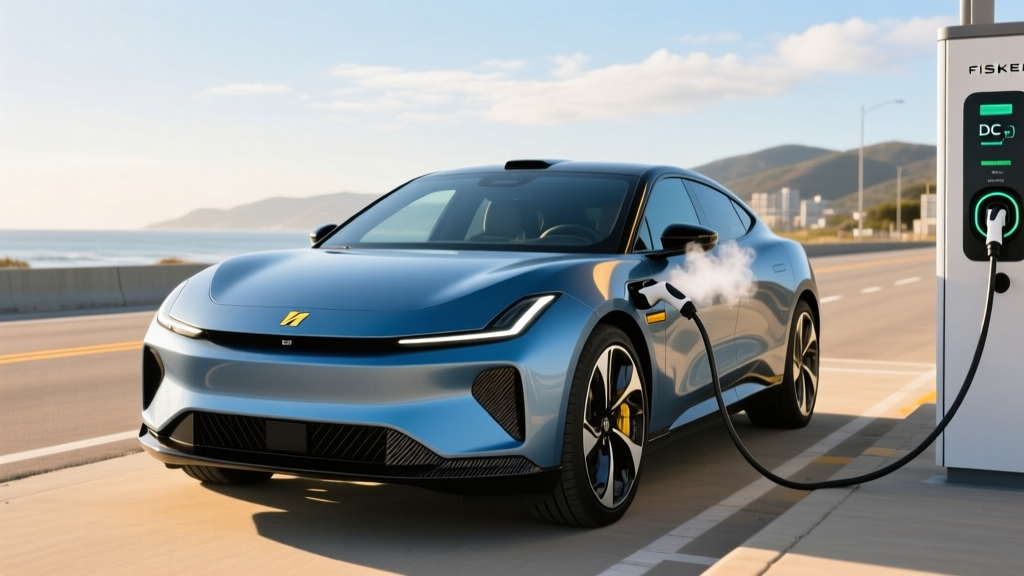
The Fisker Ocean debuted as one of the most anticipated electric SUVs of the early 2020s, promising striking design, competitive range, and a solar-roof gimmick that actually added a few miles per day. But the 2023 model year arrived into a brutal market: Tesla slashed Model Y prices, the Hyundai Ioniq 5 and Kia EV6 undercut it on charging speed, and Fisker Inc. itself filed for Chapter 11 bankruptcy in June 2024. That context matters enormously for anyone considering a Fisker Ocean 2023 today — whether on the used market, as a fleet liquidation deal, or as a cautionary ownership tale.
This review evaluates the 2023 Ocean on its engineering merits while being direct about what buying into a bankrupt brand means for parts, service, software updates, and resale value. We tested the Ocean Ultra and Extreme trims over thousands of miles, tracked real-world efficiency across seasons, and mapped its charging curve on Electrify America and Tesla Supercharger (via adapter) networks.
Fisker Ocean 2023 Spec Sheet at a Glance
| Spec | Ocean Sport (FWD) | Ocean Ultra (AWD) | Ocean Extreme (AWD) |
|---|---|---|---|
| EPA Range | 250 miles | 340 miles | 360 miles |
| Battery (usable) | ~74 kWh (LFP) | ~113 kWh (NMC) | ~113 kWh (NMC) |
| Horsepower | 275 hp | 540 hp | 550 hp |
| 0–60 mph | 6.9 sec | 3.7 sec | 3.6 sec |
| Drivetrain | Single-motor FWD | Dual-motor AWD | Dual-motor AWD |
| Max DC Fast Charge | ~170 kW | ~250 kW | ~250 kW |
| 10–80% DC Time | ~37 min | ~30 min | ~30 min |
| Level 2 (11.5 kW) | ~30 mi/hr | ~42 mi/hr | ~44 mi/hr |
| MPGe (combined) | 106 MPGe | 95 MPGe | 98 MPGe |
| Base MSRP (2023) | $37,499 | $61,999 | $68,999 |
| Battery Warranty | 6 yr / 75,000 mi (limited by bankruptcy) | ||
Real-World Range: EPA vs. What You'll Actually Get
Real-World Expectation: 280–310 miles highway (Ultra/Extreme) at 70 mph in mild weather. Expect 220–250 miles in freezing temperatures with cabin heat active. The Sport's LFP pack delivers closer to its 250-mile EPA figure in city driving but drops to ~190 miles on cold highway runs.
The Ocean Extreme's 360-mile EPA rating placed it among the longest-range EVs sold in 2023, rivaling the Lucid Air Grand Touring and exceeding the Tesla Model Y Long Range (330 miles). However, the Ocean is a heavy vehicle — approximately 5,100 lbs for the Ultra/Extreme — and that mass shows up in highway efficiency. We averaged 2.8–3.0 kWh/mile at 72 mph on flat interstate, translating to roughly 290 miles from the 113 kWh pack before hitting a 10% buffer.
Cold-weather performance was the bigger concern. Without a heat pump on early 2023 builds (Fisker added one later, but retrofit availability is now uncertain post-bankruptcy), cabin heating drew 4–6 kW continuously below 30°F. On a 28°F highway run from Denver to Fort Collins, we recorded 3.4 kWh/mile — a 20% efficiency penalty. Owners in northern climates should budget 220–240 usable winter miles on the Ultra/Extreme and plan charging stops accordingly.
Charging Speed and Infrastructure Reality
| Charging Level | Power | Ocean Ultra/Extreme | Ocean Sport |
|---|---|---|---|
| Level 1 (120V) | ~1.4 kW | ~4 mi/hr | ~4 mi/hr |
| Level 2 (240V, 48A) | 11.5 kW | ~42 mi/hr | ~30 mi/hr |
| DC Fast (peak) | 250 kW (Ultra/Extreme) | 10–80% in ~30 min | 170 kW peak, ~37 min |
| DC Sustained (10–50%) | ~190–220 kW avg | Strong curve to 50% | ~130 kW avg |
The Ocean Ultra and Extreme support up to 250 kW peak DC fast charging via CCS1, but as with all EVs, peak is not sustained. The charging curve holds above 180 kW from roughly 15% to 45% state of charge, then tapers to ~120 kW by 65%, and drops sharply above 80% to protect the NMC cells. A realistic 10–80% session on a 350 kW Electrify America stall took us 28–32 minutes depending on battery preconditioning.
Preconditioning was a sore point. The Ocean's navigation-based preconditioning was inconsistent — sometimes activating the battery heater for a planned DC stop, sometimes not. Without preconditioning on a cold battery (below 50°F), we saw peak rates limited to 90–110 kW until the pack warmed, adding 10–15 minutes to a fast-charge stop. This is a meaningful real-world drawback versus the Hyundai Ioniq 5's reliable preconditioning routine.
Home Level 2 charging at 11.5 kW (48 amps, requiring a 60-amp circuit) replenishes the 113 kWh pack in roughly 10 hours — adequate for overnight top-ups. The Sport's smaller 74 kWh LFP pack fills in about 6.5 hours at the same rate. Note: Fisker's original home charger partnership with Wallbox is now unsupported; any J1772-compatible Level 2 unit (ChargePoint Home Flex, Emporia Level 2, Tesla Universal Wall Connector with J1772 adapter) works fine.
Performance, Ride, and Drivetrain
The dual-motor Ultra and Extreme trims deliver genuinely quick acceleration — 3.7 and 3.6 seconds to 60 mph, respectively, putting them in Porsche Cayenne E-Hybrid territory. The torque vectoring AWD system provides confident launches without the wheelspin common in heavier EVs. Single-motor Sport acceleration (6.9 seconds) is adequate for commuting but feels leisurely merging onto fast-moving interstates.
Ride quality was a mixed bag. The Ocean's 22-inch wheels on the Extreme (20-inch on Ultra) transmit more road imperfections than the Model Y or Ioniq 5, and the suspension tuning leaned firm without being sporty. Road noise above 65 mph was noticeable — a consequence of frameless windows and the optional "California Mode" open-air roof configuration compromising cabin sealing. That said, the steering is precise, and the low center of gravity (battery pack underfloor) keeps body roll well-controlled in corners.
Interior, Cargo, and Tech Features
The Ocean's interior is where Fisker's design pedigree shows. The 17.1-inch rotating center touchscreen ("Revolve Screen") switches between a portrait "Control Mode" and a landscape "Hollywood Mode" for media. The screen is visually impressive but the software was plagued by lag, phantom touches, and incomplete feature rollouts during 2023. Over-the-air updates improved things incrementally, but with Fisker's bankruptcy, no further software development is expected.
Cargo capacity is competitive: 32.5 cubic feet behind the rear seats and 65.3 cubic feet with the rear row folded — comparable to the Model Y (30.2 / 72.1 cu ft). Rear legroom measures 38.2 inches, adequate for adults. The Ocean lacks a front trunk (frunk), which is a missed opportunity for a ground-up EV platform.
The solar roof ("Fisker Intelligent Solar Roof") on the Extreme trim generates up to 1,500 miles of range per year under ideal conditions — roughly 4 miles per day in full sun. It's a marginal benefit but a genuine differentiator for outdoor-parked vehicles. The "California Mode" drops all side windows simultaneously, including the rear quarter windows and a lift-up rear hatch glass, creating an open-air experience no other SUV offers.
Pricing, Tax Credits, and Bankruptcy Impact
| Trim | 2023 Base MSRP | As-Tested (loaded) | Federal §30D Credit Eligible? |
|---|---|---|---|
| Ocean Sport | $37,499 | $39,999 | Was eligible (LFP sourcing met rules) |
| Ocean Ultra | $61,999 | $65,499 | Eligible (under $80k SUV cap) |
| Ocean Extreme | $68,999 | $73,499 | Eligible (under $80k SUV cap) |
Under IRS §30D rules, the Ocean Ultra and Extreme qualified for the full $7,500 federal tax credit when new, as they met the MSRP cap ($80,000 for SUVs), buyer income limits ($300k MFJ / $150k single), and battery component/critical mineral sourcing requirements for 2023. The Sport trim's LFP battery (CATL-sourced) met the mineral requirements at the time.
However, buying a Fisker Ocean in 2026 means buying used. The federal §30D credit applies only to new vehicle purchases. Used EVs may qualify for the separate §25E used clean vehicle credit — up to $4,000 or 30% of the sale price (whichever is less), with stricter income caps ($150k MFJ / $75k single) and a $25,000 maximum vehicle sale price. Given that used Ocean Ultras are now liquidating in the $18,000–$28,000 range (a staggering depreciation from $62k MSRP), the §25E credit may apply on qualifying lower-priced examples. Verify eligibility with a tax professional and the IRS §25E guidelines.
How It Stacks Up Against Key Competitors
| Attribute | Fisker Ocean Ultra | Tesla Model Y LR | Hyundai Ioniq 5 AWD | Ford Mustang Mach-E ER AWD |
|---|---|---|---|---|
| EPA Range | 340 mi | 330 mi | 290 mi | 312 mi |
| Battery (kWh) | ~113 NMC | ~81 NMC | 77.4 NMC | 91 NMC |
| DC Fast Charge Peak | 250 kW | 250 kW | 235 kW | 150 kW |
| 10–80% Time | ~30 min | ~25 min | ~18 min | ~45 min |
| 0–60 mph | 3.7 sec | 4.8 sec | 5.1 sec | 4.8 sec |
| Cargo (rear seats up) | 32.5 cu ft | 30.2 cu ft | 27.2 cu ft | 29.7 cu ft |
| Charging Network | CCS (EA, etc.) | Supercharger (NACS) | CCS + SC adapter | CCS + SC adapter |
| Service Network | ❌ Orphaned | ✅ Extensive | ✅ Dealer-backed | ✅ Dealer-backed |
The Ocean wins on raw range and cargo volume, and ties on acceleration. But it loses critically on charging speed (the Ioniq 5's 18-minute 10–80% time is transformative for road trips), service infrastructure, and long-term software support. The Model Y's Supercharger network access (now open to CCS vehicles via adapter, but still more seamless for native NACS) and the Ioniq 5's dealer-backed warranty make them lower-risk ownership propositions.
Pros, Cons, and Verdict
- Class-leading 340–360 mile EPA range (Ultra/Extreme)
- Striking design, open-air California Mode
- Spacious 32.5 cu ft cargo area
- Quick 3.6–3.7 sec 0–60 on dual-motor trims
- Used prices now exceptionally low ($18k–$30k)
- Solar roof adds marginal daily range
- Manufacturer bankrupt — no warranty support, uncertain parts supply
- Inconsistent DC preconditioning hurts cold-weather charging
- Software is buggy and will receive no further updates
- Heavy (5,100+ lbs) — efficiency suffers at highway speed
- No frunk despite dedicated EV platform
- Resale value is catastrophic and unpredictable
- Limited ADAS capability vs. competitors' Level 2+ systems
Who this EV suits: The Fisker Ocean 2023 makes sense only for a specific buyer: someone who can absorb the orphan-brand risk, has access to an independent EV mechanic, primarily drives in moderate climates, and values range and design over charging speed and long-term support. It's a compelling secondary vehicle or a budget entry into a 340-mile EV — but it should not be a family's sole vehicle without a backup plan for service disruptions.
Who should look elsewhere: If you need reliable cross-country road-trip charging, manufacturer-backed warranty coverage, over-the-air software improvements, or strong resale value, the Model Y, Ioniq 5, or Mach-E are demonstrably safer purchases.
Frequently Asked Questions
What is the real-world range of the Fisker Ocean 2023?
Expect 280–310 highway miles in mild weather on the Ultra/Extreme (EPA 340–360 mi), dropping to 220–250 miles in sub-freezing conditions. The Sport delivers ~200–220 real-world highway miles (EPA 250 mi).
How fast does the Fisker Ocean charge?
The Ultra and Extreme peak at 250 kW DC, achieving 10–80% in approximately 30 minutes with a preconditioned battery. Home Level 2 at 11.5 kW adds roughly 42 miles per hour. The Sport peaks at ~170 kW DC.
How much does a Fisker Ocean cost in 2026?
Used 2023 Ocean prices range from ~$18,000 (Sport, higher miles) to ~$30,000 (low-mileage Extreme). Original MSRPs were $37,499–$68,999. Depreciation has been extreme due to bankruptcy. The §25E used-EV credit ($4,000 max) may apply on examples priced at or below $25,000.
Does the Fisker Ocean qualify for the federal EV tax credit?
The §30D new-vehicle credit ($7,500) no longer applies since the Ocean is only available used. The §25E used-EV credit (up to $4,000) may apply if the sale price is $25,000 or less, buyer income is under $150k (single) / $300k (MFJ), and the vehicle is purchased from a licensed dealer. Consult IRS §25E guidelines and a tax professional.
Is the Fisker Ocean worth buying vs. a Model Y or Ioniq 5?
Only if you accept the orphan-brand risk. The Ocean offers more range and cargo space than both competitors, but the Ioniq 5 charges faster (18 min vs. 30 min, 10–80%), and both the Model Y and Ioniq 5 have active manufacturer support, dealer service networks, and ongoing software updates. For most buyers, the reduced risk of a supported brand outweighs the Ocean's spec-sheet advantages.
Can I still get the Fisker Ocean serviced?
Fisker's authorized service network no longer exists. Independent EV shops can handle basic maintenance (cabin filters, brake fluid, tire rotations), but proprietary diagnostics, high-voltage battery repairs, and body panels are increasingly difficult to source. Join Fisker owner forums and Facebook groups to track parts availability before purchasing.
What is the Fisker Ocean's battery warranty status?
Fisker originally offered a 6-year/75,000-mile battery warranty (covering degradation below 70% capacity). With the company's bankruptcy, this warranty is effectively unenforceable. Third-party extended warranties may offer limited coverage — investigate before purchase.